
Thymulin prolonged the growth phase of cultured human hair follicles
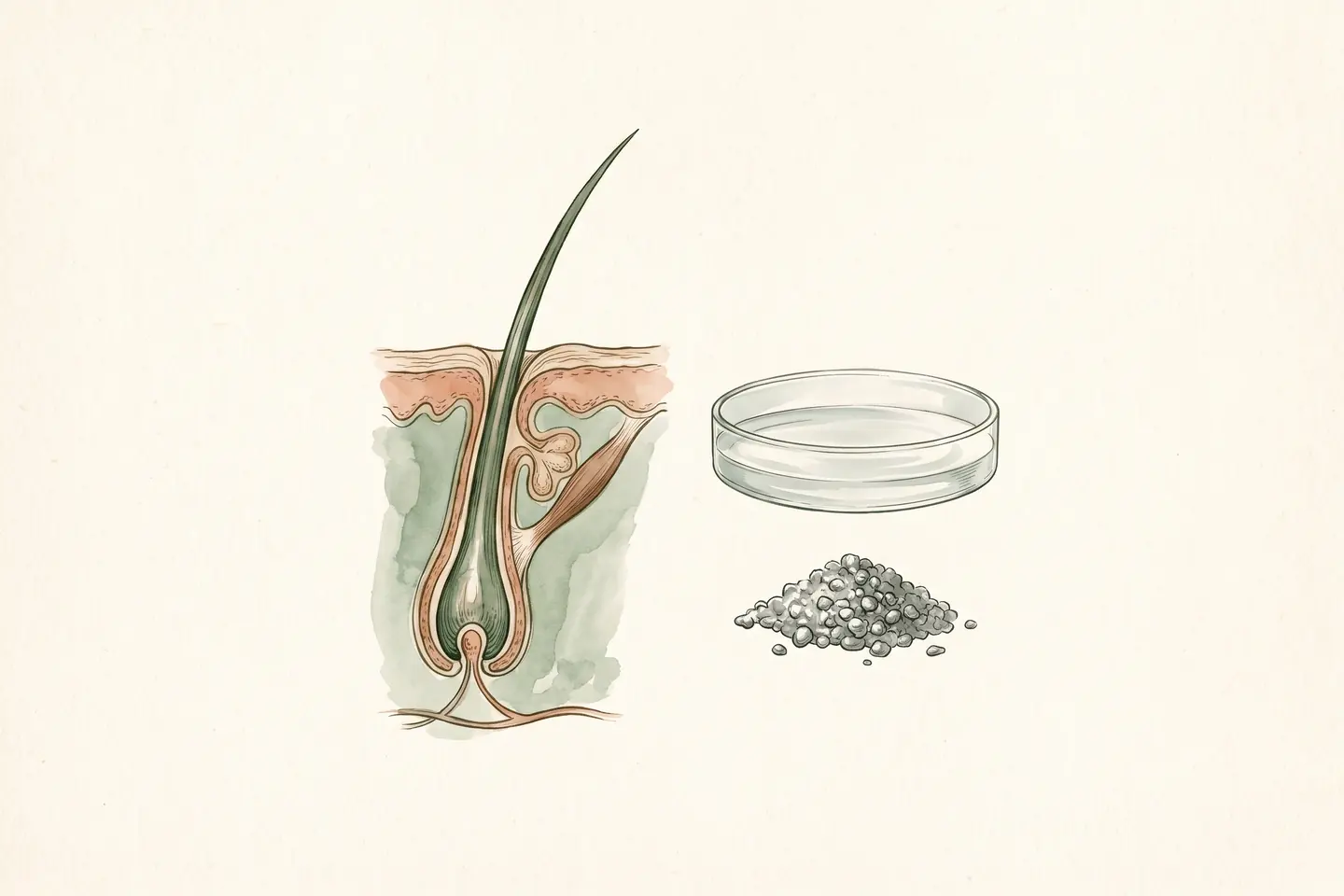
Thymulin at 10 pg/mL prolonged the growth phase of human scalp follicles in organ culture. That one study is unreplicated, and no controlled hair trial exists.

By Jay Spall, chemist and biochemist
Disclosure: Jay is a co-founder of The Peptide App. This review discusses the studies cited below; it is not a comprehensive live trial registry or treatment recommendation. Development and regulatory status can change. The app’s tools organize records and arithmetic and do not validate a research product.
On this page
- What is thymulin?
- Does zinc activate thymulin?
- Does zinc-thymulin regrow hair?
- What is the n=18 human study of zinc-thymulin?
- What evidence grade does zinc-thymulin get for hair?
- Is there a human dose for zinc-thymulin?
- Is injectable zinc-thymulin the same molecule as in the studies?
- Is zinc-thymulin safe?
- What is still unknown about zinc-thymulin?
- Sources
Key facts
| Question | Direct answer |
|---|---|
| Is zinc thymulin one story or two? | Two, and they do not share an evidence base. Zinc activating the body's own thymulin is documented human physiology [2][3]. Injecting a zinc-thymulin peptide to regrow hair is a separate, much thinner claim. |
| Does zinc activate thymulin in the body? | Yes, in a specific and narrow sense. Thymulin becomes bioactive only when zinc is bound to it, and correcting zinc deficiency restores that activity in blood, shown in a small human study and supporting animal work [2][3]. |
| Does zinc-thymulin regrow hair? | Not established. The hair mechanism comes from one ex vivo organ-culture study on isolated human follicles, not a clinical trial in living scalps, and it has not been independently replicated [1]. |
| What is zinc-thymulin's evidence grade for hair? | D, Limited: mechanistically plausible and preclinical, with no controlled human trial for the hair application. |
| Is the injectable product the same molecule studied in the papers? | Unclear. The papers study native thymulin, with or without zinc, in blood or organ culture, not a formulated, stabilized injectable product, and the formulation stability of a 9-amino-acid peptide is an open question. |
| Is zinc-thymulin safe? | Not established. The cited studies document no in vivo safety signal, but none was designed to assess an injectable version in living humans, so safety is uncharacterized, not "cleared." |
3 sources cited. View sources
What is thymulin?
Thymulin is a nine-amino-acid peptide made mostly by thymic epithelial cells, and it is inert without zinc. The zinc ion completes the conformation the peptide needs to engage its receptors. That requirement is basic endocrinology of the molecule, not a marketing claim, and it is where the solid evidence on zinc-thymulin lives.
Zinc thymulin is two stories that do not share an evidence base. Zinc activating the body's own thymulin is documented human physiology [2][3]. Injecting a zinc-thymulin peptide to regrow hair is a separate, much thinner claim. The thymulin evidence review covers thymulin's human trial record more broadly.
Does zinc activate thymulin?
Zinc activates thymulin in a specific, narrow sense: thymulin becomes bioactive only when zinc is bound to it, and correcting zinc deficiency restores that activity in blood [2][3].
In a study of 14 human subjects with mild zinc deficiency, serum thymulin bioactivity was suppressed and was corrected by zinc supplementation, directly showing that the zinc-bound form carries biological activity in human blood [2]. Earlier work in marginally zinc-deficient mice found the same pattern: active thymulin dropped with zinc deficiency and was restored, in this case in vitro, by adding zinc back [3].
Together these studies describe a real, biologically coherent mechanism: zinc status governs how much active thymulin circulates. That matters most in populations prone to marginal zinc deficiency, notably older adults, whose thymic hormone output already declines with age. Zinc as an obligate cofactor for thymulin bioactivity, shown in human serum [2] and confirmed in animal models [3], is old, well-cited immunology, not speculation.
The practical relevance is narrow. The finding concerns correcting zinc deficiency in people who are zinc-deficient, particularly aging populations with reduced thymic output, not supplementing zinc-thymulin in a zinc-replete person for some other purpose. Neither paper touches hair, and neither involves injecting an external zinc-thymulin compound into a person.
Does zinc-thymulin regrow hair?
Zinc-thymulin has not been shown to regrow hair in people: the hair claim rests on a single ex vivo study of human scalp follicles cultured outside the body [1]. In that study, thymulin at 10 pg/mL prolonged the anagen (growth) phase and stimulated melanogenesis, while a different thymic peptide, thymosin beta-4, did the opposite [1].
The result is interesting, specific, and mechanistically suggestive. It is also preclinical organ-culture data: follicles in a dish, not scalps on a person. The study resolved no delivery question, established no dose-response in living tissue, and made no randomized comparison against an active control like minoxidil.
The study establishes a plausible mechanism worth studying further, and "plausible mechanism" is the correct and complete way to describe it. The effect has not been shown in a living human scalp, has not been compared against existing treatments in any controlled way, and has not been independently reproduced by an outside lab. Forum protocol posts that cite this paper as if it demonstrates hair regrowth in people overstate what an organ-culture experiment can show. Thymosin beta-4's human trial record covers the other thymic peptide in that study.
What is the n=18 human study of zinc-thymulin?
The "n=18 human study" cited in forum protocols is uncontrolled, unblinded, and conducted by the compound's own developer, so it does not meet the bar of independent, peer-reviewed, PubMed-indexed research. That design is precisely the kind of study that should not be treated as confirmatory.
The n=18 study's existence explains why zinc-thymulin gets talked about with more confidence than the underlying science supports, not why that confidence is earned.
What evidence grade does zinc-thymulin get for hair?
Zinc-thymulin for hair rates a D, Limited: a real endocrine mechanism plus one preclinical culture study, with no controlled human trial. No randomized, controlled, blinded human trial of injectable or topical zinc-thymulin for hair outcomes exists.
A D grade is not nothing. It is also not the "established science" framing that seller-adjacent content tends to apply. The PTD-DBM evidence review covers another peptide marketed for hair regrowth.
Is there a human dose for zinc-thymulin?
No human dosing study exists for zinc-thymulin; the strongest data point is a concentration used in organ culture, 10 pg/mL [1]. Nothing translates that concentration into a topical or injectable regimen.
Any injection schedule posted online is inference layered on inference. Taking a picomolar concentration from a dish experiment and back-calculating a human dose is not how pharmacokinetics works, and no cited study validates that translation.
Is injectable zinc-thymulin the same molecule as in the studies?
Whether injectable zinc-thymulin products match the studied molecule is unclear, because the papers study native thymulin, with or without zinc, in blood or organ culture. None of them tested a specific formulated, stabilized injectable product.
Thymulin is a short peptide that requires zinc binding for its active conformation. Whether a given compounded or gray-market preparation reliably keeps that zinc-bound, bioactive state through manufacturing, storage, and injection is an open question the cited studies do not address, because they study either native serum thymulin or a controlled organ-culture exposure, not a shelf-stable commercial product.
Purity and stability of DIY or compounded peptide preparations are a recognized practical concern in general, independent of whether the underlying biology is sound. The thymulin evidence profile summarizes the compound's standing.
Is zinc-thymulin safe?
Zinc-thymulin's safety is uncharacterized: the cited studies document no in vivo safety signal, but none was designed to assess an injectable version in living humans.
The small human series referenced in forum discussions reported no local or systemic adverse effects, and the general expectation for a topical vehicle is mild irritation or dryness at most. That reassurance comes from the same uncontrolled, developer-run study that fails to establish efficacy, so it deserves the same weight: a preliminary signal, not a safety clearance. Long-term safety of repeated zinc-thymulin exposure, injected or topical, is uncharacterized in the cited studies.
What is still unknown about zinc-thymulin?
Zinc-thymulin's open questions center on whether a result in a dish carries over to people:
- Living scalp. Whether thymulin's anagen-prolonging effect in cultured follicles [1] translates to measurable hair regrowth in a living human scalp is unknown. Organ culture removes the follicle from systemic circulation, immune surveillance, and the androgen environment that drives androgenetic alopecia in vivo, so how well the model predicts real-world response is also unknown.
- Product identity. Whether marketed injectable or topical "zinc thymulin" products correspond structurally and functionally to the native zinc-bound thymulin used in these studies is unknown.
- Zinc-replete adults. Whether correcting zinc status improves outcomes in people who are not zinc-deficient is unknown; the human zinc-thymulin bioactivity data come from a mildly zinc-deficient cohort [2], not from zinc-replete adults using it as an enhancement.
- A controlled trial. Whether a randomized, blinded hair trial is planned is not addressed by the current evidence base. The absence of such a trial is the single biggest reason zinc-thymulin sits at a D grade rather than higher.
Sources
Last updated

Written by
Chemist and biochemist. Co-founder and author, The Peptide App.
Jay is a chemist, biochemist and entrepreneur whose work connects scientific research with consumer health products. He has held Chief Science Officer and product development leadership roles and previously served as Chief Revenue Officer at Minicircle.
Keep reading
Compound evidence
Thymulin needs zinc to act, and it curbed inflammation in mice
Zinc switches thymulin on, and the hormone curbed inflammation in mouse studies. Its cited human data are one 1982 case series in three children.
Compound evidence
Topical PTD-DBM regrew hair in mice by easing a brake on Wnt signaling
Topical PTD-DBM regrew hair and spurred new follicles in healing mouse skin. All three primary studies come from one Yonsei group, and no human trial exists.
Compound evidence
Thymosin Beta-4 sped rat wound healing; human trials were topical
Thymosin Beta-4 sped skin wound healing in rats, and its eye-drop and ulcer trials gave mixed results. No human trial has tested it for tendon injury.
Profiles and tools

The Peptide App
Track protocols, doses, and reconstitution in one place.
Save your calculations, set reminders, log doses, and keep outcome notes — free to start.
 or scan the QR code →