
Topical PTD-DBM regrew hair in mice by easing a brake on Wnt signaling
Topical PTD-DBM regrew hair and spurred new follicles in healing mouse skin. All three primary studies come from one Yonsei group, and no human trial exists.

By Jay Spall, chemist and biochemist
Disclosure: Jay is a co-founder of The Peptide App. This review discusses the studies cited below; it is not a comprehensive live trial registry or treatment recommendation. Development and regulatory status can change. The app’s tools organize records and arithmetic and do not validate a research product.
On this page
- What is PTD-DBM?
- What does PTD-DBM do in mice?
- What is the complete evidence base for PTD-DBM?
- Is PTD-DBM as effective as minoxidil?
- Where do PTD-DBM protocols come from?
- Is PTD-DBM safe for long-term use?
- Is vendor-sold PTD-DBM the same peptide the studies used?
- What is still unknown about PTD-DBM?
- Sources
Key facts
| Question | Direct answer |
|---|---|
| What is PTD-DBM? | A lab-made cell-penetrating peptide that blocks the interaction between CXXC5 and Dishevelled, a step that normally restrains Wnt/beta-catenin signaling in skin and hair follicle tissue [1][2]. |
| Does PTD-DBM regrow hair in humans? | No human trial has tested it. Every positive finding comes from topical application in mice [1][2][3]. |
| How strong is the evidence? | Grade E, minimal. Three preclinical papers from one research group (2015 to 2023), plus one independent review calling the approach hypothesis-generating rather than clinically actionable [1][2][3][4]. |
| Is PTD-DBM comparable to minoxidil? | Only inside one mouse study. Topical PTD-DBM produced regrowth effects described as comparable to minoxidil within that model, not in a head-to-head human trial [2]. |
| Is PTD-DBM safe? | Unknown in humans. Broad Wnt/beta-catenin activation is the same pathway implicated in proliferative processes elsewhere in biology, and no published study addresses that risk for chronic topical use. |
| Can I trust what a vendor sells as "PTD-DBM"? | Not without independent testing. PTD-DBM was never standardized as a consumer product, so sequence, purity, and endotoxin level are unverifiable without third-party mass spectrometry. |
4 sources cited. View sources
What is PTD-DBM?
PTD-DBM is a lab-made fusion peptide that blocks CXXC5 from binding Dishevelled (Dvl), releasing a brake on Wnt/beta-catenin signaling [1][2]. It joins a protein-transduction domain, which lets it cross cell membranes, to a short sequence that mimics the Dishevelled-binding motif.
Wnt/beta-catenin signaling is a developmental pathway that governs hair follicle cycling, among many other things it does throughout the body. CXXC5 acts as a negative feedback brake on it: after Wnt signaling fires, CXXC5 binds Dvl and dampens further activation, resetting the loop toward baseline [1].
PTD-DBM competes with CXXC5 for the same binding site on Dvl. It displaces the brake and de-represses Wnt/beta-catenin signaling in the tissue it reaches [1][2].
What does PTD-DBM do in mice?
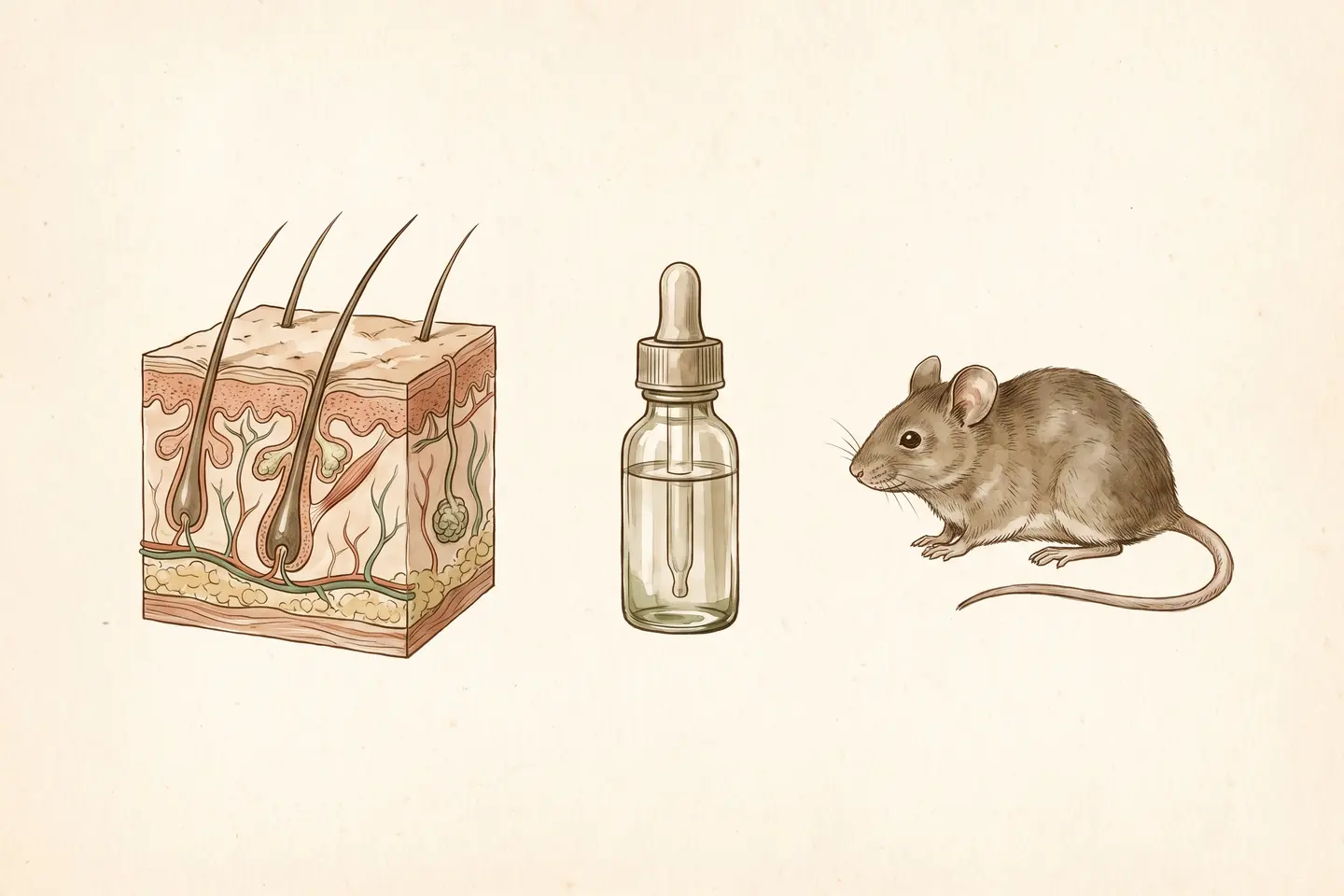
In mouse skin, PTD-DBM accelerates entry into anagen, the growth phase of the hair cycle, increases follicle-cycling activity, and promotes wound-induced hair follicle neogenesis in wound models [1][2][3]. Neogenesis is the process by which new follicles form during healing, rather than scar tissue alone.
A later paper from the same group extended the story to androgenetic alopecia biology. It described a DHT-to-PGD2 signaling axis mediated by CXXC5 that suppresses hair regrowth in mice, and it reported that PTD-DBM reversed that suppression in the mouse model [3].
The mechanism is coherent and legible. It is also a story told entirely within one animal model system, by one group of investigators.
What is the complete evidence base for PTD-DBM?
The entire published evidence base for PTD-DBM is three primary papers and one commentary, all originating from or reviewing work by the same Yonsei University group [1][2][3][4]:
- 2015, wound healing. PTD-DBM disrupts CXXC5-Dvl binding and, combined with topical valproic acid, accelerated wound healing and collagen deposition in mice [1].
- 2017, hair regrowth. The paper most forum threads cite: topical PTD-DBM stimulated hair regrowth and wound-induced hair neogenesis in C57BL/6 mice, with effects described as comparable to minoxidil in that model, and synergy when combined with valproic acid [2].
- 2023, androgenetic alopecia. The mechanism extended to a DHT-PGD2-CXXC5-Wnt axis in androgenetic alopecia biology, again in mice [3].
- 2017, independent review. Researchers affiliated with Johns Hopkins framed CXXC5-Dvl disruption as biologically plausible and worth pursuing, and called it hypothesis-generating rather than clinically actionable without human data [4].
No second, independent laboratory has replicated the core finding. No registered human trial, phase I safety study, or pharmacokinetic study exists. The E, minimal grade reflects the literature as it stands; it is not a placeholder awaiting more data.
Is PTD-DBM as effective as minoxidil?
PTD-DBM has never been compared with minoxidil in humans. The comparison comes from a within-study measurement inside a mouse hair-cycling model [2].
Describing PTD-DBM as "comparable to minoxidil" does not mean it matches minoxidil's established human efficacy and safety record. Those are different categories of evidence, and conflating them is the most common error in secondary coverage of this peptide. Zinc thymulin for hair regrowth covers another topical hair claim.
Where do PTD-DBM protocols come from?
Every dosing, frequency, and vehicle detail in PTD-DBM forum protocols traces back to a mouse experimental design, not to any human pharmacokinetic or dose-finding study [2].
Reconstitution practices such as propylene glycol or DMSO carriers, application frequency, and combination with topical valproic acid are all extrapolated from that single rodent protocol [1][2]. No study has validated any of it for human skin penetration, systemic absorption, half-life, or safe topical concentration.
Anecdotal "regrowth log" threads do not substitute for that data. They carry no control group, no verified peptide identity, and no blinding.
Is PTD-DBM safe for long-term use?
PTD-DBM's safety in humans is unknown, and its mechanism carries a plausible, unaddressed liability.
Wnt/beta-catenin signaling is not a hair-specific pathway. It regulates proliferation and differentiation across many tissue types, and unchecked activation of it is mechanistically implicated in several proliferative processes elsewhere in biology. That liability is part of why broad Wnt-pathway activators, including systemic GSK-3 inhibitors, have had a difficult track record in drug development generally.
None of the PTD-DBM papers measure chronic topical exposure, systemic absorption, or proliferative risk markers over extended timeframes [1][2][3]. The independent review stops short of endorsing clinical use and describes the approach as hypothesis-generating [4].
Reported human side effects are poorly characterized where secondary sources mention them at all. Scalp irritation, redness, and itching are described, usually in protocols that combine PTD-DBM with microneedling and topical valproic acid, which makes attributing any effect to the peptide impossible.
Is vendor-sold PTD-DBM the same peptide the studies used?
Vendor-sold PTD-DBM cannot be confirmed as the peptide the mouse studies used without third-party mass spectrometry. It is sold research-use-only, with no FDA approval of any kind.
The channels that sell it do not independently confirm sequence, purity, or endotoxin content. "PTD-DBM" on a vendor listing is a custom-synthesized research sequence, not a standardized pharmaceutical product, so nothing guarantees that what arrives matches the peptide structure used in the cited studies. How to read a peptide COA covers what a certificate of analysis can and cannot show.
What is still unknown about PTD-DBM?
Five gaps keep PTD-DBM at grade E, and each one is a reason mechanistic plausibility should not be mistaken for demonstrated human benefit or established safety:
- Human trials. No human trial of any phase exists.
- Human dosing. No published human pharmacokinetic, dosing, or safety data exist.
- Replication. No independent replication of the core mouse finding exists outside the originating group's own follow-up work [1][2][3].
- Long-term risk. No data address chronic topical exposure or long-term proliferative risk in any species.
- Product identity. No standardized manufacturing or purity verification exists for material sold under this name.
Sources
-
Lee SH et al. (2015). The Dishevelled-binding protein CXXC5 negatively regulates cutaneous wound healing. J Exp Med. pubmed.ncbi.nlm.nih.gov/26056233
-
Lee SH et al. (2017). Targeting of CXXC5 by a Competing Peptide Stimulates Hair Regrowth and Wound-Induced Hair Neogenesis. J Invest Dermatol. pubmed.ncbi.nlm.nih.gov/28595998
-
Ryu YC et al. (2023). CXXC5 Mediates DHT-Induced Androgenetic Alopecia via PGD(2). Cells. pubmed.ncbi.nlm.nih.gov/36831222
-
Kim D et al. (2017). The Negative Regulator CXXC5: Making WNT Look a Little Less Dishevelled. J Invest Dermatol. pubmed.ncbi.nlm.nih.gov/28967390
Last updated

Written by
Chemist and biochemist. Co-founder and author, The Peptide App.
Jay is a chemist, biochemist and entrepreneur whose work connects scientific research with consumer health products. He has held Chief Science Officer and product development leadership roles and previously served as Chief Revenue Officer at Minicircle.
Keep reading
Profiles and tools

The Peptide App
Track protocols, doses, and reconstitution in one place.
Save your calculations, set reminders, log doses, and keep outcome notes — free to start.
 or scan the QR code →