
Thymosin Beta-4 sped rat wound healing; human trials were topical
Thymosin Beta-4 sped skin wound healing in rats, and its eye-drop and ulcer trials gave mixed results. No human trial has tested it for tendon injury.

By Jay Spall, chemist and biochemist
Disclosure: Jay is a co-founder of The Peptide App. This review discusses the studies cited below; it is not a comprehensive live trial registry or treatment recommendation. Development and regulatory status can change. The app’s tools organize records and arithmetic and do not validate a research product.
On this page
- What is Thymosin Beta-4, and what does it do in cells?
- Does Thymosin Beta-4 heal tendon and ligament injuries?
- Do Thymosin Beta-4 eye drops work for dry eye?
- Did Thymosin Beta-4 pass its Phase 3 trial in neurotrophic keratopathy?
- Does topical Thymosin Beta-4 heal venous ulcers?
- What does the Thymosin Beta-4 human record add up to?
- Is TB-500 the same as Thymosin Beta-4?
- Where do injectable Thymosin Beta-4 doses come from?
- Is injectable Thymosin Beta-4 safe or legal?
- What is still unknown about Thymosin Beta-4 in people?
- Sources
Key facts
| Question | Direct answer |
|---|---|
| Does Thymosin Beta-4 heal a strained tendon or ligament in a person? | No human trial has tested it. The evidence for soft-tissue injury repair is entirely preclinical, from rodent wound models [1]. |
| Is TB-500 the same as Thymosin Beta-4? | No. TB-500 is a synthetic fragment marketed as a "stable" analog of TB4's active region; it is not identical to any naturally occurring fragment, and none of the human trials below tested it. Every study cited below used full-length TB4. |
| What has Thymosin Beta-4 been tested for in humans? | Eye and skin conditions in the cited trials, not muscle or tendon injuries. Those trials tested eye drops in dry eye and neurotrophic corneal disease [3][4][5] and a topical treatment for venous stasis ulcers [2]; none tested a systemic or injectable route. |
| Did the Thymosin Beta-4 human trials succeed? | Mixed. One small dry-eye trial hit its primary endpoints [3]; a larger one missed its co-primary endpoints but showed secondary benefits [4]; the Phase 3 keratopathy trial showed a strong healing trend that fell short of statistical significance [5]; the ulcer trial saw only a non-significant trend [2]. |
| How strong is the Thymosin Beta-4 evidence? | Grade D, limited. A strong mechanism, thin and narrowly indicated human data, and zero human evidence for the injuries most people use it for. |
| Is injectable Thymosin Beta-4 or TB-500 approved anywhere? | No approved systemic product exists for either. TB4 is WADA-prohibited in sport, and injectable "research use only" material carries real contamination, mislabeling, and identity-confusion risk between TB4 and TB-500. |
5 sources cited. View sources
What is Thymosin Beta-4, and what does it do in cells?
Thymosin beta-4 is a small, 43-amino-acid peptide that human cells already make, and its core, well-documented job is binding monomeric G-actin. Binding G-actin sequesters it away from the actin filament pool.
That matters because actin polymerization is the engine of cell movement. Cells crawl by extending actin-rich edges, and the rate at which G-actin is available to build those edges shapes how fast a cell migrates. In cell culture, TB4 increases keratinocyte migration two- to threefold in Boyden chamber assays [1]. In rat full-thickness wound models, it increased reepithelialization by 42 to 61% over saline controls, along with more collagen deposition [1].
The effect is real and mechanistically coherent, replicated across rodent wound models including diabetic and aged animals. It is the reason TB4 attracted serious pharmaceutical interest in the first place.
Does Thymosin Beta-4 heal tendon and ligament injuries?
No human trial has tested Thymosin Beta-4 for tendon or ligament healing; the repair evidence comes from rat skin wounds [1].
A rat's shaved dorsal skin wound and a person's partially torn rotator cuff are different tissue types with different injury biomechanics and different repair biology: epidermal migration versus tendon collagen crosslinking and fibroblast-driven remodeling. Nothing in the rodent skin literature demonstrates that systemic TB4 exposure changes tendon or ligament healing kinetics in any species, let alone in humans.
Mechanistic plausibility is a different evidence tier from demonstrated effect. The actin story, however elegant, has not been tested in human tendon or ligament, where people apply it. A separate review covers tendon injury peptide stacks.
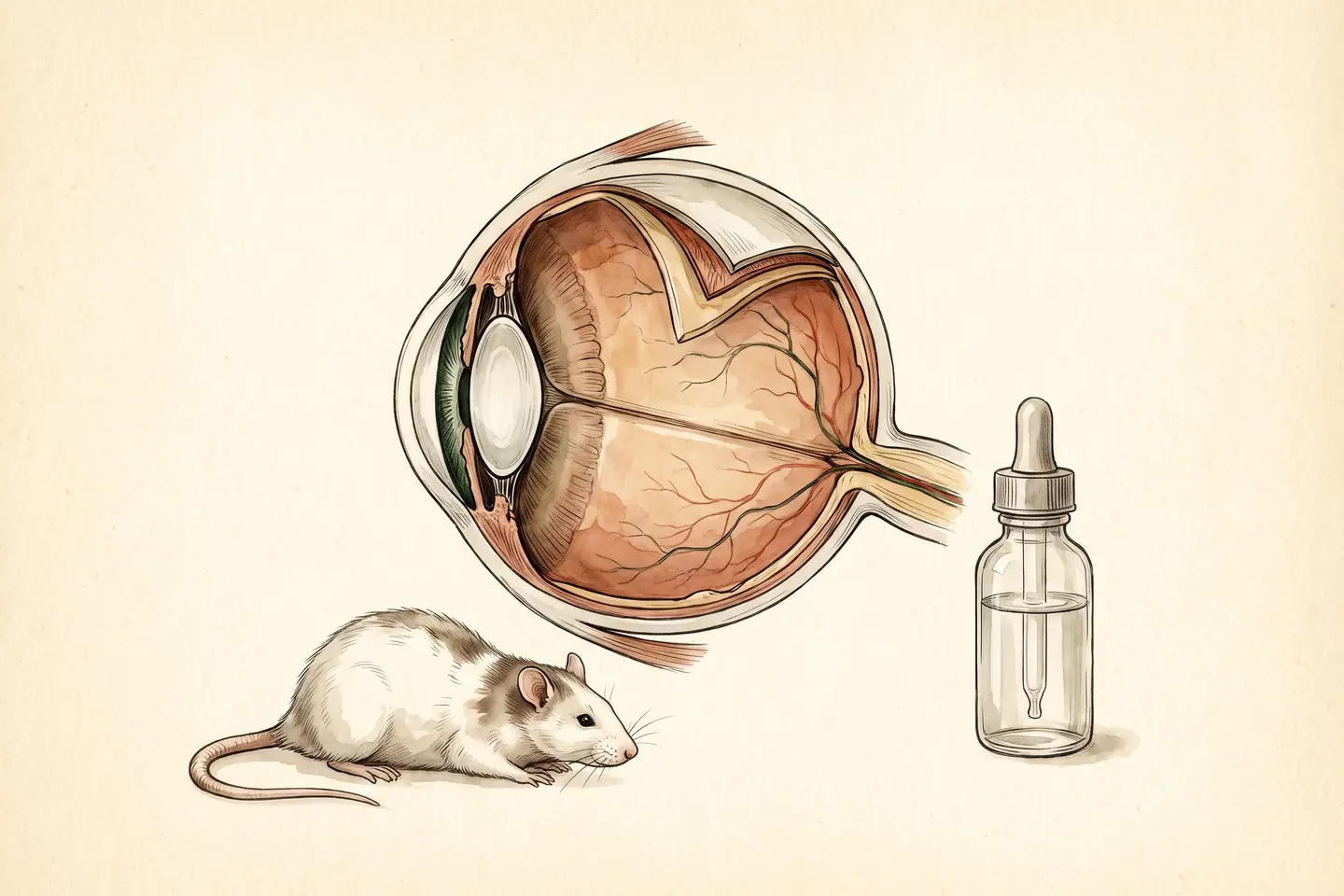
Do Thymosin Beta-4 eye drops work for dry eye?
Thymosin Beta-4 eye drops improved severe dry eye in a 9-patient trial [3], but a larger 72-patient Phase 2 trial missed its co-primary endpoints [4].
In the 9-patient trial, 0.1% TB4 (RGN-259) eye drops produced a statistically significant 35.1% reduction in ocular discomfort (p=0.0141) and a 59.1% reduction in corneal fluorescein staining (p=0.0108) at day 56, with no adverse events reported [3]. The signal is positive, but n=9 is a pilot-scale trial, not confirmatory evidence.
The 72-patient Phase 2 trial used a controlled adverse environment model. Its co-primary endpoints, ocular discomfort and inferior corneal staining at day 29, did not reach statistical significance. Several secondary endpoints did, including a 27% reduction in discomfort scores (p=0.0244) and improvements in central and superior corneal staining (p=0.0075 and p=0.0210) [4].
Missing a pre-specified primary endpoint while hitting secondaries is a common way trials fail to be definitive. It is not success, and it is not failure.
Did Thymosin Beta-4 pass its Phase 3 trial in neurotrophic keratopathy?
Thymosin Beta-4 missed statistical significance narrowly in a Phase 3 neurotrophic keratopathy trial of 18 patients, despite a large effect size [5].
Complete epithelial healing occurred in 6 of 10 patients on RGN-259 versus 1 of 8 on placebo by week 4. That large effect landed at p=0.0656, just above the conventional significance threshold, in a trial too small to reliably resolve it [5].
Among the cited human studies, the keratopathy trial is the most advanced and the closest thing to late-stage efficacy data, and it still did not clear its own bar. No adverse events of concern were seen, which matters for safety even where efficacy remains unresolved.
Does topical Thymosin Beta-4 heal venous ulcers?
Topical Thymosin Beta-4 showed only a non-significant trend toward faster venous ulcer healing in a 73-patient, double-blind Phase 2 trial [2].
The eight-site trial of topical 0.03% TB4 saw roughly 25% of patients achieve complete closure by day 84, and no statistically robust primary endpoint was met [2]. This trial comes closest in spirit to asking whether TB4 accelerates tissue repair in a person. Its answer is a weak trend, not proof.
What does the Thymosin Beta-4 human record add up to?
Thymosin Beta-4's human evidence rates Grade D, limited: a strong mechanism, thin and narrowly indicated human data, and no human evidence for the injuries most people use it for.
The four cited human trials span two organ systems, the eye and skin ulcers. They produced one clean positive, one missed primary endpoint with secondary hits, one near-miss Phase 3 trend, and one non-significant trend. No completed, powered human trial exists for systemic injury repair, cardiac tissue, CNS application, or any injectable-route indication.
Is TB-500 the same as Thymosin Beta-4?
TB-500 is not Thymosin Beta-4: it is a synthetic peptide sequence designed to mimic TB4's actin-binding region, and it has no human clinical evidence at all.
Forum and vendor material routinely treats TB-500 as functionally interchangeable with full-length TB4, often citing TB4's mechanism or even its trial history as if it applies directly. TB-500 is not a fragment that naturally occurs in the body. No published human trial has characterized its pharmacokinetics, degradation products, or dose-response behavior, and none of the five cited studies used it.
Claiming TB4's dry-eye or ulcer results as reassurance for TB-500 conflates two different molecules with two different human data records, and TB-500's record is essentially empty. The evidence grade for TB-500 is not "the same as TB4 but weaker." Why TB-500 is not thymosin beta-4 covers how the two molecules differ.
Where do injectable Thymosin Beta-4 doses come from?
The 2 to 5 mg twice-weekly injectable Thymosin Beta-4 protocols circulating online do not trace to any human dose-response study.
The cited human RCTs used topical or ophthalmic formulations at defined, low concentrations: 0.03% for venous ulcers [2] and 0.1% for the ophthalmic trials [3][4][5]. Those concentrations were established for local, not systemic, delivery. None of the cited trials established a safe or effective systemic injectable dose of TB4 in humans, and no such dose exists for TB-500.
Every injectable dosing protocol now circulating is extrapolated from animal studies, informal user reports, or nothing at all, not from human pharmacokinetic data.
Is injectable Thymosin Beta-4 safe or legal?
No approved systemic Thymosin Beta-4 or TB-500 product exists, and TB4 is prohibited under WADA's anti-doping code. The WADA ban is a legal and career consideration independent of the efficacy question, and the TB-500 ban explainer covers what that status does and does not mean.
None of the cited trials provides systemic human safety data. Every cited trial population had a specific eye or skin condition and used a topical or ophthalmic route.
Sourcing adds a separate risk layer. Injectable material sold under research-use-only labeling carries documented risk of contamination, mislabeling, and outright substitution of TB-500 for TB4 or vice versa, with no regulatory testing to catch it.
What is still unknown about Thymosin Beta-4 in people?
Thymosin Beta-4's biggest unknowns concern repeated systemic use, the way people take it for injuries:
- Long-term exposure. The long-term effects of repeated systemic exposure are unstudied in humans.
- Pathway interactions. How TB4 interacts with other repair or growth-signaling pathways is unstudied in humans.
- Injectable pharmacokinetics. None of the cited studies measured injectable-route pharmacokinetics in people.
None of this means the mechanism is wrong or the future research unpromising. It means the specific forum claim, that TB4 or TB-500 will speed healing of a torn tendon based on evidence already in hand, is not something the human data support yet.
Sources
Last updated

Written by
Chemist and biochemist. Co-founder and author, The Peptide App.
Jay is a chemist, biochemist and entrepreneur whose work connects scientific research with consumer health products. He has held Chief Science Officer and product development leadership roles and previously served as Chief Revenue Officer at Minicircle.
Keep reading

BPC-157 and TB-500
TB-500 is a fragment of thymosin beta-4, the protein tested in trials
TB-500 is a short synthetic fragment, not full-length thymosin beta-4. Every human trial in this family tested the 43-amino-acid protein, not the fragment.
Combinations and evidence
Trials back loading for tendons; stacks cite single-agent studies
Two loading programs improved Achilles pain and function in a 58-patient trial. BPC-157's orthopedic record is 35 preclinical studies and one chart review.

BPC-157 and TB-500
WADA bans BPC-157 and TB-500 as non-approved substances
WADA bans BPC-157 and TB-500 because neither is approved for human use anywhere. The ban is a regulatory category, not a finding that they enhance performance.
Profiles and tools

The Peptide App
Track protocols, doses, and reconstitution in one place.
Save your calculations, set reminders, log doses, and keep outcome notes — free to start.
 or scan the QR code →