
Trials back loading for tendons; stacks cite single-agent studies
Two loading programs improved Achilles pain and function in a 58-patient trial. BPC-157's orthopedic record is 35 preclinical studies and one chart review.

By Jay Spall, chemist and biochemist
Disclosure: Jay is a co-founder of The Peptide App. This review discusses the studies cited below; it is not a comprehensive live trial registry or treatment recommendation. Development and regulatory status can change. The app’s tools organize records and arithmetic and do not validate a research product.
On this page
- What human evidence supports BPC-157 for tendon injury?
- How does tendon healing work?
- Do anti-inflammatory agents help a healing tendon?
- What does strong human evidence for tendon recovery look like?
- Is there a tested human dose for BPC-157 in tendon injury?
- What is still unknown about tendon injury stacks?
- Sources
Key facts
| Question | Direct answer |
|---|---|
| Does any peptide or supplement stack have trial evidence for tendon injury? | No. BPC-157, the most studied candidate, has one systematic review of 36 studies: 35 were preclinical, and the single human study was a small retrospective chart review, not a trial [5]. |
| Does taking two tendon compounds together help more than either alone? | Untested in humans. The studies cited for tendon stacks test single agents, not a combination against either agent alone. |
| Do anti-inflammatory agents speed tendon repair? | Unresolved, and possibly counterproductive. Tendon biology reviews find inflammation entangled with the healing response itself, and its exact role in repair is still unclear [1][2]. |
| What does strong human evidence for tendon recovery look like? | Randomized trials of loading. In a controlled trial of 58 patients, eccentric training and heavy slow resistance produced comparable, well-documented improvement [4]. |
| What should replace a five-ingredient stack? | The one or two interventions with the strongest individual human evidence, done at the dose and timing that evidence tested, not a longer ingredient list. |
8 sources cited. View sources
What human evidence supports BPC-157 for tendon injury?
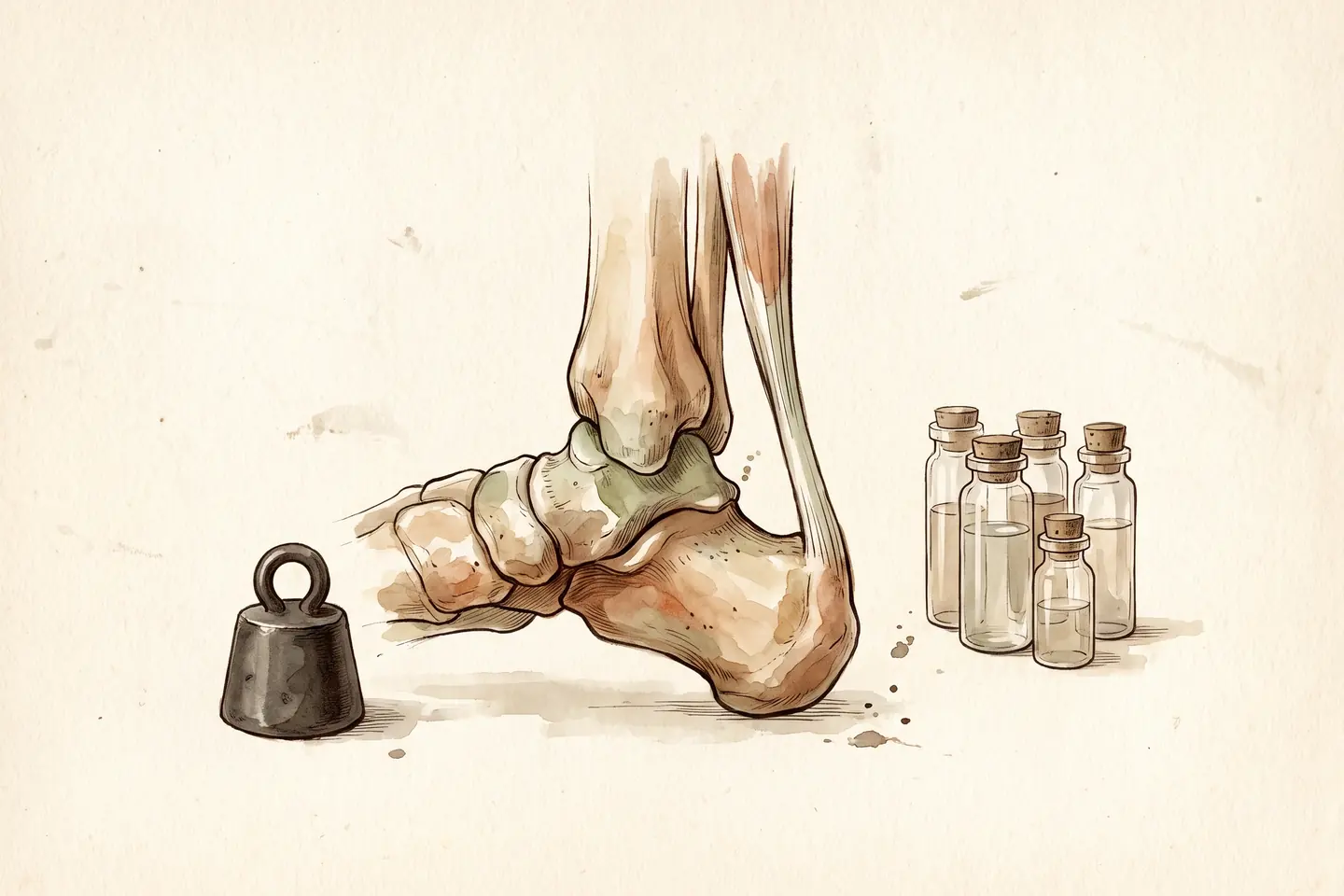
BPC-157's published human evidence in orthopedic sports medicine is one small retrospective chart review. A 2025 systematic review screened 544 articles on BPC-157 in orthopedic sports medicine and included 36 that met its criteria. Of those 36, 35 were preclinical, meaning animal or in vitro work, and exactly one was a human study: a small retrospective chart review, not a controlled trial [5].
BPC-157 is the peptide most commonly anchoring tendon stacks, so it is the clearest test of the gap between citation count and evidence quality. It appears on injury-stack lists in the same confident tone as agents that have gone through randomized human testing.
A retrospective chart review cannot establish that a compound works. It can only note that some patients who received BPC-157 had some outcome, with no control group and no way to separate the compound's effect from rest, physical therapy, or the injury's natural course. The BPC-157 human evidence review covers that small human record in more detail.
How does tendon healing work?
Tendon healing runs through three overlapping phases: early inflammation, a proliferative phase that lays down collagen and matrix, and a remodeling phase that reorganizes that matrix under load [3]. Any compound claimed to help tendon repair has to act on one of these phases, and the phases are not interchangeable targets. A stack has to justify which phase each ingredient works on.
Do anti-inflammatory agents help a healing tendon?
Whether anti-inflammatory agents help a healing tendon is an open question, and the mechanistic literature does not cleanly support assuming they do. Many tendon stacks include one or more anti-inflammatory agents, on the assumption that suppressing inflammation is straightforwardly good for a healing tendon.
A systematic review of chronic low-level inflammation in tendon tissue found inflammatory molecules and cytokines consistently present in tendon injury. Their role in the healing response itself is still unclear, though it appears to influence outcome [2]. A separate review of diet, adipokines, and tendon healing found that low-grade inflammation is entangled with tendon healing biology in ways that do not reduce to "more inflammation, worse outcome" [1].
If early inflammatory signaling is part of what recruits the cells and mediators that build new matrix, blunting it in the first days after injury is not an obviously safe addition to a stack. It is an open pharmacological question.
What does strong human evidence for tendon recovery look like?
Strong human evidence for tendon recovery comes from randomized trials of loading protocols, not from peptides or supplements. A randomized controlled trial assigned 58 patients with chronic Achilles tendinopathy to eccentric training or heavy slow resistance training for 12 weeks, with follow-up to 52 weeks. Both groups improved significantly on validated pain and function scores, and the improvement held at a year. The two loading approaches did not differ in outcome, though patients tended to report higher satisfaction with heavy slow resistance [4].
A scoping review of eccentric training protocols across 31 studies in athletic tendinopathy found consistent pain and function improvement, with heavy slow resistance and adjunct modalities showing comparable or additive effects when layered onto loading [7]. A systematic review narrowed to five randomized trials out of 5,235 screened records found that Alfredson-protocol progressive eccentric loading is the best-supported single approach for Achilles tendinopathy, with room to test combined eccentric-concentric or heavy slow resistance work further [8].
None of that is peptide or supplement evidence. It is the right comparison anyway, because it shows what a randomized, dosed, human-tested intervention looks like in this field. The gap between that record and a single retrospective chart review is not subtle.
Is there a tested human dose for BPC-157 in tendon injury?
No study supports a specific milligram figure, injection frequency, or duration for BPC-157 or any comparable peptide in a human soft-tissue injury. The human testing that would generate those numbers has not gone beyond one retrospective chart review [5].
Where real numbers exist, they come from loading, not from compounds. The eccentric-versus-heavy-slow-resistance trial ran 12 weeks of structured loading with defined sets, reps, and progression, and it produced a defined, replicated outcome in a controlled comparison [4].
Even some physical interventions have thin parameter data. A scoping review of neuromuscular electrical stimulation as a loading adjunct for patellar and Achilles tendons found 10 studies covering 166 participants, most of them healthy, not injured, and only 3 of those 10 studies reported the stimulation dosage used [6]. If dosage reporting is that inconsistent inside a category with real randomized trials, the doses on a peptide stack list are assumptions: a certain number of milligrams, a certain number of times per day, carried over from animal protocols, not tested human doses. Why BPC-157 animal studies don't support injectable use explains why that carry-over fails.
What is still unknown about tendon injury stacks?
Three questions are unanswered, and anyone building a tendon stack should be able to name them before combining anything:
- Combined effects. Whether any two of these agents interact additively, redundantly, or antagonistically has not been tested in humans for this compound family. The citation list behind a stack is a list of single-agent studies, most of them preclinical, not evidence about the stack. The evidence on stacking BPC-157 with a second repair peptide gets its own review.
- Early inflammation. Whether suppressing inflammatory signaling in the early days after a tendon or soft-tissue injury helps or hinders a repair process that depends partly on that same signaling is unresolved in the tendon biology literature itself [1][2].
- Timing with loading. Loading-based protocols have defined windows and progressions backed by controlled trials [4][7]. The compounds commonly stacked alongside them have no tested interaction with those loading windows at all.
A stack that adds compounds without a stated mechanism for why they combine, and without checking whether one component's timing works against another's target phase, is not a protocol. It is a set of single-agent citations bolted together and presented with borrowed confidence, which is why multi-ingredient stacks need evidence for each component. The better replacement for a five-ingredient stack is the one or two interventions with the strongest individual human evidence, done at the dose and timing that evidence tested.
Sources
Last updated

Written by
Chemist and biochemist. Co-founder and author, The Peptide App.
Jay is a chemist, biochemist and entrepreneur whose work connects scientific research with consumer health products. He has held Chief Science Officer and product development leadership roles and previously served as Chief Revenue Officer at Minicircle.
Keep reading

Combinations and evidence
Each ingredient in a stack needs its own evidence grade
Formal grading finds evidence certainty varies widely between parts of one protocol, so grade each ingredient. The exact combination is rarely tested.
Combinations and evidence
TB-500 alone improved rat tendon biomechanics; BPC-157 added nothing
TB-500 alone improved repaired rat tendon biomechanics; BPC-157 added nothing measurable. Human data on the pair cover four patients in one uncontrolled review.
BPC-157 and TB-500
BPC-157 healed tendons in rats; human data are three small pilots
BPC-157 improved strength and collagen organization in cut rat Achilles tendons in a 2003 study. Human data are three small pilots, none in tendon patients.
Profiles and tools

The Peptide App
Track protocols, doses, and reconstitution in one place.
Save your calculations, set reminders, log doses, and keep outcome notes — free to start.
 or scan the QR code →