Metabolic Category
Retatrutide
THE GAME CHANGER
LY3437943; GGG Tri-Agonist
Retatrutide is a triple-action peptide that tells your body to eat less, burn more calories through glucagon, and improve blood sugar control, all in one molecule for powerful weight and metabolic effects.
Retatrutide Evidence Snapshot
How these guides are reviewed- Regulatory status
- Not FDA approved · research use only
- Dosing guidance
- Reviewed by our clinical team
- Linked evidence
- 4 research sources
- Content updated
- Jul 15, 2026
Dose and schedule recommendations shown below come from The Peptide App Clinical Team. Research links are provided so readers can inspect the supporting evidence directly. Review the sources.
Quick Answers About Retatrutide
Is Retatrutide FDA approved?
No. This profile records Retatrutide as not FDA approved and for research use only.
More context
Review the regulatory and source details on this page for the current context.
What dose does The Peptide App Clinical Team recommend for Retatrutide?
Dose: Start at 0.5 mg weekly, titrate to 2.5-5 mg weekly.
More context
Schedule: weekly. Cycle: 12 weeks on, 12 weeks off (per clinical trials). This is clinical-team guidance for reference and does not replace individualized instructions from a licensed clinician.
What research supports this Retatrutide guide?
This guide links to 4 curated or current research sources.
More context
Open the research section to inspect the source titles, publication details, study types, and available abstracts directly.
Review the Retatrutide research sourcesStudied Effects & Mechanisms
Appetite Suppression
GLP-1 activation suppresses appetite and improves insulin secretion
GIP Activation
Boosts insulin and improves lipid metabolism
Glucagon Activation
Increases energy expenditure and fat oxidation
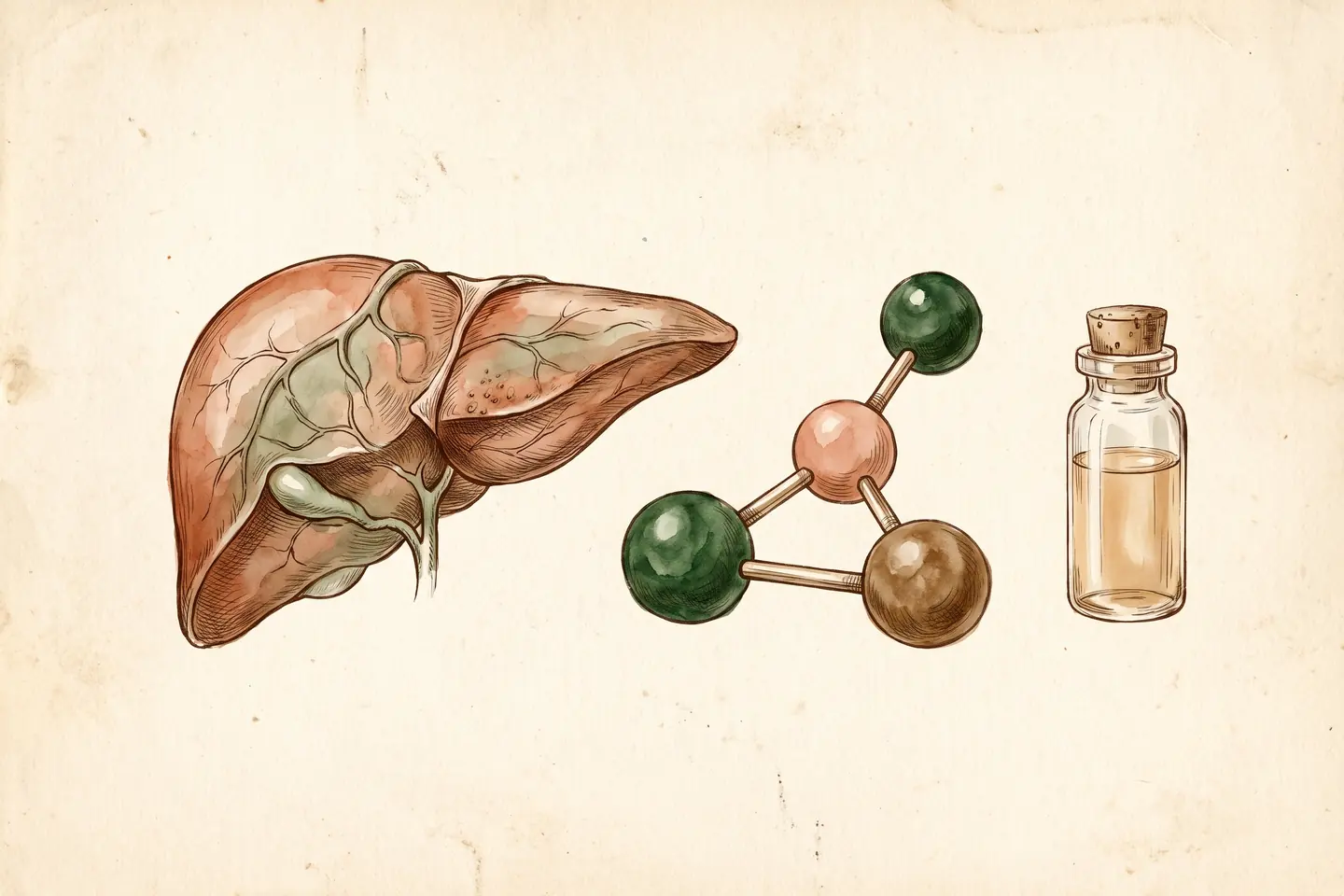
Liver Fat Reduction
Promotes hepatic fat oxidation and NAFLD reversal
Origin and history
Retatrutide, also known by its development code LY3437943, is an investigational peptide from Eli Lilly. It is a single synthetic molecule of roughly 39 amino acids engineered to activate three different hormone receptors at once: GLP-1, GIP, and glucagon. That design places it in the next generation beyond earlier incretin drugs, since semaglutide targets GLP-1 alone and tirzepatide targets GLP-1 and GIP. To survive in the body long enough to be useful, the peptide carries two deliberate modifications shared with those earlier drugs: an amino acid substitution near one end that resists breakdown by the enzyme DPP-4, and a fatty acid chain that lets it bind reversibly to albumin in the blood. These changes stretch its half-life to roughly six days, which is what makes once-weekly dosing feasible. Retatrutide is a laboratory-built agonist rather than a naturally occurring peptide, though the three hormones it mimics are all real signals the gut and pancreas normally release around meals.
What people use it for
The overwhelming reason people look into retatrutide is body-fat loss, and it has drawn attention for producing some of the largest reductions reported in any obesity study to date. Beyond appetite suppression, interest centers on its glucagon arm, which is linked to burning fat directly in the liver and to raising energy expenditure, so it is often discussed in the context of fatty liver and metabolic health rather than weight alone. Its investigational program has also studied blood-sugar control in type 2 diabetes. In the peptide community it is frequently framed as the strongest option in a good, better, best ladder against semaglutide and tirzepatide, and creators discuss stacking or transition strategies, muscle-preservation tactics during a deficit, and exit or taper protocols. It is worth stressing that these community uses run ahead of what regulators have approved, and much of the discussion is anecdotal or extrapolated from trial summaries.
What makes it unusual
Most weight-loss peptides work mainly by dialing down the calories going in, and retatrutide does that too through its GLP-1 and GIP activity, which blunt appetite in the brain and slow digestion in the gut. What sets it apart is the third target, the glucagon receptor, which adds a lever on the calories going out. Glucagon activation in the liver increases fatty acid oxidation and reduces new fat synthesis, and it may raise overall metabolic rate, an effect creators describe as mimicking what the body normally only does during prolonged fasting. Another subtle point raised in more technical explainers is that retatrutide is a relatively weak and biased agonist at the GLP-1 receptor, hitting it at a fraction of natural potency while preferentially triggering the beneficial signaling pathway and causing less receptor desensitization over time. How much real-world benefit that biased pattern delivers is not yet fully characterized. The practical takeaway is that this triple action is why it can raise metabolism during a calorie deficit instead of letting it fall, though the glucagon arm is also the part with the least long-term human safety data.
How it is administered
Retatrutide is used as a subcutaneous injection, meaning it is delivered into the fat layer under the skin rather than into muscle or a vein. Because its albumin-binding design gives it a half-life of about six days, reported protocols describe once-weekly dosing, and trial regimens have used a slow, stepwise increase over months rather than starting at a high dose. That gradual titration is generally framed as a way to limit gastrointestinal side effects while the body adjusts. The effect is systemic, since the peptide circulates and acts on receptors throughout the brain, gut, pancreas, and liver, not at the injection site. There is no approved oral or nasal form, and any specific dose or schedule is a medical decision rather than something a monograph should prescribe.
Clinical & Research Context
Those with significant weight to lose · People who haven't responded to other GLP-1 drugs · Those with type 2 diabetes and obesity · Anyone seeking cutting-edge metabolic therapy · People interested in fatty liver reversal
State of the evidence
Retatrutide has produced striking results in human trials, with a widely cited phase 2 study reporting roughly a quarter of body weight lost at the highest dose, and creators referencing emerging phase 3 topline figures near 28.7 percent at 68 weeks on 12 mg. The important caveat is scale and maturity: the well-established published data comes largely from a single phase 2 program of around 700 patients, with studies running under a year and no long-term or cardiovascular outcome follow-up yet. That is a fraction of the evidence base behind semaglutide, which has tens of thousands of trial patients and multi-year outcome data, or tirzepatide. The larger phase 3 TRIUMPH trials are still underway, so much of what circulates online is either extrapolation from short trials or personal anecdote, including self-experiments by individual creators. In short, the weight-loss signal is real and unusually strong, but the long-term safety and durability picture remains genuinely unproven.
Legal and regulatory status
As of this writing, retatrutide is not approved by the FDA or other major regulators and remains an investigational drug in Eli Lilly's clinical pipeline. It is not sold as a finished prescription medicine, which means material circulating in the community is typically research-grade or compounded and sits in a legally gray, unregulated space where purity and dosing accuracy are not guaranteed. It is most often referenced by its development code LY3437943, and it has no established brand name because it has not reached market. Because it is a metabolic drug rather than a performance agent, doping frameworks are less central than legitimate safety and quality concerns, though any competitive athlete should check current rules directly. Regulatory status in this area changes quickly, so anyone reading about it should verify the latest approvals and local laws rather than relying on a fixed snapshot.
Further listening
4 recordingsResearch-Market Price Snapshot
A compact market signal for this profile. The dedicated pricing page owns vendor, vial-size, and price-per-mg comparisons.
Updated Jul 16, 2026
- Vendors
- 35
- Listings
- 101
- Observed range
- $35–$1,512
Retatrutide Research
Live research temporarily unavailable
The live research feed did not return papers for this page. The curated references below remain available for crawlable source context.
Research references
Related Peptides
Tesamorelin
THE BELLY FAT MELTERBGoodHormonal Regulation · Anti-Aging & LongevityMetabolic · Hormonal RegulationDose2 mg↻Cycle3-6 months on, then as prescribed◷Kicks inVisceral fat reduction typically visible...FDA-approved GHRH analog that melts visceral fat
from $3.90/mg · 79 vendorsNº 005 / 006Mazdutide
THE DUAL ACTIVATORCModerateAppetite & Metabolic Control · Weight ManagementMetabolic · Appetite & Metabolic ControlDose1 mg↻CycleOngoing as prescribed in clinical trials◷Kicks inWeight loss typically begins in the first...Next-gen weight loss with dual hormone action
from $4.49/mg · 11 vendorsNº 003 / 0065-Amino-1MQ
THE FAT BURNERBGoodMetabolic Modulator · Weight ManagementMetabolic · Metabolic ModulatorDose150 mcg↻Cycle3 weeks on, 1 week off◷Kicks inMost users notice energy improvements within...Boost metabolism and burn fat without changing your diet
from $0.68/mg · 69 vendorsNº 001 / 006Epitalon
THE LONGEVITY FACTORAHighNeurological Support · Sleep RegulationHealing · Neurological SupportDose1 mg↻Cycle10-30 days on, 4-6 months off◷Kicks inSleep improvements within days; telomere...Supports cellular longevity and circadian rhythm for optimal sleep-based brain repair.
from $1.40/mg · 78 vendorsNº 002 / 006MOTS-c
THE METABOLIC MESSENGERBGoodMetabolic Modulator · Mitochondrial SupportMetabolic · Metabolic ModulatorDose5 mg↻Cycle8-12 weeks on, 4 weeks off◷Kicks inMetabolic improvements may be measurable...Exercise in a peptide - boost metabolism without the treadmill
from $0.75/mg · 110 vendorsNº 004 / 006Tirzepatide
THE TRANSFORMERAHighMetabolic Modulator · Weight ManagementMetabolic · Metabolic ModulatorDose2.5 mg▲↻Cycle12-24 weeks per treatment cycle◷Kicks inAppetite reduction within first week....The ultimate FDA-approved weight loss solution. Lose 20%+ of your body weight.
from $1.75/mg · 81 vendorsNº 006 / 006