Healing Category
GHK-Cu
THE RESTORER
Copper Tripeptide; Glycyl-L-Histidyl-L-Lysine-Copper; Kollaren
GHK-Cu is a small copper-carrying peptide that tells your cells to rebuild collagen, reduce inflammation, and protect against oxidative damage. It's especially useful for skin rejuvenation and wound healing.
GHK-Cu Evidence Snapshot
How these guides are reviewed- Regulatory status
- Not FDA approved · research use only
- Dosing guidance
- Reviewed by our clinical team
- Linked evidence
- 4 research sources
- Content updated
- Jul 15, 2026
Dose and schedule recommendations shown below come from The Peptide App Clinical Team. Research links are provided so readers can inspect the supporting evidence directly. Review the sources.
Quick Answers About GHK-Cu
Is GHK-Cu FDA approved?
No. This profile records GHK-Cu as not FDA approved and for research use only.
More context
Review the regulatory and source details on this page for the current context.
What dose does The Peptide App Clinical Team recommend for GHK-Cu?
Dose: Topical: as directed; Injectable: 1-2 mg daily.
More context
Schedule: daily. Cycle: Variable - topical ongoing, injectable cycled. This is clinical-team guidance for reference and does not replace individualized instructions from a licensed clinician.
What research supports this GHK-Cu guide?
This guide links to 4 curated or current research sources.
More context
Open the research section to inspect the source titles, publication details, study types, and available abstracts directly.
Review the GHK-Cu research sourcesStudied Effects & Mechanisms
Collagen Production
Stimulates fibroblasts to produce collagen and elastin
Wound Healing
Promotes angiogenesis and tissue regeneration
Antioxidant
Protects cells from oxidative damage
Gene Reset
Resets thousands of genes to a more youthful pattern
Origin and history
GHK-Cu is a naturally occurring tripeptide, three amino acids (glycine, histidine, and lysine) bound to a copper ion. Your body makes it on its own, and it circulates in the blood. It was discovered by the American researcher Dr. Loren Pickart in the mid-1970s, who found it in collagen tissue and proposed that it helps control both the building and the breakdown of collagen. Much of the foundational research traces back to his lab, a common theme with peptides. GHK levels are high in youth and fall sharply with age, dropping from roughly 200 units in young people to around 60 by age 65, which is one reason it is associated with the look of younger skin.
What people use it for
GHK-Cu is best known as a skin and aesthetic peptide. People read about it for firmer, plumper-looking skin, softened fine lines, and general skin rejuvenation, and it is often compared with ingredients like retinol and vitamin C. It has also been studied for wound healing: one study using a topical GHK-Cu gel on diabetic foot ulcers reported closure improving from about 60 percent to 98 percent. Interest in hair is more modest, and it is usually framed as a possible add-on rather than a replacement for established options. It is also the peptide people add to a BPC-157 and TB-500 pairing to make what the community nicknamed the glow stack. Some newer research is looking at connective-tissue repair beyond the skin.
What makes it unusual
GHK is actually a breakdown fragment of type 1 collagen, the most abundant collagen in the body. When tissue is damaged and collagen is being remodeled, GHK is released into the bloodstream, where it seeks out copper with such high affinity that it can pull copper ions off albumin, the body's main transport protein. It then delivers that copper exactly where repair enzymes need it, including enzymes for antioxidant defense and for cross-linking collagen and elastin. Unusually, it is described as regulating both the synthesis and the breakdown sides of collagen, which is what healthy remodeling requires. There is an aging angle too: as collagen stiffens with age, GHK can get trapped and released less, so less copper reaches repair sites, which some researchers frame as not just a marker of aging but part of its cause.
Topical vs injected, and microneedling
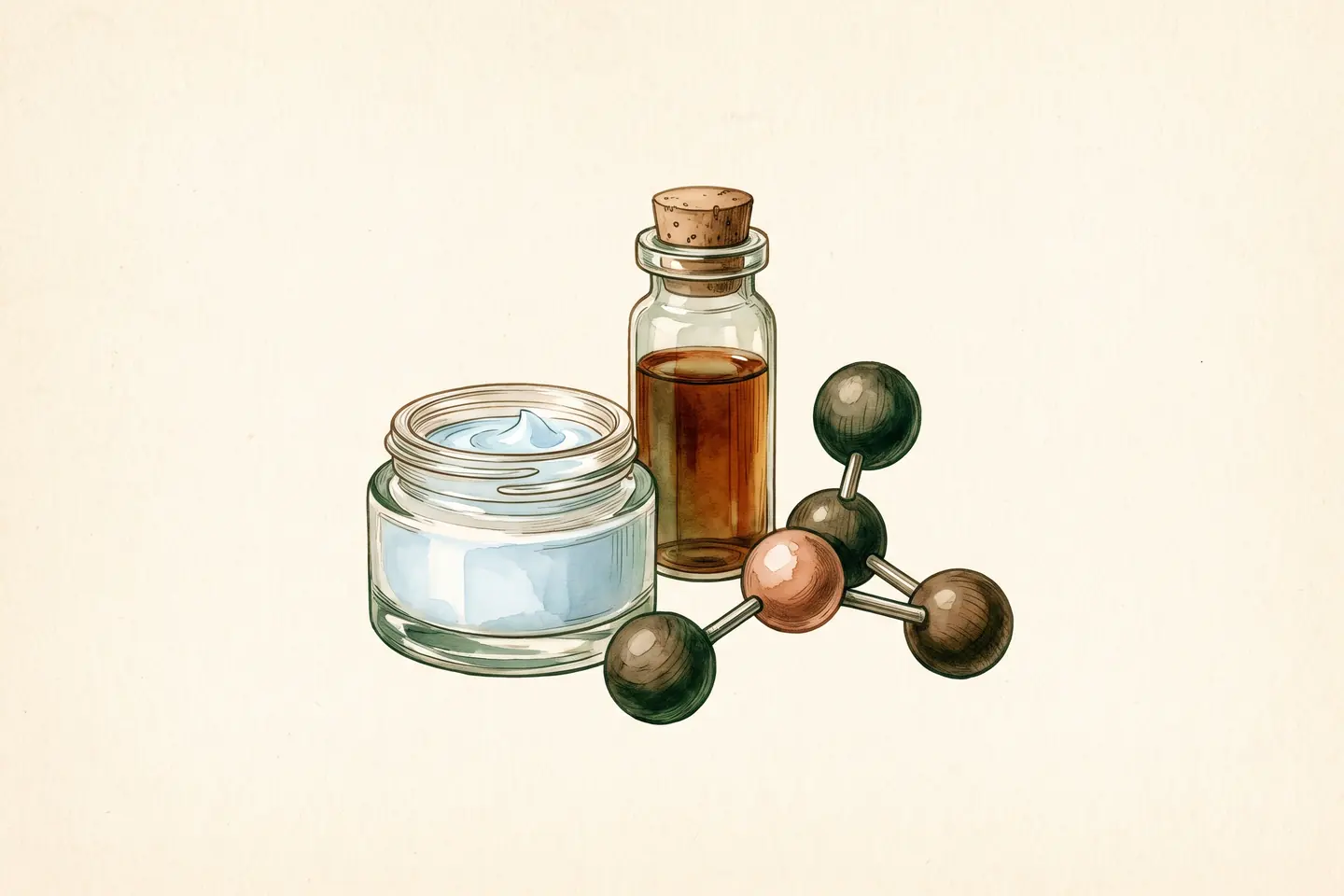
GHK-Cu is used both topically and by injection, and topical is the older and better-studied route, with a track record in cosmetics going back decades. The challenge with topical use is that GHK-Cu does not easily cross the stratum corneum, the skin's outer barrier. This is why it is often paired with microneedling: applying GHK-Cu right after microneedling is described as helping it get past that barrier and reach the skin below. Hydrating the skin with hyaluronic acid a few hours beforehand is also described as improving penetration, and some people pair topical use with red light therapy, which is discussed as synergistic. A practical quality tell is color: genuine GHK-Cu is blue because of the copper, so a colorless topical is a red flag. Injectable GHK-Cu also exists but has far less human data behind it. This is background on how it is used, not a recommendation.
Clinical & Research Context
People wanting skin rejuvenation · Those experiencing hair loss · Anyone recovering from wounds or surgery · Anti-aging enthusiasts · People with skin damage from sun or aging
State of the evidence
The strongest human data for GHK-Cu is topical and aesthetic. One study reported that about 70 percent of people treated with topical GHK-Cu showed improved collagen synthesis, compared with roughly 40 to 50 percent for vitamin C, melatonin, or tretinoin, and there are additional studies on skin appearance and wound healing. The injectable form is much less proven in humans, so its safety and benefit are harder to state with confidence. As with several peptides, a large share of the foundational work comes from a single lab, which is worth keeping in mind. The honest summary is solid topical human data for skin, alongside thinner evidence for injected use.
Legal and regulatory status
The topical form of GHK-Cu is widely sold in over-the-counter cosmetics and skincare and is not part of the FDA restriction that applies to injectable peptides like BPC-157 and TB-500. The injectable form is not FDA approved, and commentators expect it to come up in a later round of FDA discussion about compounded peptides rather than the first. Product quality varies, especially among research-chemical topicals, so the blue copper color and a reputable formulator are the checks people mention most. Rules in this area are changing quickly, so treat any status as a snapshot in time.
Further listening
3 recordingsResearch-Market Price Snapshot
A compact market signal for this profile. The dedicated pricing page owns vendor, vial-size, and price-per-mg comparisons.
Updated Jul 16, 2026
- Vendors
- 64
- Listings
- 110
- Observed range
- $20–$1,152
GHK-Cu Research
Live research temporarily unavailable
The live research feed did not return papers for this page. The curated references below remain available for crawlable source context.
Research references
Related Peptides
SNAP-8
THE EXPRESSION SMOOTHERAHighSkin Health · Anti-Aging & LongevityLongevity · Skin HealthDoseSee guide↻CycleOngoing daily use◷Kicks inWrinkle reduction typically visible after...Botox-like wrinkle reduction without the needles
from $0.15/mg · 27 vendorsNº 004 / 006BPC-157
THE HEALERAHighAccelerated Healing · Neurological SupportHealing · Accelerated HealingDose250 mcg↻Cycle4-8 weeks on, then equal break◷Kicks inGut issues often improve faster - many...Accelerates healing of tendons, ligaments, gut, and muscles throughout your body.
from $1.99/mg · 122 vendorsNº 001 / 006Epitalon
THE LONGEVITY FACTORAHighNeurological Support · Sleep RegulationHealing · Neurological SupportDose1 mg↻Cycle10-30 days on, 4-6 months off◷Kicks inSleep improvements within days; telomere...Supports cellular longevity and circadian rhythm for optimal sleep-based brain repair.
from $1.40/mg · 78 vendorsNº 002 / 006Pinealon
THE DREAMWEAVERAHighNeurological Support · Sleep RegulationCognitive · Neurological SupportDose1 mg↻Cycle4 weeks on, 8 weeks off◷Kicks inSleep improvements often noticed within the...Sleep like you mean it and wake up mentally sharp.
from $0.90/mg · 45 vendorsNº 003 / 006SS-31
THE MITOCHONDRIAL OPTIMIZERBGoodCardiovascular Support · Neurological SupportHealing · Cardiovascular SupportDose5 mg↻Cycle6 weeks on, 8 weeks off◷Kicks inEnergy improvements may be noticed within...Directly target and repair your mitochondria
from $1.60/mg · 53 vendorsNº 005 / 006Thymosin Alpha-1
THE IMMUNE SUPERCHARGERAHighAccelerated Healing · Anti-InflammatoryHealing · Accelerated HealingDose1 mg↻Cycle4 weeks on, 4 weeks off◷Kicks inImmune enhancement often measurable within...Supercharge your immune system against infections and cancer
from $3/mg · 70 vendorsNº 006 / 006