
Thymulin needs zinc to act, and it curbed inflammation in mice
Zinc switches thymulin on, and the hormone curbed inflammation in mouse studies. Its cited human data are one 1982 case series in three children.

By Jay Spall, chemist and biochemist
Disclosure: Jay is a co-founder of The Peptide App. This review discusses the studies cited below; it is not a comprehensive live trial registry or treatment recommendation. Development and regulatory status can change. The app’s tools organize records and arithmetic and do not validate a research product.
On this page
- Why is thymulin inactive without zinc?
- What does thymulin do in animals?
- Does zinc deficiency switch off thymulin?
- Has thymulin been tested in humans?
- Do animal thymulin results apply to an adult with a working thymus?
- Is the thymulin sold online the same molecule?
- How long does thymulin last in the bloodstream?
- Is zinc a better-supported lever than injecting thymulin?
- Which thymulin questions remain unanswered in humans?
- Sources
Key facts
| Question | Direct answer |
|---|---|
| What is thymulin? | A nine-amino-acid hormone made by thymic epithelial cells that works only when bound one-to-one with a zinc ion; the zinc-free form is inert [1]. |
| Is the "thymulin" sold online the molecule studied in research? | Usually not verifiably. Vendor products are often synthetic fragments or analogs (sometimes labeled PAT or synthetic FTS), and no published data confirm they match the native zinc-bound nonapeptide's structure, purity, or behavior. |
| Has thymulin been tested in humans? | Not in any cited controlled trial. The cited human data is one 1982 case series of three immunodeficient children given intravenous synthetic FTS, which showed improved cellular immunity and IgA production and has not been replicated in over 40 years [2]. |
| Is there human dosing, safety, or pharmacokinetic data for thymulin? | No. A 2014 review reports no dose-finding studies and no published PK/PD data for subcutaneous or any other route in humans [4]. |
| What is the best-evidenced lever on thymulin's biology? | Zinc status. Marginal zinc deficiency measurably lowers circulating thymulin bioactivity in animal models, and adding zinc back restores activity in vitro [3]. |
| How strong is the thymulin evidence overall? | Grade D, limited. Real, well-characterized preclinical biology, with essentially no clinical evidence in humans. |
5 sources cited. View sources
Why is thymulin inactive without zinc?
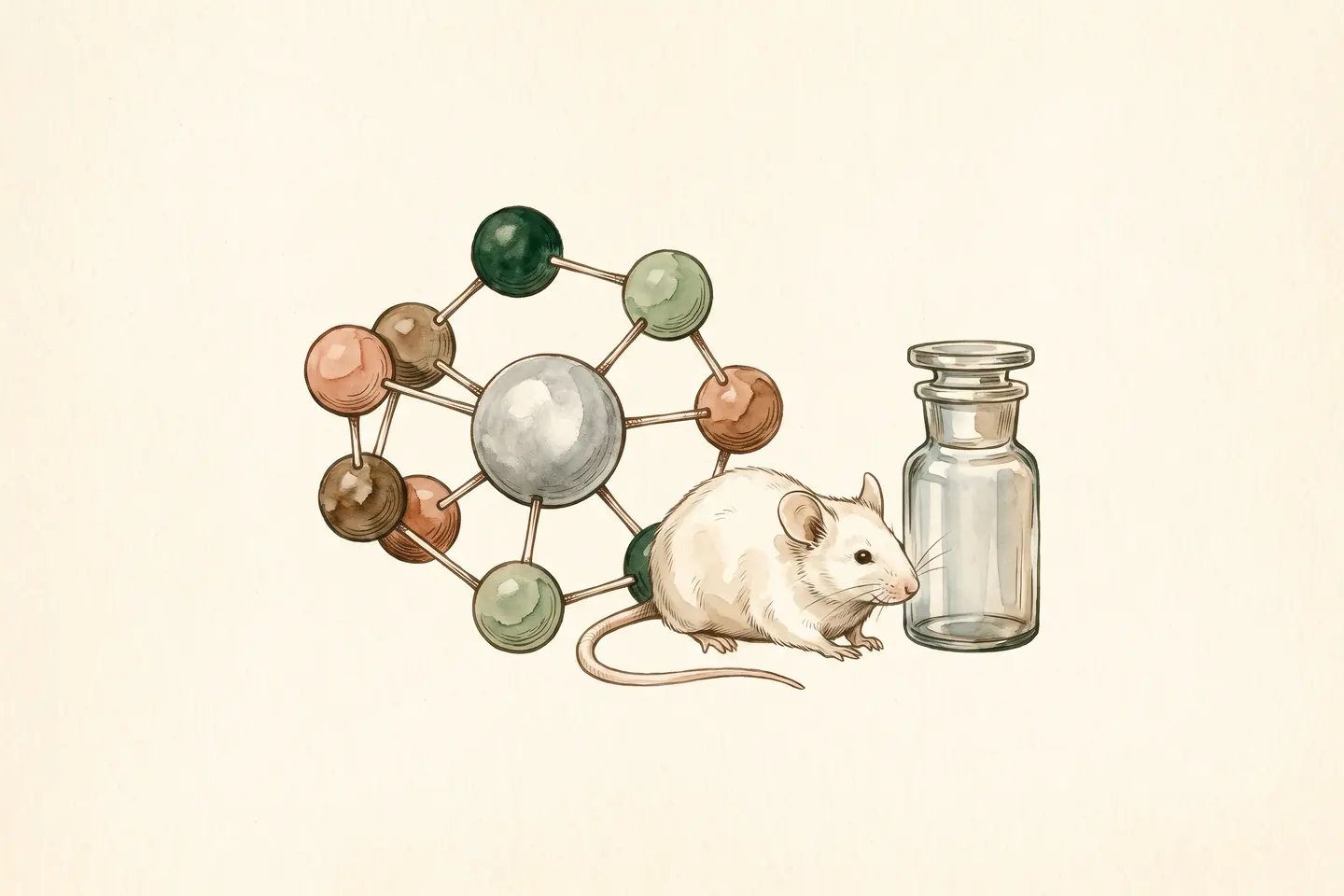
Thymulin is a nine-amino-acid peptide made by thymic epithelial cells, and it does nothing until a zinc ion binds it at a 1:1 molar ratio [1].
The 1982 PNAS paper that named the molecule showed that the zinc-free apo-peptide is completely inactive, and that zinc occupancy converts an otherwise inert chain into a biologically active metallopeptide [1]. That is the origin of the "Zn-FTS" and "serum thymic factor" names. FTS (Facteur Thymique Serique) is the peptide backbone; thymulin is specifically the zinc-bound, active complex.
The distinction matters more than most write-ups acknowledge. Thymulin's activity depends on two variables, peptide and metal, not one.
What does thymulin do in animals?
In animal models, thymulin influences T-cell differentiation and, downstream, inflammatory signaling.
A 2018 mouse study using an escalating endotoxin (LPS) challenge found that thymulin reduced circulating TNF-alpha, IL-6, and interferon-gamma, suppressed NF-kB, MAPK, and PKC-theta signaling, and decreased lymphocyte apoptosis over eight days [5]. A 2014 review compiles decades of similar rodent work documenting anti-inflammatory, analgesic, and pituitary-modulating (hypophysiotropic) effects across multiple models [4].
The biology is real and reproducible. It is also entirely rodent and in vitro biology, and "thymulin works" collapses several distinct questions into one: whether zinc activates it, whether it acts in animals, and whether an injection does anything in a person.
Does zinc deficiency switch off thymulin?
Marginal zinc deficiency lowered circulating bioactive thymulin in mice within two months, with no thymic atrophy [3].
The hormone was present but functionally silenced, and adding zinc back in vitro fully restored its activity [3]. Zinc binding as the switch that activates the peptide was shown directly in vitro and is the mechanistic basis for the molecule's name [1].
The zinc-deficiency result is among the most clinically translatable findings in the thymulin literature, and it is about zinc, not about injecting peptide.
Has thymulin been tested in humans?
The only human thymulin data among the cited studies is a 1982 case series of three immunodeficient children given intravenous synthetic FTS [2].
The children showed improved cell-mediated immunity and detectable IgA production within four weeks [2]. The series had three patients, no control group, and no replication in over four decades. Its diagnosis, combined IgA and T-cell deficiency, is unrelated to what a healthy adult would use the peptide for.
None of the cited studies is a controlled human therapeutic trial of thymulin. Everything else in the cited work, including T-cell restoration in thymectomized rodents, aging-mouse work, and endotoxemia protection, is preclinical.
Do animal thymulin results apply to an adult with a working thymus?
No cited study tests injected thymulin in an adult whose thymus still produces its own thymulin, the situation of most people using research peptides.
The preclinical characterization is careful and consistent across labs and decades; it is not weak science. A thymectomy or gene-delivery model answers a different question: what happens when a hormone is replaced in a system whose source organ has been surgically removed or artificially sustained. One example is the 320-day supraphysiological thymulin levels achieved through adenoviral delivery in athymic rats [4].
An adult with a functioning thymus is a structurally different case. None of the cited studies addresses it directly.
Is the thymulin sold online the same molecule?
Vendor "thymulin" is usually not verifiably the zinc-bound nonapeptide used in research. Forums and vendor listings use "thymulin," "FTS," "Zn-FTS," and "PAT" as though they are interchangeable, and they are not.
FTS is the unbound peptide backbone; thymulin is specifically the zinc-loaded, active complex [1]. PAT and other synthetic analogs on research-chemical sites are structurally related fragments, not the native nonapeptide. No published human safety or pharmacokinetic data establish that these analogs behave in a person like the compounds tested in the cited rodent and case-series work.
A product page that cites decades-old FTS papers to support a PAT product borrows credibility from a molecule the product does not necessarily contain in an equivalent, zinc-loaded, bioactive form. The guide to reading a peptide certificate of analysis covers what a test report can confirm about a vial.
How long does thymulin last in the bloodstream?
Thymulin has a serum half-life of roughly 10 minutes in animal models, even in its properly zinc-bound form [5].
In the 2018 mouse endotoxemia work, that short half-life of the free peptide was a real limitation, which nanoparticle-bound formulations partially addressed [5]. Nobody selling injectable thymulin online discusses that formulation problem.
The half-life alone raises questions about what the forum consensus, a once-daily or few-times-weekly subcutaneous protocol, is realistically expected to achieve.
Is zinc a better-supported lever than injecting thymulin?
Zinc status, not injected peptide, is the variable with the clearest causal evidence behind it in thymulin biology.
Thymulin requires zinc to function at all [1]. Marginal zinc deficiency measurably reduces bioactive thymulin in animals independent of thymic mass, with full restoration when zinc is added back in vitro [3].
For anyone interested in the biology thymulin sits inside, T-cell differentiation and thymic hormone signaling, adequate zinc status is the more directly evidenced, better-characterized, and far cheaper lever. The alternative is injecting a peptide whose cited human record is three children treated in 1982. A separate review examines zinc thymulin for hair regrowth.
Which thymulin questions remain unanswered in humans?
Thymulin's human unknowns cover nearly everything a user would need:
- Pharmacokinetics. No human pharmacokinetic or pharmacodynamic data exist for exogenous thymulin by any route, including subcutaneous [4].
- Dose. No human dose-finding data exist, so any "typical" dose circulating online is an anecdotal convention, not a derived figure.
- Safety in healthy adults. No safety data exist in healthy adults. The cited human data come from three immunodeficient children monitored for a specific clinical endpoint, not from healthy volunteers screened for adverse effects [2].
- Long-term and immune effects. Long-term effects, immunogenicity risk from repeated peptide exposure, and interaction with an already-functioning adult thymus remain unstudied.
- Autoimmune risk. The caution about overstimulating immune activity in autoimmune conditions is a mechanistic extrapolation, not a demonstrated finding in any published dataset.
Sources
Last updated

Written by
Chemist and biochemist. Co-founder and author, The Peptide App.
Jay is a chemist, biochemist and entrepreneur whose work connects scientific research with consumer health products. He has held Chief Science Officer and product development leadership roles and previously served as Chief Revenue Officer at Minicircle.
Keep reading
Profiles and tools

The Peptide App
Track protocols, doses, and reconstitution in one place.
Save your calculations, set reminders, log doses, and keep outcome notes — free to start.
 or scan the QR code →