
Needles in household trash endanger waste handlers more than injectors
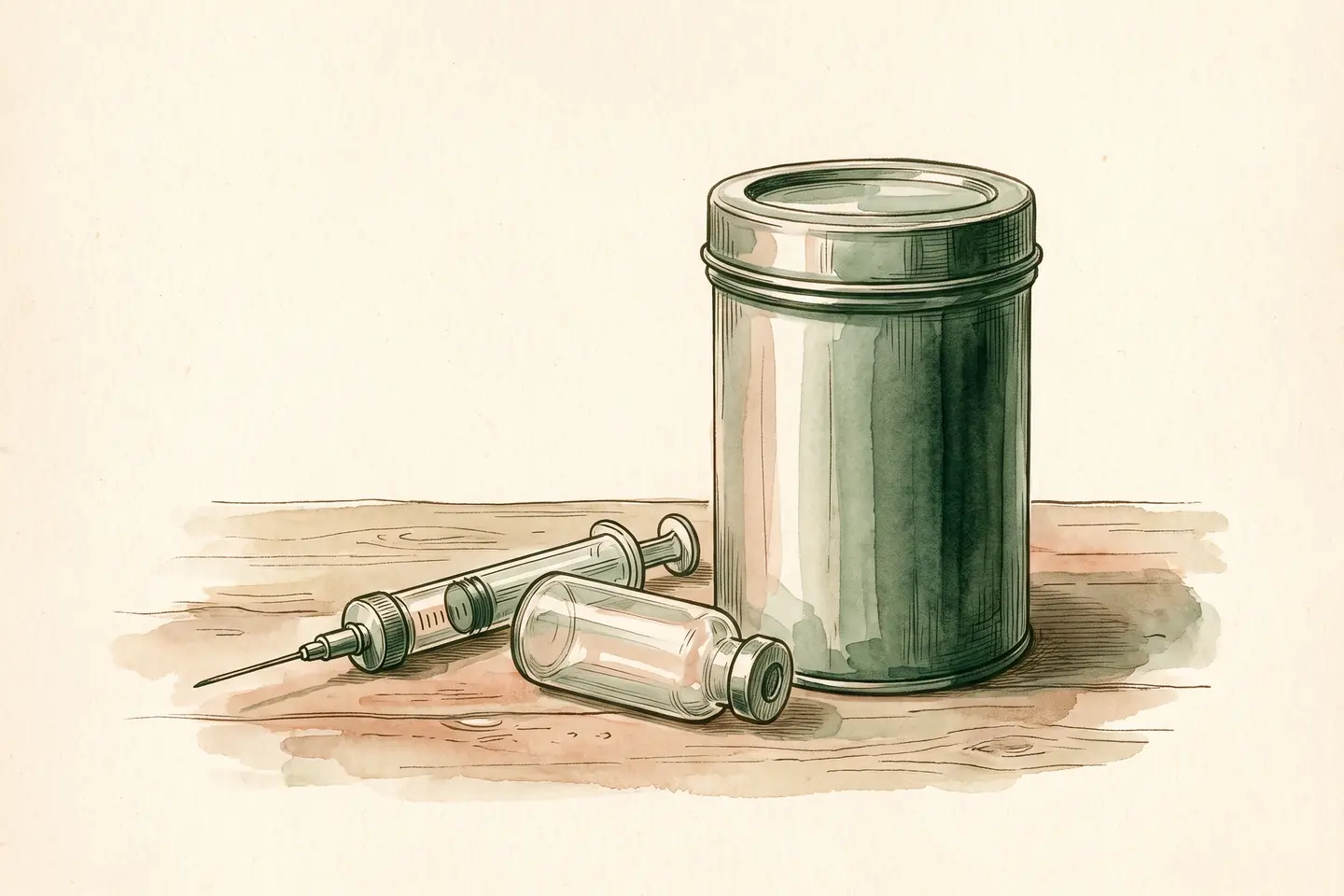
Needles in household trash mainly endanger waste handlers. Safe disposal needs a rigid, puncture-resistant, closable container and a local pathway.

By Jay Spall, chemist and biochemist
Disclosure: Jay is a co-founder of The Peptide App. This review discusses the studies cited below; it is not a comprehensive live trial registry or treatment recommendation. Development and regulatory status can change. The app’s tools organize records and arithmetic and do not validate a research product.
On this page
- Who is at risk from needles thrown in household trash?
- How do people who self-inject at home dispose of needles?
- Has any study shown which home disposal method prevents injuries?
- What counts as a sharp in a peptide reconstitution routine?
- What container and disposal pathway protect waste handlers?
- What is still unknown about home sharps disposal?
- Sources
Key facts
| Question | Direct answer |
|---|---|
| Can I just drop a used needle in my kitchen trash? | No. Most people who self-inject at home do exactly this, and the evidence flags that practice as the core problem, not a workaround [3][6]. |
| Who gets hurt if I do? | Not you. The injury lands downstream, on the person sorting or hauling the trash bag, who has no warning a sharp is inside [2]. |
| Does a detergent bottle count as a sharps container? | Not as the standard. It is rigid, which helps, but the occupational literature is built around a purpose-built rigid, puncture-resistant, closable container [4]. |
| How many sharps does one reconstituted vial generate? | Unquantified for peptide or hormone protocols. Treat any number seen online as unsourced. |
| Is the legal picture the same everywhere? | No. Disposal pathways depend on what a specific location runs, and controlled research has not addressed jurisdiction-by-jurisdiction legality of trash disposal. |
| Do clinicians explain safe disposal? | Not reliably. Studies show wide gaps in what patients are told, and fewer than one in five diabetic patients in one survey recalled receiving correct disposal advice from staff [6]. |
| Does it matter if I never get poked myself? | Yes. Your own safety is not the standard: the relevant harm is bloodborne pathogen exposure to someone else, and more than 40 pathogens have been documented from sharps injuries, with HBV, HCV and HIV accounting for most cases [4]. |
7 sources cited. View sources
Who is at risk from needles thrown in household trash?
A needle in household trash endangers the person sorting or hauling the bag, and rarely the person who injected [2]. A used needle does not stop being a puncture hazard once it leaves the injector's hand. The mechanism is simple: a contaminated point breaks skin, and bloodborne pathogens move with it.
Consumer disposal advice consistently omits who is on the other end of that puncture, and it is rarely the person who drew their own dose. Reviews of healthcare waste name waste handlers and waste collectors, alongside medical staff, as populations exposed to sharps injuries when needles are not properly disposed of [2].
Those workers do not choose the exposure and do not know a bag contains a sharp until the sharp finds them. The stakes are infectious: more than 40 pathogens have been documented from sharps injuries, with HBV, HCV and HIV accounting for most cases [4].
How do people who self-inject at home dispose of needles?
Most people who self-inject at home put used needles in household trash [3][6]. Studies from several countries document gaps in disposal practice and knowledge:
- U.S. review. An older U.S. review estimated that 8 to 9 million Americans were self-injecting at home, with most needles ending up in household trash [3].
- Portuguese survey. A primary-care survey found that most diabetic patients put needles and lancets straight into unsorted household waste, and fewer than one in five recalled receiving correct disposal advice from staff [6].
- South African survey. In a rural sample of insulin-dependent patients, most respondents lacked adequate knowledge of proper sharps disposal. Over half of those who knew someone injured by a discarded needle in their own household said that event changed their disposal habits [5].
- Chinese study. A knowledge-attitude-practice study found that roughly half of participants scored poorly on knowledge and held a neutral attitude toward safe handling [7].
Has any study shown which home disposal method prevents injuries?
None of the cited studies did: the household sharps evidence is descriptive surveys of behavior, not intervention trials measuring whether a specific disposal method reduces injuries. Household sharps disposal is not randomized-trial territory. The evidence is a cluster of cross-sectional surveys of people who self-inject, plus occupational-health framework reviews.
The grade is "consistent observational pattern," not "proven prevention effect." The occupational framework linking sharps handling to bloodborne infection risk is well established in laboratory and hospital settings [4]. The scale of medical waste streams intersecting with general trash has been documented at a systems level during recent surges in disposable medical supply use [1].
None of this is a randomized comparison of disposal routes. It is the descriptive foundation that explains why the routes matter.
What counts as a sharp in a peptide reconstitution routine?
A reconstituted-vial routine generates three different puncture hazards: the drawing needle, the injecting needle, and the empty vial. Lumping them into "use a sharps container" flattens real differences.
The drawing needle touches only the vial stopper and diluent, and the injecting needle touches the person injecting. The guide to needle sharpness and coring explains why drawing and injecting call for separate needles. The empty vial, once its stopper has been repeatedly punctured, is a puncture risk in its own right even though it is not a needle.
How many of each a typical eight-to-twelve-week protocol produces is unquantified, so treat any specific count circulating online as unsourced. The survey data do show that patients are rarely told to treat these as distinct objects at all, which likely contributes to the pattern of unsorted disposal the studies document [5][6][7].
What container and disposal pathway protect waste handlers?
The standard that protects a stranger, not just the injector, is a rigid, puncture-resistant, closable container, never recycled or overfilled, paired with a local disposal pathway. A detergent bottle is rigid, which helps, but it is not what protects a stranger sorting blind. The occupational literature is built around a purpose-built rigid, puncture-resistant, closable container [4].
Owning a container is not the gap the survey literature surfaces. Clinical advice on what to do with a full one is inconsistent or absent, which fits with over a fifth of one Portuguese cohort reporting they had received incorrect guidance [6].
Home-generated sharps sit outside the occupational frameworks built for hospitals and labs. A low-volume, time-limited protocol, a handful of draws over several weeks, does not map cleanly onto guidance written for daily, years-long insulin use, and the studies do not separate the two use cases.
What is still unknown about home sharps disposal?
The specific numbers a reader wants for a home routine are unknown, although the injury mechanism and the behavioral pattern are well documented [2][3][4][5][6][7].
- Sharps per protocol. No controlled research gives a per-protocol sharps count for reconstituted peptide or hormone vials.
- Container design. None of the cited studies tests the comparative effectiveness of specific consumer container designs at preventing downstream sanitation injuries.
- Legality. Controlled research has not addressed jurisdiction-by-jurisdiction legality of trash disposal.
Sources
Last updated

Written by
Chemist and biochemist. Co-founder and author, The Peptide App.
Jay is a chemist, biochemist and entrepreneur whose work connects scientific research with consumer health products. He has held Chief Science Officer and product development leadership roles and previously served as Chief Revenue Officer at Minicircle.
Keep reading
Handling and product records
Blunt needles core vial stoppers far more often than sharp ones
Blunt plastic needles cored 40.8% of vial stoppers versus 4.2% for sharp needles in one study. The data come from anesthesia practice, not peptide vials.
Handling and product records
Dilute peptides lose more to vial and syringe surfaces
Peptides bind to glass and plastic, so dilute solutions lose a larger share of the dose. The data come from insulin bags and colistin labware, not home vials.
Handling and product records
Poor site rotation is the top risk factor for insulin injection lumps
Lipohypertrophy affects about 42% to 59% of long-term insulin users, and poor rotation is its top risk factor. The data come from insulin, not other peptides.
Profiles and tools

The Peptide App
Track protocols, doses, and reconstitution in one place.
Save your calculations, set reminders, log doses, and keep outcome notes — free to start.
 or scan the QR code →