
Poor site rotation is the top risk factor for insulin injection lumps
Lipohypertrophy affects about 42% to 59% of long-term insulin users, and poor rotation is its top risk factor. The data come from insulin, not other peptides.

By Jay Spall, chemist and biochemist
Disclosure: Jay is a co-founder of The Peptide App. This review discusses the studies cited below; it is not a comprehensive live trial registry or treatment recommendation. Development and regulatory status can change. The app’s tools organize records and arithmetic and do not validate a research product.
On this page
- What are the three kinds of injection site lump?
- What is lipohypertrophy?
- How common is lipohypertrophy in people who inject insulin?
- Does rotating injection sites prevent lipohypertrophy?
- Why does site rotation reduce lipohypertrophy?
- How does lipohypertrophy change drug absorption?
- Does insulin lipohypertrophy research apply to peptide injections?
- How should you rotate injection sites?
- When does an injection site lump need a clinician?
- What is still unknown about site rotation for peptide injections?
- Sources
Key facts
| Question | Direct answer |
|---|---|
| Is a firm lump where I keep injecting normal? | Likely lipohypertrophy. That firm buildup of fat and fibrous tissue at a repeatedly used site is found in roughly 42% to 59% of long-term insulin injectors studied, depending on the population and detection method [1][4][5]. |
| Is the small bump right after an injection the same thing? | No. A small, soft bleb minutes after injection is a normal, transient tissue response that typically resolves within a day or two. Lipohypertrophy builds slowly, over weeks to months of repeated trauma to one small area. |
| Does rotating injection sites prevent lumps? | In insulin users, poor rotation is the strongest measured risk factor: incorrect site rotation carried an odds ratio of 8.85 for lipohypertrophy [2]. The evidence comes entirely from insulin research, not peptide-specific studies. |
| How far apart should injections be? | Roughly a finger's width between consecutive injections is a common convention from insulin technique guidelines, not a study finding. |
| Does a lump change how much drug is absorbed? | For insulin, yes. Tissue with lipohypertrophy or lipoatrophy shows slower, more erratic absorption, linked to unpredictable blood glucose response [6][7]. |
| When is a lump something other than lipohypertrophy? | When it shows warmth, spreading redness, or worsening pain over several days. That pattern points toward infection or a reaction to the injected material, not tissue buildup, and warrants medical evaluation rather than a rotation fix [8]. |
11 sources cited. View sources
What are the three kinds of injection site lump?
Injection site lumps fall into three biologically distinct types, and only lipohypertrophy responds to site rotation. Consumer advice collapses all three into a single sentence: "fatty tissue buildup, rotate more."
- A transient bleb. A small raised area appears within minutes of almost any subcutaneous injection and fades within a day or two. The bleb is an expected local tissue response to fluid volume and needle trauma, not a sign that anything went wrong.
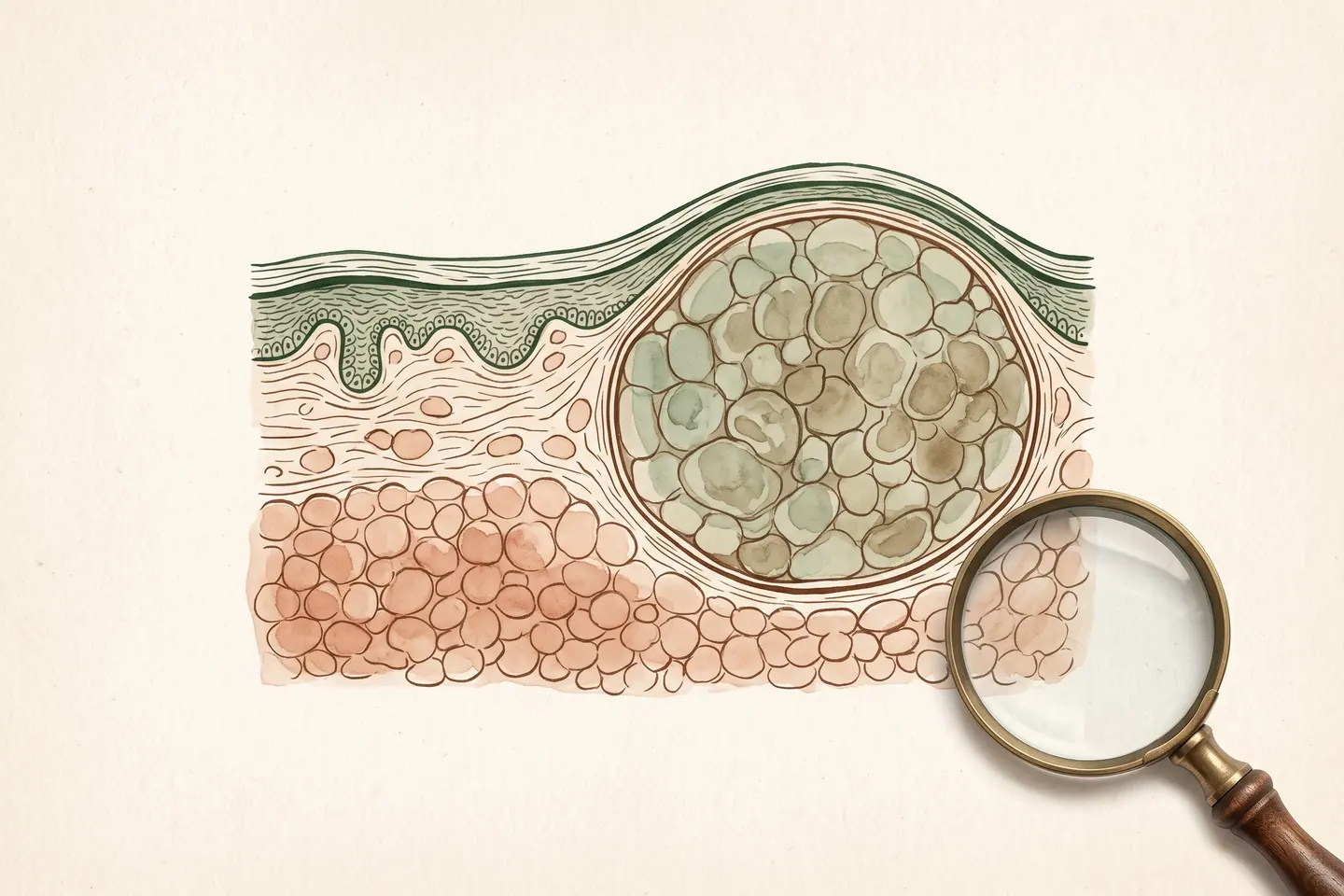
- Lipohypertrophy. The insulin literature describes lipohypertrophy as a firmer, slower-building accumulation of fat cells and fibrin at a site injected repeatedly over time [5]. It takes weeks or months to develop, not minutes.
- An inflammatory nodule. A hard, painful, or hot nodule develops over days rather than minutes and does not fit the pattern of ordinary tissue thickening. It is a reaction to what was injected or how it was prepared, not a rotation problem.
What is lipohypertrophy?
Lipohypertrophy is a structural change under the skin: fat cells and fibrin accumulate at a site that has absorbed repeated needle trauma, producing a rubbery, thickened pocket of tissue [5]. It is not a bruise or a temporary welt.
Lipohypertrophy grows gradually and is often flat, so standard inspection and palpation miss a meaningful fraction of cases. Ultrasound picks up lesions that hands and eyes do not [10][5].
The thickened tissue differs from normal subcutaneous fat in ways that matter for anyone depositing a drug into it. Altered vascularization and fibrous architecture change how a depot drains into circulation, not just how the skin looks.
Treating rotation as hygiene advice, aimed at preventing a visible lump, misses the point. The lump is a late-stage marker, and the absorption problem can start before the marker does.
How common is lipohypertrophy in people who inject insulin?
Lipohypertrophy affects roughly 42% to 59% of long-term insulin users, depending on the population and how it is detected [1][4][5].
| Study | Population | Lipohypertrophy prevalence |
|---|---|---|
| Meta-analysis of 45 studies, over 26,000 participants [1] | Insulin-treated patients | 41.8% overall, roughly 35% to 45% by region |
| Systematic review of ultrasound detection, which is more sensitive than palpation alone [4] | Insulin users | 14.5% to 88% across studies, median around 57% |
| Combined clinical and ultrasound exam [5] | Elderly patients with type 2 diabetes | 59% |
| Pediatric and young-adult cohort [3] | Children, adolescents and young adults with type 1 diabetes | 45.2% |
The evidence for lipohypertrophy is substantial, and it is entirely insulin-specific.
Does rotating injection sites prevent lipohypertrophy?
Incorrect site rotation is the strongest measured risk factor for lipohypertrophy in insulin users, with a pooled odds ratio of 8.85 across 51 studies [2]. That figure is by far the largest single risk factor identified, ahead of needle reuse (3.20), more than five years of insulin therapy (2.62), and more than two daily injections (2.27) [2].
The pediatric and young-adult cohort points the same way: improper site rotation was more common in the group that developed lipohypertrophy [3]. Large meta-analyses make this strong evidence that rotation matters for lipohypertrophy specifically.
Age itself is not a strong independent driver. In the elderly cohort of 1,227 people behind the 59% figure, prevalence did not track cleanly with age class, although structural skin changes with aging are plausible on other grounds [5].
Why does site rotation reduce lipohypertrophy?
Site rotation reduces the cumulative trauma that any single patch of tissue absorbs. In the plausible mechanism, repeated needle trauma and repeated deposition of material into the same small volume of subcutaneous tissue drive local fibrosis and fat cell change over time [5][6].
Spreading injections across a wider area, and not returning to the same exact point on consecutive uses, lowers that cumulative load. The injection technique literature describes rotation as a distribution strategy, not a treatment for lumps that have already formed.
How does lipohypertrophy change drug absorption?
Tissue with lipohypertrophy or lipoatrophy absorbs insulin more slowly and erratically, and that change has been linked to unpredictable blood glucose response [6][7]. Changed drug delivery is the reason lipohypertrophy gets studied beyond cosmetics.
A dermatology review noted that absorption from lipoatrophic areas is erratic, contributing to unpredictable blood glucose control in people who kept injecting into the same convenient, less painful spot [7]. A broader review of injection technique research found that site choice, rotation, and tissue condition all affect absorption kinetics and downstream glucose variability [6].
Tissue thickened by repeated trauma does not absorb the way healthy tissue does. The direction is toward slower, less predictable uptake, not faster uptake. Uptake also varies from one injection to the next: for someone injecting daily or near-daily, an unrotated site can silently shift the effective dose in either direction, well before a lump is noticeable [9].
The shift can happen in tissue that looks and feels normal. In the subclinical lipohypertrophy data, 19.9% of patients rotating well enough to avoid a palpable lump still showed lipohypertrophy on ultrasound, and they carried nearly tenfold higher odds of poor glycemic control [10].
Does insulin lipohypertrophy research apply to peptide injections?
Not directly: the prevalence, risk-factor and absorption findings on lipohypertrophy all come from insulin, injected daily to several times daily in relatively large volumes over years. Insulin also has its own local tissue effects beyond mechanical trauma. Lipoatrophy, tissue loss rather than buildup, has been linked to an immunological response to insulin itself [7].
Whether the same mechanism, at the same magnitude, applies to other injected peptides at different volumes and frequencies has not been established. Treating the insulin odds ratios as if they transfer directly to a different molecule is a reasonable extrapolation, not a demonstrated fact. The same molecule-by-molecule caution applies to how injection route changes peptide effects.
How should you rotate injection sites?
Rotate within one region: pick a region, map a grid of sites within it, and cycle through that grid systematically instead of hopping between anatomical zones. One region, cycled as a grid, keeps the injection-site variable as stable as it can be.
Generic advice says "rotate sites" and stops there, as if any rotation counts. Rotation has two separate jobs. The first is preventing visible lipohypertrophy, a lump you can find on exam, and incorrect rotation is its strongest single risk factor (pOR 8.85) [2]. The second is stabilizing absorption, and absorption variability can be present in tissue that looks and feels normal [10].
Preventing the lump and stabilizing absorption are not the same achievement. A rotation habit that succeeds at the first can still fail at the second if it introduces a new source of variance: switching anatomical regions. Guidance frames rotation as a systematic grid within a chosen region, not rotation across regions, and the FITTER recommendations organize technique around anatomy and physiology because different injection zones behave differently as tissue [11].
The insulin trials behind these findings did not compare absorption between, say, abdomen and glute in a head-to-head design, so they put no number on any rate difference between regions. What is defensible is the logic. Lipohypertrophic tissue is one known source of absorption variance, and hopping between zones adds a second, unmeasured one, which works against a predictable dose.
- Space consecutive injections. Insulin technique guidelines commonly suggest roughly a finger's width between consecutive injections. Treat that distance as a common clinical convention, not a study finding.
- Count needle reuse as a risk. Needle reuse is a secondary but real contributor to lipohypertrophy, with a pooled odds ratio of 3.20 [2]. The guide to needle sharpness and coring covers what reuse does to the needle and the vial.
When does an injection site lump need a clinician?
An injection site lump that grows warm, red, or increasingly painful over several days needs medical evaluation, not a change in injection spacing. Lipohypertrophy builds slowly and stays firm rather than hot.
The warm, red, painful pattern matches the inflammatory, sometimes scarring reactions documented after injection of poorly regulated or improperly prepared material [8]. A case series of intradermal injections of an unregulated biologic formulation documented persistent erythema, nodules, granulomatous inflammation, and scarring. Some cases required corticosteroids, laser therapy, or surgical removal [8].
What is still unknown about site rotation for peptide injections?
The core unknown is whether insulin's lipohypertrophy risk, and rotation's protective effect, carry over to peptides injected at smaller volumes, lower frequencies, or different depths.
- Infrequent, small-volume schedules. The insulin evidence does not cover weekly or biweekly small-volume injections. How many repeat uses of one small zone it takes before absorption starts to shift under those conditions is not established.
- Rotating across regions. Whether deliberately rotating across anatomical regions helps, hurts, or does nothing to absorption stability, compared with staying in one region, has not been tested directly in these trials. The case for staying regional is inference from anatomy and guidance structure, not a measured outcome [11].
- Silent tissue change. Subclinical, non-palpable tissue changes are documented for insulin [10]. Whether the same silent process applies at lower-volume, less-frequent dosing schedules remains an open question.
- Other contributors. Reconstitution quality, needle depth, and injection speed are plausible contributors to tissue reaction that get far less attention than rotation. The lipohypertrophy studies do not quantify their contribution relative to site rotation.
Sources
-
Famulla S, Hövelmann U, Fischer A (2016). Insulin Injection Into Lipohypertrophic Tissue: Blunted and More Variable Insulin Absorption and Action and Impaired Postprandial Glucose Control. Diabetes Care. PMID: 27411698. pubmed.ncbi.nlm.nih.gov/27411698
-
Luo D, Shi Y, Zhu M (2021). Subclinical lipohypertrophy: Easily ignored complications of insulin therapy. J Diabetes Complications. PMID: 33280982. pubmed.ncbi.nlm.nih.gov/33280982
-
Frid AH, Kreugel G, Grassi G (2016). New Insulin Delivery Recommendations. Mayo Clin Proc. PMID: 27594187. pubmed.ncbi.nlm.nih.gov/27594187
Last updated

Written by
Chemist and biochemist. Co-founder and author, The Peptide App.
Jay is a chemist, biochemist and entrepreneur whose work connects scientific research with consumer health products. He has held Chief Science Officer and product development leadership roles and previously served as Chief Revenue Officer at Minicircle.
Keep reading

Handling and product records
Needle length determines injection depth, not gauge
Needle length, not gauge, decides which tissue layer an injection reaches. Gauge measures tube diameter and has small, inconsistent effects on pain.

Handling and product records
Blunt needles core vial stoppers far more often than sharp ones
Blunt plastic needles cored 40.8% of vial stoppers versus 4.2% for sharp needles in one study. The data come from anesthesia practice, not peptide vials.
Compound evidence
Injection route matters for peptides, but effects vary by molecule
Route effects vary by molecule: glucagon peaked higher intramuscularly yet reached similar total exposure. Most peptides people inject lack human route data.
Profiles and tools

The Peptide App
Track protocols, doses, and reconstitution in one place.
Save your calculations, set reminders, log doses, and keep outcome notes — free to start.
 or scan the QR code →