
Vosoritide sped growth 1.6 cm/year in children with achondroplasia
Vosoritide at 15 µg/kg raised growth velocity 1.6 cm/year over placebo in a Phase 3 trial in children with achondroplasia. Final adult height is unmeasured.

By Jay Spall, chemist and biochemist
Disclosure: Jay is a co-founder of The Peptide App. This review discusses the studies cited below; it is not a comprehensive live trial registry or treatment recommendation. Development and regulatory status can change. The app’s tools organize records and arithmetic and do not validate a research product.
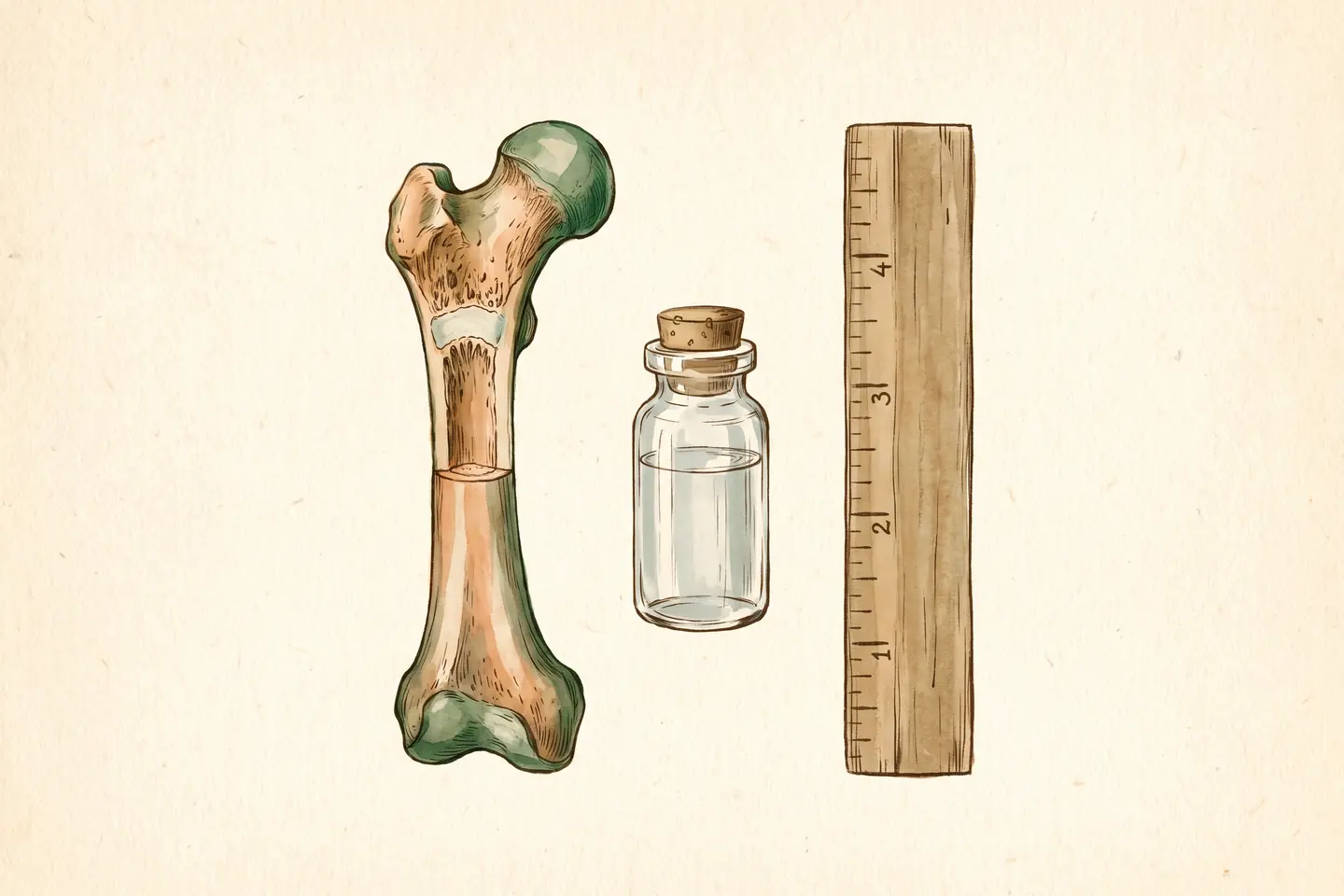
On this page
- How does vosoritide work?
- Where does vosoritide's 1.6 cm/year figure come from?
- Does vosoritide keep working after the first year?
- Does the vosoritide dose matter?
- Can vosoritide make an adult taller?
- How is vosoritide given?
- What side effects does vosoritide cause?
- What is still unknown about vosoritide?
- Sources
Key facts
| Question | Direct answer |
|---|---|
| Can vosoritide make an adult taller? | No. Every vosoritide trial enrolled children with open growth plates, and the mechanism requires active endochondral ossification, which stops at epiphyseal fusion [2][6]. |
| Where does the 1.6 cm/year figure come from? | One 52-week, randomized, double-blind, placebo-controlled Phase 3 trial in children aged 5 to under 18 with achondroplasia, comparing annualized growth velocity on vosoritide with placebo [2]. |
| Does vosoritide's effect fade with continued dosing? | No. Open-label extension data through 2 and 3 years show growth velocity holding steady or slightly rising, with a cumulative 3-year height advantage of about 5.75 cm versus an untreated comparator group [4][5]. |
| Does vosoritide increase final adult height? | Unknown. Trial cohorts have not yet reached skeletal maturity, so final-adult-height benefit is an extrapolation, not a measured outcome [4]. |
| Does vosoritide reduce spinal stenosis, sleep apnea, or surgery? | No cited trial has shown it. One small study found significant height gains with no improvement in muscle function or walking distance [7]. |
| Does the vosoritide dose matter? | Yes. Phase 2 tested 2.5 to 30 µg/kg before settling on 15 µg/kg for Phase 3, so the headline number describes one specific dose [6]. |
7 sources cited. View sources
How does vosoritide work?
Vosoritide is a modified analog of C-type natriuretic peptide (CNP), engineered for a longer half-life than the native hormone. Vosoritide binds NPR-B receptors in growth plate cartilage, and that signaling opposes an overactive FGFR3 pathway, the pathway that carries the gain-of-function mutation responsible for achondroplasia [2][6].
The practical effect is that vosoritide partially restores endochondral ossification, the process by which growth plate cartilage converts to bone and the long bones lengthen. That is a description of what vosoritide does at the receptor level. Vosoritide does not correct the underlying genetic mutation.
Where does vosoritide's 1.6 cm/year figure come from?
The 1.6 cm/year figure comes from one multicenter, randomized, double-blind Phase 3 trial in children aged 5 to under 18 [2]. The trial compared daily subcutaneous vosoritide (15 µg/kg) with placebo over 52 weeks, with annualized growth velocity as the primary endpoint [2].
A systematic review and meta-analysis pooling this and related trials confirms statistically significant improvement in annualized growth velocity, height Z-score, and standing height compared with placebo across the available randomized data [1]. Annualized growth velocity is a real, reproducible surrogate measurement. It is not total lifetime height gained: the trial measured one treatment year in one age band, not the entire growth period.
Does vosoritide keep working after the first year?
Vosoritide's growth effect has held steady or slightly increased through 3 years of open-label extension data, with no sign of fading [4][5]. In the 2-year extension of the pivotal trial, annualized growth velocity in continuously treated children rose from a baseline of 4.26 cm/year to 5.39 cm/year at week 52 and 5.52 cm/year at week 104 [5]. Children who crossed over from placebo showed a similar rise once they started active drug [5].
A longer extension analysis compared treated children with an external untreated comparator group from the CLARITY natural-history study. Treated children gained a cumulative additional 5.75 cm (95% CI 4.93-6.57) over 3 years, and the annualized velocity difference between treated and untreated children ran 1.84 cm/year in boys and 1.44 cm/year in girls across ages 6-16 [4].
Separate Phase 2 data in infants and children under 5 show a similar direction of effect on height Z-score, extending the evidence to a younger age range [3].
Does the vosoritide dose matter?
Yes: the widely quoted vosoritide growth figure describes one particular dose in one particular age range, not an inherent property of vosoritide as a class. The Phase 2 dose-finding study tested 2.5, 7.5, 15.0, and 30.0 µg/kg cohorts before converging on 15 µg/kg, the dose used in every subsequent pivotal trial [6]. Most secondary sources report the figure without the dose attached, which strips out information a careful reader needs.
Can vosoritide make an adult taller?
Vosoritide has no described way to make an adult taller: its mechanism requires active endochondral ossification, which stops at epiphyseal fusion, and every trial enrolled children with open growth plates [2][6]. Because the mechanism runs through active growth plate cartilage, no described pathway exists by which vosoritide would act once those plates have fused.
Whether treated children become taller adults is also unmeasured. No treated cohort has yet completed growth to skeletal maturity, so every persistence figure so far is an interim measurement, however encouraging, and a final-height benefit is an extrapolation [4]. For a peptide used in a different childhood growth disorder, see the mecasermin and Laron syndrome review.
How is vosoritide given?
Vosoritide is a once-daily subcutaneous injection that caregivers self-administer at home after training [3][6]. The dose is 15 µg/kg/day in children roughly 2 years and older, with a higher weight-based dose used in the youngest infant cohorts studied [3][6]. The guide to recording a prescribed plan and its outcomes covers tracking a daily regimen like this one.
What side effects does vosoritide cause?
Vosoritide's adverse events in the Phase 2 cohorts were mainly injection-site reactions and transient drops in blood pressure [1][6]. Adverse events occurred in all 35 patients across the Phase 2 dose-finding and extension cohorts, though the meta-analysis characterizes the overall safety profile as acceptable relative to benefit [1][6]. The injection-site side of daily subcutaneous dosing is covered in injection site lumps and why rotation matters.
What is still unknown about vosoritide?
Vosoritide's open questions are final adult height, complications, and function, and the current randomized and extension data do not resolve them [4][7].
- Final adult height. No treated cohort has reached skeletal maturity, so final-adult-height benefit is not yet a measured outcome [4].
- Complications. No cited trial establishes that added height changes the complications that make achondroplasia medically significant: spinal stenosis, sleep apnea, or orthopedic surgery burden.
- Muscle function and mobility. A small retrospective observational study of children on long-term vosoritide found significant height-Z-score gains over 36 months but no significant change in muscle function or 6-minute walking distance z-scores [7]. A moved growth biomarker does not automatically carry a functional benefit; growth hormone's effects on body composition versus strength raise the same issue.
- Treatment goals. Achondroplasia and broader short-stature communities have asked whether height normalization is the right treatment goal at all, a framing question the trial data cannot answer either way.
Sources
Last updated

Written by
Chemist and biochemist. Co-founder and author, The Peptide App.
Jay is a chemist, biochemist and entrepreneur whose work connects scientific research with consumer health products. He has held Chief Science Officer and product development leadership roles and previously served as Chief Revenue Officer at Minicircle.
Keep reading
Compound evidence
Growth hormone added lean mass in trials while strength stayed flat
Growth hormone added about 2.1 kg of lean mass in trials of healthy young adults, but strength stayed flat. Scans count the fluid it retains as lean mass.
Compound evidence
Mecasermin is approved for severe primary IGF-1 deficiency in children
Approved for severe primary IGF-1 deficiency in children, mecasermin raised height velocity in open-label series. Its safety record does not cover IGF-1 LR3.
Handling and product records
Poor site rotation is the top risk factor for insulin injection lumps
Lipohypertrophy affects about 42% to 59% of long-term insulin users, and poor rotation is its top risk factor. The data come from insulin, not other peptides.
Profiles and tools

The Peptide App
Track protocols, doses, and reconstitution in one place.
Save your calculations, set reminders, log doses, and keep outcome notes — free to start.
 or scan the QR code →