
Intranasal insulin matched placebo on cognition in five pooled trials
Intranasal insulin matched placebo on cognition and daily function across five pooled trials in MCI or Alzheimer's. A device switch clouds the largest trial.

By Jay Spall, chemist and biochemist
Disclosure: Jay is a co-founder of The Peptide App. This review discusses the studies cited below; it is not a comprehensive live trial registry or treatment recommendation. Development and regulatory status can change. The app’s tools organize records and arithmetic and do not validate a research product.
On this page
- Why would intranasal insulin help memory?
- What did the early intranasal insulin trials find?
- What does the pooled evidence on intranasal insulin show?
- Why does the delivery device matter for intranasal insulin?
- Did any SNIFF participants benefit from intranasal insulin?
- What doses of intranasal insulin have trials tested?
- Does intranasal insulin help older adults after surgery?
- Is intranasal insulin safe?
- Can an ordinary nasal spray deliver insulin like the trial devices?
- What is still unknown about intranasal insulin?
- Sources
Key facts
| Question | Direct answer |
|---|---|
| Does intranasal insulin improve memory in MCI or early Alzheimer's disease? | Not shown, and not disproven. Pooled data from five randomized trials show no significant effect on cognitive or functional scores [1], but a mid-study equipment change compromised the largest trial's primary comparison, so "no effect" and "wrong equipment" cannot yet be told apart. |
| What happened in the SNIFF trial? | SNIFF randomized 289 adults with MCI or Alzheimer's dementia to 40 IU of intranasal insulin or placebo, then switched delivery devices after roughly the first 49 participants, from an electronic atomizer to a simpler mechanical nasal spray [3]. |
| Did any part of SNIFF show a benefit? | Only in a post-hoc subgroup. Participants on the original device showed altered cerebrospinal fluid inflammation markers and a different progression pattern than placebo [6], which is not the trial's prespecified primary result. |
| Do the early positive trials hold up? | As a narrow signal. Early randomized trials reported improved story recall, concentrated mainly in APOE4-negative participants, with no effect on most other cognitive tests [2]. |
| Is a drugstore insulin nasal spray the same as what was tested? | No. Every positive signal traces to purpose-built hardware designed to reach the upper nasal cavity or olfactory region, and no study shows an ordinary nasal spray bottle reproduces that engineering [3][9]. |
| Is intranasal insulin safe in these trials? | Adverse events were generally mild across Alzheimer's, MCI, and unrelated surgical populations, in trials whose durations ranged widely, from four weeks to eighteen months [3][4][7]. |
9 sources cited. View sources
Why would intranasal insulin help memory?
Intranasal insulin aims to restore brain insulin signaling, which researchers describe as disrupted in Alzheimer's disease, resembling a localized, brain-specific insulin resistance [1]. The pattern is sometimes shorthanded as "type 3 diabetes" [1]. The premise is real and reasonably well supported.
Insulin receptors are dense in the hippocampus and cortex, the regions central to memory encoding and retrieval. Restoring local insulin signaling there is a mechanistically plausible target.
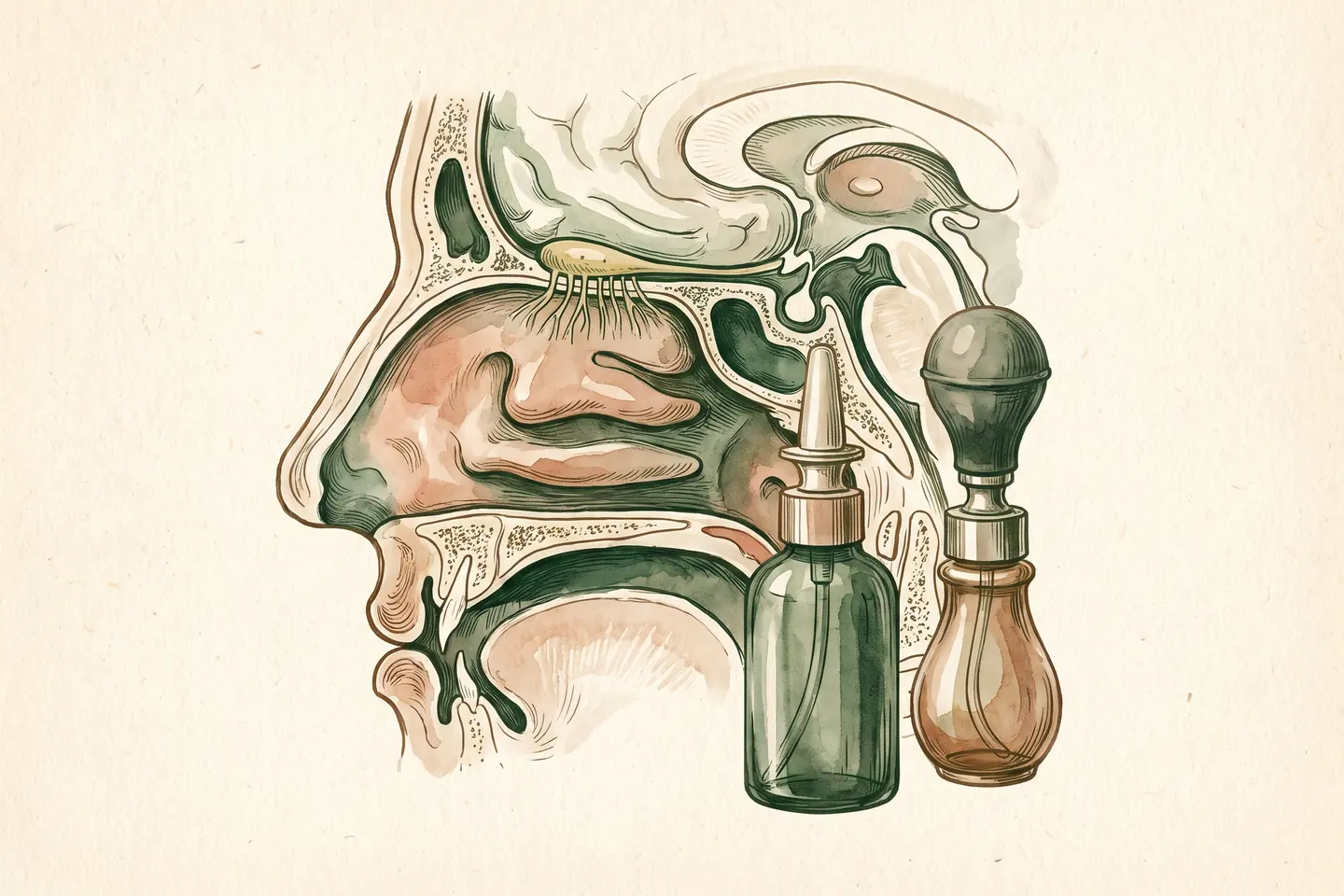
Intranasal delivery is theorized to carry insulin along olfactory and perivascular pathways toward the brain while limiting the drop in blood glucose that intravenous or subcutaneous insulin would cause [1]. A separate explainer covers how nasal peptides reach the brain.
The biology is the plausible part. Whether a given nasal device deposits meaningful insulin at those sites, instead of letting it be swallowed or cleared by mucociliary action, is an engineering question. Popular coverage keeps collapsing that engineering question into the biology question.
What did the early intranasal insulin trials find?
The earliest intranasal insulin trials found improved story recall (delayed logical memory), often only in participants who did not carry the APOE4 allele [2]. Most other cognitive domains tested showed no significant change [2].
Those trials were small, single-site, and short. Their finding comes from randomized, placebo-controlled work, so it is a real result. It is also a single-domain, subgroup-flavored result from small samples, not a broad demonstration that intranasal insulin improves memory.
What does the pooled evidence on intranasal insulin show?
Intranasal insulin showed no significant cognitive or functional benefit over placebo in a 2026 meta-analysis of five randomized trials and 540 participants with MCI or Alzheimer's disease [1]. The systematic review reported three null results:
- Cognition. No significant difference on the ADAS-Cog13 cognitive scale (mean difference -1.09, 95% CI -4.89 to 2.71) [1].
- Daily function. No difference in functional ability on the ADCS-ADL (mean difference 0.06, 95% CI -0.33 to 0.45) [1].
- Amyloid. No significant change in cerebrospinal fluid amyloid-beta [1].
A separate 2019 meta-analysis reached a broadly similar, cautious verdict [8]. Pooled across everything published, intranasal insulin does not clear the bar for a confirmed cognitive benefit in MCI or Alzheimer's disease. The evidence grade changes, as it should, once the pooled data enter the picture. Most nootropic-adjacent coverage skips that headline result.
Why does the delivery device matter for intranasal insulin?
Device design largely determines how much intranasal insulin reaches the olfactory region, so a change in device is functionally a change in the dose delivered to the target tissue. Deposition pattern means how much drug reaches the upper nasal cavity and olfactory epithelium versus the lower nasal passages. The labeled dose on the vial can stay the same while the dose at the target changes.
SNIFF, the largest single study feeding every meta-analysis, changed devices partway through. The trial randomized 289 of 432 screened adults to 40 IU of insulin or placebo daily for a 12-month blinded phase [3]. Roughly the first 49 participants were dosed with one nasal delivery device, and the study then switched to a different, mechanically simpler device for the rest of the trial [3].
The switch is not a footnote about packaging. SNIFF is not cleanly one trial. It is closer to two smaller trials, dosed differently at the brain, stitched into one dataset.
Device dependence is not unique to SNIFF. A randomized trial of glulisine, a rapid-acting insulin analog, used yet another purpose-built system, the Impel NeuroPharma Precision Olfactory Delivery device, in 35 participants and found no significant cognitive difference from placebo [9]. Different molecule, different hardware, same null result. The glulisine trial supports treating device engineering as a real variable rather than an incidental detail.
Did any SNIFF participants benefit from intranasal insulin?
Only a post-hoc subgroup of SNIFF participants, those dosed with the original device, showed a signal: altered cerebrospinal fluid inflammatory markers and a different trajectory of decline than placebo [6].
The follow-up analysis of cerebrospinal fluid biomarkers was restricted to what it called "the cohort which showed benefit" [6]. The phrase describes a subgroup outcome, not the trial's primary, fully powered comparison. Findings from splits that were not prespecified carry a much weaker evidence grade than a primary endpoint.
What doses of intranasal insulin have trials tested?
Trial doses cluster around 40 IU of regular insulin, given once daily or in several doses a day [3][4]. SNIFF gave 40 IU daily [3].
A newer, shorter phase 2A/B trial gave 40 IU four times daily for four weeks, alongside empagliflozin, an oral diabetes drug [4]. The trial reported a similar safety profile across all arms and a modest rise in a cognitive composite score in the insulin group [4]. Its authors stated that a longer, larger trial is needed before drawing conclusions [4].
Does intranasal insulin help older adults after surgery?
Two small randomized trials in older surgical patients reported reduced delirium incidence and better early cognitive test scores after several days of intranasal insulin [5][7]. Those trials test short-term postoperative cognition, a different population and a different clinical question.
The surgical trials are not evidence about long-term memory in MCI or Alzheimer's disease.
Is intranasal insulin safe?
Intranasal insulin has produced generally mild adverse events across Alzheimer's, MCI, and unrelated surgical trial populations [3][4][7]. Trial durations vary widely, from four weeks to eighteen months [3][4][7].
The phase 2A/B trial found a safety profile similar across all arms [4]. The postoperative trials add to a broadly consistent mild-safety picture across trial types.
Can an ordinary nasal spray deliver insulin like the trial devices?
No study shows that an ordinary nasal spray bottle reproduces the purpose-built delivery hardware behind every positive intranasal insulin signal [3][9]. Those devices were designed to reach the upper nasal cavity or olfactory region [3][9].
Nobody has published evidence that off-device, DIY, or off-label nasal insulin replicates the deposition pattern of any trial device. That use is untested, not proven ineffective. Other nasal peptides have their own trial records, including nasal oxytocin and intranasal neuropeptide Y for PTSD.
What is still unknown about intranasal insulin?
The delivery hardware, not the underlying biology, is the unresolved variable in intranasal insulin research. Three questions remain:
- Device versus biology. No trial has compared the two SNIFF devices within one randomized design to isolate the device effect from the biological effect. SNIFF's split was a mid-trial necessity, not a planned comparison [3].
- Engineered delivery. Whether insulin that reaches the brain through a properly engineered nasal device improves memory remains open.
- Arbitrary products. Whether an arbitrary nasal insulin product improves memory is close to answered, and pooled data trend toward no [1].
Neither "it works" nor "it failed" is currently supportable.
Sources
-
Silva AMP, Gonçalves OR, Tudella GCN (2026). Intranasal insulin for mild cognitive impairment and Alzheimer's disease: A systematic review and meta-analysis of randomized controlled trials. Rev Neurol (Paris). pubmed.ncbi.nlm.nih.gov/41436338
-
Avgerinos KI, Kalaitzidis G, Malli A (2018). Intranasal insulin in Alzheimer's dementia or mild cognitive impairment: a systematic review. J Neurol. pubmed.ncbi.nlm.nih.gov/29392460
-
Craft S, Raman R, Chow TW (2020). Safety, Efficacy, and Feasibility of Intranasal Insulin for the Treatment of Mild Cognitive Impairment and Alzheimer Disease Dementia: A Randomized Clinical Trial. JAMA Neurol. pubmed.ncbi.nlm.nih.gov/32568367
-
Erichsen JM, Register TC, Sutphen C (2025). A phase 2A/B randomized trial of metabolic modulators intranasal insulin and empagliflozin for MCI and early AD. Alzheimers Dement. pubmed.ncbi.nlm.nih.gov/41057918
-
Sun M, Ruan X, Zhou Z (2024). Effect of intranasal insulin on perioperative cognitive function in older adults: a randomized, placebo-controlled, double-blind clinical trial. Age Ageing. pubmed.ncbi.nlm.nih.gov/39216470
-
Kellar D, Register T, Lockhart SN (2022). Intranasal insulin modulates cerebrospinal fluid markers of neuroinflammation in mild cognitive impairment and Alzheimer's disease: a randomized trial. Sci Rep. pubmed.ncbi.nlm.nih.gov/35079029
-
Mi Y, Wen O, Ge L (2023). Protective effect of intranasal insulin on postoperative cognitive dysfunction in elderly patients with metabolic syndrome undergoing noncardiac surgery: a randomized clinical trial. Aging Clin Exp Res. pubmed.ncbi.nlm.nih.gov/37993761
-
Lu J, Xu Z (2019). Efficacy of Intranasal Insulin in Improving Cognition in Mild Cognitive Impairment and Alzheimer Disease: A Systematic Review and Meta-analysis. Am J Ther. pubmed.ncbi.nlm.nih.gov/30648990
-
Rosenbloom M, Barclay TR, Kashyap B (2021). A Phase II, Single-Center, Randomized, Double-Blind, Placebo-Controlled Study of the Safety and Therapeutic Efficacy of Intranasal Glulisine in Amnestic Mild Cognitive Impairment and Probable Mild Alzheimer's Disease. Drugs Aging. pubmed.ncbi.nlm.nih.gov/33719017
Last updated

Written by
Chemist and biochemist. Co-founder and author, The Peptide App.
Jay is a chemist, biochemist and entrepreneur whose work connects scientific research with consumer health products. He has held Chief Science Officer and product development leadership roles and previously served as Chief Revenue Officer at Minicircle.
Keep reading
Compound evidence
Intranasal neuropeptide Y was well tolerated in a 26-person PTSD trial
Intranasal NPY was well tolerated in a 26-person PTSD trial. Higher doses were linked to a larger anxiety drop than placebo, a single-dose secondary outcome.

Compound evidence
Nasal oxytocin matched placebo on sexual function in three trials
Nasal oxytocin did no better than placebo for sexual desire, arousal or function in three trials. One couples trial found a modest rise in orgasm intensity.
Compound evidence
Nasal peptides can reach the brain via two narrow neural pathways
Nasal peptides can reach the brain along olfactory and trigeminal nerves, but slowly. Oxytocin took up to 75 minutes to rise in human cerebrospinal fluid.
Profiles and tools

The Peptide App
Track protocols, doses, and reconstitution in one place.
Save your calculations, set reminders, log doses, and keep outcome notes — free to start.
 or scan the QR code →