
Nasal peptides can reach the brain via two narrow neural pathways
Nasal peptides can reach the brain along olfactory and trigeminal nerves, but slowly. Oxytocin took up to 75 minutes to rise in human cerebrospinal fluid.

By Jay Spall, chemist and biochemist
Disclosure: Jay is a co-founder of The Peptide App. This review discusses the studies cited below; it is not a comprehensive live trial registry or treatment recommendation. Development and regulatory status can change. The app’s tools organize records and arithmetic and do not validate a research product.
On this page
- How do nasal peptides reach the brain?
- Why doesn't most of a nasal peptide dose reach the brain?
- Has nose-to-brain delivery been measured in living humans?
- How long does a nasal peptide take to reach the brain?
- Do all peptides reach the brain through the nose?
- Do nasal BPC-157, Semax and Selank reach the brain?
- What is still unknown about nose-to-brain peptide delivery?
- Sources
Key facts
| Question | Direct answer |
|---|---|
| Do nasal peptide sprays reach the brain at all? | Yes, by two anatomical routes. The olfactory and trigeminal nerve pathways can carry molecules from the nasal cavity into the central nervous system without crossing the blood-brain barrier [4][7]. The pathways exist; they do not mean most of the dose gets there. |
| Is nose-to-brain delivery a fast shortcut? | No. In living humans given oxytocin, cerebrospinal fluid (CSF) levels took up to 75 minutes to rise significantly, well after plasma peaked at 15 minutes [1]. The route is diffusion along nerve bundles and perivascular spaces, not an express lane. |
| Do BPC-157, Semax or Selank sprays reach the brain? | Unknown. None of the studies cited below reports human CSF or brain-tissue measurements for those peptides, so how much, if any, reaches the brain in people is not known. |
| What fraction of a nasal dose reaches the brain? | None of the studies cited below establishes a clean percentage, even for oxytocin. Plasma and CSF oxytocin concentrations did not correlate (r < 0.10), so a rise in blood levels says almost nothing about what happened in the brain [1]. |
| Why do people feel something after using these sprays? | Systemic absorption, the peptide entering general circulation and acting on the body like an injected or swallowed dose, is at least as plausible as brain-specific delivery. No dose-fraction data exist for most of these products. |
8 sources cited. View sources
How do nasal peptides reach the brain?
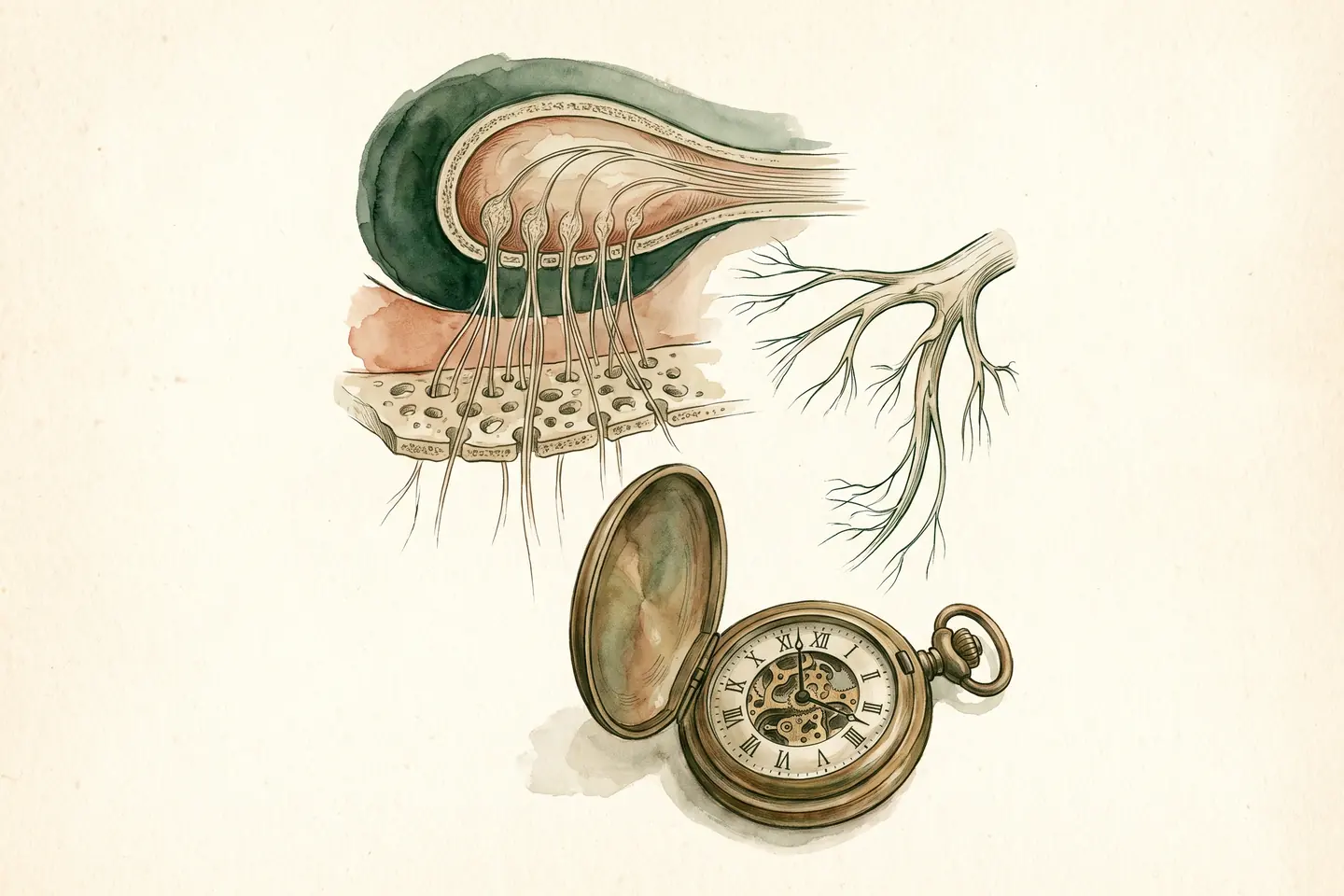
Nasal peptides can reach the central nervous system by two documented routes that bypass the blood-brain barrier: the olfactory pathway and the trigeminal pathway. The olfactory pathway runs along olfactory sensory neurons, whose endings sit in a small patch of epithelium high in the nasal cavity and whose axons project directly into the olfactory bulb. The trigeminal pathway runs along branches of the trigeminal nerve that innervate the rest of the nasal mucosa and enter the brainstem.
Reviews describe both routes consistently. Intranasal delivery can circumvent the blood-brain barrier "due to the special anatomy of the olfactory and trigeminal neural pathways that connect the nasal mucosa with the brain and the perivascular pathway within the CNS" [4]. Other reviews frame the same anatomy as a way to achieve "higher cerebrospinal fluid drug bioavailability compared to intravenous routes" for select molecules [6][7].
Why doesn't most of a nasal peptide dose reach the brain?
Most of a nasal spray lands on ordinary respiratory tissue that drains toward the throat and general circulation, not toward neurons, because the olfactory epithelium is a small fraction of the nasal surface. A pathway existing is not the same as a pathway being efficient. Only the olfactory epithelium connects directly to the olfactory bulb.
Three technical obstacles shrink the dose further. Mucociliary clearance sweeps material out of the nose within minutes, nasal enzymes degrade unprotected peptides, and only a small mucosal surface connects to neural tissue [3][7].
Device and formulation therefore matter, although none of the studies cited below supplies a human device-effect number. Reviews of intranasal engineering describe nanoparticle carriers, mucoadhesive formulations and delivery devices built to keep more of a dose in contact with olfactory tissue for longer, because without those modifications, clearance and swallowing dominate [3][5][6].
The mechanism reviews behind nose-to-brain claims draw largely on preclinical work, nanoparticle engineering and in vitro barrier models, not on measurements in unanesthetized people using a spray bottle at home [3][5][8]. That distinction matters more than almost anything else in nasal peptide delivery. The reviews explain why researchers are optimistic about the route and catalogue its obstacles [3][5][6][7][8].
Has nose-to-brain delivery been measured in living humans?
Yes, for oxytocin: a randomized study gave healthy adults intranasal oxytocin or placebo and found oxytocin rose significantly in both plasma and cerebrospinal fluid [1]. The study sampled blood and CSF over time, and its result is real, useful evidence that the nose-to-brain route can function in humans [1].
Direct measurement of brain or CSF exposure in a living human is the highest grade of evidence for nasal delivery, because it is the evidence that answers whether a spray reaches the brain. What nasal oxytocin trials show covers whether that exposure translates into clinical effects.
How long does a nasal peptide take to reach the brain?
In the human oxytocin study, cerebrospinal fluid levels took up to 75 minutes to reach a significant increase, while plasma peaked at 15 minutes and fell by 75 minutes [1]. Those kinetics undercut the "fast bypass" story. The route is diffusion along nerve bundles and perivascular spaces, not an express lane.
Plasma and CSF concentrations were essentially uncorrelated (r < 0.10) [1]. Blood levels and brain-fluid levels moved on different timelines and did not track each other, so central exposure cannot be inferred from how much of a molecule shows up in blood.
Any product claim of rapid cognitive or mood effects "straight to the brain" within minutes is unsupported by the kinetics measured in that study.
Do all peptides reach the brain through the nose?
Nose-to-brain delivery is not a universal peptide property: in a mouse study of five radiolabeled incretin-pathway peptides given intranasally, only three achieved widespread brain distribution [2]. The three were exenatide, dulaglutide and a designed dual agonist called DA4-JC; the two others did not perform as well [2].
The mouse study shows the route is real in an animal model and, just as important, that it is molecule-specific. It is the clearest illustration that "it's a peptide, so it goes nose-to-brain" is not a valid inference [2]. Whether a given molecule reaches the brain intranasally depends on its size, charge, stability against nasal enzymes and other specific properties, not on the fact that it was sprayed into a nose.
Do nasal BPC-157, Semax and Selank reach the brain?
None of the studies cited below reports a human cerebrospinal fluid or brain-tissue measurement for BPC-157, Semax or Selank, so whether nasal doses reach the brain in people is unknown. These compounded peptide sprays come up in casual conversation, clinics and podcasts, and the missing data are a real evidence gap, not a minor omission.
Without that data, three explanations for a subjective effect are equally live: central nervous system delivery via the olfactory or trigeminal route, ordinary systemic absorption acting on peripheral or blood-brain-barrier-permeable targets, or a placebo response. None of them has been paired with the randomized, CSF-sampling design used for oxytocin [1].
The human outcome data for each peptide are covered separately in Semax's cognitive evidence, Selank's anxiety trials and BPC-157's human studies.
What is still unknown about nose-to-brain peptide delivery?
The open questions sit between the anatomy and the consumer spray bottle:
- Dose fraction. None of the studies cited below supplies a human pharmacokinetic number for what fraction of an ordinary nasal spray dose, delivered the way a person uses one, ends up in brain tissue for the peptides sold in consumer sprays.
- Dose and technique. For BPC-157, Semax, Selank or any similar peptide, the dose, spray technique or formulation needed to reproduce even the modest CSF increases oxytocin showed is unknown.
- Delivery technology. Preclinical and engineering research is trying to close the gap with nanoparticle carriers and better-characterized delivery devices [3][5][6][8]. That work is not yet evidence about what a consumer spray does in a person's brain today.
Sources
Last updated

Written by
Chemist and biochemist. Co-founder and author, The Peptide App.
Jay is a chemist, biochemist and entrepreneur whose work connects scientific research with consumer health products. He has held Chief Science Officer and product development leadership roles and previously served as Chief Revenue Officer at Minicircle.
Keep reading

Compound evidence
Nasal oxytocin matched placebo on sexual function in three trials
Nasal oxytocin did no better than placebo for sexual desire, arousal or function in three trials. One couples trial found a modest rise in orgasm intensity.
Compound evidence
Selank matched a benzodiazepine for anxiety in a 62-patient trial
Selank matched the benzodiazepine medazepam on anxiety scales in a 62-patient Russian trial. The trial had no placebo arm and has no international replication.
Compound evidence
Semax sped neurological recovery in open-label Russian stroke trials
Semax sped neurological recovery in open-label Russian stroke trials. Its one healthy-adult study enrolled 20 men with no placebo arm or blinding.
Profiles and tools

The Peptide App
Track protocols, doses, and reconstitution in one place.
Save your calculations, set reminders, log doses, and keep outcome notes — free to start.
 or scan the QR code →