
DSIP's best human results are in alcohol and opiate withdrawal
DSIP showed statistically weak sleep effects in a controlled trial of 16 insomniacs. Its stronger withdrawal signal comes from uncontrolled trials.

By Jay Spall, chemist and biochemist
Disclosure: Jay is a co-founder of The Peptide App. This review discusses the studies cited below; it is not a comprehensive live trial registry or treatment recommendation. Development and regulatory status can change. The app’s tools organize records and arithmetic and do not validate a research product.
On this page
Key facts
| Question | Direct answer |
|---|---|
| Does DSIP reliably increase deep (delta wave) sleep in humans? | No. The name comes from a 1977 rabbit study [1]. A properly controlled human trial found statistically weak sleep effects, and its authors declined to call the result clinically meaningful [5]. |
| What is the strongest human evidence for DSIP? | Uncontrolled open-label trials in alcohol and opiate withdrawal, where large percentages of patients improved [3][4]. With no control group, expectation effects and the withdrawal process resolving on its own cannot be ruled out. |
| What evidence grade does DSIP deserve? | D, limited: one small RCT with a weak result, two open-label trials with no placebo arm, and animal work from the 1970s-80s. Nothing has been replicated in decades. |
| Is DSIP's receptor mechanism known? | No. A 1984 review flagged the receptor target as unresolved [2], and nothing since has settled it. |
| Is the DSIP people inject today the same thing that was studied? | Unknown. The trials used IV peptide of presumably verified identity. Today's product is self-sourced, injected subcutaneously or used nasally, sold research-use-only, and has no independent purity or identity testing. |
| Should someone use DSIP as a sleep aid? | The data do not support that use well. DSIP's best-supported signal is stress-axis and withdrawal-related, not sleep architecture. |
5 sources cited. View sources
Where does the name delta sleep-inducing peptide come from?
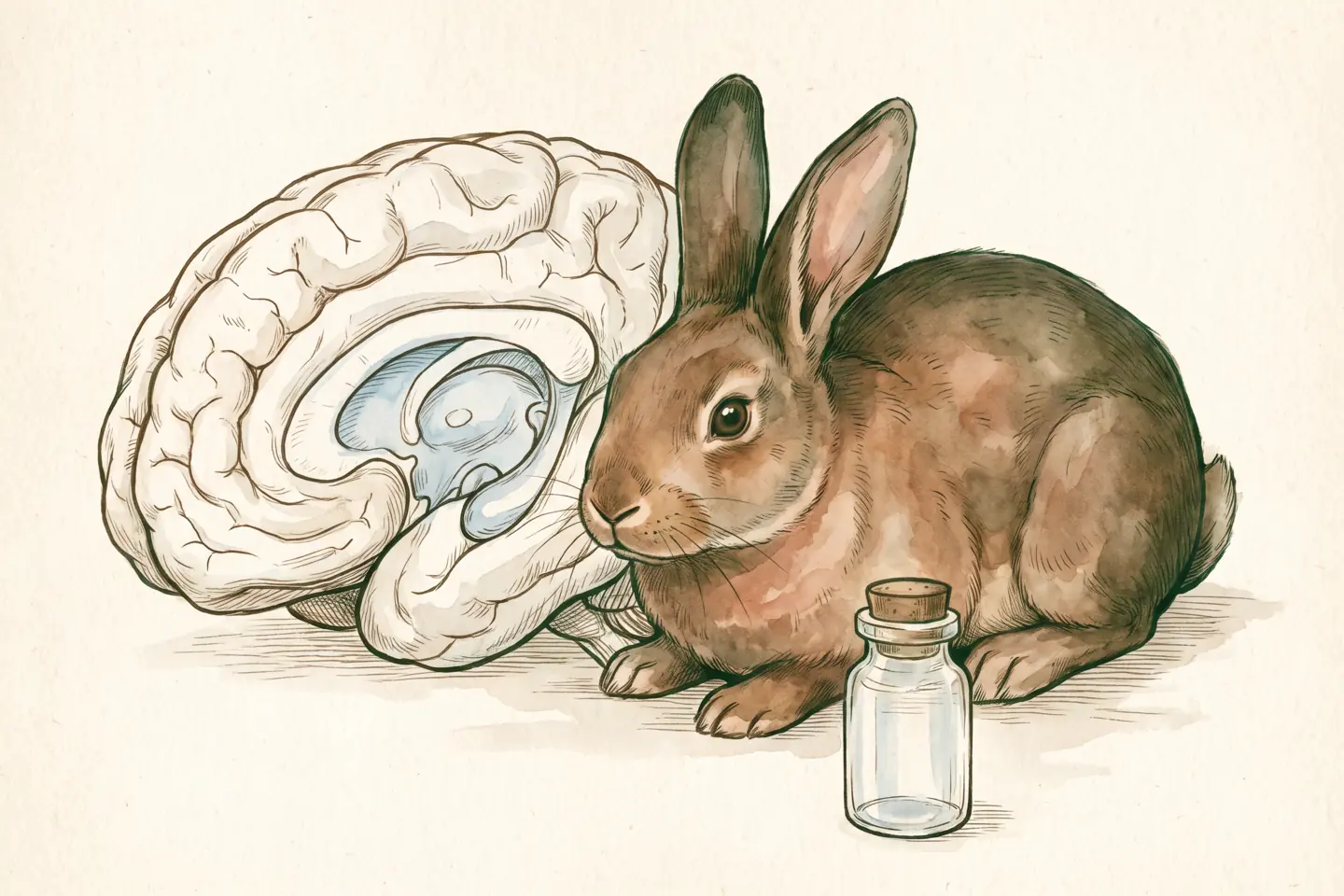
DSIP's name comes from a 1977 rabbit study, not from human trials [1]. "Delta sleep-inducing peptide" is a description assigned at the moment of discovery, not a conclusion reached after decades of confirmatory trials.
In 1977, Schoenenberger and colleagues isolated a nonapeptide from rabbit brain perfusate. Among nine candidate peptides tested, it was the one that specifically increased delta and spindle EEG activity when infused into rabbit brain ventricles [1].
The rabbit study is solid 1970s neurochemistry: a peptide sequence, a bioassay, and a specific effect in an animal model. It is not a human clinical finding. It also predates essentially all the mechanistic work that would normally come before assigning a peptide a functional name with confidence.
How does DSIP work?
DSIP's receptor has never been identified, and its mechanism remains unresolved. A 1984 review that surveyed the DSIP literature across rabbits, rats, mice, cats, and humans described a strikingly broad pharmacology: effects on neurotransmitter systems, circadian timing, hormone secretion, and withdrawal biology. The review explicitly noted that the receptor mechanism remained unresolved even after years of study [2].
The same review found that the sleep effect was not consistent across species. In cats, DSIP affected REM sleep more than delta sleep [2]. A peptide whose foundational literature shows species-dependent, mechanistically unexplained effects is not a settled sleep-architecture agent. DSIP is an interesting molecule with an open question at its center.
Does DSIP improve sleep in humans?
DSIP produced statistically weak sleep benefits in a controlled trial of 16 chronic insomniacs, and the authors declined to call them clinically meaningful [5]. Bes and colleagues ran the randomized, double-blind, placebo-controlled trial in 1992, giving IV DSIP (25 nmol/kg) or placebo in a matched-pairs design.
Sleep efficiency improved and sleep latency shortened relative to placebo, but the effects were statistically weak. The authors noted that the result may have been confounded by an incidental change in the placebo group's sleep during the study. Their conclusion: short-term DSIP treatment is not likely to provide major therapeutic benefit for chronic insomnia [5].
That trial is the only controlled human sleep-EEG trial cited below. Every claim that DSIP "increases delta sleep in humans" traces back either to this modest trial or to the 1977 rabbit ventricle study [1]. Forum summaries present both with the same confidence, as if an intraventricular infusion in a rabbit and a double-blind human RCT carry equal evidentiary weight. They do not, and the human data do not support strong claims about sleep architecture.
Does DSIP help with alcohol or opiate withdrawal?
DSIP's most striking human results come from two uncontrolled, open-label withdrawal trials by Dick and colleagues [3][4]. In the first, IV DSIP given as the sole treatment produced a beneficial effect in 48 of 49 evaluable patients, with anxiety resolving within hours and no major side effects reported [3].
In the second, a larger cohort of 107 inpatients, marked improvement or resolution of withdrawal symptoms occurred in 97% of opiate-dependent and 87% of alcohol-dependent patients, though the opiate patients needed more injections [4]. Those numbers are the reason DSIP picked up an early reputation for withdrawal management.
Neither trial had a placebo or comparator arm. Withdrawal symptoms fluctuate, patients in a supervised setting often improve regardless of intervention, and expectation effects are substantial in withdrawal treatment research generally. Without a control group, "48 of 49 improved" shows that the treatment was not obviously harmful and that patients got better. It does not isolate DSIP as the cause.
No one has repeated these trials with a modern controlled design in the four decades since. The withdrawal work is a real, biologically plausible, historically consistent signal around HPA-axis and stress modulation, sitting on a foundation no one has followed up with the kind of trial that would establish it.
How strong is the DSIP evidence overall?
DSIP's evidence grade is D, limited. The grade rests on one small human RCT with a statistically weak result, two open-label withdrawal trials with no placebo arm, and animal work from the 1970s-80s. Nothing has been replicated in decades.
What DSIP dose did the studies use?
The human DSIP trials cited below used IV administration at 25 nmol/kg, a dose calculated by body weight and delivered directly into the bloodstream under clinical supervision [3][4][5]. Forum protocols typically describe 100 to 300 mcg subcutaneous before bed, and none of the cited human trials used that route or amount.
Subcutaneous self-injection or intranasal use of an unverified research-use-only peptide is a different pharmacokinetic scenario entirely. None of the cited studies shows whether those routes achieve exposure comparable to IV dosing, let alone a comparable effect. Why injection route matters for peptides covers how route changes exposure molecule by molecule.
Forum protocols sometimes stack DSIP with growth-hormone-releasing peptides for a combined "sleep and recovery" effect. The evidence on those combinations is covered in DSIP-secretagogue sleep stacks lack clinical trial evidence.
Is DSIP safe?
Long-term DSIP safety in humans has not been studied. The clinical trials reported minimal adverse effects, but they were short, supervised, and used pharmaceutical-grade material of known identity.
Real-world users report headache, daytime grogginess or altered sleep patterns, injection-site irritation, and a notably high rate of no effect at all. Sourcing adds a variable the original researchers never had to manage. Research-chemical vendors selling DSIP are not required to verify peptide identity, purity, or concentration, so nothing guarantees that the product a person injects matches the labeled dose, or even the labeled molecule.
What is still unknown about DSIP?
Four questions about DSIP have no answer:
- Receptor. The receptor mechanism is unresolved [2].
- Brain entry. None of the cited studies directly tested whether subcutaneous or intranasal DSIP crosses into the central nervous system in meaningful amounts at self-administered doses. How nasal peptides reach the brain covers the intranasal route.
- Withdrawal. Whether the withdrawal findings would survive a placebo-controlled replication is unknown, because that replication has never been run.
- Sleep. Whether any sleep benefit exists beyond the weak, possibly confounded signal in the 16-person 1992 trial is unknown.
DSIP is a real, well-characterized peptide whose name oversold its mechanism from the day it was coined. Its human sleep-EEG record is thin and unconvincing, its stress and withdrawal signal is more interesting but uncontrolled, and today's self-administration adds sourcing and dosing uncertainties the original human trials never faced.
Sources
Last updated

Written by
Chemist and biochemist. Co-founder and author, The Peptide App.
Jay is a chemist, biochemist and entrepreneur whose work connects scientific research with consumer health products. He has held Chief Science Officer and product development leadership roles and previously served as Chief Revenue Officer at Minicircle.
Keep reading

Combinations and evidence
DSIP sleep stacks rest on mixed DSIP trials and a real GH-sleep link
DSIP's small human sleep trials were inconsistent, though deep sleep and GH release are linked. No published human trial has tested DSIP with a GH secretagogue.
Compound evidence
Injection route matters for peptides, but effects vary by molecule
Route effects vary by molecule: glucagon peaked higher intramuscularly yet reached similar total exposure. Most peptides people inject lack human route data.
Compound evidence
Nasal peptides can reach the brain via two narrow neural pathways
Nasal peptides can reach the brain along olfactory and trigeminal nerves, but slowly. Oxytocin took up to 75 minutes to rise in human cerebrospinal fluid.
Profiles and tools

The Peptide App
Track protocols, doses, and reconstitution in one place.
Save your calculations, set reminders, log doses, and keep outcome notes — free to start.
 or scan the QR code →