
DSIP sleep stacks rest on mixed DSIP trials and a real GH-sleep link
DSIP's small human sleep trials were inconsistent, though deep sleep and GH release are linked. No published human trial has tested DSIP with a GH secretagogue.

By Jay Spall, chemist and biochemist
Disclosure: Jay is a co-founder of The Peptide App. This review discusses the studies cited below; it is not a comprehensive live trial registry or treatment recommendation. Development and regulatory status can change. The app’s tools organize records and arithmetic and do not validate a research product.

On this page
- What did DSIP's sleep trials show?
- Does a growth-hormone secretagogue improve sleep?
- Does stacking DSIP with a GH secretagogue make a stronger sleep protocol?
- Is melatonin a sedative in a DSIP sleep stack?
- What treatment has the strongest evidence for chronic insomnia?
- Does light therapy help insomnia?
- What is still unknown about DSIP sleep stacks?
- Sources
Key facts
| Question | Direct answer |
|---|---|
| Has a DSIP-plus-secretagogue sleep stack been tested in a trial? | No. No published human trial has combined delta sleep-inducing peptide with a growth-hormone secretagogue and measured sleep outcomes. |
| Is DSIP's own sleep evidence solid? | No. The human DSIP sleep literature is small, decades old, and inconsistent, and several trials failed to reproduce the sedative effect its name implies. |
| Do GH secretagogues have sleep data? | Not in the cited studies. Their inclusion rests on the well-established link between slow-wave sleep and GH pulsatility, not on a trial showing a secretagogue improves sleep quality. |
| What has strong randomized evidence for chronic insomnia? | CBT-i, a behavioral treatment, with sleep restriction and stimulus control as the components carrying the measurable effect [1][4][5]. |
| Does melatonin work as a sedative substitute? | No. Its effect is timing-dependent and modest, a circadian signal rather than a sedative mechanism. |
| Does combining weak evidence make a stronger protocol? | No. A stack inherits its weakest evidence, not the average, and adds unmeasured interaction risk on top. |
5 sources cited. View sources
What did DSIP's sleep trials show?
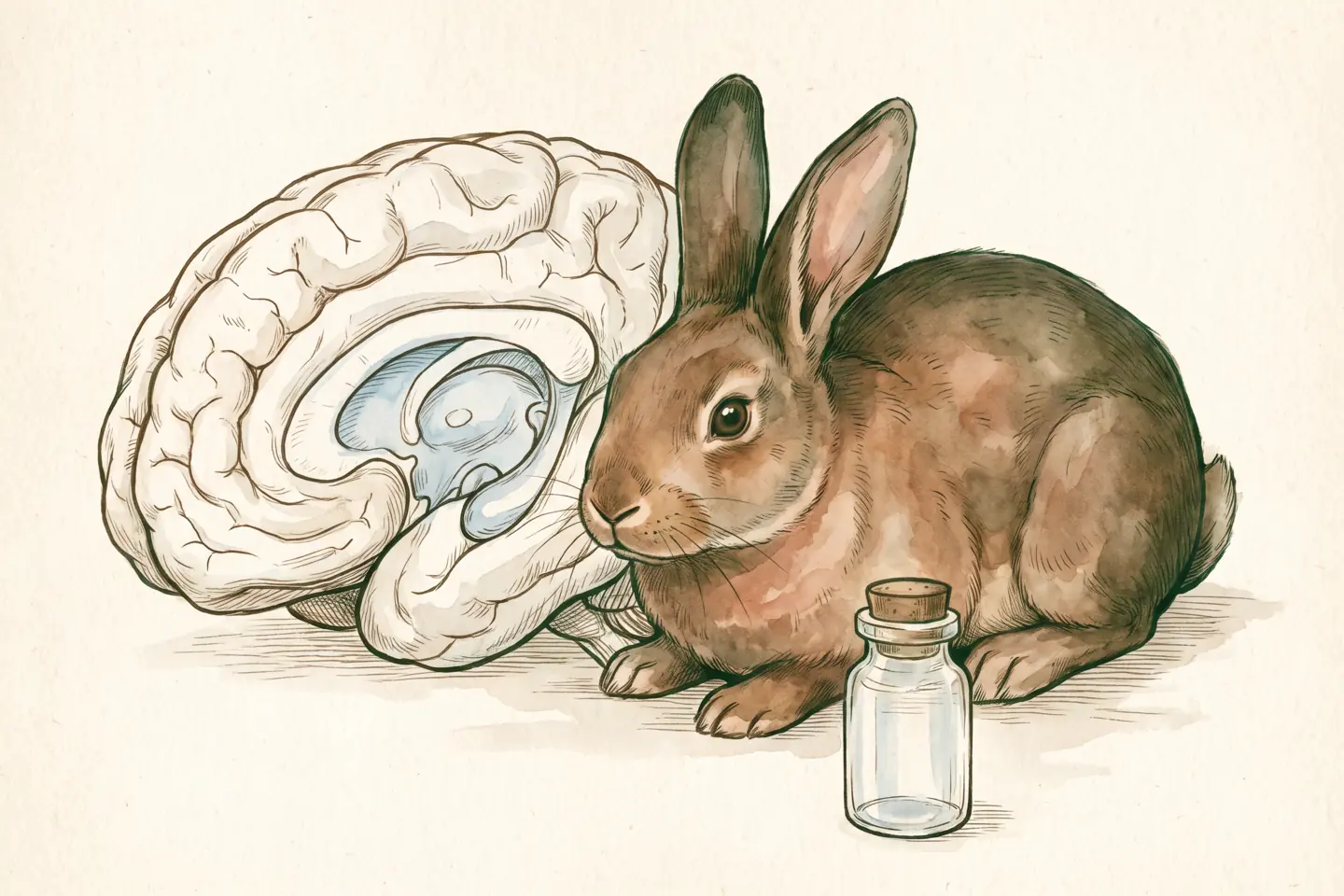
DSIP's human sleep trials are small, decades old, and inconsistent, and several failed to show a reliable improvement over placebo on objective sleep measures in chronic insomnia. DSIP was named in the 1970s for an effect seen in animal work: injecting it into rabbits appeared to induce a delta-wave sleep state. The name stuck before the human evidence caught up, and the human evidence never caught up.
The human trials ran in an era with looser standards for sleep-architecture measurement than current polysomnography studies use. Their failure to replicate is not a technicality; it is the central fact about the compound. DSIP anchors nearly every "sleep stack" sold, and its name promises more than its human trials delivered. A separate analysis covers whether DSIP increases deep sleep in humans.
Recent reviews of recovery peptides list DSIP as a candidate while explicitly conceding that clinical trials are lacking. At least one such review has an author with peptide-industry ties, a reason to discount its framing rather than amplify it.
Does a growth-hormone secretagogue improve sleep?
None of the cited studies shows that a growth-hormone secretagogue, taken as part of a sleep protocol, improves sleep onset, sleep maintenance, or sleep architecture in humans. Most protocols pair a GH secretagogue with DSIP on the logic that slow-wave sleep and GH release are linked, so a compound that increases GH pulsatility should, by extension, improve sleep. The relationship between deep sleep and GH secretion is real and well described physiologically.
The trial that would connect the two is the missing middle step in the stack's logic. Extrapolating from "GH rises during deep sleep" to "a GH secretagogue will deepen sleep" is a mechanistic guess, not a demonstrated effect. For a DSIP stack, the accurate label for the claim is plausible and untested.
Does stacking DSIP with a GH secretagogue make a stronger sleep protocol?
No published human trial has combined DSIP with a growth-hormone secretagogue and measured sleep outcomes. The stack is two separate literatures glued together by a protocol, not a tested intervention.
The instinct behind a stack is that two independently plausible mechanisms should compound, and that logic holds only if each component is independently validated. DSIP has old, inconsistent human trial data and a track record of failing to replicate its namesake effect. The GH secretagogue has no sleep-outcome trial data in the cited studies, only an adjacent physiological association.
Adding them together does not produce "medium-strength" evidence. The stack's evidence is set by its weakest link, DSIP's failed replication, plus an unmeasured interaction: both DSIP and GH secretagogues act on the somatotropic and HPA axes, and no trial has assessed whether combining agents that perturb the same neuroendocrine system blunts, cancels, or paradoxically worsens sleep architecture instead of improving it. Peptide marketing does not address that interaction because no one has studied it.
A person stacking these compounds runs an uncontrolled experiment on themselves, with no comparison group. The general case for evidence on every component of a stack applies in full to DSIP stacks.
Is melatonin a sedative in a DSIP sleep stack?
Melatonin is a circadian signal, not a sedative: its documented effect is timing-dependent and modest, shifting the signal for sleep onset rather than sedating the way a hypnotic drug does. Melatonin sometimes appears alongside DSIP or a secretagogue in these protocols, and treating it as an interchangeable "third peptide" misreads what it does.
A protocol that layers melatonin onto DSIP and a secretagogue as one more sedative combines three different mechanisms: a circadian-timing agent, a sedation claim, and a GH-axis claim. None of the three has been tested together. Of those three, only circadian timing has randomized trial support among the cited studies, and only by analogy, through light-timing trials [3].
What treatment has the strongest evidence for chronic insomnia?
Cognitive behavioral therapy for insomnia (CBT-i) has the strongest, most consistently replicated evidence for chronic insomnia in adults. That evidence is behavioral, not pharmacological or peptide-based. A 2015 meta-analysis of 20 randomized trials covering 1,162 participants found that CBT-i improved sleep onset latency by roughly 19 minutes at posttreatment compared with inactive controls, along with measurable gains in wake after sleep onset and sleep efficiency [1]. A larger 2024 component network meta-analysis, drawing on 241 trials and more than 31,000 participants, confirmed CBT-i's effect while working out which pieces of the multicomponent therapy carry the benefit [2].
Sleep restriction and stimulus control are the components carrying the measurable effect [1][4][5]. A separate network meta-analysis isolated sleep restriction therapy as the component with the clearest effect on self-reported insomnia severity, while several commonly bundled components, including psychoeducation and relaxation training, showed no significant independent effect [4].
The American Academy of Sleep Medicine's own systematic review and GRADE assessment, built from 124 qualifying studies out of 1,244 screened, reached the same conclusion: behavioral and psychological interventions are the evidence-graded first-line approach for chronic insomnia [5].
None of this evidence involves DSIP, secretagogues, or any injectable peptide. CBT-i is the benchmark a "sleep stack" should be compared against, and the gap in trial quality is not close.
Does light therapy help insomnia?
Bright light therapy reduced wake after sleep onset in a 2023 meta-analysis of 22 studies and 685 participants, with 13 studies pooled in the meta-analysis [3]. Morning exposure advanced the sleep-wake rhythm and evening exposure delayed it, but light therapy did not reliably change total sleep time or sleep latency [3].
Light timing has a smaller but real role supported by randomized trials. Its effect is a circadian-timing effect, similar in kind to what melatonin does, and like melatonin's, it is not a sedative effect.
What is still unknown about DSIP sleep stacks?
Whether DSIP or the DSIP-secretagogue combination improves human sleep is unknown:
- DSIP's sleep effect. Whether DSIP has any reliable sleep effect in a modern, adequately powered trial is unknown; the existing data predate current polysomnography standards.
- Secretagogues and sleep. Whether any GH secretagogue changes sleep quality independent of its GH effect is unknown.
- Interaction with melatonin. Whether combining a somatotropic-axis peptide with a circadian agent like melatonin produces any interaction, positive or negative, is unknown.
What is known sits at a comparatively strong evidence grade: behavioral treatment for chronic insomnia works, has been replicated across thousands of participants, and requires no guessing about receptor mechanisms that were never tested together [1][2][5].
Sources
-
Trauer JM, Qian MY, Doyle JS (2015). Cognitive Behavioral Therapy for Chronic Insomnia: A Systematic Review and Meta-analysis. Ann Intern Med. pubmed.ncbi.nlm.nih.gov/26054060
-
Furukawa Y, Sakata M, Yamamoto R (2024). Components and Delivery Formats of Cognitive Behavioral Therapy for Chronic Insomnia in Adults: A Systematic Review and Component Network Meta-Analysis. JAMA Psychiatry. pubmed.ncbi.nlm.nih.gov/38231522
-
Chambe J, Reynaud E, Maruani J (2023). Light therapy in insomnia disorder: A systematic review and meta-analysis. J Sleep Res. pubmed.ncbi.nlm.nih.gov/37002704
-
Steinmetz L, Simon L, Feige B (2024). Network meta-analysis examining efficacy of components of cognitive behavioural therapy for insomnia. Clin Psychol Rev. pubmed.ncbi.nlm.nih.gov/39504928
-
Edinger JD, Arnedt JT, Bertisch SM (2021). Behavioral and psychological treatments for chronic insomnia disorder in adults: an American Academy of Sleep Medicine systematic review, meta-analysis, and GRADE assessment. J Clin Sleep Med. pubmed.ncbi.nlm.nih.gov/33164741
Last updated

Written by
Chemist and biochemist. Co-founder and author, The Peptide App.
Jay is a chemist, biochemist and entrepreneur whose work connects scientific research with consumer health products. He has held Chief Science Officer and product development leadership roles and previously served as Chief Revenue Officer at Minicircle.
Keep reading
Compound evidence
DSIP's best human results are in alcohol and opiate withdrawal
DSIP showed statistically weak sleep effects in a controlled trial of 16 insomniacs. Its stronger withdrawal signal comes from uncontrolled trials.

Combinations and evidence
Each ingredient in a stack needs its own evidence grade
Formal grading finds evidence certainty varies widely between parts of one protocol, so grade each ingredient. The exact combination is rarely tested.

Combinations and evidence
Longevity stack compounds show uneven results, each tested on its own
NAD+ precursors raised blood NAD+ but left function mostly flat; elamipretide missed both Phase 3 co-primary endpoints. No study has tested any two together.
Profiles and tools

The Peptide App
Track protocols, doses, and reconstitution in one place.
Save your calculations, set reminders, log doses, and keep outcome notes — free to start.
 or scan the QR code →