Healing Category
Cartalax
THE CARTILAGE BUILDER
AED (Ala-Glu-Asp), T-31
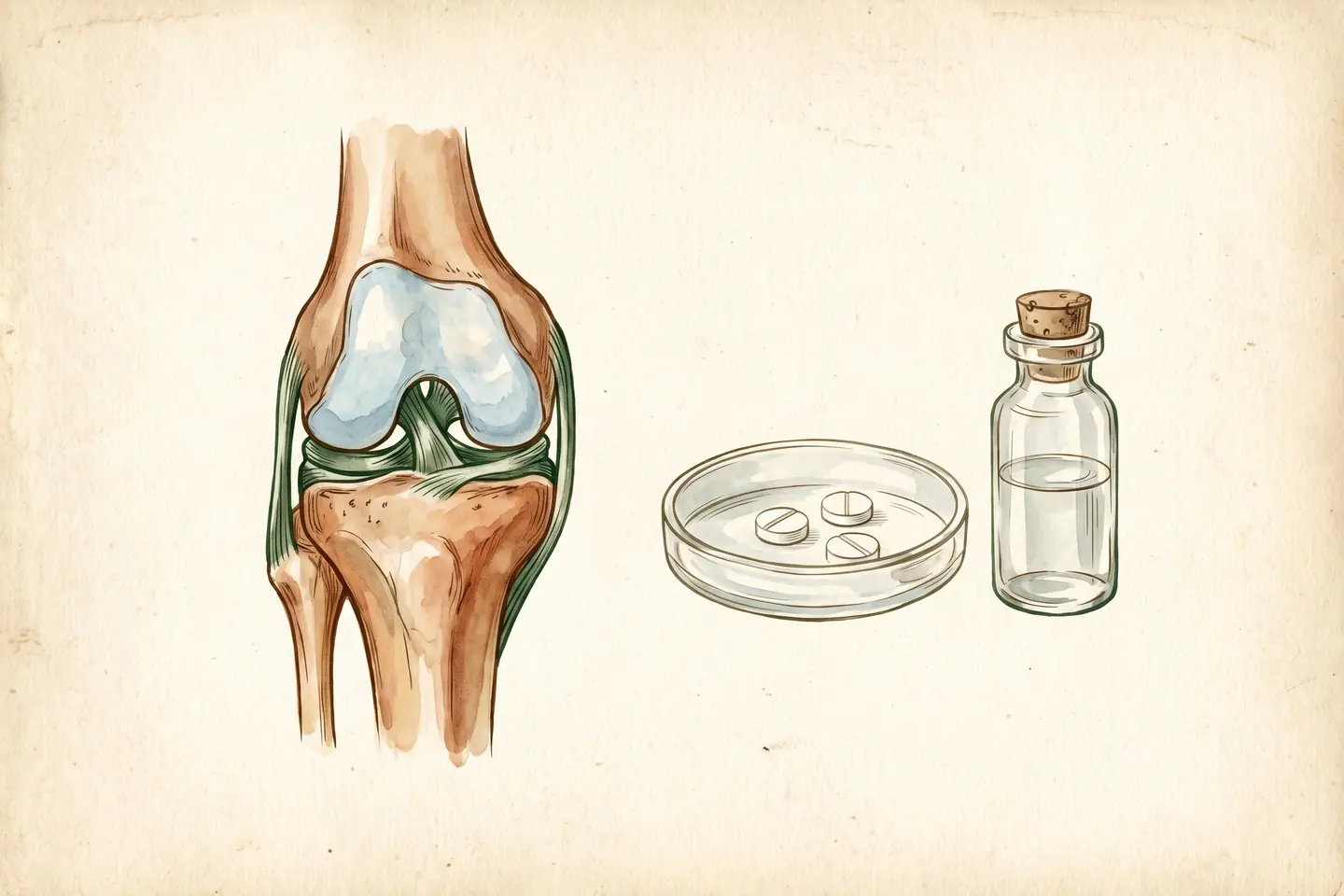
Cartalax is a synthetic tripeptide designed to support cartilage and connective tissue health. It works by entering joint cells and modifying gene expression to promote tissue repair, reduce inflammation, and slow degenerative processes. It's particularly useful for osteoarthritis and age-related joint decline.
Cartalax Evidence Snapshot
How these guides are reviewed- Regulatory status
- Not FDA approved · research use only
- Dosing guidance
- No established regimen
- Linked evidence
- 1 research sources
- Content updated
- Sep 15, 2026
Research links are provided so readers can inspect the supporting evidence directly.
Quick Answers About Cartalax
Is Cartalax FDA approved?
No. This profile records Cartalax as not FDA approved and for research use only.
More context
Review the regulatory and source details on this page for the current context.
What research supports this Cartalax guide?
This guide links to 1 curated or current research sources.
What are the side effects of Cartalax?
We don't list specific side effects for Cartalax.
Is Cartalax safe?
Cartalax has an editorial safety grade of A (Excellent Safety).
More context
Well-tolerated synthetic peptide with no significant side effects at recommended doses. Safety depends on dose, sourcing, health history and medical supervision, so this page does not call it safe for personal use.
Studied Effects & Mechanisms
Origin and history
Cartalax is a very small synthetic peptide made of just three amino acids, and it comes from a family called peptide bioregulators developed at a research institute in Russia over the past several decades, the same short-peptide tradition associated with Vladimir Khavinson that produced Epitalon and Pinealon. The idea behind that family is that a very short peptide can slip inside an aging cell and help it work more like it did when it was younger. Its name suggests cartilage, but that framing is a little misleading, because the most relevant research is not on cartilage directly but on fibroblasts, the cells that build and maintain connective tissue throughout the body, including cartilage, tendons, ligaments, skin, and even the walls of blood vessels. There is actually no published study on Cartalax and cartilage itself, so the joint and connective tissue angle is a reasonable extension of the fibroblast work rather than a proven cartilage effect. It has stayed a niche compound outside that Russian lineage and is only now drawing wider attention.
What people use it for
People look into Cartalax mainly for joints and connective tissue, and it almost always comes up next to BPC-157 and TB-500, though it is best understood as a different kind of tool. Rather than a repair option for an active injury, it is framed as long-term maintenance for aging connective tissue. Community reports describe some users noticing their joints feeling more solid under load, such as when squatting or pressing, over a couple of weeks, while others notice nothing at all, and responders tend to describe a gradual improvement in comfort rather than the obvious healing sensation people associate with BPC-157. Longtime commentators in the peptide space speak highly of it for stubborn, nagging joint complaints and for the accumulated wear connective tissue takes on with age. More careful sources frame it as a longevity and upkeep peptide to run over the long haul, not something to reach for when a joint or tendon is actively hurting, where the better-studied repair peptides make more sense.
What makes it unusual
What makes Cartalax unusual is where it acts. Most peptides are too big to enter a cell, so they dock on the surface and send a signal inward, but Cartalax is small enough to pass through the cell and reach the nucleus, where the DNA is kept. A cell never uses all of its DNA at once, it reads certain instructions and ignores the rest, and as a cell ages it tends to read fewer of the instructions that drive repair and more of the ones that break tissue down. In laboratory models Cartalax is described as attaching to specific spots on the DNA and shifting which instructions the cell reads back toward a younger pattern, without changing the genes themselves, which is what scientists call an epigenetic effect. In lab work on skin cells the aging cells began dividing and regenerating more, fewer died off, and they lowered production of MMP9, an enzyme that breaks down collagen and supportive tissue and that rises with age, so the picture is more repair on one side and less breakdown on the other. Separate studies on kidney cells reported it pushing cells away from senescence, the state where a cell is still alive but has stopped dividing and doing its job, and raising the activity of SIRT6, a gene tied to longevity and to keeping cells stable as they age.
How it is administered
Cartalax is used as a subcutaneous injection, the route associated with the Russian bioregulator peptides. Because there is no human dosing study, everything about how it is taken comes from the small number of people who have used it rather than from trials. The recurring pattern they describe is short cycles of daily use, on the order of a couple of weeks at a time, repeated a few times a year with several months off in between rather than continuous year-round dosing. The rationale offered for that on-and-off approach follows from the proposed mechanism, since a short burst is thought to trigger the shift in how cells read their DNA and those changes are then expected to hold during the time off. Its action is meant to be systemic, reaching connective-tissue cells throughout the body. These cycles are described for context, not as a recommendation on route, dose, or schedule.
Who is this for
People with osteoarthritis or joint pain · Athletes with cartilage wear · Aging individuals with joint stiffness · Those recovering from joint injuries · Anyone wanting to preserve joint health
State of the evidence
This is where expectations have to stay in check. Everything known about how Cartalax works, the effects on those cells and the way it interacts with DNA, comes from studies on cells in a dish and on animal tissue, and there are no human clinical trials on it at all. On top of that, almost all of the research traces to a single group in Russia, and no independent laboratory in the West has reproduced it, which is a recurring caveat across the Khavinson short peptides. The mechanism is consistent and genuinely interesting, but the evidence is early, narrow, and has not been through the kind of independent testing that would let anyone treat it as proven. Because there are no trials there is also no clean timeline, so reported effects rest on anecdote, and those effects are described as subtle and gradual rather than dramatic. The fair summary is to take the mechanism seriously while holding the conclusions loosely, since this is not settled science.
Legal and regulatory status
Cartalax is not approved by the FDA for any use and is not recognized as a dietary supplement in the United States, so it generally circulates as a research chemical sold for laboratory use rather than as a medicine. Its background sits within Russian bioregulator research, which does not translate into Western approval. One safety point that careful sources raise is that anyone with cancer or a history of cancer should not use it without a physician's involvement, since a compound that nudges cells to grow and divide is a real concern in that setting, and it has never been studied in people with cancer. There is also simply no long-term human safety data, so that unknown is part of what a user accepts. Material sold outside a regulated supply chain can vary in identity and purity.
Further listening
1 recording
Cartalax price snapshot
In-stock prices from 49 vendors, checked Oct 14, 2026.
- Vendors
- 49
- Listings
- 49
- Observed range
- $31–$179
Market evidence
Cartalax product testing and COAs
We found certificates from some of the Cartalax vendors we track. Based on the certificates our crawler found; vendors may publish more than we index. Research on this page describes the molecule. Vendor certificates concern particular market samples or batches; they do not change the research evidence or establish clinical safety, sterility, or suitability for use.
The clinic network
Want a clinician's view on Cartalax?
Request a free connection to a peptide clinic, by telehealth or in person. A licensed clinician decides whether any treatment is right for you. What peptide therapy involves
Related Peptides
Gotratix
THE MUSCLE REGENERATORAHighGrowth Hormone & Musculoskeletal Support · Anti-Aging & LongevityHealing · Growth Hormone & Musculoskeletal SupportDoseSee guide↻CycleNo established SubQ dosing cycle.◷Kicks inStrength and endurance improvements...Muscle peptide for strength, endurance, and recovery
Full profileNº 002 / 006Sigumir
THE JOINT REBUILDERAHighAccelerated Healing · Growth Hormone & Musculoskeletal SupportHealing · Accelerated HealingDoseSee guide↻CycleNo established SubQ dosing cycle.◷Kicks inJoint improvements may be gradual over 2-4...Rebuild your cartilage and relieve joint pain
Full profileNº 006 / 006CJC-1295 (no DAC)
THE PULSE AMPLIFIERBGoodGrowth Hormone & Musculoskeletal Support · Anti-Aging & LongevityHealing · Growth Hormone & Musculoskeletal SupportDose100 mcg↻Cycle8 weeks on, 8 weeks off◷Kicks inSleep improvements within 1-2 weeks; body...Short-acting GH pulse boost timed to your body's natural rhythm
from $2.65/mg · 188 vendorsNº 001 / 006Ipamorelin
THE AMPLIFIERAHighGrowth Hormone & Musculoskeletal Support · Anti-Aging & LongevityHealing · Growth Hormone & Musculoskeletal SupportDose200 mcg↻Cycle8-12 weeks on, 4 weeks off◷Kicks inSleep improvements within days; body...Pure growth hormone boost without the unwanted side effects.
from $1.80/mg · 235 vendorsNº 003 / 006KPV
THE INFLAMMATION ERASERAHighAntimicrobial & Antiviral · Accelerated HealingHealing · Antimicrobial & AntiviralDose500 mcg↻CycleNo clinically established cycle for this...◷Kicks inInflammation reduction often noticed within...Anti-inflammatory tripeptide for gut healing and skin
from $1.60/mg · 227 vendorsNº 004 / 006Pinealon
THE DREAMWEAVERAHighNeurological Support · Sleep RegulationCognitive · Neurological SupportDose1 mg↻CycleA firsthand report used a 20-day course; no...◷Kicks inSleep improvements often noticed within the...Sleep like you mean it and wake up mentally sharp.
from $1.70/mg · 121 vendorsNº 005 / 006