
Swallowed peptides rarely survive; oral semaglutide is an exception
Swallowed peptides face stomach enzymes, intestinal enzymes, and gut-wall and liver barriers. Oral semaglutide is the clearest documented exception.

By Jay Spall, chemist and biochemist
Disclosure: Jay is a co-founder of The Peptide App. This review discusses the studies cited below; it is not a comprehensive live trial registry or treatment recommendation. Development and regulatory status can change. The app’s tools organize records and arithmetic and do not validate a research product.
On this page
- Does stomach acid destroy swallowed peptides?
- What other barriers do swallowed peptides face?
- How does oral semaglutide get past these barriers?
- Does oral semaglutide work?
- Why does oral semaglutide need strict dosing rules?
- Are injectable peptides all absorbed the same way?
- Does the SNAC approach work for other peptides?
- How can you tell if an oral peptide product is real?
- Sources
Key facts
| Question | Direct answer |
|---|---|
| Why can't peptides be swallowed? | Swallowed peptides must survive three barriers in a row: stomach enzymes, pancreatic and intestinal enzymes, then absorption across the gut wall and liver metabolism, before a single molecule reaches the bloodstream [5][8]. |
| Is stomach acid what destroys peptides? | No. Acid activates pepsin, which does the first cutting, but pancreatic enzymes (trypsin, chymotrypsin) and enzymes lining the small intestine finish the job further downstream [5][8]. |
| Has anyone solved oral peptide delivery? | Oral semaglutide is the clearest documented case. Its co-formulated absorption enhancer, SNAC, lets a fraction of the dose cross the stomach wall near the tablet, before the intestine gets a chance at it [3]. |
| Does oral semaglutide work? | Yes, in large trials at effective clinical doses, under a strict dosing ritual and with a well-documented mechanism behind it [4][2]. That is not the same as any peptide sold as an oral capsule working. |
| Are injectable peptides all absorbed the same way? | No. Subcutaneous absorption varies with molecular size, structure, and formulation; not every injectable peptide behaves the same way in the body [1]. |
| How can I tell an oral peptide product is real? | Published data showing a specific structural modification or absorption-enhancing technology and a measured bioavailability number, not just the word "oral" on the label [5][8]. |
8 sources cited. View sources
Does stomach acid destroy swallowed peptides?
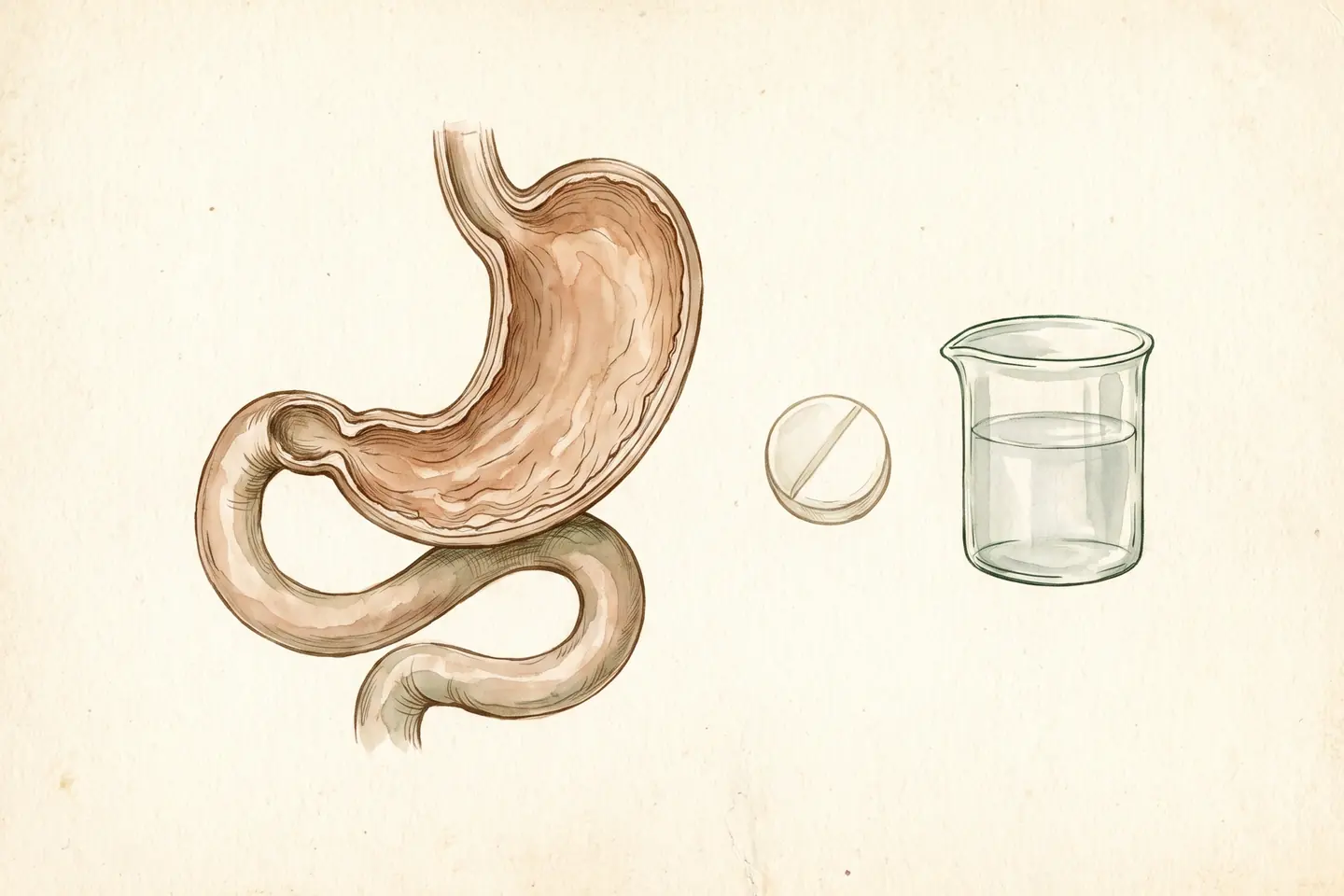
Stomach acid alone does not destroy swallowed peptides: acid switches on pepsin, and pancreatic and intestinal enzymes finish the job further downstream [5][8]. The popular explanation, "stomach acid destroys peptides," describes one enzyme's activation trigger and calls it the whole story.
Acid matters mainly because it activates pepsin, an enzyme that starts cutting peptide bonds in the stomach. What survives that first pass then meets a second barrier: pancreatic proteases such as trypsin and chymotrypsin, released into the small intestine, along with a dense layer of brush-border peptidases sitting directly on the intestinal lining [5][8].
These enzymes exist to reduce dietary protein to absorbable amino acids and small fragments, and to them a therapeutic peptide looks, biochemically, like food. A peptide built to survive acid can still be shredded a few inches later.
What other barriers do swallowed peptides face?
Swallowed peptides that survive both enzymatic waves still have to cross the intestinal wall and then pass through the liver. The intestinal wall is built from tightly joined epithelial cells and coated in mucus that traps large, water-loving molecules before they ever reach the wall itself [7].
Whatever finally makes it into the bloodstream from the gut is routed straight to the liver before circulating anywhere else, and first-pass metabolism there can degrade a further share of the dose. Reviews of oral peptide and protein delivery consistently describe a compounding, three-part problem, not a single acid bath: gastric, then intestinal enzymatic, then absorption-and-hepatic [5][8].
How does oral semaglutide get past these barriers?
Oral semaglutide is the clearest documented case of a peptide engineered around this gauntlet, using SNAC, an absorption enhancer packed into the same tablet. SNAC is sodium N-[8-(2-hydroxybenzoyl) aminocaprylate], and the engineering around it is specific rather than general.
Human and preclinical dog studies found that oral semaglutide is not absorbed the way small-molecule drugs are, spread diffusely across the intestine. Absorption happens locally in the stomach, in the small area immediately surrounding the dissolving tablet, and it requires SNAC [3]. The studies attribute SNAC's effect to two actions: it locally raises pH near the tablet, which offers transient protection from enzymatic degradation, and it promotes a transcellular route across stomach cells without disrupting the tight junctions between them [3].
That mechanism is compound-specific: it was demonstrated for semaglutide, not established as a route other peptides can borrow. SNAC creates a narrow, local, time-limited window of absorption in one organ, for one molecule, and even then most of the dose does not make it through. The specific bioavailability percentage often quoted for oral semaglutide does not trace to the cited trial or mechanistic papers. Why oral semaglutide tablets need such large doses covers what that low absorption means for dosing.
Does oral semaglutide work?
Oral semaglutide works in large trials: the PIONEER program of phase 3 randomized trials enrolled more than 9,500 participants at doses of 3 mg, 7 mg, and 14 mg [4]. PIONEER compared oral semaglutide against placebo and against active comparators including empagliflozin, sitagliptin, and injectable liraglutide [4]. Multiple large randomized trials with consistent findings make a strong evidence grade.
The mechanism and the clinical outcome are separate evidence tiers. The transcellular absorption mechanism comes from translational research combining human pharmacokinetic data with preclinical dog studies [3]. That research is strong evidence for how the drug gets in, but it is not itself a measure of clinical benefit.
Why does oral semaglutide need strict dosing rules?
Oral semaglutide is usable despite low absorption because of dose and timing discipline, not a loophole in the biology. Practical guidance for clinicians emphasizes administration conditions tied directly to how fragile the absorption window is: the tablet is taken on an empty stomach with a small volume of water, and other food, drink, or medication is withheld for a period afterward [2].
Missing those conditions narrows the already-thin absorption window further. That level of procedural strictness is itself evidence of how marginal the mechanism is, not incidental packaging.
Are injectable peptides all absorbed the same way?
Injectable peptides are not interchangeable either: subcutaneous absorption varies with molecular size, structure, and formulation [1]. A meta-analysis of GLP-1 receptor agonist cardiovascular outcome trials notes that these drugs differ meaningfully in structure and duration of action, with dosing intervals ranging from daily to weekly across compounds. It analyzed cardiovascular outcomes partly by structural homology as a subgroup variable [1].
Two injectable peptides can have different absorption and persistence profiles depending on molecular size and formulation. "Injectable, therefore bioavailable and equivalent" is as much an oversimplification as "oral, therefore useless." Why injection route matters for peptides covers how those effects vary by molecule.
Does the SNAC approach work for other peptides?
Whether SNAC works for peptides beyond semaglutide is an open question. Reviews of oral peptide delivery catalog a wide range of strategies under active investigation: permeation enhancers, enzyme inhibitors, nanoparticle and self-emulsifying carriers, and mucus-penetrating and cell-penetrating peptide designs. They describe these largely as approaches in various stages of development rather than established, commercialized solutions [5][7][8].
Oral insulin is the sharpest cautionary example of how stubborn the compounding barrier is. Despite decades of work with permeation enhancers, protective polymers, and various carrier systems, no oral insulin product has reached routine commercial use [6].
None of the cited reviews supports the idea that "oral peptide" as a category has been solved. They support a narrower, more interesting fact: semaglutide was solved, at real cost, for a specific site, with a specific enhancer, and with absorption still low enough to require strict dosing rules. How linaclotide works without being absorbed covers a different oral approach.
How can you tell if an oral peptide product is real?
A real oral peptide product comes with published data showing a specific structural modification or absorption-enhancing technology and a measured bioavailability number [5][8]. The word "oral" on a label is not that evidence.
Any other peptide sold as an oral product needs its own version of the semaglutide evidence, or it has not earned the same benefit of the doubt. One popular peptide's oral claims show what that gap looks like in practice.
Sources
-
Kristensen SL, Rørth R, Jhund PS (2019). Cardiovascular, mortality, and kidney outcomes with GLP-1 receptor agonists in patients with type 2 diabetes: a systematic review and meta-analysis of cardiovascular outcome trials. Lancet Diabetes Endocrinol. pubmed.ncbi.nlm.nih.gov/31422062
-
Morales J, Shubrook JH, Skolnik N (2020). Practical guidance for use of oral semaglutide in primary care: a narrative review. Postgrad Med. pubmed.ncbi.nlm.nih.gov/32643514
-
Buckley ST, Bækdal TA, Vegge A (2018). Transcellular stomach absorption of a derivatized glucagon-like peptide-1 receptor agonist. Sci Transl Med. pubmed.ncbi.nlm.nih.gov/30429357
-
Rodbard HW, Dougherty T, Taddei-Allen P (2020). Efficacy of oral semaglutide: overview of the PIONEER clinical trial program and implications for managed care. Am J Manag Care. pubmed.ncbi.nlm.nih.gov/33439582
-
Drucker DJ (2020). Advances in oral peptide therapeutics. Nat Rev Drug Discov. pubmed.ncbi.nlm.nih.gov/31848464
-
Spoorthi Shetty S, Halagali P, Johnson AP (2023). Oral insulin delivery: Barriers, strategies, and formulation approaches: A comprehensive review. Int J Biol Macromol. pubmed.ncbi.nlm.nih.gov/37263330
-
Abdulkarim M, Sharma PK, Gumbleton M (2019). Self-emulsifying drug delivery system: Mucus permeation and innovative quantification technologies. Adv Drug Deliv Rev. pubmed.ncbi.nlm.nih.gov/30974131
-
Nicze M, Borówka M, Dec A (2024). The Current and Promising Oral Delivery Methods for Protein- and Peptide-Based Drugs. Int J Mol Sci. pubmed.ncbi.nlm.nih.gov/38255888
Last updated

Written by
Chemist and biochemist. Co-founder and author, The Peptide App.
Jay is a chemist, biochemist and entrepreneur whose work connects scientific research with consumer health products. He has held Chief Science Officer and product development leadership roles and previously served as Chief Revenue Officer at Minicircle.
Keep reading
Compound evidence
Injection route matters for peptides, but effects vary by molecule
Route effects vary by molecule: glucagon peaked higher intramuscularly yet reached similar total exposure. Most peptides people inject lack human route data.
Compound evidence
Linaclotide works as a pill because its receptor faces into the gut
Linaclotide acts on receptors facing the inside of the gut, so it never needs absorption. Trials show strong constipation benefit and weaker pain evidence.
BPC-157 and TB-500
Oral BPC-157 was tested against induced gut injury in rats
In rat studies, BPC-157 dissolved in drinking water was tested against induced gut injury. No study has measured its absorption in people or set a dose.
Profiles and tools

The Peptide App
Track protocols, doses, and reconstitution in one place.
Save your calculations, set reminders, log doses, and keep outcome notes — free to start.
 or scan the QR code →