
Oral BPC-157 was tested against induced gut injury in rats
In rat studies, BPC-157 dissolved in drinking water was tested against induced gut injury. No study has measured its absorption in people or set a dose.

By Jay Spall, chemist and biochemist
Disclosure: Jay is a co-founder of The Peptide App. This review discusses the studies cited below; it is not a comprehensive live trial registry or treatment recommendation. Development and regulatory status can change. The app’s tools organize records and arithmetic and do not validate a research product.
On this page
- Has oral BPC-157 been tested in human trials?
- Does surviving stomach acid make oral BPC-157 bioavailable?
- How much of an oral peptide reaches the bloodstream?
- What do the rat drinking-water studies of BPC-157 show?
- Can oral BPC-157 reach an injured tendon or joint?
- Is there a validated oral BPC-157 dose?
- Does oral BPC-157 avoid the risks of unregulated products?
- What is still unknown about oral BPC-157?
- Sources
Key facts
| Question | Direct answer |
|---|---|
| Is there human trial evidence for oral BPC-157? | No. A 2026 biopharmaceutics review reports decades of preclinical activity across organ systems, but no validated dosing regimen for any route, oral or injected, and no completed Phase II human trial [4]. |
| Does "stable in stomach acid" mean oral BPC-157 reaches the bloodstream? | No. Gastric stability is a chemistry observation. Oral bioavailability of other peptides ranges from roughly 5% to over 50%, depending on the molecule and how heavily it is re-engineered or formulated, so stability alone predicts almost nothing about how much reaches tissue [1][5][7][8]. |
| Is there a measured oral-to-injected dose equivalence for BPC-157? | No. No pharmacokinetic comparison of the two routes exists, and the 2026 review flags that pharmacokinetic-pharmacodynamic gap as a barrier to clinical development [4]. |
| Are the rat gut-injury studies of oral BPC-157 real? | Yes. Rat studies exist in which BPC-157 was dissolved in drinking water and tested for protection against gut injury. |
| Can an oral BPC-157 capsule reach a healing tendon? | Unknown. None of the studies cited below reports human absorption, distribution, or half-life data for BPC-157 by any route, and gut protection in a rodent drinking treated water is a different pharmacokinetic problem from reaching a joint or tendon [4]. |
8 sources cited. View sources
Has oral BPC-157 been tested in human trials?
No completed Phase II human trial has tested BPC-157 by any route, oral or injected, and no validated dosing regimen exists [4]. BPC-157 is a synthetic fifteen-amino-acid fragment derived from a gastric protein, studied for decades in animal models.
A 2026 biopharmaceutics review describes cytoprotective and regenerative activity reported across multiple organ systems. The same review is direct about what has not happened alongside that reporting: no approved formulation of BPC-157 exists for any route [4].
That gap, decades of animal reporting against zero human dose-finding data, is the fact most oral-capsule marketing skips entirely.
Does surviving stomach acid make oral BPC-157 bioavailable?
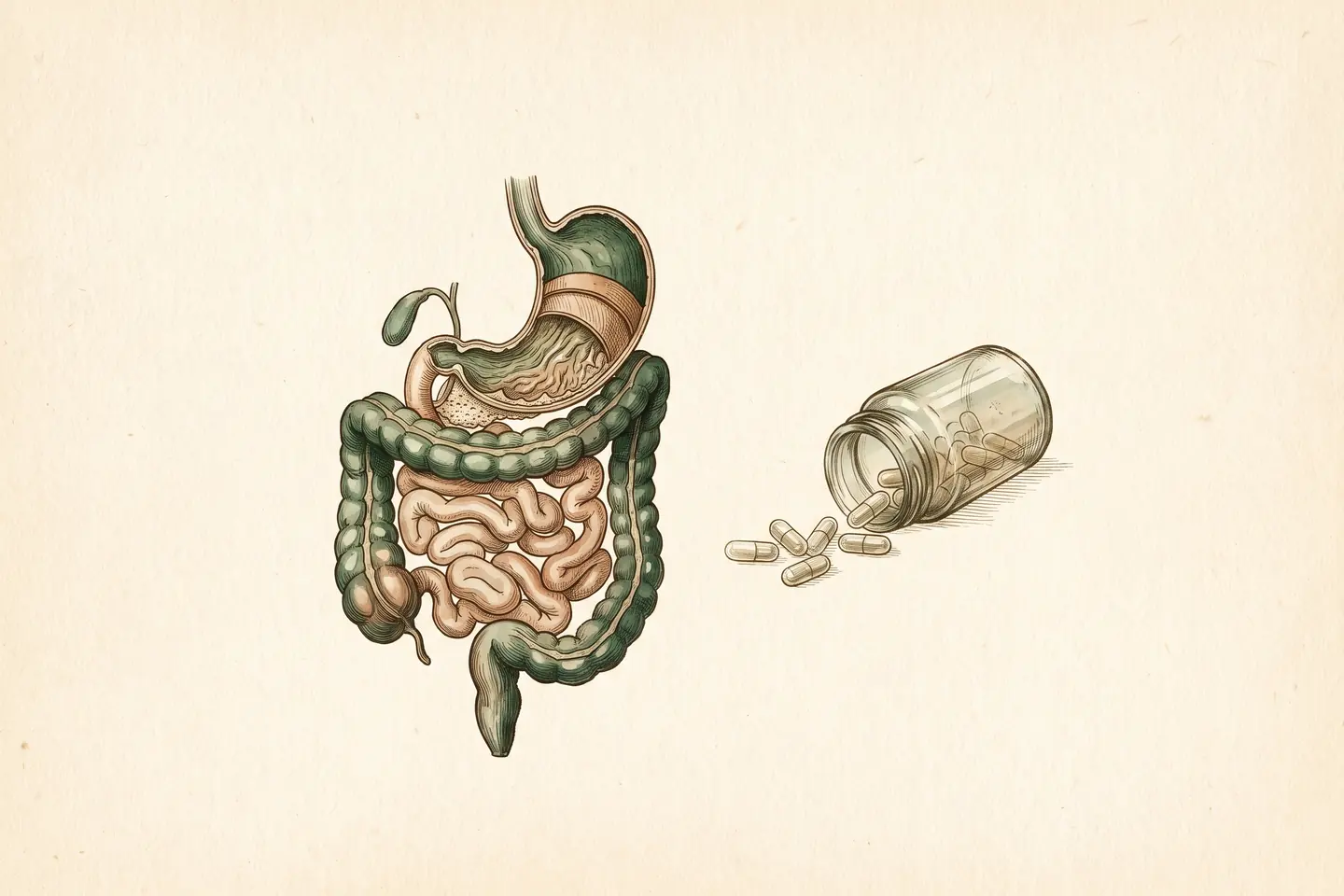
Stability in stomach acid does not make oral BPC-157 bioavailable. Gastric stability is a chemistry observation, and the claim that a peptide surviving stomach acid is "therefore bioavailable" skips a whole field of pharmaceutics built around proving that step, not assuming it.
Ordinary gastric digestion is aggressive. In vitro modeling of meat protein digestion identified 592 distinct peptide fragments generated from just 67 source proteins during normal stomach processing [2]. That is the fate most intact peptides face without specific protection. A separate guide explains why most peptides can't be swallowed.
How much of an oral peptide reaches the bloodstream?
Oral bioavailability studies of peptides other than BPC-157 range from roughly 5% to over 50%, depending on the molecule and how heavily it is re-engineered or formulated for absorption [1][5][7][8]. Even peptides deliberately engineered to survive the gut often post modest numbers.
An orally active analog of exendin-4 retained meaningful activity by oral gavage in mice only after its trypsin cleavage sites were mutated [3]. An oral parathyroid hormone fragment delivered in a microemulsion reached only 5.4% relative bioavailability from the stomach and 12.0% from the ileum, compared with direct injection [5]. Encapsulated G-CSF, protected by a nanoparticle system with built-in protease inhibition, achieved about 13.6% relative bioavailability [7].
A cyclopeptide drug given orally in rats was poorly absorbed. Its formulators had to add a solubilizing excipient and, for practical use, switch to a non-oral route entirely [8]. The rare exception among these studies, a chemically re-engineered all-D-amino-acid peptide, resisted gut proteolysis almost completely and reached roughly 58% oral bioavailability. It needed that structural redesign because its natural mirror-image form degrades within seconds in the same conditions [1].
The common excipient citric acid can modestly slow gut proteolysis at low pH, but the effect is narrow and route-specific, not a general fix [6]. None of these studies involves BPC-157. They establish the rule that oral marketing pages skip: gastric stability is necessary but nowhere near sufficient, and most peptides need purpose-built formulation to reach circulation in meaningful amounts by mouth.
What do the rat drinking-water studies of BPC-157 show?
In a substantial part of the BPC-157 rodent literature, rats received the peptide dissolved in their drinking water and were then evaluated for protection against chemically or surgically induced gut injury. Sellers on both sides of the injectable-versus-oral argument cite this research while leaving out its design. The injectable side of that argument is traced in the analysis of local BPC-157 injection protocols.
The 2026 biopharmaceutics review describes the broader preclinical record as reporting activity across organ systems while pharmacokinetic and pharmacodynamic data remain disconnected. Effects are reported in animals without matching absorption or distribution measurements to explain how BPC-157 reaches the tissue, by any route [4].
Can oral BPC-157 reach an injured tendon or joint?
No study has measured whether swallowed BPC-157 reaches a tendon or joint at a meaningful concentration. The disconnect between pharmacokinetic and pharmacodynamic data matters most for the question someone recovering from a tendon or joint injury is asking.
Gut protection in a rat drinking treated water involves tissue exposed directly to the peptide at the site of injury. Getting a meaningful concentration from the same swallowed dose into a joint capsule or tendon sheath is a separate pharmacokinetic problem, and no study identified in the 2026 review measures it [4].
Is there a validated oral BPC-157 dose?
No validated dosing regimen exists for BPC-157 by any route, oral or injected, according to the 2026 biopharmaceutics review [4]. The dosing figures on seller and forum pages, often around 250 to 500 micrograms once or twice daily, do not trace to any human pharmacokinetic study.
A stated oral-to-injectable dose equivalence is not a measurement. It is a guess formatted to look like a specification.
Does oral BPC-157 avoid the risks of unregulated products?
Oral BPC-157 carries the same supply-chain risk as injectable BPC-157, because neither is an approved drug. Product sourced online is not independently verified for purity, dose accuracy, or contamination the way a regulated pharmaceutical would be.
That risk has nothing to do with BPC-157's theoretical mechanism. It applies equally whether the label says oral or injectable.
What is still unknown about oral BPC-157?
Whether oral BPC-157 is absorbed in humans at all has never been measured. The open questions:
- Human pharmacokinetics. None of the studies cited below is a human absorption, distribution, or half-life study of BPC-157, by any route [4]. How long BPC-157 lasts in the body is equally unmeasured in people.
- Oral fraction. No study measures what fraction of an oral dose reaches systemic circulation, let alone a specific injured tendon or joint.
- Route comparison. No trial compares an oral protocol against an injected one for any human outcome.
The defensible position is narrower than either side of the seller argument. Oral BPC-157 has a rodent gut-injury literature behind it. The injectable route has no better human translational evidence. Neither has been shown in a person to reach a healing tendon at a concentration that does anything measurable at all.
Sources
Last updated

Written by
Chemist and biochemist. Co-founder and author, The Peptide App.
Jay is a chemist, biochemist and entrepreneur whose work connects scientific research with consumer health products. He has held Chief Science Officer and product development leadership roles and previously served as Chief Revenue Officer at Minicircle.
Keep reading
BPC-157 and TB-500
BPC-157's half-life is under 30 minutes in rats and dogs
BPC-157's elimination half-life is under 30 minutes in rats and dogs, the only species measured. The 4 to 6 hour figure online doesn't trace to a study.
BPC-157 and TB-500
BPC-157 healed rat injuries when given orally or by systemic injection
BPC-157 improved healing in rats by intraperitoneal shot, in drinking water or as a topical cream. No human study has compared routes or injection sites.
BPC-157 and TB-500
BPC-157 has 100-plus studies, nearly all from one Zagreb group
The Zagreb group behind most BPC-157 papers reports gut, tendon and vascular effects in animals. Independent replication by other labs is scarce.
Profiles and tools

The Peptide App
Track protocols, doses, and reconstitution in one place.
Save your calculations, set reminders, log doses, and keep outcome notes — free to start.
 or scan the QR code →