
BPC-157's half-life is under 30 minutes in rats and dogs
BPC-157's elimination half-life is under 30 minutes in rats and dogs, the only species measured. The 4 to 6 hour figure online doesn't trace to a study.

By Jay Spall, chemist and biochemist
Disclosure: Jay is a co-founder of The Peptide App. This review discusses the studies cited below; it is not a comprehensive live trial registry or treatment recommendation. Development and regulatory status can change. The app’s tools organize records and arithmetic and do not validate a research product.
On this page
- What is the half-life of BPC-157?
- What happens to BPC-157 after an injection?
- Has BPC-157's half-life been measured in humans?
- Where does the 4 to 6 hour BPC-157 half-life figure come from?
- Why do peptides like BPC-157 clear so quickly?
- How is half-life different from how long BPC-157 lasts?
- Does BPC-157's half-life justify twice-daily injections?
- Can BPC-157's effects outlast its time in the bloodstream?
- What is still unknown about BPC-157's pharmacokinetics?
- Sources
Key facts
| Question | Direct answer |
|---|---|
| What is the half-life of BPC-157? | Under 30 minutes, in rats and dogs. The only published pharmacokinetic study of the intact peptide measured an elimination half-life under 30 minutes at every dose tested [7]. |
| Where does the 4 to 6 hour half-life figure come from? | No identifiable published source. The figure repeated on clinic pages, podcasts, and forums does not trace to any pharmacokinetic study. |
| Has BPC-157's half-life been measured in humans? | No. The controlled work is in rats and beagle dogs, and no published study has drawn human blood after an injection and modeled the clearance curve. |
| Is twice-daily BPC-157 dosing based on measured clearance? | No. The twice-daily interval is built to match the untraceable 4 to 6 hour figure, not measured human clearance, because no published human pharmacokinetic study of BPC-157 exists. |
| Why do people report BPC-157 effects lasting hours? | Plasma clearance and biological effect are separate measurements. Effects that outlast a molecule's time in circulation are documented for other peptide systems and have not been established for BPC-157 [1][3]. |
| How much injected BPC-157 reaches the blood intact? | 14 to 19 percent in rats and 45 to 51 percent in dogs after intramuscular injection [7]. The rest breaks down into peptide fragments and then amino acids [7]. |
7 sources cited. View sources
What is the half-life of BPC-157?
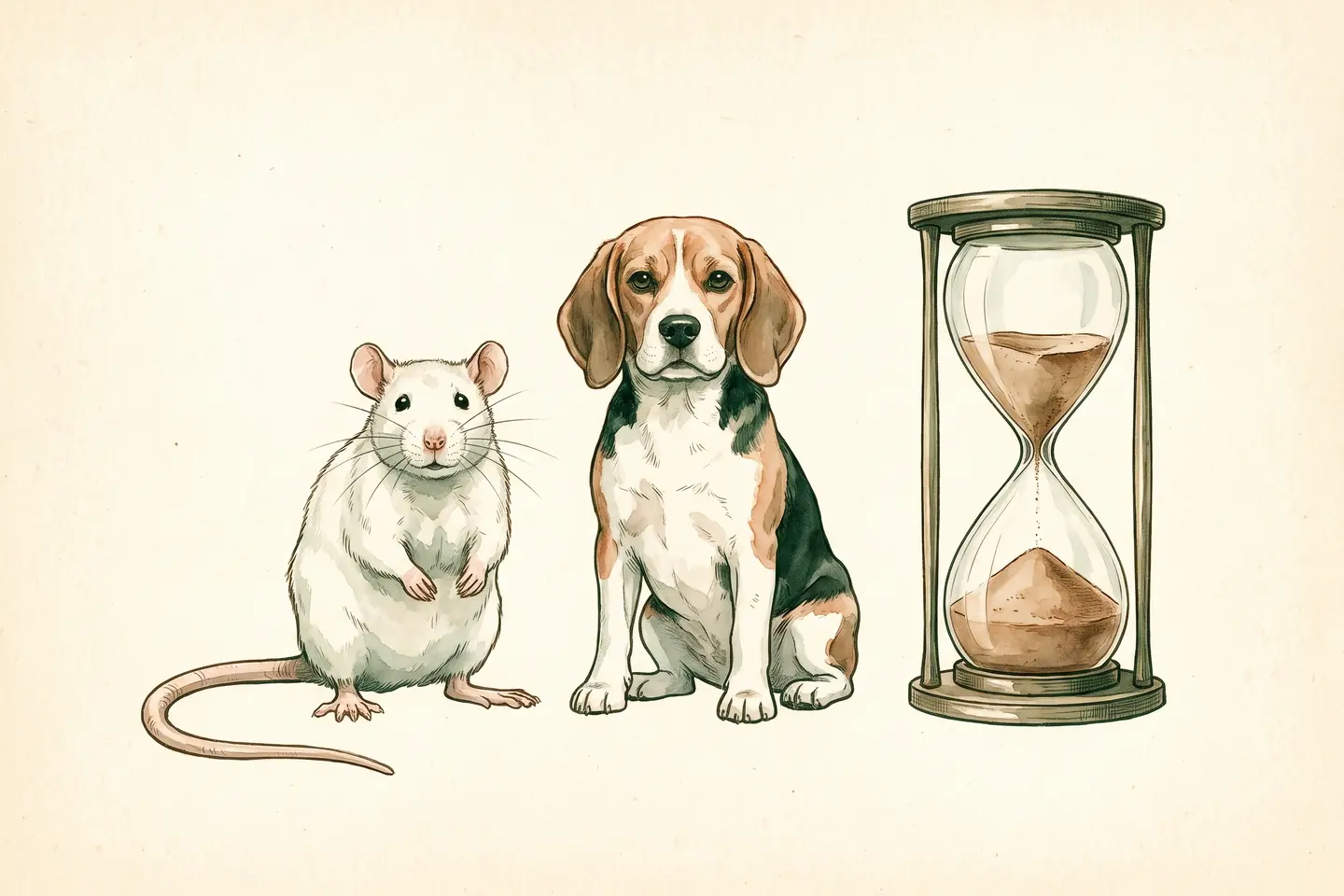
BPC-157's elimination half-life is under 30 minutes in rats and beagle dogs, the only species in which it has been measured [7]. The figure comes from a 2022 pharmacokinetic study that tested intravenous and intramuscular administration at three ascending doses, with both single and repeated dosing [7].
The half-life of the intact peptide stayed under 30 minutes at every dose tested. Kinetics were linear across doses in both species, so BPC-157 did not accumulate or saturate its clearance pathways in a way that would change the half-life at higher doses [7].
The 2022 study meets the bar of a real pharmacokinetic study. It used serial blood sampling and standard modeling, the same methodology used in controlled human work on other short-half-life compounds such as the urodilatin infusion trial [2]. Its evidence grade is preclinical: a single study in two species.
What happens to BPC-157 after an injection?
After an intramuscular injection, 14 to 19 percent of a BPC-157 dose reaches the bloodstream intact in rats, and 45 to 51 percent in dogs [7]. A radiolabeled tracer in the same study showed the fate of the rest. BPC-157 broke down rapidly into small peptide fragments and then into single amino acids, which entered normal amino acid metabolism. Excretion ran through urine and bile [7].
Route of administration changes that picture. An intravenous injection produces a sharp peak and a fast decline. An intramuscular or subcutaneous injection creates a local depot that releases the compound into circulation more gradually, which changes both the peak concentration and how much of the dose reaches the bloodstream intact. Popular BPC-157 dosing guides rarely distinguish between routes when they repeat the half-life figure. The differences between intramuscular and subcutaneous injection are covered separately.
Has BPC-157's half-life been measured in humans?
No published study has measured BPC-157's half-life in humans. Nothing published has drawn human blood after a BPC-157 injection and modeled the clearance curve.
Rat and dog clearance does not automatically transfer to a person. Body size, enzyme activity, and injection technique differ across species. Anyone stating a human half-life for BPC-157, in either direction, is extrapolating past what has been measured, and no published study bridges rat and dog clearance rates to a person injecting subcutaneously at 11 p.m. after surgery.
A 2026 review of BPC-157's translational development flags the absence of any completed Phase II clinical trial and the lack of a validated human dosing regimen. The review describes a persistent gap between BPC-157's preclinical pharmacological activity and the pharmacokinetic data needed to support it [6]. What human research on BPC-157 does and does not show is covered separately.
Where does the 4 to 6 hour BPC-157 half-life figure come from?
The 4 to 6 hour figure has no identifiable published source. Clinic pages, podcasts, and forums repeat it, but it does not trace to any pharmacokinetic study, and the number underneath most twice-daily dosing charts does not match the only data set that exists [7].
The 2022 study notes that BPC-157 becomes essentially undetectable in plasma at some point after administration. That is a clearance observation, not a half-life measurement [7]. Clearance time and half-life are related but not interchangeable. A compound can take several half-lives to become undetectable, because its concentration keeps halving until it falls below the assay's sensitivity.
The origin of the 4 to 6 hour figure is undocumented. One explanation fits the discrepancy: a rough clearance window, reported informally as a "half-life" in vendor materials or forum summaries and then copied forward without a check against the paper.
Why do peptides like BPC-157 clear so quickly?
Small peptides generally clear from plasma in minutes rather than hours, because blood is full of enzymes built to cut short amino acid chains apart. Once a peptide loses its intact structure, it generally stops behaving like the original molecule, even if fragments or free amino acids remain detectable afterward.
Single-digit-minute half-lives are common among peptide-based compounds. In one controlled human infusion trial, the peptide hormone urodilatin cleared with an elimination half-life of about 5.6 minutes [2]. BPC-157's half-life of under 30 minutes in rats and dogs also falls in minutes, not hours [7].
How is half-life different from how long BPC-157 lasts?
Elimination half-life is the time BPC-157's plasma concentration takes to fall by half, assuming first-order kinetics, not how long the peptide lasts. Half-life is a different measurement from how long a drug stays detectable or how long its effect takes to wear off. Conflating those measurements is the error that has propagated through BPC-157 dosing advice.
In conventional drug dosing, clinicians typically wait roughly four to five half-lives for a compound to reach steady state or clear the body. Human antibiotic pharmacokinetics illustrates the convention: "more than four half-lives" is the standard threshold used to define steady-state sampling [5]. The principle is general pharmacology, not a BPC-157 finding, but it shows why the distinction matters. If BPC-157's half-life is 30 minutes, four half-lives is two hours, not four to six.
Does BPC-157's half-life justify twice-daily injections?
No measured half-life supports twice-daily BPC-157 injections. The twice-daily logic is coherent only if the 4 to 6 hour figure were real: space doses to avoid long gaps below an assumed effective concentration.
That logic needs two things nobody has: a documented human half-life, and evidence that the plasma concentration of intact BPC-157 tracks with the effect someone is trying to achieve. If BPC-157's plasma half-life is under 30 minutes, a twice-daily subcutaneous schedule built on a 4-hour assumption leaves detectable circulating peptide for a small fraction of the day, not the sustained coverage the schedule implies.
More frequent injection is not automatically correct either. No one has published a human dose-response or dose-frequency study from which to derive an evidence-based interval [6]. The dosing logic in vendor calculators and forum protocols was not built from the pharmacokinetic data that exist [7].
Dexrazoxane shows what a schedule built on measurement looks like. The chelating agent, used ahead of certain chemotherapy regimens, has a short plasma half-life that makes repeated bolus dosing an inefficient way to sustain exposure, so investigators measured its rapid clearance directly and designed a 96-hour continuous infusion around it [4]. Nothing comparable exists for BPC-157. A twice-daily schedule built on an untraceable number cannot be fixed by choosing a better interval, because the human measurement that would justify any interval has not been done.
Can BPC-157's effects outlast its time in the bloodstream?
Effects that outlast a molecule's time in the blood are documented for GLP-1 receptor agonists and growth hormone [1][3], but no study has tested whether BPC-157 behaves the same way. Plasma clearance and downstream biological effect are separate measurements, and a receptor-level or tissue-level effect can outlast the triggering molecule's presence in blood.
Immediate intravenous infusion and weeks of ongoing dosing with GLP-1 receptor agonists produced measurably different effects on kidney handling of uric acid. Acute plasma presence and cumulative downstream effect are not interchangeable [1]. Growth hormone replacement shows a related pattern: sodium retention and fluid shifts measured after seven days differed from those measured after twelve months, even though circulating growth hormone clears on a much shorter timescale [3].
Local injection-site delivery of BPC-157 is sometimes defended on the same theory, that tissue-level, receptor-mediated signaling outlasts plasma presence. The idea is mechanistically plausible for a peptide acting locally rather than through sustained systemic concentration. It remains a hypothesis that neither the rat and dog pharmacokinetic study nor the translational review confirms [7][6]. A separate analysis traces where local BPC-157 injection protocols come from.
What is still unknown about BPC-157's pharmacokinetics?
BPC-157's human half-life, the right concentration to track, and the duration of any effect are all unmeasured:
- Human half-life. No published study has measured BPC-157 clearance in people, by any route.
- What to measure. Whether the plasma concentration of intact BPC-157 is the right thing to track at all is unresolved.
- Effect duration. How long any downstream effect lasts, the question that matters for dosing, has not been measured.
- Dosing interval. No human dose-response or dose-frequency study exists to set an interval [6].
Animal pharmacokinetic data point to fast clearance of the intact molecule [7]. No human clearance study exists, and every human half-life figure in circulation, including 4 to 6 hours, is extrapolation.
Sources
-
Wragge TM, Cooper BE (1993). Correlation of aminoglycoside and vancomycin pharmacokinetic parameters. Ann Pharmacother. pubmed.ncbi.nlm.nih.gov/8286806
-
Mateescu DM, Gavrilescu DM, Constantinescu FE (2026). BPC-157 as an Investigational Peptide Therapeutic: Biopharmaceutical Challenges, Formulation Strategies, and Translational Development Barriers. Pharmaceutics. pubmed.ncbi.nlm.nih.gov/42198317
-
He L, Feng D, Guo H (2022). Pharmacokinetics, distribution, metabolism, and excretion of body-protective compound 157, a potential drug for treating various wounds, in rats and dogs. Front Pharmacol. pubmed.ncbi.nlm.nih.gov/36588717
Last updated

Written by
Chemist and biochemist. Co-founder and author, The Peptide App.
Jay is a chemist, biochemist and entrepreneur whose work connects scientific research with consumer health products. He has held Chief Science Officer and product development leadership roles and previously served as Chief Revenue Officer at Minicircle.
Keep reading
BPC-157 and TB-500
BPC-157 healed tendons in rats; human data are three small pilots
BPC-157 improved strength and collagen organization in cut rat Achilles tendons in a 2003 study. Human data are three small pilots, none in tendon patients.
BPC-157 and TB-500
BPC-157 healed rat injuries when given orally or by systemic injection
BPC-157 improved healing in rats by intraperitoneal shot, in drinking water or as a topical cream. No human study has compared routes or injection sites.
BPC-157 and TB-500
BPC-157 has 100-plus studies, nearly all from one Zagreb group
The Zagreb group behind most BPC-157 papers reports gut, tendon and vascular effects in animals. Independent replication by other labs is scarce.
Profiles and tools

The Peptide App
Track protocols, doses, and reconstitution in one place.
Save your calculations, set reminders, log doses, and keep outcome notes — free to start.
 or scan the QR code →