
Dihexa eased memory deficits in rats and in Alzheimer's model mice
Oral dihexa improved memory in rat and mouse models but failed in a Huntington's rat model. It has no human trials, and its key mechanism paper was retracted.

By Jay Spall, chemist and biochemist
Disclosure: Jay is a co-founder of The Peptide App. This review discusses the studies cited below; it is not a comprehensive live trial registry or treatment recommendation. Development and regulatory status can change. The app’s tools organize records and arithmetic and do not validate a research product.
On this page
- What is dihexa?
- Is dihexa's HGF/c-Met mechanism proven?
- Is dihexa billions of times more potent than BDNF?
- What did animal studies of dihexa find?
- Does dihexa work in every brain disease model?
- Has dihexa been tested in humans?
- Where do dihexa doses come from?
- What side effects does dihexa cause?
- Does dihexa's c-Met pathway raise cancer concerns?
- What evidence grade does dihexa earn?
- Sources
Key facts
| Question | Direct answer |
|---|---|
| Has dihexa been tested in humans? | No. Every dihexa study is preclinical, in rats or mice, and no human trial has been registered or completed. |
| Where does the "billions of times more potent than BDNF" claim come from? | An in vitro comparison of spinogenic activity in cultured hippocampal neurons. It is not a measure of cognition, and not a whole-animal or clinical potency comparison [1]. |
| Does oral dihexa work in animals? | Yes, in rodent memory models. Oral dihexa reversed scopolamine-induced memory deficits in rats [1], and a separate group later replicated oral efficacy in an Alzheimer's mouse model [5]. |
| Is dihexa's HGF/c-Met mechanism proven? | No. The key 2014 paper proposing the HGF/c-Met mechanism has been formally retracted [2]. The pathway is plausible, but that specific evidence for it no longer stands. |
| Does dihexa work in every neurodegeneration model? | No. Dihexa failed to improve motor function, memory or weight loss in a rat model of Huntington's disease [6]. |
| Where do forum doses of 5-20 mg come from? | No study. No human pharmacokinetic or dosing data exist for dihexa by any route, sublingual protocols included. |
| Is dihexa safe? | Unknown. No human safety data exist, and dihexa's proposed pathway runs through c-Met, an oncogene. No study has assessed its long-term proliferative or oncogenic risk. |
6 sources cited. View sources
What is dihexa?
Dihexa is a small-molecule peptidomimetic derived from angiotensin IV, engineered to be metabolically stable and orally bioavailable, unlike its parent peptide. Why peptides can't be swallowed explains the problem that engineering set out to solve.
Dihexa is proposed to bind hepatocyte growth factor (HGF) and potentiate HGF's activity at the c-Met receptor. The c-Met receptor is a receptor tyrosine kinase involved in cell growth, motility and, in the nervous system, synaptic remodeling. The pitch built on this mechanism is straightforward: activate a growth-factor pathway in the hippocampus, grow more dendritic spines, and encode memories better.
The mechanistic case is not baseless. The foundational 2013 study used its rat memory and cell-culture results to argue that dihexa crosses the blood-brain barrier and acts centrally [1]. A 2015 narrative review laid out the broader argument for HGF/c-Met as a druggable target in Alzheimer's-relevant biology, drawing entirely on the same small preclinical literature of animal and cell data [3]. Reviews summarize; they do not generate new evidence.
Is dihexa's HGF/c-Met mechanism proven?
Dihexa's HGF/c-Met mechanism is unproven: the 2014 paper that tried to nail down the causal chain has been formally retracted [2].
That paper reported that blocking c-Met signaling blocked dihexa's procognitive and synaptogenic effects in rats [2]. Retraction does not necessarily mean the underlying biology is wrong. It means the specific evidence offered for it is no longer valid, and the mechanistic claim rests on weaker footing than it appeared to a few years ago.
Anyone citing "dihexa works via HGF/c-Met, it's been shown" is citing a paper that was pulled from the literature.
Is dihexa billions of times more potent than BDNF?
Dihexa's "billions of times more potent than BDNF" claim comes from an in vitro spinogenesis assay in cultured hippocampal neurons, run in the foundational 2013 study [1].
Spine formation in a dish is not a measure of cognition. The comparison was not made in any behavioral or clinical measure, and it is not a whole-animal or clinical potency comparison [1]. The BDNF evidence covers the growth factor on the other side of that comparison.
What did animal studies of dihexa find?
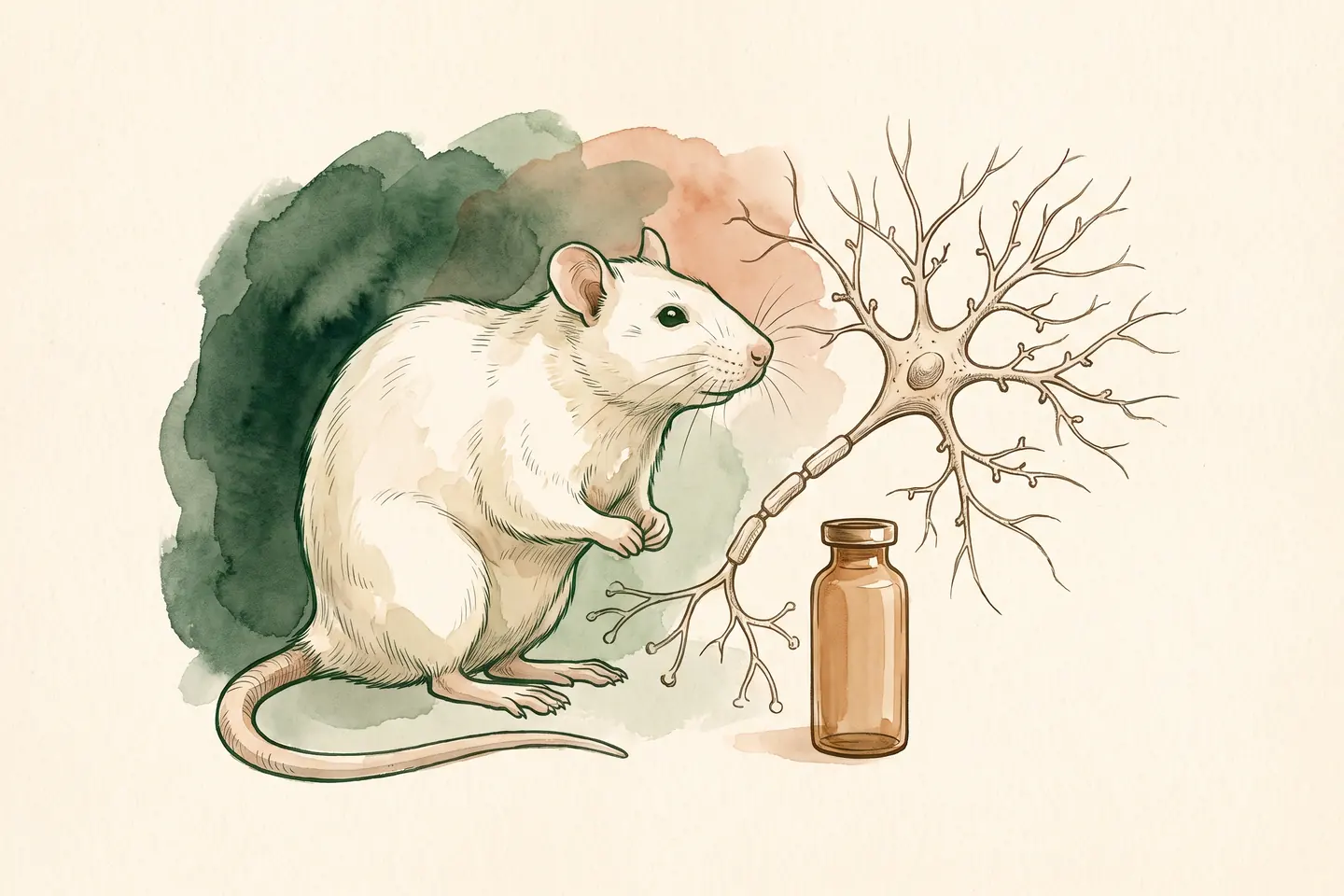
Oral dihexa reversed memory deficits in rats and improved maze performance in an Alzheimer's mouse model [1][5].
- Foundational rat study, 2013. Oral dihexa reversed scopolamine-induced spatial memory impairment in rats, and dihexa produced dendritic spinogenesis in cultured hippocampal neurons at picomolar concentrations [1].
- APP/PS1 mouse study, 2021. In a transgenic mouse model bred to develop Alzheimer's-like pathology, oral dihexa improved water maze performance and increased markers of synaptic density, an effect the authors attributed to PI3K/AKT signaling downstream of the receptor pathway [5]. A separate group ran this study, replicating oral efficacy. It is a real, peer-reviewed positive finding in a disease-relevant animal model, and it is still a mouse model, not a person.
- Systematic review, 2018. Across 32 preclinical studies of angiotensin IV and its analogs, including dihexa, the review found benefit in 8 of 9 cognitive-impairment rodent models [4]. It is the closest thing to an aggregated evidence base that exists.
Does dihexa work in every brain disease model?
Dihexa failed in a rat model of Huntington's disease, with no improvement in motor function, spatial memory or weight loss across 40 animals [6].
The 2024 study used 3-nitropropionic acid to induce Huntington's-like neurotoxicity [6]. The negative result shows that dihexa's procognitive effect is not a universal rescue of any damaged brain. It points to an effect that depends heavily on the specific model and mechanism of impairment being tested.
Has dihexa been tested in humans?
No human trial of dihexa has been registered or completed. Every dihexa study is preclinical, in rats or mice.
The gap in human data is total: no trials, no published case series, no pharmacokinetic profile and no established safety margin. The 2018 systematic review states explicitly that its search found zero qualifying human studies [4].
Where do dihexa doses come from?
Dihexa dosing protocols, including the forum figures of 5-20 mg and sublingual regimens, trace to no published study.
No published human pharmacokinetic study establishes dihexa's absorption, half-life or effective human dose by any route: oral, topical or injectable. The rodent studies used doses calculated for rat body weight and rat pharmacokinetics, delivered by researchers under controlled lab conditions, with brain and blood levels measured by the study team rather than self-reported by the animal.
Every number circulating in forums and seller blogs is a backward extrapolation or a copy of a copy, with no traceable origin in the peer-reviewed literature. A specific human milligram dose for dihexa is not sourced to any study, so treat it as folklore until proven otherwise.
What side effects does dihexa cause?
Dihexa's side effects are known only from anecdotal reports outside the peer-reviewed literature, and no controlled data exist.
Those reports describe headache, irritability, anxiety, overstimulation and, in some users, a paradoxical brain fog or cognitive blunting. They also describe irritation from the DMSO or ethanol solvents commonly used to dissolve dihexa for use. All of it is unverified self-report and should be weighed as such.
Does dihexa's c-Met pathway raise cancer concerns?
Dihexa raises a theoretical cancer question that no study has addressed: its proposed action runs through c-Met, an oncogene implicated in growth and metastasis across multiple cancer types.
The c-Met receptor is not a niche, cognition-only receptor. Activating a proliferative growth-factor pathway for the sake of hippocampal spinogenesis is a concern that has nothing to do with typical nootropic side-effect profiles.
None of the rodent studies was designed or powered to assess long-term proliferative or oncogenic risk. This is a different category of open question from anxiety or headache.
What evidence grade does dihexa earn?
Dihexa earns evidence grade E, minimal.
The rodent data are real, peer-reviewed and mechanistically coherent as a research program. They are largely oral-route and largely positive in memory-impairment and Alzheimer's models, and they come from a concentrated set of overlapping author groups, with one key mechanistic paper retracted and one disease model showing no effect at all.
That is a mechanistically interesting research program, not evidence of a human nootropic. The leap from it to a self-administered human dose, at a number nobody can source, through a receptor pathway with unresolved proliferative risk, has no support in any study. The dihexa evidence profile summarizes the grade and the studies behind it.
Sources
Last updated

Written by
Chemist and biochemist. Co-founder and author, The Peptide App.
Jay is a chemist, biochemist and entrepreneur whose work connects scientific research with consumer health products. He has held Chief Science Officer and product development leadership roles and previously served as Chief Revenue Officer at Minicircle.
Keep reading

Compound evidence
BDNF infusions triggered dose-limiting side effects in an ALS trial
Recombinant BDNF infused into the spinal fluid of ALS patients caused dose-related side effects that capped the dose. Exercise raises blood BDNF reliably.
Compound evidence
Swallowed peptides rarely survive; oral semaglutide is an exception
Swallowed peptides face stomach enzymes, intestinal enzymes, and gut-wall and liver barriers. Oral semaglutide is the clearest documented exception.
Profiles and tools

The Peptide App
Track protocols, doses, and reconstitution in one place.
Save your calculations, set reminders, log doses, and keep outcome notes — free to start.
 or scan the QR code →