
KPV curbed inflammation in rodent colitis and peritonitis models
KPV reduced inflammation in rodent colitis and peritonitis models from two research groups. No human trial exists, and oral uptake in people is unestablished.

By Jay Spall, chemist and biochemist
Disclosure: Jay is a co-founder of The Peptide App. This review discusses the studies cited below; it is not a comprehensive live trial registry or treatment recommendation. Development and regulatory status can change. The app’s tools organize records and arithmetic and do not validate a research product.
On this page
Key facts
| Question | Direct answer |
|---|---|
| What is KPV? | A three-amino-acid fragment (Lys-Pro-Val) matching the C-terminal end of alpha-MSH, a hormone the body produces naturally. KPV is not alpha-MSH itself. |
| Has KPV been tested in humans? | No. Every published finding comes from mouse models, rat models, or isolated human cell lines. No completed Phase 1 trial, RCT, or cohort study appears on PubMed or ClinicalTrials.gov as of mid-2026. |
| Does KPV's anti-inflammatory mechanism hold up? | In rodents, consistently. KPV suppresses NF-kB signaling and reduces inflammatory cell infiltration in murine peritonitis and colitis, through a pathway at least partly independent of classical melanocortin receptors [1][3]. The work is entirely preclinical. |
| Does swallowing KPV work the way forums say? | Unproven. Gut peptidases normally digest tripeptides before they enter circulation, KPV's cell and mouse data depend on the intestinal transporter PepT1, and the strongest delivery study needed a nanoparticle carrier to beat free peptide [2][5]. Plain oral capsules were not the tested format. |
| Is the microgram-and-cycling forum protocol evidence-based? | No. Every dose in the literature is a rodent dose, often given by injection or a targeted delivery system. Human numbers circulating online are extrapolation. |
| What is KPV's risk profile? | Unestablished. Users report injection-site irritation and mild flu-like symptoms with injectable use, no human safety trial exists, and unregulated research-grade material carries purity and identity risk. |
5 sources cited. View sources
What is KPV?
KPV is the three-residue C-terminal tail of alpha-MSH, Lys-Pro-Val, which retains a meaningful part of the full hormone's anti-inflammatory activity on its own. Alpha-MSH is a peptide hormone with several biological roles.
That retention is the entire premise of KPV as a research compound: strip the hormone down to its active tail and see whether the tail still works.
What do rodent studies show about KPV?
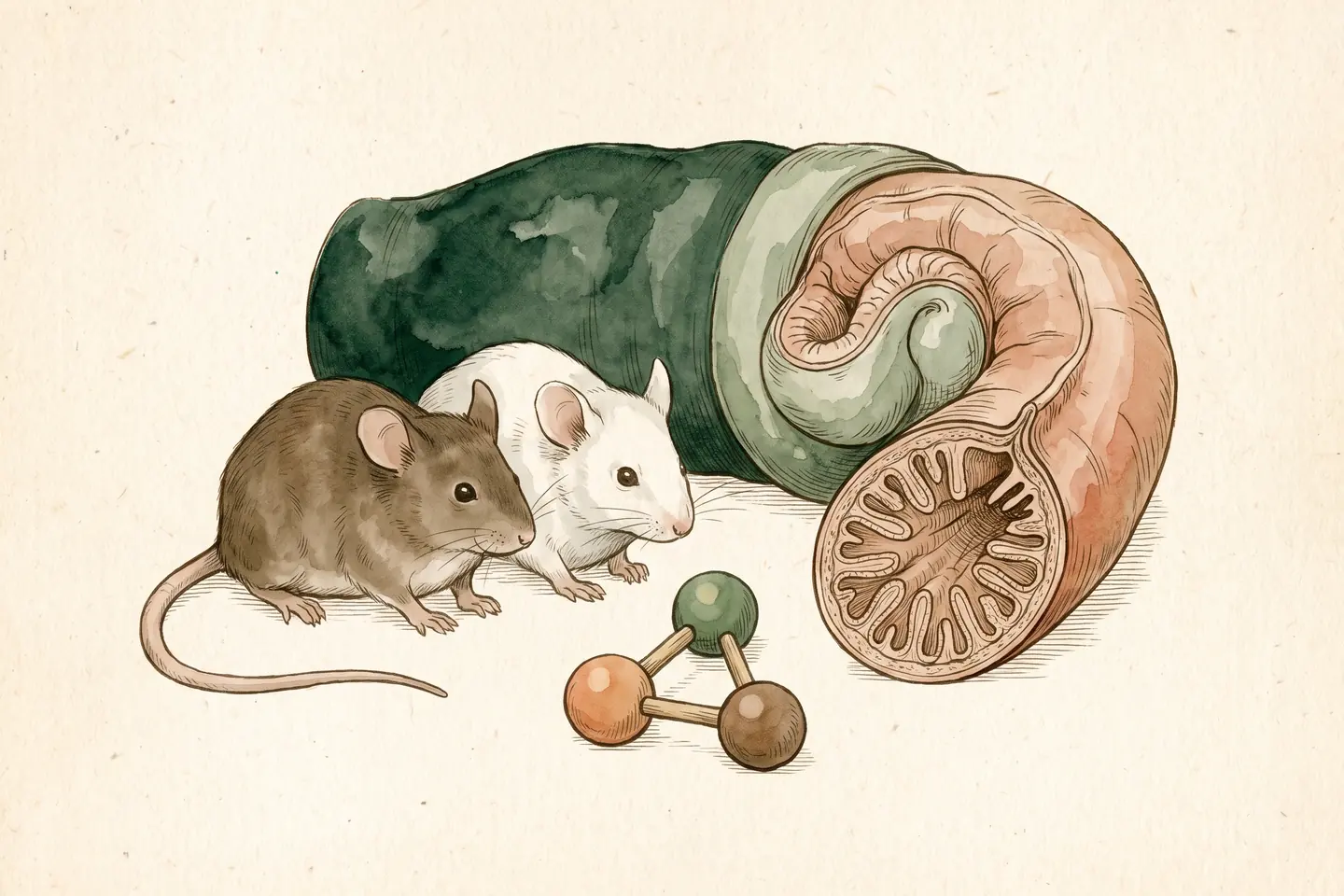
KPV reduced inflammation in at least three separate rodent disease models, run by two different research groups [1][2][3]. The results line up across models:
- Peritonitis. In a 2003 crystal-induced peritonitis model in mice, KPV reduced neutrophil accumulation about as effectively as the full alpha-MSH molecule [1]. Neutrophils are the first-responder immune cells that drive acute inflammation.
- Colitis. A 2008 study found KPV reduced inflammatory markers in DSS-induced and T-cell transfer colitis models and rescued MC1R-nonfunctional mice from lethal colitis [3].
- Oral colitis dosing. A separate 2008 study found oral KPV reduced colitis severity in two mouse models, DSS and TNBS [2].
The preclinical story is coherent and reasonably well replicated: a small peptide fragment that dampens inflammatory signaling, tested across at least three rodent models by two groups [1][2][3]. A 2007 review of alpha-MSH-derived peptides describes KPV as a promising candidate for a range of inflammatory conditions, on the condition that further translational work confirms it [4]. Forum summaries tend to drop that condition.
How does KPV reduce inflammation?
KPV suppresses NF-kB and MAP kinase signaling, the intracellular pathways that switch on production of pro-inflammatory cytokines, in human intestinal epithelial and T-cell lines [2]. That suppression depends on the peptide entering the cell through PepT1, a transporter normally used to move small peptides across the gut lining [2].
The mechanism does not appear to need the receptors alpha-MSH normally binds. In the 2003 peritonitis study, KPV's effect persisted in mice with nonfunctional MC1 receptors and was not blocked by an MC3/4 receptor antagonist [1]. The colitis study found the same pattern, rescuing MC1R-nonfunctional mice from lethal colitis [3].
Receptor-independent action is an active and still-narrow area of preclinical inquiry involving a handful of studies. Consumer coverage presents it as settled pharmacology. It is a consistent early signal in animal models, which is a different thing from a validated human mechanism.
What grade does the KPV evidence earn?
KPV carries a D (Limited) grade because every available citation falls into one of four buckets: rodent disease models (colitis, peritonitis), human cell lines in culture, drug-delivery engineering studies, or literature reviews summarizing those.
None of it is a human trial. A D grade does not mean the biology is fake. It means the evidence has not cleared the bar where anyone can say what KPV does in a living human, because nobody has published that study.
Consumer-facing coverage erases the distinction almost universally. A mouse colitis result becomes "helps gut inflammation." A cell-line NF-kB finding becomes "reduces inflammation in the body." The same compression shows up around gut claims, as the absent evidence for teduglutide and leaky gut illustrates.
Does oral KPV survive digestion?
Whether intact KPV survives human digestion is unestablished. Tripeptides are the size and structure gut peptidases are built to break down before absorption, a general problem covered in why peptides can't be swallowed.
KPV shows oral activity in mouse studies because its uptake appears to depend on PepT1, a transporter that can move certain small peptides across the intestinal wall intact [2]. No study establishes whether that transporter behaves the same way, at the same efficiency, in the different gut environment of a human swallowing a research-grade capsule.
The strongest direct evidence undercuts the "just take it orally" narrative. A 2017 drug-delivery study built hyaluronic acid-functionalized nanoparticles specifically to get KPV past the gut and to inflamed tissue, and that engineered system outperformed free, unprotected oral KPV at reducing colitis markers in mice [5]. The researchers built the carrier because free oral KPV was not doing the job efficiently on its own. A capsule of loose tripeptide is not equivalent to what was studied.
What KPV dose has been studied?
Every dose in the primary KPV literature is a rodent dose, given by injection, intraperitoneal delivery, or a specialized oral nanoparticle formulation, not a human oral capsule regimen.
No published human pharmacokinetic data establish what dose, if any, produces a detectable blood or tissue level of intact KPV in a person.
The microgram ranges and week-long cycling schedules in dosing guides derive from no study in the KPV literature. They are informal convention and should be read as such rather than as a calibrated protocol. What peptide dosing research tests covers how far those conventions sit from trial data.
What are KPV's side effects?
No controlled human trial has measured KPV's side effects. Users of injectable KPV report injection-site redness and soreness, and some report mild transient flu-like symptoms. Those reports are anecdotal.
No long-term human safety data exist for any route.
What is still unknown about KPV?
Four gaps separate KPV's rodent biology from any human use:
- Absorption. Whether intact KPV reaches meaningful concentrations in human blood or tissue after oral, injectable, or topical use is unknown.
- Mechanism. Whether the receptor-independent anti-inflammatory mechanism seen in rodents translates to human tissue at all is untested.
- Dose. No study establishes an effective or safe human dose by any route.
- Product identity. KPV is an unregulated research-use-only compound with no independent verification standard, so whether material sold as KPV matches its assumed purity and identity is unverified. Reading a peptide certificate of analysis is the only check available.
The product gap matters as much as the pharmacology. A compound with a strong mechanistic story is only as good as what is in the vial or capsule.
Sources
Last updated

Written by
Chemist and biochemist. Co-founder and author, The Peptide App.
Jay is a chemist, biochemist and entrepreneur whose work connects scientific research with consumer health products. He has held Chief Science Officer and product development leadership roles and previously served as Chief Revenue Officer at Minicircle.
Keep reading
Compound evidence
Teduglutide grows gut lining in short bowel syndrome, its approved use
Teduglutide grows intestinal lining and cuts IV nutrition needs in short bowel syndrome trials. No trial has tested it for leaky gut or IBS.
Compound evidence
Glucose blunts GHRH-driven GH release, giving fasted dosing a basis
Glucose blunts GHRH-stimulated growth hormone release, which gives fasted dosing a real basis. The timing windows and dietary fat rules have no such test.
Compound evidence
Swallowed peptides rarely survive; oral semaglutide is an exception
Swallowed peptides face stomach enzymes, intestinal enzymes, and gut-wall and liver barriers. Oral semaglutide is the clearest documented exception.
Profiles and tools

The Peptide App
Track protocols, doses, and reconstitution in one place.
Save your calculations, set reminders, log doses, and keep outcome notes — free to start.
 or scan the QR code →