
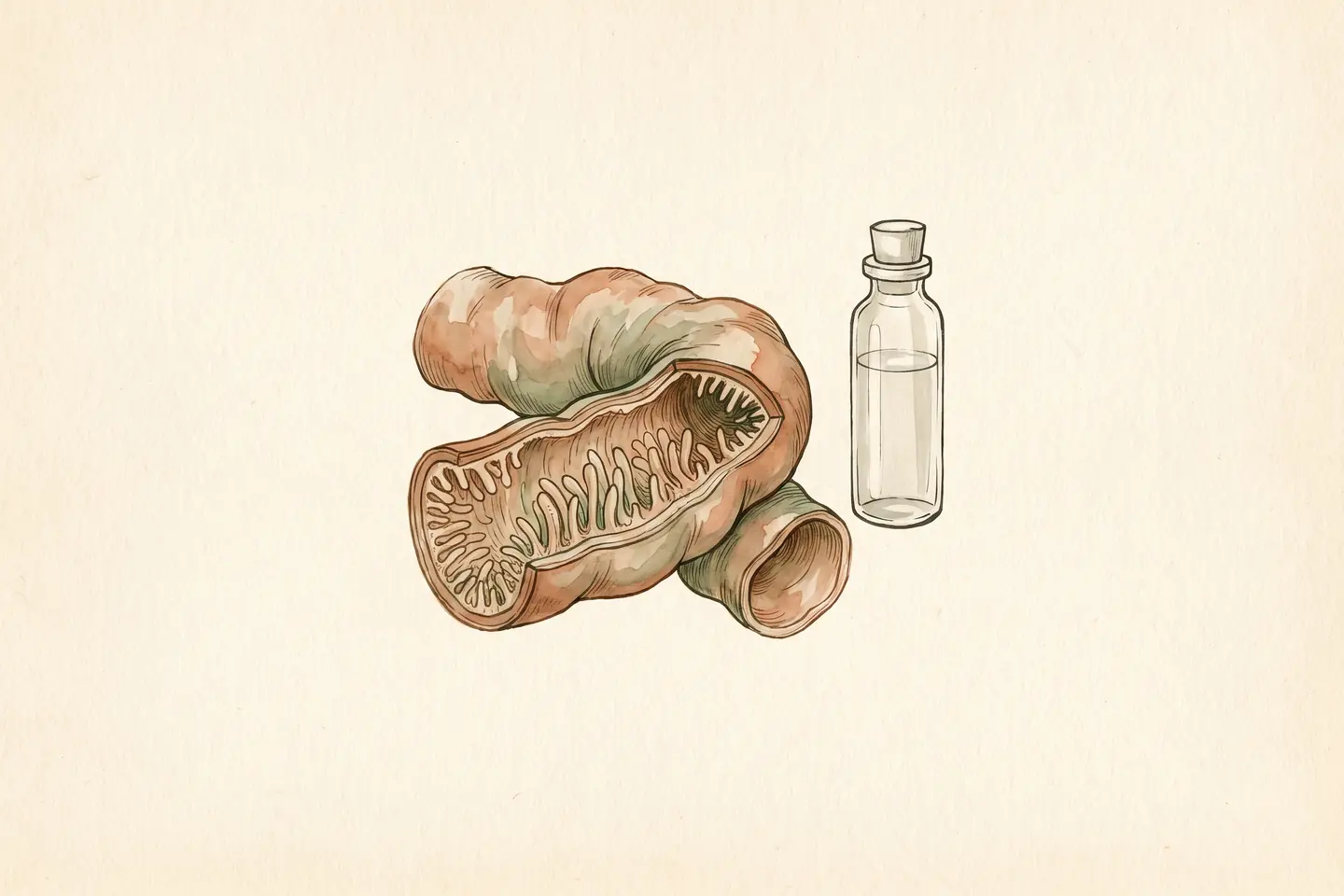
Teduglutide grows gut lining in short bowel syndrome, its approved use
Teduglutide grows intestinal lining and cuts IV nutrition needs in short bowel syndrome trials. No trial has tested it for leaky gut or IBS.

By Jay Spall, chemist and biochemist
Disclosure: Jay is a co-founder of The Peptide App. This review discusses the studies cited below; it is not a comprehensive live trial registry or treatment recommendation. Development and regulatory status can change. The app’s tools organize records and arithmetic and do not validate a research product.
On this page
- What is teduglutide approved for?
- How does teduglutide work?
- How well does teduglutide work in short bowel syndrome?
- Has teduglutide been tested for leaky gut or IBS?
- Why doesn't teduglutide's short bowel evidence carry over to a normal bowel?
- Why does teduglutide require colonoscopy surveillance?
- What does the evidence for leaky gut treatments look like?
- Is zonulin a reliable measure of leaky gut?
- What is still unknown about teduglutide in a normal bowel?
- Sources
Key facts
| Question | Direct answer |
|---|---|
| Is teduglutide approved for leaky gut or IBS? | No. Teduglutide's only approval is for short bowel syndrome with intestinal failure (SBS-IF) in patients who depend on parenteral nutrition or IV fluids. |
| Does teduglutide regrow intestinal lining? | Yes, in short bowel syndrome. As a GLP-2 analog, teduglutide increases villus height and crypt depth in SBS trials [3][4], a compensatory response to resected bowel, not a general repair switch. |
| Has teduglutide been tested for leaky gut or IBS? | No. Every controlled trial cited below enrolled SBS-IF patients on parenteral support [3][4][5][6], and none studied intact bowel, IBS, or permeability markers. |
| Why is teduglutide's growth effect a caution in its approved population? | GLP-2 signaling is mitogenic to mucosa, so prescribing information for the approved use requires colonoscopy surveillance. The cited trials do not report that surveillance data directly. |
| Does anything have real evidence for "leaky gut"? | Modest biomarker shifts. Some RCTs show diet or probiotic interventions shift zonulin or lipopolysaccharide [1][7][8], with certainty graded very low to moderate, and the biomarkers themselves remain contested [2][9]. |
| Will teduglutide help IBS or nonspecific gut symptoms in a normal bowel? | No trial evidence says it will. Teduglutide was studied in people with a structural deficit that an anatomically normal bowel does not have. |
9 sources cited. View sources
What is teduglutide approved for?
Teduglutide is FDA-approved only for short bowel syndrome with intestinal failure (SBS-IF), in patients who depend on parenteral nutrition or IV fluids.
In short bowel syndrome, a resection has removed absorptive surface area. Leaky gut, IBS, and nonspecific digestive symptoms are not approved uses.
How does teduglutide work?
Teduglutide is a DPP-4 resistant analog of glucagon-like peptide 2 (GLP-2), engineered to survive longer than native GLP-2 so it can be dosed once daily.
GLP-2 receptor signaling in the intestine drives crypt cell proliferation and reduces enterocyte apoptosis. That is why treated patients show measurable increases in villus height and crypt depth. In short bowel syndrome, that trophic push is compensatory: it partially rebuilds surface area the patient no longer has.
A post hoc analysis of the pivotal STEPS trial found that plasma citrulline, a marker of functional enterocyte mass, rose more with teduglutide than with placebo. The citrulline change correlated inversely with the change in parenteral support volume [4]. That correlation is the clearest evidence that the mechanism does what it is supposed to do in SBS-IF: more functional mucosa, less need for IV nutrition.
How well does teduglutide work in short bowel syndrome?
Teduglutide reduces parenteral nutrition and fluid requirements in SBS-IF, and the evidence is solid: multiple randomized, placebo-controlled trials and long-term open-label extensions in adults and children.
A systematic review of adult data found teduglutide reduced parenteral nutrition and fluid requirements compared with placebo, with similar adverse event rates between arms across the trials reviewed [3].
The STEPS-3 extension followed patients for up to 42 months. Patients treated continuously since the original trial had mean parenteral support reductions of roughly 9.8 liters per week, a 50% drop from baseline, and two of fourteen patients achieved full independence from parenteral support by the end of the extension [5].
In infants and children, open-label phase 3 studies found that parenteral support requirements dropped by at least 20% from baseline in a majority of treated patients by 24 weeks. Some children achieved enteral autonomy entirely [6].
Has teduglutide been tested for leaky gut or IBS?
No clinical trial has tested teduglutide for leaky gut or IBS. Every controlled trial cited below enrolled patients with SBS-IF on parenteral support [3][4][5][6], people with a documented anatomical deficit and existing dependence on parenteral nutrition.
None of those trials included people with normal bowel length, nonspecific GI symptoms, or a diagnosis of "leaky gut," and none measured permeability biomarkers as an outcome. The population studied and the population being marketed to online are not the same population. The trial evidence does not transfer between them by default.
For someone with IBS or nonspecific gut symptoms and an anatomically normal bowel, no trial evidence shows teduglutide does anything. For a peptide drug that works in the gut without being absorbed, see how linaclotide works.
Why doesn't teduglutide's short bowel evidence carry over to a normal bowel?
Teduglutide's benefit in short bowel syndrome compensates for missing absorptive surface, and an anatomically normal bowel is not missing any.
Nothing about the GLP-2 mechanism implies the same growth signal is neutral or beneficial in a bowel that already has normal length and normal absorptive capacity. Growth-promoting signaling aimed at tissue that is not missing anything is a different biological question. The SBS trials were not designed to answer it.
Why does teduglutide require colonoscopy surveillance?
Teduglutide's approved use requires colonoscopy screening before starting and periodic surveillance afterward, because GLP-2 mediated mucosal proliferation is a proliferative signal in any bowel it is given to.
That monitoring burden is built directly into how teduglutide is prescribed for its approved indication. The requirement does not trace to a specific figure in the cited trial reports. Adverse event tables in the systematic review and the pediatric study emphasize events consistent with known SBS-IF complications and known teduglutide reactions, not long-term neoplasia rates [3][6]. The surveillance requirement is a structural fact about teduglutide's growth mechanism, not a statistic from a single trial.
The surveillance exists because sustained trophic signaling to intestinal mucosa is not risk-free, even in a population where the growth compensates for missing tissue. Applying the same signal to mucosa that is not missing anything removes the compensatory justification and keeps the proliferative mechanism intact. None of the trials cited below shows what that trade-off looks like.
What does the evidence for leaky gut treatments look like?
Randomized trials of diet and probiotic interventions show modest, heterogeneous shifts in permeability biomarkers such as zonulin and lipopolysaccharide [1][7][8]. That literature is a useful contrast in evidence quality.
A meta-analysis of probiotic, synbiotic, and prebiotic trials found significant reductions in lipopolysaccharide and zonulin levels after supplementation. It rated the certainty of evidence as very low for lipopolysaccharide and moderate for zonulin, with high statistical heterogeneity across studies [1].
A randomized crossover trial in older adults found that a polyphenol-rich diet reduced serum zonulin after eight weeks compared with a control diet [7]. A secondary analysis of a probiotic trial for depression found that permeability markers predicted which patients benefited on liver-related outcomes [8].
These are real randomized trials with real, if modest and heterogeneous, effects on biomarkers. None of them involves teduglutide. Larazotide acetate and the leaky gut myth examines the same concept through another peptide.
Is zonulin a reliable measure of leaky gut?
Zonulin is not a settled measure of intestinal permeability.
A meta-analysis in liver cirrhosis patients found significantly elevated zonulin versus controls but flagged extremely high heterogeneity between the four included studies [2]. A validation study of sugar-based permeability testing in healthy adults noted that the methodology is still being normalized, with only pilot data available in IBS-D patients [9].
Even the interventions studied for permeability outcomes carry hedged, heterogeneous evidence. That makes the complete absence of any teduglutide trial in this population more conspicuous, not less relevant.
What is still unknown about teduglutide in a normal bowel?
The trophic mechanism itself is not in dispute [3][4]; what teduglutide does to tissue that did not need rebuilding is the open question.
- Permeability and symptoms. None of the trials cited below tested whether GLP-2 receptor agonism changes intestinal permeability markers, symptom scores, or barrier function in people with an anatomically intact bowel.
- Neoplasia risk. Whether the neoplasia-related risk that justifies colonoscopy monitoring in SBS-IF patients applies proportionally, more, or less in a normal bowel is untested.
- The missing trial. The question stays open because nobody has run a trial built to answer it.
Sources
-
Ghorbani Z, Shoaibinobarian N, Noormohammadi M (2025). Reinforcing gut integrity: A systematic review and meta-analysis of clinical trials assessing probiotics, synbiotics, and prebiotics on intestinal permeability markers. Pharmacol Res. pubmed.ncbi.nlm.nih.gov/40378939
-
Dumitru A, Tocia C, Dumitru E (2025). Intestinal permeability assessed by serum zonulin in liver cirrhosis: A systematic review and meta-analysis. Medicine (Baltimore). pubmed.ncbi.nlm.nih.gov/40258754
-
Naberhuis JK, Tappenden KA (2016). Teduglutide for Safe Reduction of Parenteral Nutrient and/or Fluid Requirements in Adults: A Systematic Review. JPEN J Parenter Enteral Nutr. pubmed.ncbi.nlm.nih.gov/25883117
-
Jeppesen PB, Gabe SM, Seidner DL (2020). Citrulline correlations in short bowel syndrome-intestinal failure by patient stratification: Analysis of 24 weeks of teduglutide treatment from a randomized controlled study. Clin Nutr. pubmed.ncbi.nlm.nih.gov/31784300
-
Seidner DL, Fujioka K, Boullata JI (2018). Reduction of Parenteral Nutrition and Hydration Support and Safety With Long-Term Teduglutide Treatment in Patients With Short Bowel Syndrome-Associated Intestinal Failure: STEPS-3 Study. Nutr Clin Pract. pubmed.ncbi.nlm.nih.gov/29761915
-
Chiba M, Masumoto K, Kaji T (2023). Efficacy and Safety of Teduglutide in Infants and Children With Short Bowel Syndrome Dependent on Parenteral Support. J Pediatr Gastroenterol Nutr. pubmed.ncbi.nlm.nih.gov/37364133
-
Del Bo' C, Bernardi S, Cherubini A (2021). A polyphenol-rich dietary pattern improves intestinal permeability, evaluated as serum zonulin levels, in older subjects: The MaPLE randomised controlled trial. Clin Nutr. pubmed.ncbi.nlm.nih.gov/33388204
-
Gawlik-Kotelnicka O, Rogalski J, Czarnecka-Chrebelska KH (2024). The Interplay Between Depression, Probiotics, Diet, Immunometabolic Health, the Gut, and the Liver-A Secondary Analysis of the Pro-Demet Randomized Clinical Trial. Nutrients. pubmed.ncbi.nlm.nih.gov/39683419
-
Khoshbin K, Khanna L, Maselli D (2021). Development and Validation of Test for "Leaky Gut" Small Intestinal and Colonic Permeability Using Sugars in Healthy Adults. Gastroenterology. pubmed.ncbi.nlm.nih.gov/33865841
Last updated

Written by
Chemist and biochemist. Co-founder and author, The Peptide App.
Jay is a chemist, biochemist and entrepreneur whose work connects scientific research with consumer health products. He has held Chief Science Officer and product development leadership roles and previously served as Chief Revenue Officer at Minicircle.
Keep reading
Compound evidence
Larazotide eased celiac symptoms but missed its permeability endpoint
Larazotide reduced gluten-triggered symptoms in four celiac trials. It missed its permeability endpoint in the larger ones, and Phase 3 was halted in 2022.

Compound evidence
Linaclotide works as a pill because its receptor faces into the gut
Linaclotide acts on receptors facing the inside of the gut, so it never needs absorption. Trials show strong constipation benefit and weaker pain evidence.
Compound evidence
GHK-Cu injection bypasses the gut's copper regulation
Injected GHK-Cu skips the gut checkpoint that regulates copper absorption, and copper is about 16% of its mass. No study has measured copper levels in users.
Profiles and tools

The Peptide App
Track protocols, doses, and reconstitution in one place.
Save your calculations, set reminders, log doses, and keep outcome notes — free to start.
 or scan the QR code →