
GHK-Cu injection bypasses the gut's copper regulation
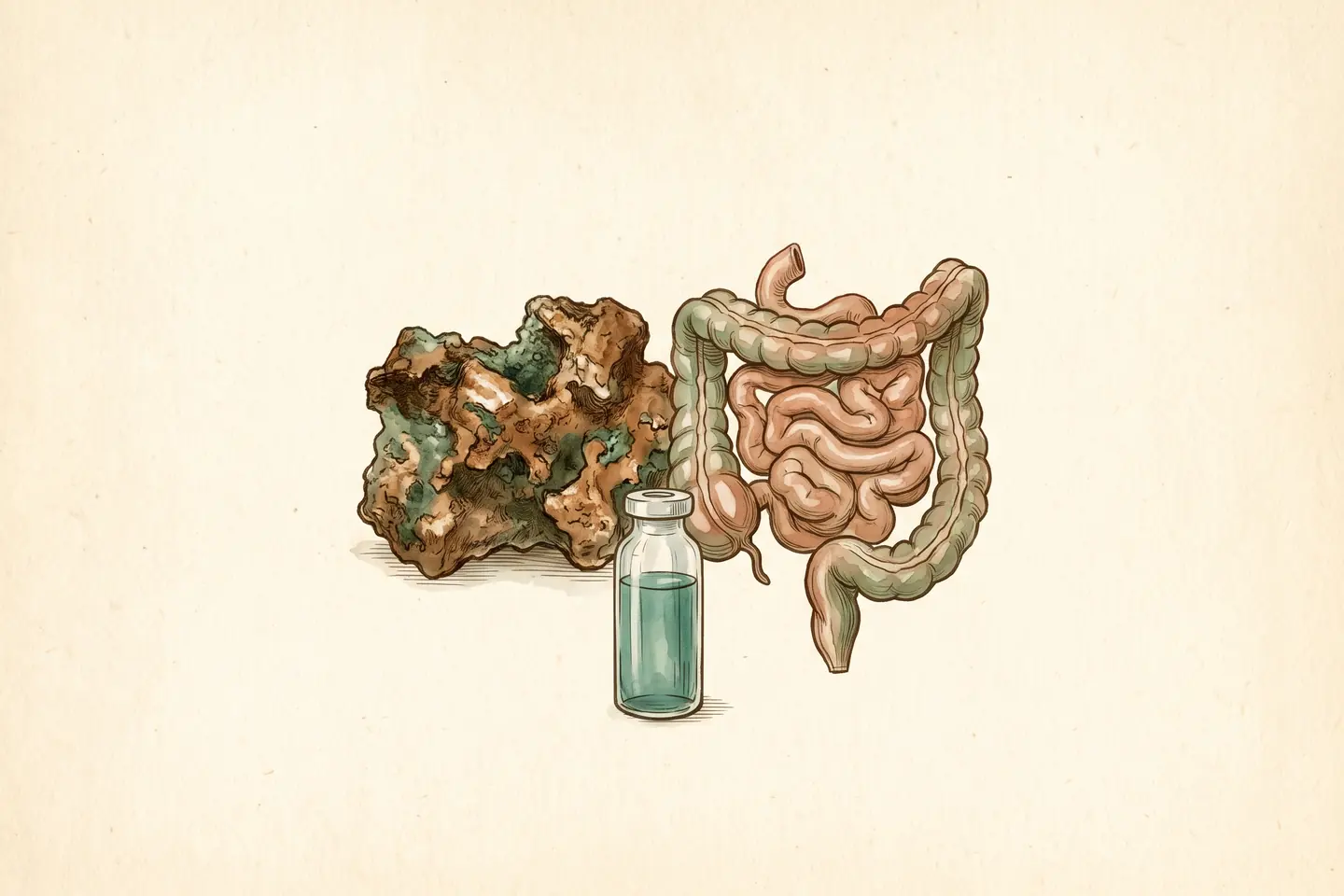
Injected GHK-Cu skips the gut checkpoint that regulates copper absorption, and copper is about 16% of its mass. No study has measured copper levels in users.

By Jay Spall, chemist and biochemist
Disclosure: Jay is a co-founder of The Peptide App. This review discusses the studies cited below; it is not a comprehensive live trial registry or treatment recommendation. Development and regulatory status can change. The app’s tools organize records and arithmetic and do not validate a research product.
On this page
Key facts
| Question | Direct answer |
|---|---|
| Does injecting GHK-Cu daily deliver too much copper? | Nobody has measured it. No published human study tracks blood copper or ceruloplasmin in GHK-Cu users, and injection skips the gut's absorption control, so the oral upper limit does not transfer cleanly. |
| How much elemental copper is in a GHK-Cu dose? | Copper accounts for roughly one-sixth of the complex's mass by basic peptide chemistry, so a milligram of the complex carries a fraction of a milligram of copper. No study reports what real-world injection regimens add up to over weeks or months. |
| Does the body handle injected copper differently from dietary copper? | Yes. Oral copper absorption is tightly regulated at the intestinal wall before copper reaches the bloodstream [6]. Injection bypasses that checkpoint and delivers copper straight into tissue. |
| Is there a safe copper ceiling, and does it apply to injections? | The tolerable upper intake level for oral copper in adults is 10 mg per day [5]. That figure was built for dietary and supplement intake regulated by gut absorption, and it was never designed for a parenteral route. |
| Has copper been given by injection safely? | Yes, in parenteral nutrition. Those guidelines are careful and have moved toward lower copper doses than earlier practice, precisely because bypassing the gut changes the risk math [2][4][7]. |
| Is daily injection more concerning than a copper pill? | The comparison has not been studied. Route changes toxicology for trace minerals in general, and "small dose equals safe dose" does not carry over automatically from mouth to needle [3][6]. |
7 sources cited. View sources
Does injecting GHK-Cu deliver too much copper?
No published study has measured copper status in people who inject GHK-Cu. No study reports serum copper, ceruloplasmin, or any other marker of copper status in GHK-Cu users, at any frequency or duration.
That gap is the whole problem. The oral copper limits that people reach for were built for a route that injection bypasses, and the parenteral copper guidelines were built for patients with no other copper source.
What is GHK-Cu?
GHK-Cu is a copper complex, not only a peptide: three amino acids, glycine, histidine, and lysine, in a naturally occurring human sequence, holding a copper ion inside the structure. The "Cu" in the name is not decorative. The molecule's biological identity depends on that copper being present.
Tissue peptidases break down the peptide backbone on a normal biological timescale, and the copper ion does not disappear when they do. It is released into the local pool of free and loosely bound copper, where it meets the same handling machinery as copper from any other source: transport proteins, ceruloplasmin binding, and eventual redistribution or excretion, governed by copper-specific transporters such as ATP7A and ATP7B [6].
That distinction matters. A peptide that transiently interacts with a copper-dependent enzyme makes a different biological claim from a peptide that works as a copper delivery vehicle. GHK-Cu is the second. Every dose is mechanistically a copper dose with a peptide wrapper.
Why does injection change the copper question?
Injection removes the intestinal checkpoint that regulates how much copper enters the body. Dietary copper has to cross the intestinal lining, and that crossing is actively regulated: the body adjusts how much copper it absorbs and how much it excretes back into the gut and bile, based on existing copper status [6].
That regulation keeps oral intake within a workable range even when diets vary widely from day to day. Every published tolerable upper intake level assumes it is intact and functioning.
Copper delivered under the skin or into muscle enters tissue and circulation without passing through the absorption control step at all.
The problem is not unique to GHK-Cu. Parenteral nutrition formularies treat copper dosing as a separate problem from oral intake recommendations, and those formularies have trended toward more conservative copper doses as the field has learned more about accumulation risk in patients who cannot excrete it normally [2][4]. Trace element supplementation guidelines for parenteral nutrition warn that copper beyond baseline contamination levels can push some patients into toxicity, particularly neonates with immature excretory systems [7].
Once the gut is bypassed, the safe dose becomes a different question from the one answered for a pill or a meal.
How much copper is in a milligram of GHK-Cu?
Roughly one-sixth of a milligram. The GHK tripeptide backbone weighs roughly 340 grams per mole before binding copper, and the chelated complex comes out to roughly 400 grams per mole, which puts elemental copper at around 16 percent of the compound's total mass. That figure follows from standard atomic and peptide chemistry rather than from a clinical measurement.
The oral reference figures do have citations. An exposure-response modeling review estimates an optimal oral copper intake around 2.6 mg per day, above the U.S. recommended dietary intake of 0.9 mg per day and below the tolerable upper intake level of 10 mg per day [5].
By that arithmetic, a single small injected dose is unlikely to approach 10 mg of copper on its own. What no study reports is what a realistic daily, repeated injection regimen adds up to over weeks, how it compares against an oral reference that assumes intact gut regulation, or how either squares with tissue absorbing copper without the buffering step the reference range was built around.
Does stacking oral copper sources exceed the limit?
Not reliably. One review of combined ocular-vitamin and multivitamin use found that copper, unlike vitamin A and zinc, generally stayed under the recommended upper intake ceiling even when products were combined [1].
That is a reassuring data point for oral copper. It says nothing about an injected route with no absorption ceiling at all.
What does copper toxicology establish?
Copper's oral dose-response relationship is unusually well characterized for a trace mineral, and its parenteral evidence base is separate and more cautious.
A modeling review built an exposure-response curve spanning both copper deficiency and excess, landing on an estimated optimal intake of 2.6 mg per day, bracketed by a 0.9 mg per day recommended minimum and a 10 mg per day upper limit [5]. That curve exists because copper toxicity and deficiency have both been studied across enough populations and exposure routes to model the relationship with some confidence, at least for oral and drinking-water exposure.
Parenteral copper has its own evidence base, built almost entirely around patients on total or partial parenteral nutrition who cannot eat normally. That literature has moved toward lower, more cautious copper dosing over successive guideline revisions, because injected copper behaves differently from dietary copper and because monitoring tools for trace element status remain limited [2].
Pediatric and neonatal guidance goes further. Requirements and toxicity thresholds shift meaningfully with age, weight, and clinical status, and copper contaminating standard IV fluids can be enough to meet needs without any added supplementation [4][7].
None of that work was generated to answer the GHK-Cu question. It establishes that injected copper is a different pharmacokinetic situation from oral copper, with its own dosing logic built by clinicians managing closely monitored patients who have no other copper source. It does not describe what happens to someone injecting a copper peptide daily while eating a normal, copper-containing diet.
What is unknown about injected GHK-Cu and copper?
Four things about injected GHK-Cu have never been measured:
- Copper status in users. No study measures serum copper, ceruloplasmin, or any marker of copper status in people using GHK-Cu injections, at any frequency or duration. Which lab panels to run before starting peptides covers what baseline testing shows.
- Breakdown rate. How fast human tissue breaks down the peptide, and therefore how quickly its copper becomes free and enters normal handling pathways, is not characterized in any of the studies cited below.
- A parenteral dose-response curve. No published equivalent of the oral exposure-response curve [5] exists for repeated parenteral or subcutaneous copper-peptide dosing outside the clinical parenteral nutrition setting.
- An upper limit for the route. No tolerable upper intake level has been established for injected copper peptides.
Non-oral routes carry their own risk profile for other trace minerals too. A review of zinc toxicity notes that inhalation and topical exposure can pose risks that do not map onto oral reference values [3].
Whether daily GHK-Cu injection amounts to a trivial trace top-up or a meaningful cumulative load is an unmeasured question rather than an answered one. Topical GHK-Cu's trial evidence covers the route that has been tested in randomized trials, and the three-peptide GHK-Cu combination covers what happens to the copper question when compounds are stacked.
Sources
-
Vellos K, Highland J, Yousefzai R (2019). Dosage considerations in the combined use of ocular-specific vitamins and nutrients and multivitamin products: A systemic review and analysis. J Am Pharm Assoc (2003). pubmed.ncbi.nlm.nih.gov/30948238
-
Osland EJ, Ali A, Isenring E (2014). Australasian Society for Parenteral and Enteral Nutrition guidelines for supplementation of trace elements during parenteral nutrition. Asia Pac J Clin Nutr. pubmed.ncbi.nlm.nih.gov/25516311
-
Schoofs H, Schmit J, Rink L (2024). Zinc Toxicity: Understanding the Limits. Molecules. pubmed.ncbi.nlm.nih.gov/38999082
-
Zemrani B, McCallum Z, Bines JE (2018). Trace Element Provision in Parenteral Nutrition in Children: One Size Does Not Fit All. Nutrients. pubmed.ncbi.nlm.nih.gov/30469420
-
Chambers A, Krewski D, Birkett N (2010). An exposure-response curve for copper excess and deficiency. J Toxicol Environ Health B Crit Rev. pubmed.ncbi.nlm.nih.gov/21170809
-
van den Berghe PV, Klomp LW (2009). New developments in the regulation of intestinal copper absorption. Nutr Rev. pubmed.ncbi.nlm.nih.gov/19906252
-
Burjonrappa SC, Miller M (2012). Role of trace elements in parenteral nutrition support of the surgical neonate. J Pediatr Surg. pubmed.ncbi.nlm.nih.gov/22498394
Last updated

Written by
Chemist and biochemist. Co-founder and author, The Peptide App.
Jay is a chemist, biochemist and entrepreneur whose work connects scientific research with consumer health products. He has held Chief Science Officer and product development leadership roles and previously served as Chief Revenue Officer at Minicircle.
Keep reading
Compound evidence
Topical GHK-Cu closed diabetic ulcers faster in a 40-patient trial
Topical GHK-Cu gel closed diabetic ulcers faster than vehicle in a 40-patient trial. Injectable GHK-Cu has no published human trial.
Combinations and evidence
TB-500's parent protein has stronger human data than GHK-Cu or BPC-157
Thymosin beta-4, TB-500's parent protein, has small controlled trials, but none tested the TB-500 fragment. No study has tested all three peptides together.
Compound evidence
Injection route matters for peptides, but effects vary by molecule
Route effects vary by molecule: glucagon peaked higher intramuscularly yet reached similar total exposure. Most peptides people inject lack human route data.
Profiles and tools

The Peptide App
Track protocols, doses, and reconstitution in one place.
Save your calculations, set reminders, log doses, and keep outcome notes — free to start.
 or scan the QR code →