Healing Category
Bronchogen
THE LUNG RESTORER
AEDL peptide
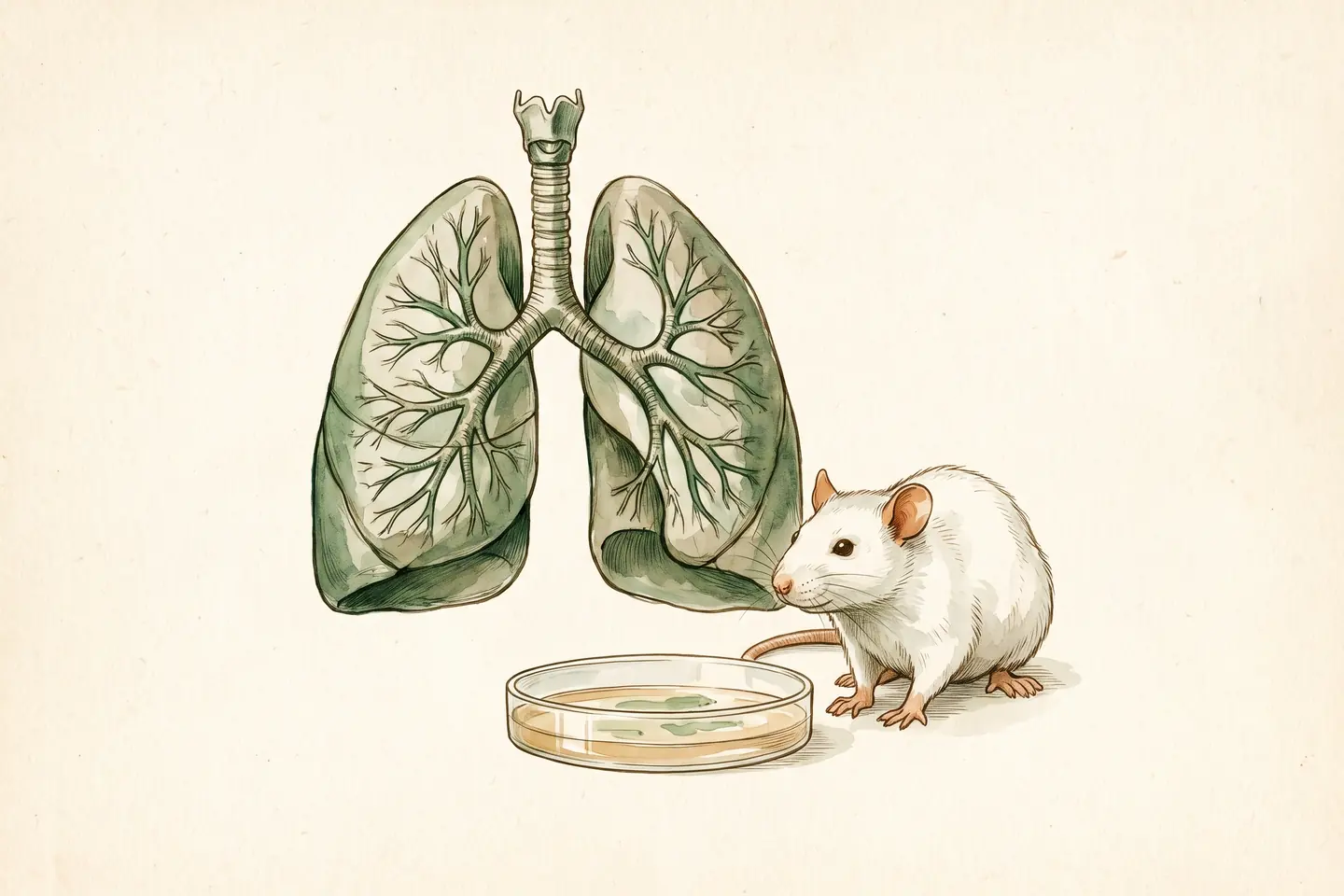
Bronchogen is a short peptide (AEDL) from the Khavinson family designed to support respiratory health. It works by modifying gene expression in lung tissue, helping restore the epithelial lining, reduce inflammation, and improve surfactant production. It's studied for COPD, chronic bronchitis, and age-related lung decline.
Bronchogen Evidence Snapshot
How these guides are reviewed- Regulatory status
- Not FDA approved · research use only
- Dosing guidance
- Reviewed by our clinical team
- Linked evidence
- 6 research sources
- Content updated
- May 8, 2026
Dose and schedule recommendations shown below come from The Peptide App Clinical Team. Research links are provided so readers can inspect the supporting evidence directly. Review the sources.
Quick Answers About Bronchogen
Is Bronchogen FDA approved?
No. This profile records Bronchogen as not FDA approved and for research use only.
More context
Review the regulatory and source details on this page for the current context.
What dose does The Peptide App Clinical Team recommend for Bronchogen?
Dose: 750 mcg daily.
More context
Schedule: daily. Cycle: 4 weeks on, 8 weeks off. This is clinical-team guidance for reference and does not replace individualized instructions from a licensed clinician.
What research supports this Bronchogen guide?
This guide links to 6 curated or current research sources.
More context
Open the research section to inspect the source titles, publication details, study types, and available abstracts directly.
Review the Bronchogen research sourcesStudied Effects & Mechanisms
Epigenetic Regulation
Binds DNA to modify gene expression in lung tissue
Anti-Inflammatory
Reduces pro-inflammatory cytokines (TNF-α, IL-6)
Epithelial Repair
Restores bronchial lining and mucosal barrier function
Surfactant Production
Enhances lung surfactant for better gas exchange
Clinical & Research Context
People with COPD or chronic bronchitis · Smokers or former smokers · Those recovering from respiratory infections · Aging individuals with declining lung function · Anyone exposed to environmental pollutants
Research-Market Price Snapshot
A compact market signal for this profile. The dedicated pricing page owns vendor, vial-size, and price-per-mg comparisons.
Updated Jul 16, 2026
- Vendors
- 6
- Listings
- 6
- Observed range
- $32–$70
Bronchogen Research
Live PubMed intelligence from the research crawler
Effect of the peptide bronchogen (Ala-Asp-Glu-Leu) on DNA thermostability.
Bulletin of experimental biology and medicine · Jan 1, 2011
Thermodynamic parameters of DNA melting in the presence of a peptide bronchogen in various concentrations were estimated on a differential scanning microcalorimeter. Bronchogen was shown to serve as a DNA-stabilizing agent. Bronchogen increased the melting temperature of DNA from calf thymus and mouse liver by 3.1°C in a narrow range of r (molar ratio of bronchogen/DNA b.p., 0.01-0.055). A further increase in r was not accompanied by changes in the melting temperature. The complex melting enthalpy (ΔH(melt)) remained unchanged in this range of r (0.01-1.0). ΔH(melt) for DNA from the thymus and mouse liver was 11.4 and 12.7 cal/g, respectively. Our results indicate that bronchogen is not an adenine-thymine-specific or guanine-cytosine-specific ligand. The type of binding is considered as strong and occasional. The binding occurs with both strands of DNA (mainly with nitrogen bases).
CT-guided percutaneous large-needle aspiration and bleomycin sclerotherapy for bronchogenic cyst: report of four cases.
Journal of vascular and interventional radiology : JVIR · Jul 1, 2010
PURPOSE: Fine needle aspiration alone has been used as a treatment for bronchogenic cysts, but is subject to a high rate of recurrence. The purpose of this study was to review our experience with computed tomography (CT)-guided percutaneous large-needle aspiration and bleomycin sclerotherapy of bronchogenic cysts in four patients. MATERIALS AND METHODS: Four patients with bronchogenic cysts at subcarinal (n = 1), paraspinal (n = 1), or intrapulmonary (n = 2) sites were treated at two medical centers with percutaneous transthoracic aspiration with a 17.5-gauge needle and sclerotherapy with use of bleomycin as the sclerosant agent. Clinical symptoms were seen in three of the four patients: recurrent cough in two and recurrent chest discomfort and palpitation in one. CT was used to guide the procedures. After sclerotherapy, the sizes of ablated cysts were followed by CT. RESULTS: At a median follow-up of 10 months (range, 6-14 months), all three patients with symptoms had symptomatic relief and all four patients showed a nearly complete regression of bronchogenic cyst on follow-up CT. No recurrence was encountered. Minor complications included a small asymptomatic pneumothorax at the end of the procedure in one patient and a mild fever (38.0 degrees C-38.5 degrees C) on the first day after sclerotherapy in one patient, which resolved spontaneously without treatment. No major complications occurred. CONCLUSIONS: CT-guided percutaneous treatment of bronchogenic cysts with large-needle aspiration and bleomycin sclerotherapy was safe and effective in this limited series. Further investigation of this technique is warranted.
[ANTIINFLAMMATORY AND REGENERATIVE EFFECT OF PEPTIDE THERAPY IN THE MODEL OF OBSTRUCTIVE LUNG PATHOLOGY].
Rossiiskii fiziologicheskii zhurnal imeni I.M. Sechenova · Feb 1, 2017
The effect of the tetrapeptide bronchogen on the structural and functional state of the bronchial epithelium and inflammatory activity in the lungs was studied in the chronic obstructive pulmonary disease (COPD) model, created in rats by a 60-day intermittent exposure to nitrogen dioxide. The cell composition and cytokine-enzyme profile of bronchoalveolar lavage fluid (BALF), the content of secretory immunoglobulin A and surfactant protein B in BALF were determined. Following the course of peptide treatment the decreased activity of neutrophilic inflammation with the normalization of cellular composition and profile of pro-inflammatory cytokines and enzymes in the bronchoalveolar space was observed. The structure of bronchial epithelium, disturbed during formation of COPD model, was restored and accompanied by restoration of its functional activity as evidenced by an increase of secretory immunoglobulin A (local immunity marker) and surfactant protein B, responsible for reducing the alveolar surface tension.
Modulating Effect of Peptide Therapy on the Morphofunctional State of Bronchial Epithelium in Rats with Obstructive Lung Pathology.
Bulletin of experimental biology and medicine · Sep 1, 2015
On the model of chronic obstructive pulmonary disease, the effect of therapy with low-molecular-weight peptides on restructuring and functional activity of bronchial epithelium for restoring the immune and barrier function of the lungs and prevention of inflammatory process progression was studied. Chronic obstructive pulmonary disease was modeled in rats by 60-day intermittent exposure to NO2. Administration of tetrapeptide Bronchogen for 1 month eliminates symptoms of remodeling of the bronchial epithelium and lung tissue typical of chronic obstructive pulmonary disease (goblet cell hyperplasia, squamous metaplasia, lymphocytic infiltration and emphysema, and restoration of ciliated cells). Enhanced production of secretory IgA, a local immunity marker, attested to normalization of functional activity of bronchial epithelium, while normalization of cell composition and profile of proinflammatory cytokines in the bronchoalveolar space reflected reduction of neutrophilic inflammation.
[Laparoscopic extirpation of retroperitoneal bronchogenic cyst].
Magyar sebeszet · Feb 1, 2006
The retroperitoneal bronchogenic cyst is an extremely rare anomaly. During the examination of an 18-year-old female patient due to her extreme thinness, the abdominal ultrasound and later the CT indicated as an accidental finding--a left side adrenal/suprarenal adenoma, which turned out to be hormonally inactive. But while we were doing a laparoscopic surgical intervention we found a 6-8-cm cyst in the retroperitoneum, between the greater curvature and the spleen. It contained light grey, mucinous liquid. The left suprarenal gland had normal size and appearance. During the microscopic examination the removed terime showed cystic structures, which were covered inside with multilayer ciliated columnar epithelium, mucous excretory glands, a whole layer of connective/interstitial and smooth muscle tissue. Neither cartilage, nor gastrointestinal epithelium was found. Only a few publications have reported about retroperitoneal bronchogenic cyst so far. These lesions occur very rarely at the greater curvature. Although this alteration is really unusual, bronchogenic cysts have to be expected in the differential diagnostics of the retroperitoneal tumors.
Research references
Related Peptides
Chonluten
THE BREATH ENHANCERAHighPulmonary Health · BioregulatorHealing · Pulmonary HealthDoseSee guide↻Cycle4 weeks on, 8 weeks off◷Kicks inLung function improvements develop gradually...Restore lung tissue and breathe easier
from $1.55/mg · 9 vendorsNº 004 / 006KPV
THE INFLAMMATION ERASERAHighAntimicrobial & Antiviral · Accelerated HealingHealing · Antimicrobial & AntiviralDose500 mcg↻Cycle4-8 weeks or as needed◷Kicks inInflammation reduction often noticed within...Anti-inflammatory tripeptide for gut healing and skin
from $1.60/mg · 73 vendorsNº 005 / 006Pinealon
THE DREAMWEAVERAHighNeurological Support · Sleep RegulationCognitive · Neurological SupportDose1 mg↻Cycle4 weeks on, 8 weeks off◷Kicks inSleep improvements often noticed within the...Sleep like you mean it and wake up mentally sharp.
from $0.90/mg · 45 vendorsNº 006 / 006Bonomarlot
THE BLOOD BUILDERAHighImmune System Modulation · Cellular RegenerationHealing · Immune System ModulationDoseSee guide↻Cycle4 weeks on, 12 weeks off◷Kicks inBlood count improvements typically seen...Rejuvenate your blood factory for stronger immunity
Full profileNº 001 / 006Bonothyrk
THE CALCIUM MASTERAHighHormonal Regulation · Cellular RegenerationLongevity · Hormonal RegulationDoseSee guide↻Cycle4 weeks on, 12 weeks off◷Kicks inMineral balance improvements over weeks;...Balance calcium and build stronger bones naturally
Full profileNº 002 / 006Cartalax
THE CARTILAGE BUILDERAHighGrowth Hormone & Musculoskeletal Support · BioregulatorHealing · Growth Hormone & Musculoskeletal SupportDoseSee guide↻Cycle4 weeks on, 12 weeks off◷Kicks inJoint comfort improvements typically noticed...Joint and cartilage support through gene regulation
from $1.60/mg · 29 vendorsNº 003 / 006