
Peptide gels in the vial come from self-assembly, not chemical damage
Peptide gelling in the vial is a physical rearrangement of intact chains, not chemical damage. No PubMed study shows that AOD-9604 or kisspeptin-10 gels.

By Jay Spall, chemist and biochemist
Disclosure: Jay is a co-founder of The Peptide App. He has commercial interests in the health and peptide industry. This article is educational and includes links to the app’s tools. Research on one compound or formulation does not establish the safety or stability of a different product.
On this page
- Does a gel in the vial mean the peptide is chemically damaged?
- How does a peptide turn into a gel?
- Why does a peptide gel hold its water instead of separating?
- Do AOD-9604 and kisspeptin-10 gel in the vial?
- Do self-assembly design rules apply to hormone fragments like kisspeptin-10?
- What does kisspeptin-10's sequence predict about gelling?
- What does AOD-9604's sequence predict about gelling?
- What makes BPC-157 the structural opposite of a gel-former?
- What decides whether a peptide gels or stays liquid?
- Which variable matters most for peptide gelation?
- Should a stubborn or gelled peptide vial be shaken?
- What do approved peptide labels say about mixing and inspection?
- Will a peptide gel loosen if the vial is left to stand?
- Does warming a peptide vial dissolve a gel?
- Is a cloudy peptide solution the same as a gel?
- When is a strange-looking peptide vial a real problem?
- Does a peptide that gels have higher purity?
- Does gel behavior say anything about whether AOD-9604 or kisspeptin-10 works?
- What is kisspeptin-10's compounding status in the United States?
- Sources
Key facts
| Question | Direct answer |
|---|---|
| Does a gel in the vial mean the peptide is degraded? | Not necessarily. Gelation is a physical rearrangement of intact chains, not a chemical breakdown of them, and the covalent structure can be entirely unchanged [1][2]. |
| What happens physically when a peptide gels? | Chains find each other through water-avoiding contact, hydrogen-bond into beta sheets, and build a fibril network that holds water inside it. Materials chemists build hydrogels on purpose this way [7]. |
| Do AOD-9604 and kisspeptin-10 gel on reconstitution? | Unproven. No primary study measuring gelation of either peptide turned up in PubMed [27], and every source found asserting it sells peptides or monetizes traffic to sellers. Both sequences carry features consistent with self-assembly, which is plausibility, not proof. |
| Does the amount of diluent matter? | Yes, decisively. Self-assembling peptides form self-supporting gels only above a critical concentration, so the same peptide can set in a little water and stay liquid in more [5][10]. |
| Should a stubborn vial be shaken? | No. Agitation drives protein aggregation at the air-liquid interface, a measured effect in formulation science, though the measurements are on antibodies and larger proteins rather than short peptides [17][18][19]. |
| When is a strange-looking vial a real problem? | When it shows cloudiness, visible particles, fibers, foreign debris, or a color that should not be there. Approved injectable labels, cited only as handling precedent, say discard on those signs [20][21]. |
| Does gelling show that a peptide is pure? | No. Appearance after reconstitution does not rank purity in either direction; identity and purity are numbers on an analytical report. |
28 sources cited. View sources
Does a gel in the vial mean the peptide is chemically damaged?
A gel by itself is not evidence of chemical damage: gelation is physical instability, a rearrangement of intact chains, and the act of gelling breaks no covalent bond. Formulation science splits instability into two categories that behave differently and mean different things.
Chemical instability changes covalent bonds: deamidation, oxidation, hydrolysis of the backbone, disulfide scrambling. Atoms move, and the molecule that comes out is not the molecule that went in.
Physical instability changes how intact molecules arrange themselves relative to each other: unfolding, adsorption to surfaces, aggregation, precipitation, gelation. Every covalent bond survives. What changes is the arrangement.
That split is the organizing frame of the standard reviews of protein pharmaceutical stability [1][2]. Gelation sits squarely on the physical side. A peptide that has gelled has not been chopped up or oxidized by the act of gelling; it has associated.
A gelled vial is not automatically fine, either. A gel says the chains rearranged; it says nothing, in either direction, about whether the chains are intact, and a great deal of internet advice conflates the two. How peptides degrade through deamidation and oxidation covers the chemical side.
How does a peptide turn into a gel?
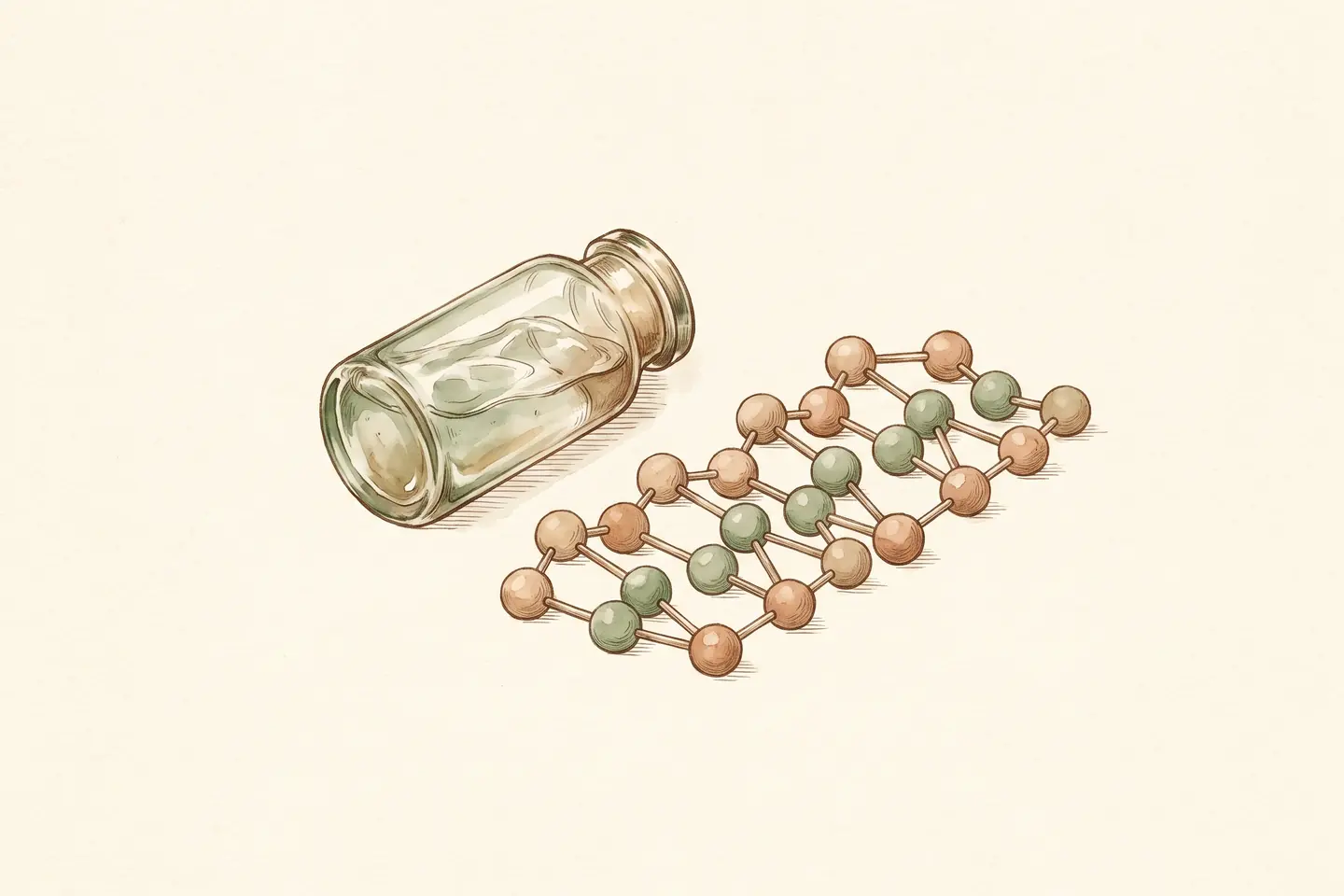
Peptide gelation is understood to run in three steps: chains pair up by hiding their hydrophobic faces, hydrogen-bond into beta sheets, and the fibers entangle into a network spanning the container.
Picture the peptide as a string of beads. Some beads are comfortable in water. Others, the hydrophobic ones (valine, leucine, isoleucine, phenylalanine, tryptophan), would rather touch each other than touch water. The three steps apply when a string carries a run of those water-avoiding beads on one face.
- Chains pair up by hiding their hydrophobic faces against each other. In the best-studied model system, a designed beta-hairpin called MAX1, the fibril core is a valine-rich hydrophobic sandwich. Reducing the ability to make lateral hydrophobic contacts measurably slows the kinetics of assembly and lowers the mechanical rigidity of the resulting gel [4].
- The paired chains hydrogen-bond into beta sheets running along the growing fiber. Aromatic rings, where present, can stack on top of that. In one ultrashort designed tetrapeptide, backbone hydrogen bonding and aromatic stacking together stabilize the sheet ladders [5].
- The fibers entangle and branch into a percolating network. Rheology and dynamic light scattering both show power-law behavior with comparable critical exponents at the percolation threshold, which is the signature of a network spanning the whole container [6].
At step three, the liquid stops being a liquid. Nothing left the vial, and nothing was added.
Real-time high-speed atomic force microscopy in liquid has imaged parts of this process directly for one model beta-sheet peptide, KFE8 [3]. That study is explicit that complete assembly pathways have not yet been resolved, and that different morphologies form at a solid-liquid interface than in bulk solution [3].
Why does a peptide gel hold its water instead of separating?
A peptide gel holds its water because the fibrils form a continuous scaffold through the liquid, the opposite geometry from precipitation, in which the solid separates and settles. A gel is not the peptide falling out of solution.
In a gel, the liquid stays where it is, held by capillary forces in the mesh, by hydration of the fibril surfaces, and by the osmotic cost of squeezing solvent out of a network that spans the container.
The proportions make the point. Self-supporting peptide hydrogels form at low single-digit percentages of peptide by weight. One well-characterized short sequence gels at a critical gelation concentration of 20 mg/mL and above, which is 2 percent w/v [5]; the threshold is sequence-specific, and that is one measured value, not a general figure. Everything else in that gel is water: the vial contains the same peptide and the same water it contained a minute earlier, reorganized.
The same behavior is why the peptide-hydrogel field exists at all. Injectable drug-delivery scaffolds, tissue-engineering matrices and wound materials are built by deliberately engineering the behavior that shows up uninvited in a reconstitution vial [7]. In that field a gel is not a defect. It is the product.
Do AOD-9604 and kisspeptin-10 gel in the vial?
No published measurement shows that AOD-9604 or kisspeptin-10 gels, although they are the two peptides most often named as gel-formers. PubMed searches for gelation, aggregation, fibril formation, self-assembly and formulation behavior returned no rheology study, critical gelation concentration, or structural characterization of a gelled state for either [27].
For kisspeptin, the aggregation literature that exists concerns kisspeptin's relationship to other peptides' amyloid, not kisspeptin assembling itself. For AOD-9604, the published work is anti-doping detection and metabolism, not physical chemistry. The exact queries and their hit counts are listed in full, so anyone can rerun them [27]. A failed search is not proof of absence: the measurement could sit in a formulation patent, a supplier technical file, or a journal outside PubMed's scope [27].
Every source found asserting that these two peptides gel is a vendor page, a vendor's help-center article, or a blog monetized by peptide traffic. None presents primary data. Several state confidently that gelling indicates high purity, a claim with no mechanism behind it and an obvious commercial interest in front of it.
The evidence grade is commonly reported by sellers, mechanistically plausible from the sequences, not demonstrated in published measurement.
Do self-assembly design rules apply to hormone fragments like kisspeptin-10?
Applying self-assembly design rules to kisspeptin-10 or AOD-9604 is an extrapolation, because every system in the cited self-assembly literature is a peptide designed to assemble.
Those systems are MAX1 and its variants [4][6][9][11][23], KFE8 [3], the VEK octapeptides [10], Phg4 [5], the naphthalene-dipeptide [22], and (FKFE)2 [25]. Not one is a naturally occurring hormone fragment. The design rules those systems yield are real, but they were extracted from molecules selected for that behavior.
A hormone fragment was never selected for anything of the kind. Carrying the rules over to one is the weakest joint in the plausibility argument for kisspeptin-10 and AOD-9604, and it is a larger limit than the missing measurement.
What does kisspeptin-10's sequence predict about gelling?
Kisspeptin-10's sequence makes gelling plausible, not proven: four of its ten residues are aromatic, and its net charge near neutral pH is roughly +2.
Kisspeptin-10 is residues 112 to 121 of the KISS1 precursor, sequence Tyr-Asn-Trp-Asn-Ser-Phe-Gly-Leu-Arg-Phe, carried as the C-terminally amidated form [8]. Its four aromatic residues are one tyrosine, one tryptophan and two phenylalanines.
Aromatic stacking is a real lever on beta-sheet assembly, and a strong one. In one designed tetrapeptide, changing only the geometry of the rings, swapping flexible phenylalanine for rigid phenylglycine at constant aromatic content, converted a non-assembling sequence into a hydrogelator [5]. That study varied ring orientation, not aromatic count: it establishes that aromatic stacking can be decisive, not that four aromatics out of ten is itself predictive.
The broader proposition, that aromatic side-chain interactions drive early self-assembly recognition, is described in the primary literature as controversial rather than settled [25].
The +2 charge counts the arginine and the free N-terminus, with the C-terminal amide removing the usual negative. A net charge modulus of 2 sits above the threshold at which a systematic charge study found self-supporting gels form, which was a charge modulus greater than 1 [10]. That study tested only moduli of 0, +2 and minus 2, so it establishes a floor and not a window: nothing in it says a higher charge would prevent gelation.
What does AOD-9604's sequence predict about gelling?
AOD-9604's sequence points both ways: low net charge favors association, but a disulfide loop resists beta-sheet formation and its hydrophobicity takes the weaker, aliphatic route.
AOD-9604 is a tyrosine attached to the front of human growth hormone residues 177 to 191 [12]. Mapping that onto the somatotropin sequence gives Tyr-Leu-Arg-Ile-Val-Gln-Cys-Arg-Ser-Val-Glu-Gly-Ser-Cys-Gly-Phe. The two cysteines are the ones that form a native intramolecular disulfide in the parent hormone, so the fragment carries a small constrained loop [13].
That loop cuts against gelation. A disulfide bridging Cys182 and Cys189 in mature growth-hormone numbering constrains eight of the fragment's sixteen residues into a cycle, and a cyclized backbone cannot readily adopt the extended conformation an intermolecular beta sheet requires. Which form a given batch carries, closed disulfide loop or free thiols, changes the prediction, and nothing in the published literature settles it.
AOD-9604's hydrophobicity is mostly aliphatic rather than aromatic: leucine, isoleucine and two valines concentrated in the first half, with only two aromatic residues in sixteen (the added tyrosine and the terminal phenylalanine). The aliphatic route to assembly is real but weaker.
A systematic study replacing the phenylalanines of a model amphipathic beta-sheet peptide found that aromatics are not strictly required, but the natural aliphatic substitutions (alanine, valine, leucine) retained assembly competency only with attenuated kinetics [25]. Enhanced hydrogelation appeared with cyclohexylalanine, a non-natural residue AOD-9604 does not contain [25]. The aliphatic case for AOD-9604 is the weaker half of that result, not the stronger half.
AOD-9604's net charge near neutral pH is low, on the order of +1, and low net charge removes the electrostatic repulsion that keeps chains apart. In the systematic charge study, decreasing charge modulus increased lateral aggregation of the fibers, producing denser, stiffer networks [10]. In a separate kinetics study, point substitutions that reduced total peptide charge made gelation faster [11]. Neither study measured a failure to dissolve.
In one study, growth hormone fibrils needed zinc
Growth hormone itself forms cross-beta amyloid fibrils in the presence of zinc ions, and the same work found growth hormone co-localized with zinc in pituitary tissue, suggesting it may be stored in an ordered assembled form and release monomer on demand [14]. That is context for why ordered peptide self-assembly is not automatically pathology.
The zinc dependence matters. The finding is not evidence that growth hormone self-assembles unprompted, a reconstitution vial supplies no zinc, and the mechanism does not transfer to a fragment sitting in water.
What makes BPC-157 the structural opposite of a gel-former?
BPC-157 packs four prolines, four charged side chains and no aromatic residue into fifteen positions, which is close to the design brief for a peptide that will not form a beta sheet.
Peptides that reliably dissolve clear tend to be the structural opposite of the gel-formers. BPC-157's sequence is Gly-Glu-Pro-Pro-Pro-Gly-Lys-Pro-Ala-Asp-Asp-Ala-Gly-Leu-Val [15]. Its four charged side chains are one glutamate, one lysine and two aspartates, on top of the charged termini.
Proline is the canonical beta-sheet breaker: it lacks the backbone amide hydrogen a sheet needs, and its ring sterically hinders the extended conformation. That is why proline substitution is used as a deliberate strategy to disrupt amyloid assembly [16].
The reasoning is sound and general. Applied to any specific vial, it is still an inference, not a measurement.
What decides whether a peptide gels or stays liquid?
Four variables decide whether the same peptide gels or stays liquid: concentration, pH, ionic strength and temperature. That conditional behavior is not a quirk of a few sequences; it is the central finding of the hydrogel literature.
| Dial | What the literature shows | Practical consequence |
|---|---|---|
| Concentration | Self-supporting gels form only above a critical gelation concentration. Below it, the same peptide gives a free-flowing solution [5][10]. | The volume of diluent sets it. |
| pH | Net charge sets whether chains repel or associate. Point substitutions that shift a peptide's net charge shift the pH at which thermally triggered gelation is permitted [9]. | Whether a given pH helps or hurts depends on the sequence, not on a general rule. |
| Ionic strength | Salt screens electrostatic repulsion. Increasing ionic strength reduced intramolecular and intermolecular electrostatic repulsion and made gelation kinetics faster in a designed beta-hairpin series [11]. Ionic strength is also listed among the standard triggers for peptide self-assembly [7]. | Reconstituting into saline versus into unsalted water is a real variable, not a wash. |
| Temperature | Hydrophobically driven assembly is thermally triggered. One designed hairpin was tuned to undergo thermally triggered hydrogelation at physiological conditions: pH 7.4, 150 mM sodium chloride, 37 degrees Celsius [9]. | Warming can trigger gelation rather than reverse it. |
The pH row is the one most often turned into a rule of thumb. For a peptide with a basic isoelectric point, a mildly acidic diluent raises net positive charge and increases electrostatic repulsion between chains. For an acidic peptide, the same move does the opposite. Which case a given sequence falls into is calculable from the sequence, and nothing in the published literature establishes the answer for AOD-9604 or kisspeptin-10.
The ionic-strength row has its own limit. The study that gels at pH 7.4 with 150 mM sodium chloride held salt constant [9]. It establishes that gelation occurs at physiological ionic strength, not that varying salt is itself the lever. The lever claim rests on the kinetics study that did vary it [11].
Which variable matters most for peptide gelation?
Concentration, set by the volume of diluent at reconstitution, is the variable most tightly coupled to gelation in the measured literature.
Self-supporting gelation has a concentration threshold; below it, no percolating network forms [5][10]. Of the four variables, concentration is the one fixed at the moment of reconstitution, and it is also the least discussed, because it is unglamorous. That is a statement about which variable the physics is most sensitive to, not a recommendation about what to put in a vial.
Should a stubborn or gelled peptide vial be shaken?
Shaking a peptide vial is the wrong move: it manufactures air-liquid interface, where proteins and peptides adsorb, unfold and aggregate. The handling findings describe how liquid behaves in a container; they are physical chemistry, not instructions for use, and not guidance about administering anything to anyone.
Shaking creates and destroys bubble surfaces thousands of times, dragging molecules onto fresh interfaces over and over. The effect is quantified, not asserted. Across a panel of sixteen antibodies, the initial rate at which surface pressure rose on adsorption to the air-liquid interface strongly predicted how much each one aggregated under agitation stress, while hydrophobicity and equilibrium surface pressure did not [17].
Orbital shaking of vials is a standard forced-degradation test because it reliably produces aggregation, and the amount depends on shaking orbit, frequency, and whether the vial is upright or on its side [18]. That dependence does not reduce to a simple ranking of interface area: turbidity rose in vertical orientation only at a 3 mm orbit and in horizontal orientation only at a 30 mm orbit, and computational fluid dynamics of how air and liquid disperse predicted the pattern better than interfacial area alone [18]. Where surfactants protect a formulation, they work by competing for that interface [19].
All three of those studies are on monoclonal antibodies or larger proteins; none studied a short peptide. The stated mechanism in all three is interfacial unfolding, and a ten-mer or sixteen-mer with little tertiary structure to unfold is a materially different case. The direction of the finding is conservative either way: agitation has a documented cost in the systems where it has been measured, and no documented benefit anywhere. Why peptide vials should not be shaken covers the agitation evidence in more depth.
Some beta-sheet peptide gels are shear-thinning and self-healing: they flow under applied shear and immediately re-form a solid gel when the shear stops, a behavior that depends on how much the fibril network branches [23]. Mechanical force can temporarily liquefy some gels. That is not an argument for shaking, since the interfacial aggregation penalty is separate from and additive to whatever the shear does, and the gel re-forms anyway.
What do approved peptide labels say about mixing and inspection?
The Cetrotide and Humatrope labels both say not to shake, and both say not to use a reconstituted solution that is cloudy or contains particles [20][21]. Those labels are consistent with the direction of the agitation data, and they are quoted as handling and storage-science precedent only.
- The Cetrotide (cetrorelix) label, for an approved decapeptide supplied as a lyophilized powder, instructs the user to "gently swirl the vial until the solution is clear and without residues. Avoid forming bubbles," warns "Do not shake or you will create bubbles in your medicine," and states "Do not use a Cetrotide solution if it contains particles or if it is not clear" [20].
- The Humatrope (somatropin) label states "Do not shake. The reconstituted solution should be clear," and "Inspect visually for particulate matter and discoloration. If the resulting solution is cloudy or contains particulate matter do not use" [21].
What the measurements support is narrow: minimal agitation and no foam generation reduce interfacial turnover, which is the variable the aggregation data track. Slow addition of solvent down the vial wall is widely advised and fits the same mechanism, but no study measuring it has been found, so it remains plausible practice rather than a demonstrated result.
Cetrotide and Humatrope are approved drugs with real formulation development behind them. Research peptides, including AOD-9604, kisspeptin-10 and BPC-157, are not FDA-approved drugs. The labels' approval does not extend to them, and the handling conventions in those labels do not transfer to unapproved material as recommendations, endorsements or a read-across.
Will a peptide gel loosen if the vial is left to stand?
Waiting does not reverse an assembling peptide gel, because gel networks measurably stiffen as they age [22]. For a lyophilized cake that has not finished wetting, time helps; for a peptide that has already started to self-assemble, time does the opposite.
In a well-characterized dipeptide gelator, thin low-persistence fibers form first, then laterally associate into thicker bundles, and the initially weak hydrogel becomes stronger with time [22]. "Give it time and it will relax" is standard reconstitution folklore, and the self-assembly literature does not support it for a gel that is already forming.
Does warming a peptide vial dissolve a gel?
Warming triggers hydrophobically driven peptide self-assembly instead of reversing it; one designed peptide was tuned specifically to undergo thermally triggered hydrogelation at 37 degrees Celsius [9].
"Warm it up, warmth dissolves things" holds for most ordinary solids. Heat is not a solvent for a hydrophobically driven assembly. This is one of the clearest cases where an intuition imported from dissolving sugar gives the wrong answer for peptides.
Is a cloudy peptide solution the same as a gel?
A cloudy peptide solution is not a gel: only uniform gelling has the physical self-assembly explanation, and approved labels treat cloudiness as a discard signal [20][21].
Cloudiness is where the physical explanation and the approved-label instruction diverge, and the divergence should be stated rather than smoothed over. The Cetrotide and Humatrope labels tell the user to discard a cloudy solution [20][21], and for an approved product with a known formulation and a validated release specification, that is the correct rule. Nothing in the gelation mechanism overrides it.
A uniform gel and a cloudy solution are not the same observation, and what cloudiness in an injectable vial can mean is a separate question from gelation.
When is a strange-looking peptide vial a real problem?
A strange-looking peptide vial is a real problem when it shows discrete particles, fibers, foreign material or a color shift, none of which is gelation. The decision rule is a boundary, not a reassurance.
A gel is a plausible physical state. Smooth, uniform, no discrete inclusions, no color that was not there before. For a sequence with the structural features of a self-assembler, that is consistent with self-assembly and is not, by itself, evidence of chemical degradation.
Visible particulates and discoloration are a different signal entirely. Discrete particles, fibers, flakes, glass, angular debris, or a color shift are the failure mode that injectable-product standards exist to catch. Injections are required to be essentially free from visible particulates [24], and the approved labels tell the user to discard on exactly those findings [20][21].
| Observation | What it is consistent with |
|---|---|
| Uniform thickening or gelling, no discrete inclusions, no cloudiness | Physical self-assembly. Expected for some sequences, concentration-dependent, not evidence of chemical damage. |
| Cloudiness | Not explained by the gelation mechanism. Approved injectable labels treat it as a discard signal. |
| Discrete particles, fibers, flakes, or foreign material | Not gelation. This is the category injectable standards are written to catch. |
| Color that was not present before | Not gelation. Chromophore formation generally implicates chemical change, since the common routes to a colored degradant are oxidative and Maillard chemistry rather than any rearrangement of intact chains [1]. |
| A sequence with no self-assembly features refusing to dissolve | Unexplained. Gelation chemistry does not cover it. |
The accurate rule is not "a cloudy vial is always fine." It is this: uniform gelling in a peptide whose sequence supports self-assembly has a physical explanation; cloudiness, visible foreign material and discoloration do not, and those are where the explanation runs out.
Does a peptide that gels have higher purity?
Gelling says nothing about purity: identity and purity are analytical questions answered by chromatography and mass spectrometry, while appearance after reconstitution is a physical state.
What the peptide is, and how much of the material is that peptide, are answered by chromatography and mass spectrometry on the material itself, against a reference standard, before anything is dissolved. Identity and purity are numbers on an analytical report. How the solution looks after diluent is added depends on concentration, pH, ionic strength, temperature and the sequence's own assembly behavior.
A high-purity peptide with a self-assembling sequence can gel, and will above its critical gelation concentration. A low-purity peptide with a non-assembling sequence will dissolve clear. Appearance after reconstitution does not rank purity in either direction, and the vendor claim that gelling demonstrates high purity has no mechanism behind it. It is a sales line wearing a lab coat.
The corollary matters more than the correction: appearance will not tell anyone what is in a vial. Only analysis will, and the guide to reading a peptide certificate of analysis covers where those numbers appear.
Does gel behavior say anything about whether AOD-9604 or kisspeptin-10 works?
Gel behavior answers a physical-chemistry question, not whether AOD-9604, kisspeptin-10 or BPC-157 does anything in a person, and it supports no position on that. The gel chemistry is general information only, not medical advice, dosing guidance or instructions for use.
A 2026 narrative review of peptides marketed as modulating the growth-hormone and IGF-1 axis stratifies that class across evidence tiers, running from regulatory-grade randomized trial data down to a complete absence of human studies, and places AOD-9604 toward the thin end [26]. Kisspeptin-10 and BPC-157 fall outside that review's scope and carry no evidence tier from it. AOD-9604's human trial record is covered separately.
What is kisspeptin-10's compounding status in the United States?
At its October 29, 2024 meeting, the United States Pharmacy Compounding Advisory Committee voted against adding kisspeptin-10 to the 503A bulk drug substances list [28].
The committee voted the same way on ipamorelin, ibutamoren mesylate and L-theanine [28]. That is a compounding-eligibility decision. It places the compound and has no bearing on any physical-chemistry claim about gelation.
Sources
-
Manning MC, Chou DK, Murphy BM, Payne RW, Katayama DS. Stability of protein pharmaceuticals: an update. Pharm Res. 2010;27(4):544-575. PMID 20143256. DOI 10.1007/s11095-009-0045-6. Retrieved via PubMed. Review. The standard framing of chemical versus physical instability, and the chemical routes (including oxidation) that produce colored degradants.
-
Wang W. Protein aggregation and its inhibition in biopharmaceutics. Int J Pharm. 2005;289(1-2):1-30. PMID 15652195. DOI 10.1016/j.ijpharm.2004.11.014. Retrieved via PubMed. Review. Aggregation mechanisms and the factors that drive them.
-
Bertouille J, Kasas S, Martin C, Hennecke U, Ballet S, Willaert RG. Fast self-assembly dynamics of a beta-sheet peptide soft material. Small. 2023;19(20):e2206795. PMID 36807731. DOI 10.1002/smll.202206795. Retrieved via PubMed. Real-time high-speed atomic force microscopy of KFE8 in liquid. Cited with its own stated limit: the paper says complete assembly pathways have not yet been resolved and that interface and bulk give different morphologies.
-
Rajagopal K, Ozbas B, Pochan DJ, Schneider JP. Probing the importance of lateral hydrophobic association in self-assembling peptide hydrogelators. Eur Biophys J. 2006;35(2):162-169. PMID 16283291. DOI 10.1007/s00249-005-0017-7. Retrieved via PubMed. Hydrophobic contact as a load-bearing part of the mechanism; MAX1's valine-rich core.
-
Wychowaniec JK, Patel R, Leach J, et al. Aromatic stacking facilitated self-assembly of ultrashort ionic complementary peptide sequence: beta-sheet nanofibers with remarkable gelation and interfacial properties. Biomacromolecules. 2020;21(7):2670-2680. PMID 32401499. DOI 10.1021/acs.biomac.0c00366. Retrieved via PubMed. The phenylalanine-to-phenylglycine swap (constant aromatic content, changed ring geometry) and the 20 mg/mL critical gelation concentration.
-
Yucel T, Micklitsch CM, Schneider JP, Pochan DJ. Direct observation of early-time hydrogelation in beta-hairpin peptide self-assembly. Macromolecules. 2008;41(15):5763-5772. PMID 19169385. DOI 10.1021/ma702840q. Retrieved via PubMed. Percolation and network formation, with matched critical exponents from rheology and light scattering.
-
Pentlavalli S, Coulter S, Laverty G. Peptide nanomaterials for drug delivery applications. Curr Protein Pept Sci. 2020;21(4):401-412. PMID 31893991. DOI 10.2174/1389203721666200101091834. Retrieved via PubMed. Review, cited only for field-level description: the applications the hydrogel field builds, and the standard trigger list (pH, ionic strength, enzymes, light).
-
UniProtKB entry Q15726 (KISS1_HUMAN), metastin/KiSS-1 precursor. Kisspeptin-10 annotated as residues 112 to 121 with C-terminal phenylalanine amidation. Sequence at those positions retrieved and verified as YNWNSFGLRF. rest.uniprot.org/uniprotkb/Q15726.
-
Rajagopal K, Lamm MS, Haines-Butterick LA, Pochan DJ, Schneider JP. Tuning the pH responsiveness of beta-hairpin peptide folding, self-assembly, and hydrogel material formation. Biomacromolecules. 2009;10(9):2619-2625. PMID 19663418. DOI 10.1021/bm900544e. Retrieved via PubMed. Net charge, pH, thermal triggering, and the MAX1(K15E) variant that gels at pH 7.4, 150 mM sodium chloride, 37 degrees Celsius. Note: this study held ionic strength constant and did not vary it.
-
Roberts D, Rochas C, Saiani A, Miller AF. Effect of peptide and guest charge on the structural, mechanical and release properties of beta-sheet forming peptides. Langmuir. 2012;28(46):16196-16206. PMID 23088490. DOI 10.1021/la303328p. Retrieved via PubMed. Self-supporting gels above a critical concentration when charge modulus is greater than 1, and lateral fiber aggregation increasing as charge modulus falls. Three octapeptides at moduli 0, +2 and minus 2; a floor, not a window.
-
Larsen TH, Branco MC, Rajagopal K, Schneider JP, Furst EM. Sequence-dependent gelation kinetics of beta-hairpin peptide hydrogels. Macromolecules. 2009;42(21):8443-8450. PMID 20161466. DOI 10.1021/ma901423n. Retrieved via PubMed. The ionic-strength lever: raising ionic strength screens intramolecular and intermolecular electrostatic repulsion and speeds gelation; charge-reducing point substitutions do the same.
-
Cox HD, Smeal SJ, Hughes CM, Cox JE, Eichner D. Detection and in vitro metabolism of AOD9604. Drug Test Anal. 2015;7(1):31-38. PMID 25208511. DOI 10.1002/dta.1715. Retrieved via PubMed. Primary source for the AOD-9604 structure: growth hormone 177 to 191 with an additional tyrosine at the N-terminus. Numbering conventions differ in the literature; Source 26 writes the same product as hGH 176-191. The sixteen-residue molecule is the same, and sequence positions in this article follow Source 12, checked against Source 13.
-
UniProtKB entry P01241 (SOMA_HUMAN), somatotropin. Signal peptide 1 to 26, mature chain 27 to 217, disulfide bonds at precursor positions 79-191 and 208-215 (mature Cys53-Cys165 and Cys182-Cys189). Mature residues 177 to 191 retrieved and verified as LRIVQCRSVEGSCGF. rest.uniprot.org/uniprotkb/P01241.
-
Jacob RS, Das S, Ghosh S, et al. Amyloid formation of growth hormone in presence of zinc: relevance to its storage in secretory granules. Sci Rep. 2016;6:23370. PMID 27004850. DOI 10.1038/srep23370. Retrieved via PubMed. Fibril formation is zinc-dependent in this work, and the article states that dependence explicitly rather than presenting fibrillation as an unconditional property.
-
Ilic S, Drmic D, Zarkovic K, et al. Ibuprofen hepatic encephalopathy, hepatomegaly, gastric lesion and gastric pentadecapeptide BPC 157 in rats. Eur J Pharmacol. 2011;667(1-3):322-329. PMID 21645505. DOI 10.1016/j.ejphar.2011.05.038. Retrieved via PubMed. Cited only for the published BPC-157 sequence (GEPPPGKPADDAGLV), not for any efficacy claim. It is a rodent study and this article makes no use of its outcomes.
-
Chemerovski-Glikman M, Frenkel-Pinter M, Mdah R, Abu-Mokh A, Gazit E, Segal D. Inhibition of the aggregation and toxicity of the minimal amyloidogenic fragment of tau by its Pro-substituted analogues. Chemistry. 2017;23(40):9618-9624. PMID 28544138. DOI 10.1002/chem.201701218. Retrieved via PubMed. Proline as a beta-sheet breaker, used deliberately to disrupt assembly through steric hindrance.
-
Shieh IC, Patel AR. Predicting the agitation-induced aggregation of monoclonal antibodies using surface tensiometry. Mol Pharm. 2015;12(9):3184-3193. PMID 26198590. DOI 10.1021/acs.molpharmaceut.5b00089. Retrieved via PubMed. Sixteen-antibody panel linking air-liquid interfacial adsorption rate to agitation-induced aggregation. Antibodies, not short peptides.
-
Dasnoy S, Illartin M, Queffelec J, Nkunku A, Peerboom C. Combined effect of shaking orbit and vial orientation on the agitation-induced aggregation of proteins. J Pharm Sci. 2024;113(3):669-679. PMID 37611666. DOI 10.1016/j.xphs.2023.08.016. Retrieved via PubMed. Shaking as a standard forced-degradation stress; orbit and orientation interact, and computational fluid dynamics predicted the pattern better than interface area alone. Three proteins, not short peptides.
-
Kannan A, Shieh IC, Fuller GG. Linking aggregation and interfacial properties in monoclonal antibody-surfactant formulations. J Colloid Interface Sci. 2019;550:128-138. PMID 31055138. DOI 10.1016/j.jcis.2019.04.060. Retrieved via PubMed. Spontaneous adsorption to air-solution interfaces as a major cause of aggregation; surfactants work by competing for the interface. A single antibody, not a short peptide.
-
DailyMed label, CETROTIDE (cetrorelix acetate) for injection, EMD Serono. SetID
aca7768e-28a7-4027-b1d8-e66247665f79. Retrieved and quotations verified against the label. Cited as handling and storage-science precedent for a lyophilized peptide only: gentle swirling until clear and without residues, avoid bubbles, do not shake, do not use if it contains particles or is not clear. Not an endorsement of, or a read-across to, any unapproved research peptide. -
DailyMed label, HUMATROPE (somatropin) for injection, Eli Lilly and Company. SetID
a774e1ae-3997-49ee-8b0e-99a2b315d409. Retrieved and quotations verified against the label. Cited as handling and storage-science precedent only: "Do not shake," solution should be clear, inspect for particulate matter and discoloration, discard if cloudy or containing particulate matter. -
Chen L, Morris K, Laybourn A, et al. Self-assembly mechanism for a naphthalene-dipeptide leading to hydrogelation. Langmuir. 2010;26(7):5232-5242. PMID 19921840. DOI 10.1021/la903694a. Retrieved via PubMed. Thin low-persistence fibers laterally associate over time and the initially weak hydrogel becomes stronger, not weaker.
-
Sathaye S, Zhang H, Sonmez C, et al. Engineering complementary hydrophobic interactions to control beta-hairpin peptide self-assembly, network branching, and hydrogel properties. Biomacromolecules. 2014;15(11):3891-3900. PMID 25251904. DOI 10.1021/bm500874t. Retrieved via PubMed. Shear-thinning with immediate re-formation, and the fibril branching that controls whether it happens.
-
United States Pharmacopeia, General Chapter 790, Visible Particulates in Injections. Cited for the standard itself, that injections be essentially free from visible particulates, which is the portion I could retrieve. doi.usp.org/USPNF/USPNF_M7197_01_01.html. The chapter's procedural specifics (magnification, background, illumination) sit behind the USP-NF subscription and are elaborated in General Chapter 1790; I could not retrieve either, so no procedural detail is asserted in this article.
-
Bowerman CJ, Ryan DM, Nissan DA, Nilsson BL. The effect of increasing hydrophobicity on the self-assembly of amphipathic beta-sheet peptides. Mol Biosyst. 2009;5(9):1058-1069. PMID 19668872. DOI 10.1039/b904439f. Retrieved via PubMed. Aromatics are not strictly required for assembly, but the natural aliphatic substitutions (Ala, Val, Leu) retained competency with attenuated kinetics, and enhanced hydrogelation appeared with cyclohexylalanine, a non-natural residue. Also the source for the statement that the aromatic-interaction hypothesis is described in the primary literature as controversial.
Moderate confidence, flagged
-
Dominikowski A, Rekos Z, Olejarz M, Szczepanek-Parulska E, Domin R, Ruchala M. The emerging landscape of performance-enhancing peptides modulating GH-IGF1 axis: bridging the gap between clinical evidence and patient self-administration. Front Endocrinol. 2026;17:1822475. PMID 42395176. DOI 10.3389/fendo.2026.1822475. Retrieved via PubMed. A narrative review, not a systematic one, so graded moderate. Cited only for the regulatory status and evidence tiering of the growth-hormone-axis compound class, which is the scope it covers. It does not cover kisspeptin-10 or BPC-157, and is not cited for either, nor for any physical-chemistry claim.
-
The named-peptide gelation claim itself is unverified, and here is the audit trail. Searches run against PubMed on 5 August 2026 via the NCBI E-utilities interface, with result counts as returned:
kisspeptin AND (self-assembly OR amyloid OR fibril OR aggregation)returned 24 results. None measured kisspeptin's own assembly; the amyloid-adjacent hits concern kisspeptin in relation to other amyloid systems or as a tissue biomarker.kisspeptin AND (gelation OR rheology OR hydrogel OR viscosity OR reconstitution)returned 10 results. The closest is a study formulating a kisspeptin analog into a cyclodextrin and dextran carrier hydrogel for sustained release, which is a separate polymer network holding the peptide, not the peptide gelling itself.AOD9604 OR AOD-9604returned 23 results, all anti-doping detection, metabolism, pharmacology, or review.(AOD9604 OR AOD-9604) AND (gelation OR rheology OR hydrogel OR formulation OR solubility OR self-assembly)returned 0 results.
A failed search is not proof of absence. This may exist in a formulation patent, a supplier technical file, or a journal outside PubMed's scope. What can be said is that it is not in the indexed biomedical literature, and the mechanism sections of this article rest on general self-assembly science plus sequence analysis rather than on any measurement of these two molecules.
-
United States Pharmacy Compounding Advisory Committee, meeting of 29 October 2024. The committee voted against adding kisspeptin-10, ipamorelin, ibutamoren mesylate, and L-theanine to the 503A bulk drug substances list. Confirmed from the agency's own advisory-committee calendar listing for that date plus independent trade reporting of the votes (a4pc.org). Graded moderate because the primary meeting transcript and briefing document sit on servers that blocked every retrieval attempt from here, so the vote is confirmed through secondary reporting rather than read directly. Cited only for the fact of the vote.
Deliberately excluded
Peptide vendor pages, vendor help-center articles, and peptide-affiliate blogs. These are, as far as I can find, the only sources asserting that AOD-9604 and kisspeptin-10 gel on reconstitution. Every one of them either sells peptides or monetizes traffic to sellers, and not one presents rheology, a critical gelation concentration, a batch identifier, or any primary measurement. Several assert that gelling indicates high purity, which has no mechanism and an obvious commercial interest behind it. Naming a phenomenon is not evidence for it; the phenomenon may well be real, but a claim sourced entirely to interested parties with no data is not a citation, and this library does not launder one into a fact.
The compounding-advisory briefing document for kisspeptin-10. The 29 October 2024 meeting happened and the vote is sourced (Source 28), but the briefing document behind it is a separate matter. I went looking for it because a claim circulates that it discusses kisspeptin-10 aggregation sensitivity. Every request to the agency's document servers returned an error or a redirect to an anti-bot host, so I never read it and cannot confirm that it says anything about aggregation. Nothing from it is cited here, in either direction. An earlier draft of this article paraphrased that claim from secondary reporting; it is removed, because a document I have not read is not a source.
USP General Chapter 1790 and the visible-inspection procedure detail. An earlier version of this article described the inspection conditions for visible particulates (no magnification, black and white backgrounds, controlled illumination). That detail is not in the retrievable portion of General Chapter 790 and I could not retrieve General Chapter 1790, so the procedural specifics were removed rather than sourced to a page that does not carry them. Only the standard itself is cited.
Anti-doping bibliographies and drug-pipeline listings that mention AOD-9604 in passing. They confirm the compound exists and is monitored, and add nothing about its physical chemistry.
Ozbas et al., Macromolecules 2004, on salt-triggered beta-hairpin folding. Suggested during review as the ionic-strength citation. It is not indexed in PubMed and I could not retrieve it to confirm what it measures, so it is not cited. Source 11, which I did retrieve and which explicitly varies ionic strength, carries that claim instead.
Last updated

Written by
Chemist and biochemist. Co-founder and author, The Peptide App.
Jay is a chemist, biochemist and entrepreneur whose work connects scientific research with consumer health products. He has held Chief Science Officer and product development leadership roles and previously served as Chief Revenue Officer at Minicircle.
Keep reading
Storage and handling
Peptide degradation depends on water, time and sequence, not just heat
Peptides degrade mainly through deamidation and oxidation, water-dependent reactions set by sequence. Time in solution and pH matter alongside temperature.

Storage and handling
Vial cloudiness has at least four causes; two are quality failures
Vial cloudiness can mean air, undissolved solid, aggregation, or contamination, and only some warrant discarding. Clarity proves neither sterility nor potency.
Storage and handling
Gentle swirling dissolves peptide powder; shaking whips in air
Shaking makes large proteins unfold and clump at the air-water surface. Lab tests skipped short peptides, which have little folded structure to lose.
Profiles and tools

The Peptide App
Track protocols, doses, and reconstitution in one place.
Save your calculations, set reminders, log doses, and keep outcome notes — free to start.
 or scan the QR code →