
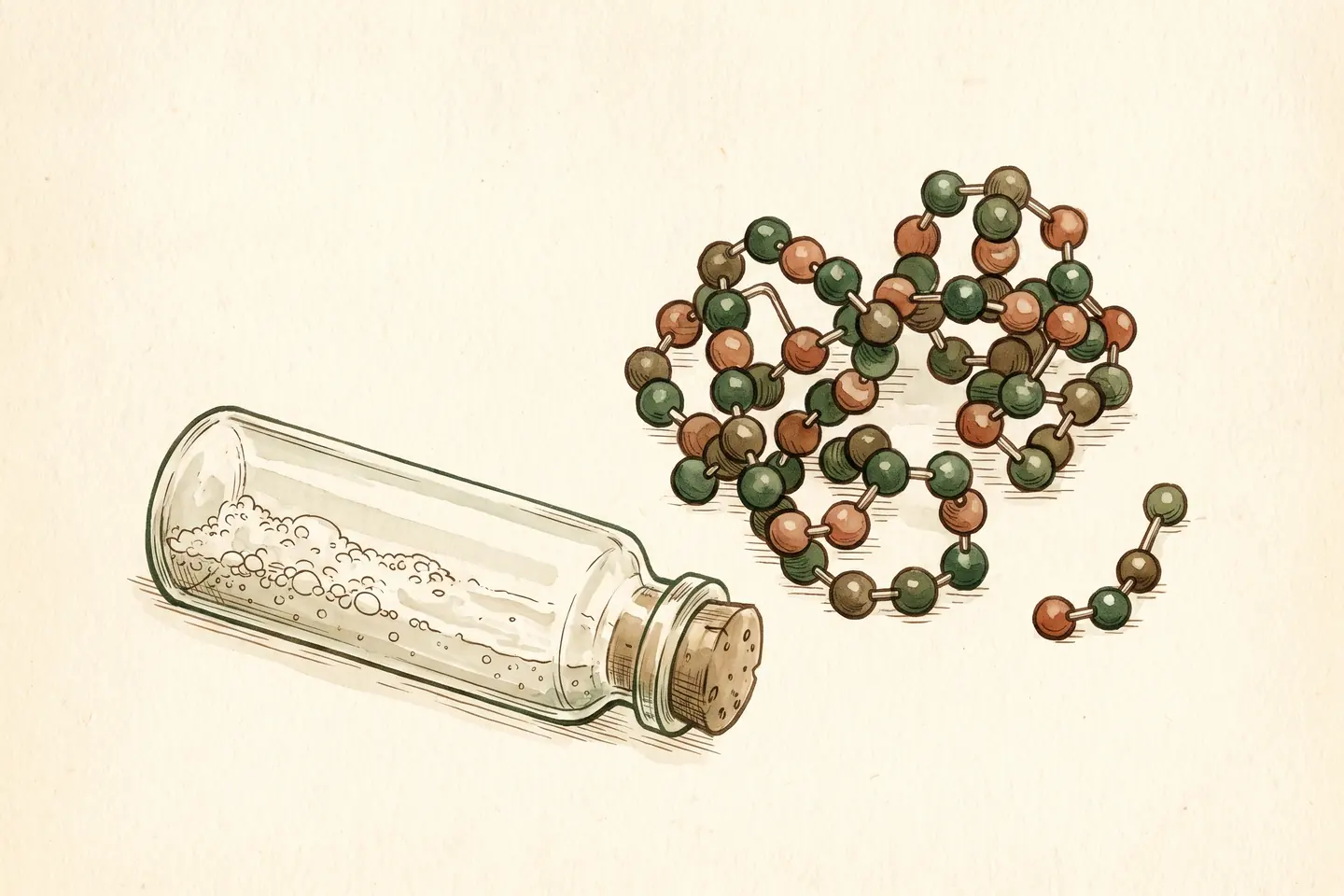
Gentle swirling dissolves peptide powder; shaking whips in air
Shaking makes large proteins unfold and clump at the air-water surface. Lab tests skipped short peptides, which have little folded structure to lose.

By Jay Spall, chemist and biochemist
Disclosure: Jay is a co-founder of The Peptide App. This article is educational and includes links to the app’s tools. Research on one compound or formulation does not establish the safety or stability of a different product.
On this page
- How does shaking damage proteins in a vial?
- Why are antibodies more vulnerable to shaking than short peptides?
- What does agitation do to antibodies and clotting factors in lab tests?
- Has shaking been tested on short peptides?
- Is it safe to swirl or invert a vial to dissolve the powder?
- Does a cloudy vial after mixing mean the contents are ruined?
- Is a vial that froze in transit worse than one that got warm?
- What matters more than shaking for a small peptide's potency?
- How do you match a vial's mg/mL to the units on a syringe?
- Sources
Key facts
| Question | Direct answer |
|---|---|
| Is "never shake the vial" real science or ritual? | Real science with a missing qualifier. Agitation drives dissolved molecules to the air-water surface, where they can unfold and clump, but the magnitude depends heavily on what is in the vial, which the blanket rule never mentions [3]. |
| Will one accidental shake ruin a small peptide? | Almost certainly not a disaster. A short linear peptide has little folded structure to lose at an interface, though the agitation studies never tested short peptides directly. |
| Does shaking damage large proteins like antibodies or clotting factors? | Yes, measurably, in lab stress testing of antibodies, IVIg, and factor VIII products. The subvisible particles formed can trigger immune activity in lab assays [1][2][3]. |
| Is a cloudy vial always ruined? | No. Some formulations are suspensions designed to look turbid. In a formulation meant to be a clear solution, new cloudiness or visible particles are the red flag worth documenting and reporting [4][5]. |
| Which is worse for a reconstituted vial, a warm trip or a freeze? | Freezing is frequently the more destructive event. Labs use freeze-thaw cycling deliberately to generate protein particles, a reason to treat freezing with at least as much caution as heat [1]. |
| How do I read mg/mL against the units on my syringe? | With the number your provider specified, not an assumed conversion. A vial's concentration (mg/mL) and a syringe's unit markings are separate measurement systems tied together only by the specific product's labeling. |
8 sources cited. View sources
How does shaking damage proteins in a vial?
Shaking damages dissolved proteins by driving them to the air-water interface, where they partially unfold and stick together into aggregates. The hazard is the interface, not the physical jostling itself.
Water-soluble proteins fold so that hydrophobic segments hide on the inside and hydrophilic segments face outward, toward water. An air interface disrupts that arrangement by pulling the hydrophobic patches toward the air side.
Proteins are amphiphilic, so they migrate to the air-liquid interface and adsorb onto it. Once adsorbed, a folded protein can partially unfold to accommodate the mismatch, exposing regions normally tucked inside its three-dimensional structure. Those exposed, unfolded molecules are prone to sticking to each other, which is the seed of aggregation [7][8].
Shaking multiplies the exposure by whipping air into the liquid and creating foam, which dramatically increases interface area relative to gentle swirling. Unfolded molecules at the interface form aggregates and, eventually, subvisible particles suspended in the liquid.
Why are antibodies more vulnerable to shaking than short peptides?
Antibodies are more vulnerable because they are large folded proteins with structure to lose, while a short linear peptide has little or no tertiary structure to unfold. A monoclonal antibody is a roughly 150-kilodalton protein held in shape by a dense network of weak, disruptable forces: hydrogen bonds, hydrophobic packing, and a few disulfide bridges.
Interface-driven aggregation is a well-documented concern in the development of monoclonal antibodies, which are large, glycosylated, multi-domain proteins engineered for chronic use and often formulated at high concentration for at-home injection [8]. Antibody aggregation can affect both potency and immune reactions to the drug, so pharmaceutical scientists have built assay systems that provoke and measure interface-driven instability during development, deliberately exposing candidate antibodies to agitation and air-water interfaces [3]. In these surface-mediated stress assays, antibody variants differ substantially in how much they aggregate at air-water and solid-liquid interfaces, and susceptibility correlates with other markers of the molecule's inherent stability [3].
A short linear peptide does not have the same interface-driven failure mode available to it. Insulin sits in between: small by protein standards, but it folds around disulfide bonds and can misfold and fibrillate under the same class of physicochemical stress, including agitation, that affects larger proteins [6].
What does agitation do to antibodies and clotting factors in lab tests?
Agitating intravenous immunoglobulin (IVIg) formulations generated subvisible particles of 2 to 10 microns whose concentration predicted complement activation in human serum, roughly linearly [1]. That is a real, measured biological consequence of agitation, demonstrated in serum assays rather than as a clinical outcome in treated patients.
When nine commercially available recombinant factor VIII products were reconstituted and put through use-relevant stress, they differed substantially in soluble aggregate and subvisible particle content. Reconstitution itself was one of the stress points examined [2].
The evidence comes from controlled laboratory stress testing, not clinical trials in patients. It is solid and reproducible for large, structurally complex proteins: antibodies, IVIg, and clotting factor concentrates.
Has shaking been tested on short peptides?
The agitation studies behind the rule used large proteins, and none put a short linear peptide, such as a 15-amino-acid chain, through the same protocol. The direct evidence on agitation-induced particles and their consequences comes from antibodies, IVIg, factor VIII and, for aggregation more broadly, insulin [1][2][3][6].
The physics predicts a much smaller effect for such molecules. That prediction is not the same as an effect measured and found to be zero, and none of the cited studies quantifies how many shakes, or how vigorous, would meaningfully affect a short peptide.
That gap is why the universal "never shake" rule fails as written. It borrows real caution from large-protein science and applies it uniformly, without saying that the underlying risk scales down sharply as the molecule gets smaller and simpler.
Is it safe to swirl or invert a vial to dissolve the powder?
Gentle swirling or inversion to dissolve powder is not the dangerous part; the danger is repeated, vigorous, air-incorporating agitation after the powder has dissolved. Reconstitution and mixing are different physical events.
Adding diluent down the vial wall and swirling gently is a low-shear process aimed at wetting and dissolving solid material. Shaking to "mix it up" afterward is a separate, higher-shear event that whips air into the solution and creates the interface conditions that drive aggregation [3].
Does a cloudy vial after mixing mean the contents are ruined?
A cloudy vial signals a problem only when the formulation is built to be a clear solution. Some formulations are suspensions by design and are supposed to look turbid or milky when properly mixed, so know which type is in your hand before applying the rule.
In a solution meant to be clear, visible or near-visible turbidity is a quality signal worth taking seriously. Detecting and characterizing subvisible particles is an entire analytical discipline in protein pharmaceutical development, using techniques from light obscuration to imaging and spectroscopy, for exactly that reason [4][5]. The other causes of haze are covered in what cloudiness in an injectable vial means.
Is a vial that froze in transit worse than one that got warm?
Yes: a vial that froze and thawed in transit is a more legitimate concern than one that got warm in a bag for an afternoon. Most storage instructions warn about warmth instead. Freeze-thaw cycling is one of the standard stresses researchers use, alongside agitation, because it reliably generates protein particles for study [1].
Ice crystal formation concentrates dissolved protein into a shrinking liquid pocket and creates new ice-water interfaces, which can be at least as disruptive as an air-water interface. Heat exposure in transit is covered in judging heat damage to shipped peptides.
What matters more than shaking for a small peptide's potency?
Heat, repeated freeze-thaw cycling, and bacteriostatic water's working life after opening are mechanistically more proportionate concerns for a small peptide than a few seconds of agitation. Most FAQs give these risks only a throwaway line.
General handling guidance commonly flags heat and repeated freeze-thaw cycling as degradation risks for peptide solutions. The cited studies do not establish the magnitude of either effect for any given peptide, so the comparison is a general caution, not a cited finding. None of these risks carries the body of interfacial-aggregation literature that shaking does. Working life after reconstitution is covered in how long reconstituted peptides last in the fridge.
How do you match a vial's mg/mL to the units on a syringe?
Match them by doing the conversion explicitly from the vial's label and the dose your provider specified, because no single conversion factor applies across all products. A vial's concentration is a physical property, printed as mg/mL.
The markings on a syringe barrel (units, IU, or mL) reflect how that particular syringe type is calibrated, and different syringe families are not interchangeable without doing the arithmetic. Use the mg/mL (or IU/mL) figure on your specific vial's label together with the dose your provider specified in the same units. If the syringe is marked in different units than the label, convert explicitly rather than matching numbers by sight. The spacing problem is explained in why syringe scales aren't interchangeable.
Sources
-
Velankar KY, Gawalt ES, Wen Y (2024). Pharmaceutical proteins at the interfaces and the role of albumin. Biotechnol Prog. pubmed.ncbi.nlm.nih.gov/38647437
-
Hollowell P, Li Z, Hu X (2020). Recent Advances in Studying Interfacial Adsorption of Bioengineered Monoclonal Antibodies. Molecules. pubmed.ncbi.nlm.nih.gov/32353995
Last updated

Written by
Chemist and biochemist. Co-founder and author, The Peptide App.
Jay is a chemist, biochemist and entrepreneur whose work connects scientific research with consumer health products. He has held Chief Science Officer and product development leadership roles and previously served as Chief Revenue Officer at Minicircle.
Keep reading

Storage and handling
Vial cloudiness has at least four causes; two are quality failures
Vial cloudiness can mean air, undissolved solid, aggregation, or contamination, and only some warrant discarding. Clarity proves neither sterility nor potency.

Storage and handling
Hour for hour, heat spikes outweigh mild warmth in shelf-life math
Mean kinetic temperature, the accepted excursion math, weights spikes far above mild warmth. It needs stability data that gray-market sellers rarely publish.

Handling and product records
Peptides that won't dissolve need a pH shift first, not more water
Peptide solubility can drop sharply near the isoelectric pH, where net charge nears zero. Dissolving in mild acid or base before diluting is the standard fix.
Profiles and tools

The Peptide App
Track protocols, doses, and reconstitution in one place.
Save your calculations, set reminders, log doses, and keep outcome notes — free to start.
 or scan the QR code →