
Peptide degradation depends on water, time and sequence, not just heat
Peptides degrade mainly through deamidation and oxidation, water-dependent reactions set by sequence. Time in solution and pH matter alongside temperature.

By Jay Spall, chemist and biochemist
Disclosure: Jay is a co-founder of The Peptide App. This article is educational and includes links to the app’s tools. Research on one compound or formulation does not establish the safety or stability of a different product.
On this page
- How do peptides degrade?
- How does deamidation damage a peptide?
- Which amino acids make a peptide prone to oxidation?
- Does heat cause peptide degradation?
- Why does a reconstituted peptide degrade faster than freeze-dried powder?
- How does reconstitution water change peptide degradation?
- Do insulin-syringe units measure a peptide dose?
- How strong is the evidence on peptide storage chemistry?
- Does a peptide degrade the same way after injection?
- Can you tell how far the peptide in your vial has degraded?
- Sources
Key facts
| Question | Direct answer |
|---|---|
| Does a cloudy peptide vial mean the peptide has degraded? | Not necessarily, and a clear vial does not certify potency either. Deamidation and oxidation mostly yield soluble products, so a solution can lose meaningful integrity while staying clear; cloudiness usually points to aggregation, particulates, or contamination. |
| What happens when a peptide "goes bad"? | Two defined reactions. Deamidation converts asparagine through a cyclic intermediate into isoaspartate or aspartate (glutamine deamidates more slowly), and oxidation principally attacks methionine, cysteine, tryptophan, tyrosine, and histidine. |
| Does refrigeration alone protect a reconstituted peptide? | No. Temperature is one of three levers; the other two are the pH of the reconstitution water and the time the peptide spends dissolved. A cold vial in solution for weeks is not automatically better off than a warm one mixed yesterday. |
| Why does adding water start a degradation clock? | Water is a required reactant for deamidation and for most oxidation pathways. Lyophilized powder has almost no free water, which is why dry peptide tolerates storage far better than reconstituted peptide. |
| Are all peptides equally fragile? | No. An exposed asparagine next to glycine carries a deamidation liability however carefully it is chilled, while a sequence with no methionine, cysteine, or tryptophan is comparatively resistant to oxidation. |
| What should change how I travel with a peptide? | Minimize cumulative time in solution and cumulative heat exposure, the two variables with a real chemical basis. A cooler bag slows reactions already running in a dissolved peptide; heat does not ruin it in a single exposure the way a solvent spill would. |
5 sources cited. View sources
How do peptides degrade?
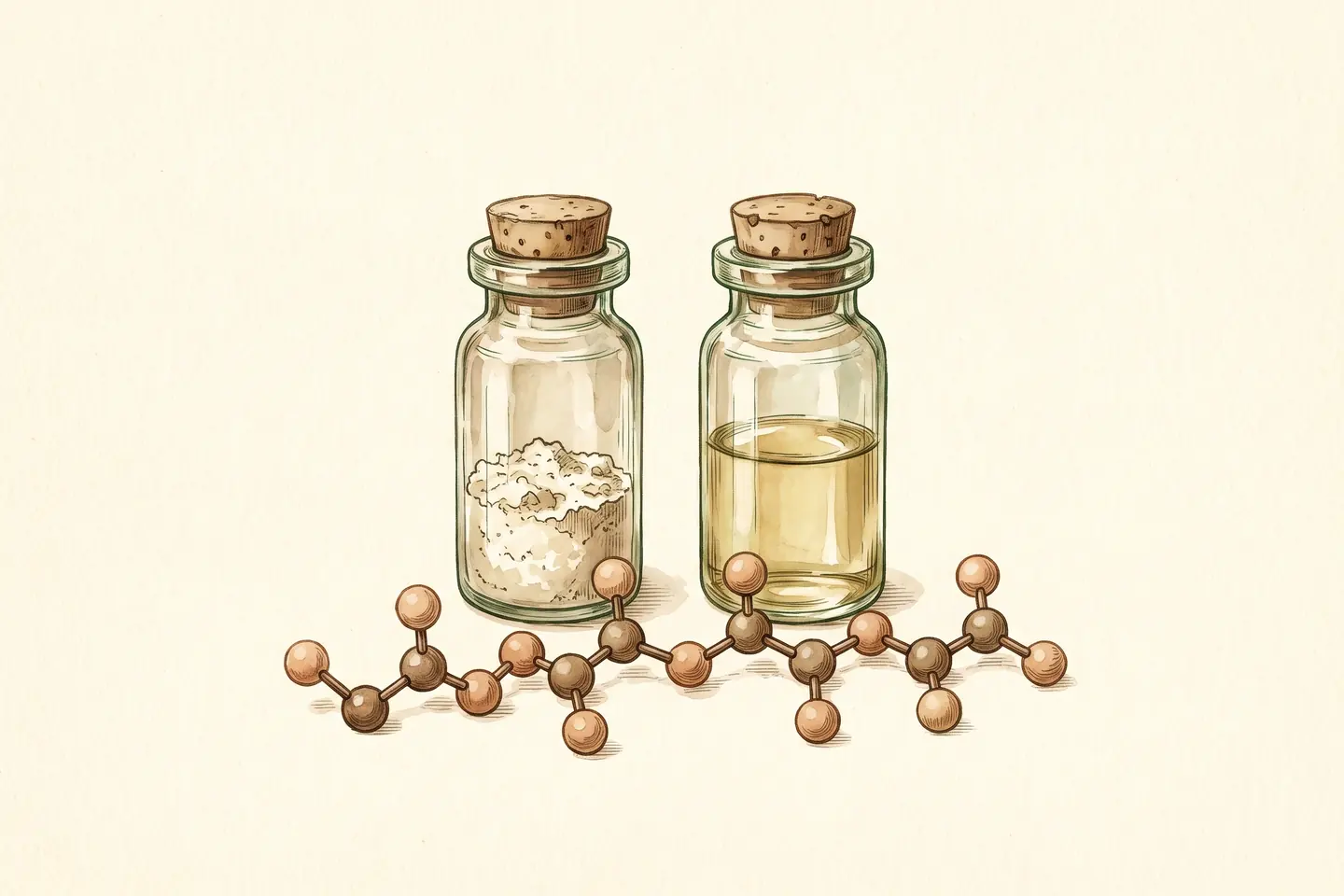
Peptides degrade mainly through two chemical reactions, deamidation and oxidation, each with known reactive sites in the amino acid sequence. Most successful biologic drugs, including many peptide therapeutics now in clinical use, carry a peptidic backbone, and that backbone is what makes deamidation and oxidation relevant in the first place [3].
Neither reaction is a vague breakdown. Both mostly yield soluble products, so a peptide solution can lose meaningful integrity while staying perfectly clear. Cloudiness usually points to a separate problem, such as aggregation, particulates, or contamination, covered in what cloudiness in an injectable vial means.
How does deamidation damage a peptide?
Deamidation begins when an asparagine side chain attacks the adjacent peptide bond, forming a cyclic succinimide intermediate that then hydrolyzes into a mixture of isoaspartate and aspartate. Glutamine residues also deamidate, more slowly.
Peptide chemistry describes deamidation as strongly dependent on the residue immediately after the asparagine. An asparagine-glycine arrangement is considered one of the faster-reacting motifs studied in model peptides. A peptide with an exposed asparagine next to glycine carries that deamidation liability no matter how carefully it is chilled.
Which amino acids make a peptide prone to oxidation?
Methionine, cysteine, tryptophan, tyrosine, and histidine are the residues most prone to oxidation. The reactive sites are the sulfur atoms of methionine and cysteine, the indole ring of tryptophan, the phenol ring of tyrosine, and the imidazole ring of histidine.
Oxidation is usually catalyzed by trace metals, light, or dissolved oxygen in the formulation. A sequence without any of those residues is structurally closer to oxidation-resistant than one with several of them clustered near the molecule's surface. Two different peptides do not deserve identical storage rituals. Light's role is covered in when peptide light protection matters.
Does heat cause peptide degradation?
Heat speeds up peptide degradation, but neither deamidation nor oxidation requires it: both run at room temperature and in the refrigerator, given water, time, and the right chemical environment.
Formulated biologic drug substances broadly face this kind of degradation-driven storage limit, whether the molecule is a peptide, a protein, or a nucleotide construct in a lipid particle. The mRNA vaccine field has documented in detail how storage and in-use stability challenges persist even with careful formulation and cold-chain handling [5]. The lesson carries over: cold alone does not solve chemistry driven by water and time.
A cooler bag matters because it slows reactions already running in a dissolved peptide, not because heat ruins a peptide in a single exposure the way a solvent spill would. Scoring a specific heat excursion during shipping is a separate problem.
Why does a reconstituted peptide degrade faster than freeze-dried powder?
A reconstituted peptide degrades faster because water is a required reactant for deamidation and for most oxidation pathways. Lyophilized (freeze-dried) powder has almost no free water available to drive those reactions, which is why dry peptide tolerates storage far better.
The reconstituted-versus-lyophilized distinction is the single fact that should reorganize storage and travel decisions. A vial of dry powder in a cooler bag is chemically closer to being paused than a vial of dissolved peptide in the same bag. The dissolved peptide keeps running deamidation and oxidation the entire time, only more slowly when cold.
Reconstitute as close as possible to the point of use, and treat days since reconstitution as at least as important a number as degrees in the cooler. Storage-stability literature on other formulated biologics reinforces that framing even though the molecule class differs [5]. A cold vial that has sat in solution for weeks is not automatically better off than a warm one mixed yesterday.
For travel, the two variables with a real chemical basis are cumulative time in solution and cumulative heat exposure. The same logic applied to transit is in why freeze-dried peptides tolerate shipping.
How does reconstitution water change peptide degradation?
The pH of the reconstitution water changes both deamidation and oxidation rates, because both reactions are pH-dependent. Bacteriostatic water and plain sterile water look identical, but they are not chemically interchangeable inputs.
Temperature is one of three levers on a reconstituted peptide's degradation. The other two are the pH of the water used to reconstitute it and the time it spends dissolved rather than as dry powder.
Do insulin-syringe units measure a peptide dose?
Insulin-syringe units do not measure a peptide dose by themselves; they follow a volume convention borrowed from insulin's historical concentration standard. Concentration is plain arithmetic: the units printed on a syringe correspond to a specific mass in a specific volume, and confusion over them is a units problem, not a chemistry problem.
Trial-grade peptide dosing is described in milligrams, as with tirzepatide's studied doses up to 15 mg weekly [1]. Translating a milligram dose onto a unit-marked syringe requires knowing the concentration in your vial, not assuming the markings mean the same thing across products. The arithmetic is laid out in syringe units measure volume, not dose.
How strong is the evidence on peptide storage chemistry?
Peptide storage chemistry claims rest mostly on mechanistic and review-level literature, a lower grade than randomized trials but a legitimate one. The deamidation and oxidation mechanisms themselves are long-established structural biochemistry.
At review grade, the literature supports that chemical degradation is a recognized, named challenge in the storage and in-use stability of formulated biologics generally [4][5]. Consumer content tends to blur foundational biochemistry, review-level synthesis, and clinical-trial evidence into one vague appeal to unnamed research. Storage chemistry evidence means "this is how the chemistry works," not "this trial measured your vial's degradation curve."
Randomized-trial grade looks different. The SURPASS-CVOT outcomes trial of tirzepatide, a peptide GIP/GLP-1 receptor agonist dosed up to 15 mg once weekly, randomized over 13,000 participants and is designed to establish cardiovascular noninferiority against an active comparator [1]. Consensus guidance for type 2 diabetes management now incorporates GLP-1 receptor agonist peptides as a standard option based on that kind of trial evidence [2].
Efficacy and cardiovascular safety are different questions from chemical stability. The trials still calibrate the evidence grade a reader should expect before trusting a specific efficacy claim about a peptide.
Does a peptide degrade the same way after injection?
A peptide does not necessarily degrade the same way after injection, because the environment it meets in the body differs meaningfully from its environment in the vial [4][5]. In vivo stability is a distinct question from shelf stability [4].
What happens to a peptide's structure inside the body's own chemical environment is still actively studied, and current experimental approaches for tracking a therapeutic protein's fate after injection remain limited [4].
Can you tell how far the peptide in your vial has degraded?
No visual check can tell how far the peptide in a vial has degraded; only an analytical assay shows what fraction has deamidated or oxidized on a given day. Consumer vials do not come with one, and little public literature gives a reader any other way to know.
Ranking one peptide's vulnerability precisely would take measured rate differences between specific sequence motifs. That kind of table exists in specialized peptide chemistry literature.
Sources
-
Nicholls SJ, Bhatt DL, Buse JB (2024). SURPASS-CVOT design and baseline characteristics. Am Heart J. PMID: 37758044. pubmed.ncbi.nlm.nih.gov/37758044
-
Davies MJ, Aroda VR, Collins BS (2022). Management of Hyperglycemia in Type 2 Diabetes, 2022. Diabetes Care. PMID: 36148880. pubmed.ncbi.nlm.nih.gov/36148880
-
Anselmo AC, Gokarn Y, Mitragotri S (2019). Non-invasive delivery strategies for biologics. Nat Rev Drug Discov. PMID: 30498202. pubmed.ncbi.nlm.nih.gov/30498202
-
Schuster J, Koulov A, Mahler HC (2020). In Vivo Stability of Therapeutic Proteins. Pharm Res. PMID: 31900680. pubmed.ncbi.nlm.nih.gov/31900680
-
Oude Blenke E, Örnskov E, Schöneich C (2023). The Storage and In-Use Stability of mRNA Vaccines and Therapeutics: Not A Cold Case. J Pharm Sci. PMID: 36351479. pubmed.ncbi.nlm.nih.gov/36351479
Last updated

Written by
Chemist and biochemist. Co-founder and author, The Peptide App.
Jay is a chemist, biochemist and entrepreneur whose work connects scientific research with consumer health products. He has held Chief Science Officer and product development leadership roles and previously served as Chief Revenue Officer at Minicircle.
Keep reading
Storage and handling
Hour for hour, heat spikes outweigh mild warmth in shelf-life math
Mean kinetic temperature, the accepted excursion math, weights spikes far above mild warmth. It needs stability data that gray-market sellers rarely publish.

Storage and handling
Freeze-dried peptides tolerate shipping far better than dissolved ones
Freeze-dried peptides tolerate shipping because a dry, glassy state slows most degradation. Labels set the rules; Cetrotide's dry powder must be refrigerated.
Storage and handling
Vial cloudiness has at least four causes; two are quality failures
Vial cloudiness can mean air, undissolved solid, aggregation, or contamination, and only some warrant discarding. Clarity proves neither sterility nor potency.
Profiles and tools

The Peptide App
Track protocols, doses, and reconstitution in one place.
Save your calculations, set reminders, log doses, and keep outcome notes — free to start.
 or scan the QR code →