
Melanotan II's receptor promiscuity explains its multiple effects
Melanotan II causes tanning and erections by activating several melanocortin receptors at once. Its human trials, run from 1996 to 2000, enrolled 23 people.

By Jay Spall, chemist and biochemist
Disclosure: Jay is a co-founder of The Peptide App. This review discusses the studies cited below; it is not a comprehensive live trial registry or treatment recommendation. Development and regulatory status can change. The app’s tools organize records and arithmetic and do not validate a research product.
On this page
- What is Melanotan II?
- Which melanocortin receptors does Melanotan II activate?
- Can Melanotan II be dosed for a tan without the libido effect?
- What did the Melanotan II human trials show?
- What doses did the Melanotan II trials use?
- What serious harms have Melanotan II users reported?
- Do the original Melanotan II trials apply to vials sold online today?
- What has never been studied about Melanotan II?
- Sources
Key facts
| Question | Direct answer |
|---|---|
| Does Melanotan II work for tanning and libido? | Human data show both effects, but the tanning data come from a three-person open-label pilot [1]. The controlled trials measured erectile function, not tanning, in a total of 20 men [2][3]. |
| Is Melanotan II FDA-approved or regulated? | No. Melanotan II never advanced past small early-phase human trials and has no approved indication. Anything sold today is unregulated research material of unverified purity. |
| Why does Melanotan II darken moles? | Melanotan II is a non-selective melanocortin agonist that activates MC1R on melanocytes throughout the skin, not only where a tan is wanted. The same mechanism drives the new pigmentation and mole changes reported in case literature. |
| Is the erection effect a side benefit or the main pharmacology? | Main pharmacology, at a different subtype of the same receptor family. MC4R activation in the central nervous system drives arousal and erection, independent of the MC1R tanning pathway [1][2][3]. |
| Has anyone been seriously harmed by Melanotan II? | Yes. Published cases include rhabdomyolysis with acute kidney injury after a single high dose [4] and renal infarction plausibly linked to MC-receptor-driven vasoconstriction, alongside 215 adverse-event calls to one national poison center over 11 years [5]. |
| Does the trial evidence apply to a vial bought online today? | Only to the molecule as pharmacologically characterized then. It says nothing about the purity, dose accuracy, or identity of unregulated product injected now, which is a supply-chain problem, not a pharmacology problem. |
5 sources cited. View sources
What is Melanotan II?
Melanotan II is a synthetic cyclic peptide built to mimic and outlast alpha-melanocyte-stimulating hormone (alpha-MSH), the body's natural signal for skin pigmentation.
Melanotan II diverges from the natural hormone, and from its FDA-approved cousin afamelanotide, in selectivity. Afamelanotide is engineered to favor MC1R, the receptor on melanocytes that triggers melanin production, and its approved use is reviewed separately. Melanotan II instead binds non-selectively, essentially firing the whole melanocortin receptor family at once.
Melanotan II never advanced past small early-phase human trials, and it has no approved indication.
Which melanocortin receptors does Melanotan II activate?
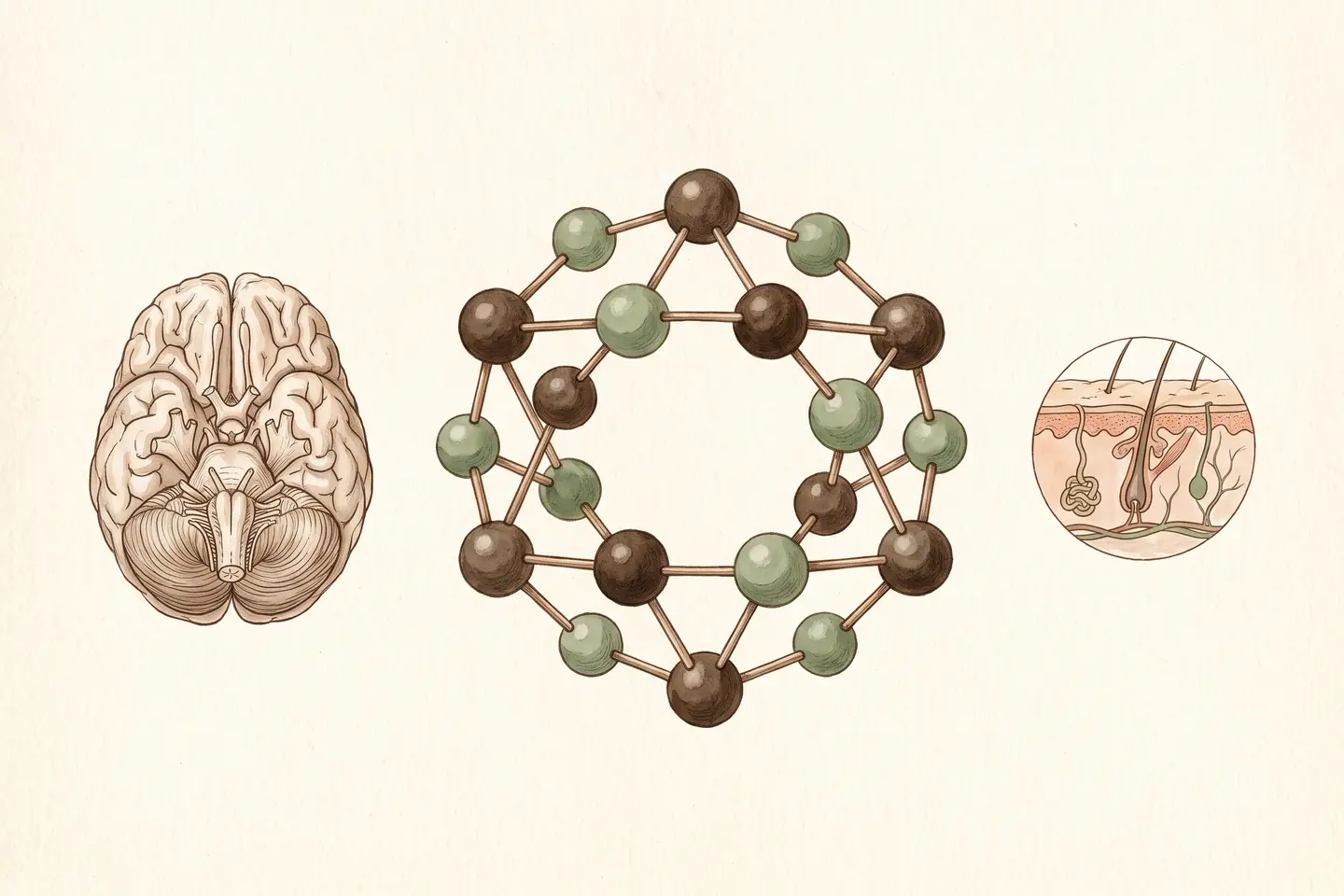
Melanotan II binds MC1R, MC3R, MC4R, and MC5R, and that receptor promiscuity explains its unrelated effects: MC1R drives tanning, while MC4R drives erections and sexual desire.
MC1R activation on skin melanocytes produces the tanning effect people are chasing. The first human proof-of-concept trial documented quantifiable tanning alongside spontaneous erections in just three volunteers [1].
MC4R sits centrally in the hypothalamus, where it is deeply involved in appetite regulation and sexual arousal circuitry. MC4R activation is why Melanotan II reliably produces erections and increased sexual desire in clinical trials, independent of any tanning [2][3]. It is also the plausible route to the appetite suppression users report anecdotally.
MC3R and MC5R have their own roles in energy homeostasis and exocrine function, far less characterized in humans. How Melanotan II and bremelanotide overlap is covered separately.
Can Melanotan II be dosed for a tan without the libido effect?
No dose of Melanotan II separates the tan from the libido effect, because the drug activates a receptor family, not a single receptor.
The ratio of effects a user gets depends on individual receptor density and sensitivity, which nobody can predict from a vial label.
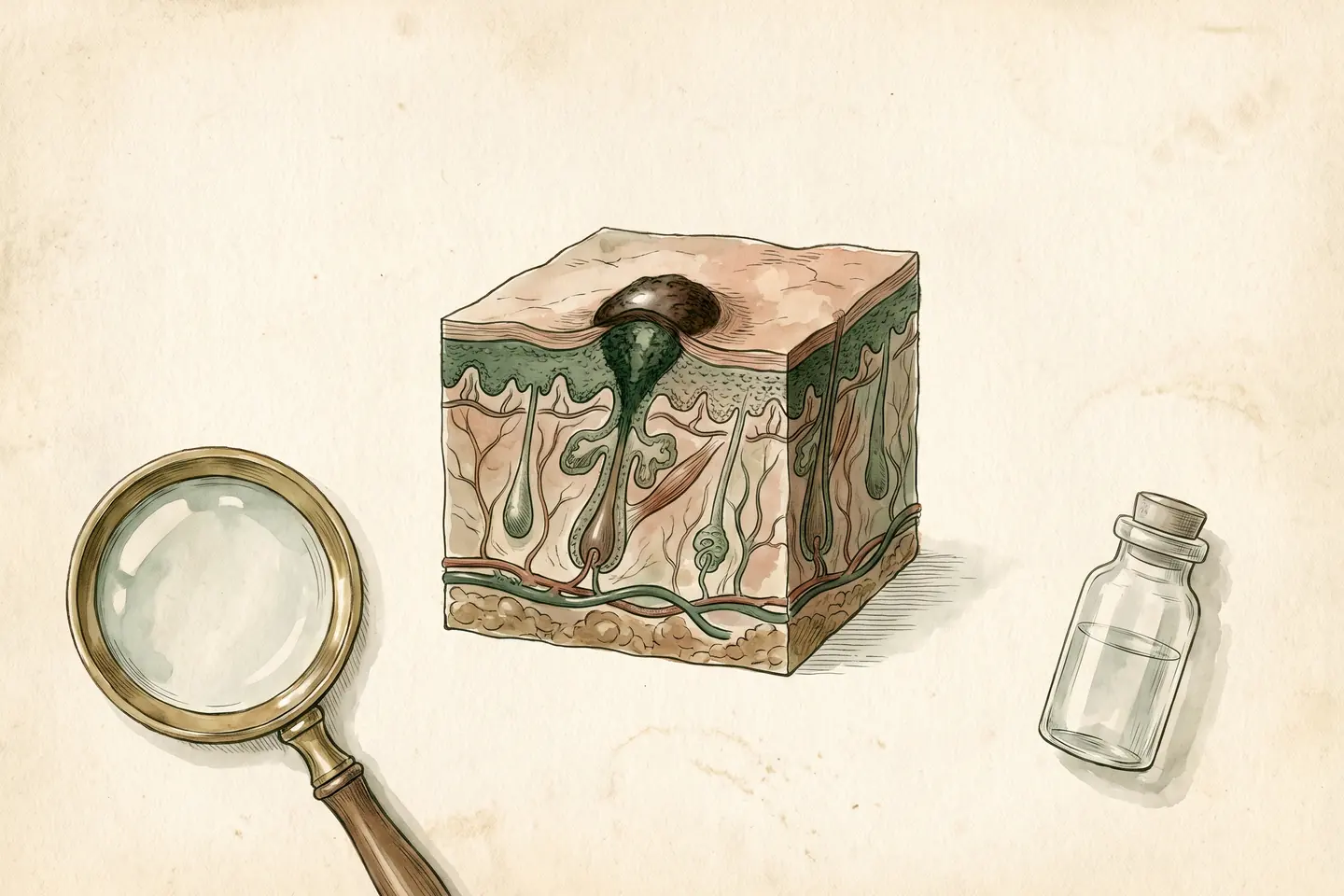
The same non-selectivity is the most credible mechanistic explanation for the melanocyte-related case reports. MC1R stimulation does not discriminate between the skin a user is trying to darken and existing nevi, which are collections of melanocytes primed to respond to exactly this signal. The mole changes and melanoma risk have their own analysis.
What did the Melanotan II human trials show?
Three small trials from 1996 to 2000, with 23 participants in total, showed tanning in one open-label pilot and erections in two controlled erectile dysfunction trials [1][2][3].
No published randomized tanning trial exists. The human trial evidence is thin and points somewhere other than where most users assume:
- 1996 pilot. An open-label pilot in three healthy men found that subcutaneous Melanotan II at 0.01 to 0.03 mg/kg produced measurable tanning and erections lasting one to five hours [1].
- 1998 crossover trial. A double-blind, placebo-controlled crossover trial in ten men with psychogenic erectile dysfunction found that Melanotan II at 0.025 mg/kg produced clinically apparent erections in 8 of 10 participants. Tip rigidity lasted 38 minutes versus 3 minutes for placebo (p=0.0045), and nausea and yawning were the main side effects [2].
- 2000 crossover trial. A follow-up crossover trial in ten men with organic erectile dysfunction recorded erections after 12 of 19 active injections versus 1 of 21 placebo doses, plus a significant increase in subjective sexual desire. Severe nausea followed 4 of 19 injections [3].
Across the trials, the reported side effects were nausea, facial flushing, and yawning shortly after injection [2][3]. The erectile and libido effects are, pharmacologically, the point, not a side effect [1][2][3].
These small, short trials of erectile endpoints do not establish broad or long-term safety, and they do not validate separately supplied research material. Development never advanced to Phase 2 or 3. Melanotan II's evidence grade is D, limited: a real signal for the erectogenic mechanism, essentially no controlled data on tanning as an endpoint, and no long-term safety surveillance.
What doses did the Melanotan II trials use?
The Melanotan II trials used 0.01 to 0.03 mg/kg subcutaneously in the pilot [1] and a fixed 0.025 mg/kg in both erectile dysfunction trials [2][3].
Clinical staff administered verified compound in those trials. For a 75 kg adult, the trial range works out to roughly 0.75 to 2.25 mg per dose.
That arithmetic makes the toxicity case report legible. A 6 mg single self-injection [4] sits well above the roughly 2.25 mg upper end of any dose studied in controlled conditions for a 75 kg adult, and it used material of unknown purity.
None of the trials describes a maintenance or loading dosing schedule. That framework comes from bodybuilding-adjacent forum culture, not from any trial protocol.
What serious harms have Melanotan II users reported?
Published Melanotan II harms include rhabdomyolysis with acute kidney injury after one 6 mg self-injection [4] and a renal infarction plausibly attributable to the drug [5].
A 39-year-old man who self-injected 6 mg of internet-sourced Melanotan II developed a sympathomimetic toxidrome: tachycardia peaking at 146 bpm, hypertension, and rhabdomyolysis with creatine kinase reaching 17,773 IU/L, along with acute kidney injury requiring ICU admission [4].
A separate case report describes renal infarction plausibly attributable to Melanotan II, with the authors proposing melanocortin-receptor-driven vasoconstriction as the mechanism. The same report notes that a single national poison center logged 215 Melanotan II-related adverse event inquiries between 2008 and 2019 [5].
Rhabdomyolysis, acute kidney injury, and renal infarction [4][5] appear nowhere in the controlled trials, most plausibly because those trials were too small, too short, and too controlled in dosing to generate them.
The case reports have limits of their own. They describe unregulated, self-sourced, self-dosed product, where the adverse event could stem from the peptide itself, a contaminant, an incorrect concentration, or all three at once. Poison center call volume shows that adverse events are common enough to generate hundreds of inquiries. It does not show whether the peptide, the dose, or the manufacturing was the proximate cause in any individual case.
Do the original Melanotan II trials apply to vials sold online today?
The 1996 to 2000 trials describe the Melanotan II molecule as tested then, not the purity, dose accuracy, or identity of a vial bought online today.
The molecule studied in those trials is reasonably well characterized at the doses and durations tested. Whatever arrives in a vial from an unregulated research-peptide seller today has not been verified against that molecule. That is a supply-chain problem, not a pharmacology problem.
Whether Melanotan II is safe has no general answer. The answer depends on whether a specific product matches the specific thing that was studied, and pharmacology cannot settle that.
What has never been studied about Melanotan II?
Melanotan II has never been studied in a randomized tanning trial, in long-term use, or under a surveillance protocol for mole changes:
- Tanning. With no randomized tanning trial, the tanning effect that motivates most current use rests on mechanism and a three-person open-label pilot [1].
- Mole surveillance. No study has systematically tracked melanocytic lesion changes over time in Melanotan II users. The mole-darkening and new-growth reports that concern dermatologists exist as case observations, not as a studied incidence rate.
- Source of harms. Nobody has established what fraction of adverse events in the case literature stems from the peptide itself versus contamination, mislabeled concentration, or user error.
- Long-term use. No data exist on long-term or repeated-cycle use. Every controlled trial was a single-dose or short crossover design.
Sources
Last updated

Written by
Chemist and biochemist. Co-founder and author, The Peptide App.
Jay is a chemist, biochemist and entrepreneur whose work connects scientific research with consumer health products. He has held Chief Science Officer and product development leadership roles and previously served as Chief Revenue Officer at Minicircle.
Keep reading
Compound evidence
Melanotan II's real risks come from receptor nonselectivity
Melanotan II activates melanocortin receptors beyond the skin and, in a case report, altered how moles looked. Whether it raises melanoma rates is unmeasured.
Combinations and evidence
Melanotan II and PT-141 act on the same melanocortin receptor family
Melanotan II and PT-141 share melanocortin receptors, so stacking adds agonism rather than a second mechanism. No trial has tested the two together.

Compound evidence
Afamelanotide implants, approved for EPP, extended pain-free sun time
The FDA-approved afamelanotide implant gave people with EPP more pain-free sun time in two Phase 3 trials. No controlled trial covers tanning or libido.
Profiles and tools

The Peptide App
Track protocols, doses, and reconstitution in one place.
Save your calculations, set reminders, log doses, and keep outcome notes — free to start.
 or scan the QR code →