
Melanotan II's real risks come from receptor nonselectivity
Melanotan II activates melanocortin receptors beyond the skin and, in a case report, altered how moles looked. Whether it raises melanoma rates is unmeasured.

By Jay Spall, chemist and biochemist
Disclosure: Jay is a co-founder of The Peptide App. This review discusses the studies cited below; it is not a comprehensive live trial registry or treatment recommendation. Development and regulatory status can change. The app’s tools organize records and arithmetic and do not validate a research product.
On this page
- Is Melanotan II dangerous?
- Why are Melanotan II's side effects predictable?
- Does Melanotan II cause melanoma?
- How does Melanotan II change the way moles look?
- What do regulator warnings about melanotan products mean?
- How does afamelanotide differ from Melanotan II?
- What is still unknown about Melanotan II's risks?
- Sources
Key facts
| Question | Direct answer |
|---|---|
| Is Melanotan II dangerous? | Yes, in specific ways. Melanotan II activates melanocortin receptors that are not selective for skin, and it reaches users through an unregulated supply chain. It is not a "mystery poison," and it is not "basically fine" either. |
| Does Melanotan II cause melanoma? | No causal rate is established. One case report documents moles changing during Melanotan II use [5], and other case reports describe melanoma diagnoses in users. Single cases show association, and heavy sun exposure in users is a real confounder. |
| Why does Melanotan II darken skin and moles? | Darkening is the drug working as designed. Melanotan II binds the melanocortin receptors that control pigment production, so darkening is an on-target effect, not a mysterious side reaction [6]. |
| Is Melanotan II legal or approved anywhere? | No. Melanotan II has never received marketing authorization for any use. National medicines regulators have warned about unlicensed melanotan products, a statement about unregulated supply, not a formal finding that the compound causes cancer. |
| Are the sex-drive and blood-pressure effects side effects? | They are on-target too. Melanocortin receptors outside the skin sit in pathways tied to appetite and sexual arousal, and a related melanocortin agonist trial recorded erection and arousal effects alongside skin reactions [2]. |
| Is there a safer, studied alternative? | Afamelanotide, a receptor-selective melanocortin analog, is approved for one rare light-sensitivity condition and has trial and registry safety data [1][3][4]. It is not interchangeable with Melanotan II or approved for tanning. |
6 sources cited. View sources
Is Melanotan II dangerous?
Melanotan II's danger is real and specific: it activates melanocortin receptors that are not selective for skin, and it reaches users through an unregulated supply chain.
Melanotan II is not a "mystery poison," and it is not "basically fine" either. Part of its risk comes from the molecule's biology: broad receptor activation that darkens moles and switches on effects far from the skin. The rest comes from the vial: unknown purity, unknown dose, and unknown contamination. How that broad activation produces tanning, arousal, and appetite effects at once is covered in how receptor promiscuity explains Melanotan II's multiple effects.
Why are Melanotan II's side effects predictable?
Melanotan II's side effects follow from its targets: it activates several melanocortin receptor subtypes at once, in tissues well beyond the skin [6].
The melanocortin receptors are a small family, MC1R through MC5R, distributed in tissues involved in pigmentation, appetite, stress response, and steroid signaling [6]. Melanotan II is not selective among them, and that nonselectivity is the entire story.
Tanning happens because MC1R agonism drives melanin production in melanocytes. MC1R is also the receptor whose natural genetic variants are established markers of melanoma risk in the general population [6]. Increased sexual arousal, appetite changes, and blood pressure shifts happen because other melanocortin receptors, active elsewhere in the body, switch on at the same time.
A closely related melanocortin-4 receptor agonist, tested in a randomized, placebo-controlled trial for obesity, produced headache, sexual-arousal disturbance, and erections as on-target effects. Its skin reactions were serious enough that the trial was stopped early [2]. That compound is not Melanotan II, but it shares the receptor logic: hit melanocortin pathways broadly, and the effects are broad, not a clean cosmetic outcome.
Does Melanotan II cause melanoma?
No study has established that Melanotan II causes melanoma; case reports describe melanoma diagnoses and changing moles in users, which shows an association, not a causal rate.
Dermatology and toxicology literature describes new and changing melanocytic lesions, including melanoma diagnoses, in Melanotan II users, plus separate reports of priapism, rhabdomyolysis, and renal complications. Case series of this kind show that a signal exists and deserves serious attention.
They cannot show how common these outcomes are among all users, because no registry, no denominator, and no control group exist. People who inject an unregulated tanning peptide also tend to seek more ultraviolet exposure on purpose, since a tan is the point of using it. UV exposure is an independent, well-established melanoma risk factor, and case reports cannot separate the drug's contribution from the sun-seeking behavior it encourages.
How does Melanotan II change the way moles look?
Melanotan II changed a young man's moles enough under dermoscopy that clinicians could no longer confidently tell a benign nevus from melanoma by sight [5].
The case report followed sequential dermoscopic imaging of his moles before and during self-injection, and it is the strongest published clinical documentation specific to Melanotan II [5]. The finding was not "a mole turned into cancer." The moles' dermoscopic appearance changed under the drug's influence.
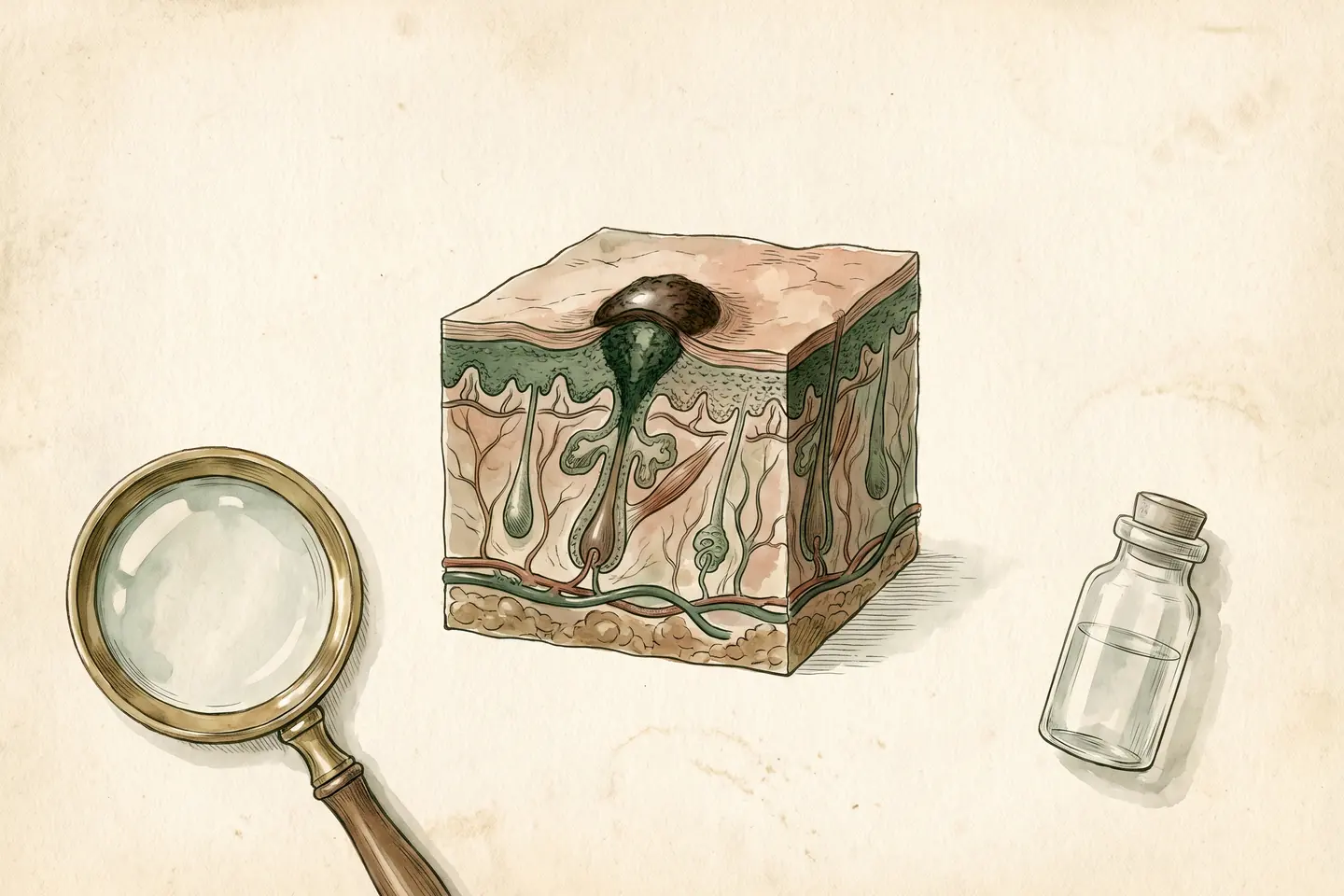
One patient cannot establish a rate, an odds ratio, or causation. The case does establish a clinical problem: the receptor activation that darkens skin also alters the visual architecture of existing moles, and that architecture is the signal dermatologists rely on to catch melanoma early. A drug that changes what moles look like creates a surveillance blind spot, whether or not it independently causes cancer.
What do regulator warnings about melanotan products mean?
Regulator warnings about melanotan mean the products are unlicensed and unchecked, not that a regulator has formally ruled that Melanotan II causes a specific disease.
The UK's medicines regulator and Australia's therapeutics regulator have issued formal safety warnings on unlicensed melanotan products. A warning about an unapproved product states that the compound has never gone through controlled manufacturing standards, dose verification, sterility testing, or pharmacovigilance. It is a different kind of evidence from a clinical trial or a case series, and it answers a different question.
Injectable products sourced outside any regulated supply chain carry unknown purity, unknown actual dose per vial, and unknown contamination risk, on top of whatever the molecule itself does. Part of the risk is the drug's biology, and part is that nobody is checking what is in the vial. A guide to reading a peptide certificate of analysis explains what a vendor test report does and does not show.
How does afamelanotide differ from Melanotan II?
Afamelanotide is a melanocortin-1 receptor agonist approved for erythropoietic protoporphyria, and unlike Melanotan II it has controlled-trial and registry safety data behind it [1][3][4].
Erythropoietic protoporphyria is a rare condition that causes severe light sensitivity. A systematic review of photoprotective treatments for it found that afamelanotide, delivered as a subcutaneous implant, produced a moderate positive effect on light tolerance, one of the few interventions in that review with controlled-trial support [1].
A German post-authorization safety study following 200 treated patients found a safety profile consistent with earlier trials. It reported that 91.0% of patients who started treatment were still on it, with meaningful quality-of-life improvement [3]. A dermatology review of afamelanotide's broader potential uses noted that nearly all patients experience diffuse skin darkening, an expected, on-target pigmentary effect, not an adverse surprise [4].
None of that endorses afamelanotide for tanning, which is not its approved purpose. Its receptor selectivity and monitored dosing are not equivalent to Melanotan II's broader receptor activity and unregulated sourcing. The comparison shows what a melanocortin agonist looks like after registries and controlled follow-up, a process Melanotan II has never been through. The afamelanotide approval evidence is reviewed in full separately.
What is still unknown about Melanotan II's risks?
Whether Melanotan II independently raises melanoma incidence remains unmeasured, along with several other risks:
- Melanoma incidence. No randomized trial of Melanotan II has measured melanoma risk, and no population-level study estimates how much, if at all, it raises melanoma incidence beyond the surveillance problem it creates.
- Nevus transformation. The case-report literature has not resolved whether melanocortin receptor agonism drives transformation of an existing atypical nevus or only makes atypical nevi harder to read visually.
- Product quality. None of the cited studies measured the purity, dosing accuracy, or contamination profile of products sold outside regulated channels, and that profile is likely to vary batch to batch.
- Cardiovascular effects. Long-term cardiovascular effects of repeated melanocortin receptor activation outside a formal trial setting remain undocumented for Melanotan II.
Sources
Last updated

Written by
Chemist and biochemist. Co-founder and author, The Peptide App.
Jay is a chemist, biochemist and entrepreneur whose work connects scientific research with consumer health products. He has held Chief Science Officer and product development leadership roles and previously served as Chief Revenue Officer at Minicircle.
Keep reading
Compound evidence
Melanotan II's receptor promiscuity explains its multiple effects
Melanotan II causes tanning and erections by activating several melanocortin receptors at once. Its human trials, run from 1996 to 2000, enrolled 23 people.

Compound evidence
Afamelanotide implants, approved for EPP, extended pain-free sun time
The FDA-approved afamelanotide implant gave people with EPP more pain-free sun time in two Phase 3 trials. No controlled trial covers tanning or libido.
Combinations and evidence
Melanotan II and PT-141 act on the same melanocortin receptor family
Melanotan II and PT-141 share melanocortin receptors, so stacking adds agonism rather than a second mechanism. No trial has tested the two together.
Profiles and tools

The Peptide App
Track protocols, doses, and reconstitution in one place.
Save your calculations, set reminders, log doses, and keep outcome notes — free to start.
 or scan the QR code →