
Bronchogen reversed COPD-like lung remodeling in a rat study
Bronchogen reversed COPD-like lung remodeling in one rat study and activated bronchial genes in human cell cultures. No human clinical trial has tested it.

By Jay Spall, chemist and biochemist
Disclosure: Jay is a co-founder of The Peptide App. This review discusses the studies cited below; it is not a comprehensive live trial registry or treatment recommendation. Development and regulatory status can change. The app’s tools organize records and arithmetic and do not validate a research product.
On this page
- What is Bronchogen?
- How is Bronchogen supposed to work?
- What did Bronchogen do in human bronchial cells?
- Does Bronchogen work in an animal model of COPD?
- Has Bronchogen been tested in human clinical trials?
- Do Khavinson's human aging trials count as evidence for Bronchogen?
- Is there a tested Bronchogen dose?
- Is Bronchogen safe?
- What is still unknown about Bronchogen?
- Sources
Key facts
| Question | Direct answer |
|---|---|
| What is Bronchogen? | A synthetic four-amino-acid peptide, Ala-Glu-Asp-Leu (AEDL), not a plant extract, hormone, or proprietary blend. Bronchogen is one of the short "bioregulator" peptides developed by Vladimir Khavinson's group, each named for the organ it was designed to target. |
| Has Bronchogen been tested in a human clinical trial? | No. No randomized or placebo-controlled human trial of Bronchogen exists. |
| What evidence for Bronchogen exists? | Preclinical work only: gene activation and direct DNA binding in human bronchial cell cultures [1], reversed tissue remodeling in a rat model of chemically induced COPD-like lung damage [2], and biophysical chemistry showing the peptide stabilizes DNA structure [3]. |
| Do human trials of other Khavinson peptides count for Bronchogen? | No. Those trials, where they exist, tested different peptides, with different sequences and named targets, for different endpoints. Citing them for Bronchogen is cross-extrapolation. |
| What is Bronchogen's evidence grade? | E, minimal: mechanistically plausible, preclinically supported, unproven in humans. |
| Is Bronchogen safe? | Long-term human safety is unknown because no controlled human trial has run. Injection-site reactions are a known risk of subcutaneous peptide use, and research-use-only sourcing adds purity, sterility, and mislabeling risk. |
3 sources cited. View sources
What is Bronchogen?
Bronchogen is the synthetic tetrapeptide Ala-Glu-Asp-Leu, four amino acids in a fixed order. Bronchogen belongs to a family of short "bioregulator" peptides that Vladimir Khavinson's group developed, each named for the organ it was designed to target.
Bronchogen is not a tissue extract with an undefined mixture of active constituents. It is a single defined sequence that a peptide synthesis lab could make and verify by mass spectrometry. That makes claims about Bronchogen testable in a way that claims about a "proprietary complex" are not.
The defined sequence also sets a standard: every finding attributed to Bronchogen should trace to studies of this exact sequence. Its cousins in the same peptide family, including Cardiogen and Ventfort, have different sequences and were developed for different organs. Cardiogen's evidence stands or falls on its own studies, and so does Bronchogen's.
How is Bronchogen supposed to work?
Bronchogen is proposed to enter cells and bind DNA directly, changing which genes are transcribed, instead of acting through a surface receptor. The case for short peptide bioregulators rests on this non-receptor claim: tetrapeptides and shorter fragments can enter cells and bind DNA, rather than triggering a receptor and signaling cascade the way a hormone or growth factor does.
Skeptical commentary usually dismisses the idea out of hand: "it's just four amino acids, there's no receptor, so nothing happens." That objection misreads the proposed mechanism rather than refuting it. Short peptide-DNA interaction, including binding at nitrogen bases without a classical receptor, is a documented biophysical phenomenon.
Biophysical work supports the binding claim for Bronchogen specifically. Bronchogen raised the melting temperature of calf thymus and mouse liver DNA by 3.1 degrees Celsius at low molar ratios (0.01 to 0.055), which indicates the peptide binds directly to DNA and stabilizes its double helix at nitrogen bases on both strands [3]. The thermostability data support the binding mechanism but say nothing on their own about tissue-level or organism-level effects.
What did Bronchogen do in human bronchial cells?
In cultured human embryonic bronchial epithelial cells, Bronchogen bound DNA, and the binding was associated with activation of a coordinated cluster of bronchial differentiation genes [1]. Biophysical methods placed the binding at the major groove, at the N7 position of guanine, and the activated genes were NKX2-1, FOXA1, FOXA2, SCGB1A1, SCGB3A2, MUC4, MUC5AC, and SFTPA1 [1]. The cultures were examined across passages 1, 7, and 14 [1].
Those genes are established markers of bronchial epithelial identity and secretory function. The result is specific: a defined peptide, a defined binding site, and a biologically coherent gene cluster. The cultures establish plausible biological activity at the cellular level in human-derived tissue, a stronger starting point than a rodent-only or purely synthetic-chemistry study.
The cell data remain an in vitro finding. Gene activation in a dish is not a functional outcome in a living respiratory tract, let alone a human one, and cell cultures establish nothing about activity in an intact organism.
Does Bronchogen work in an animal model of COPD?
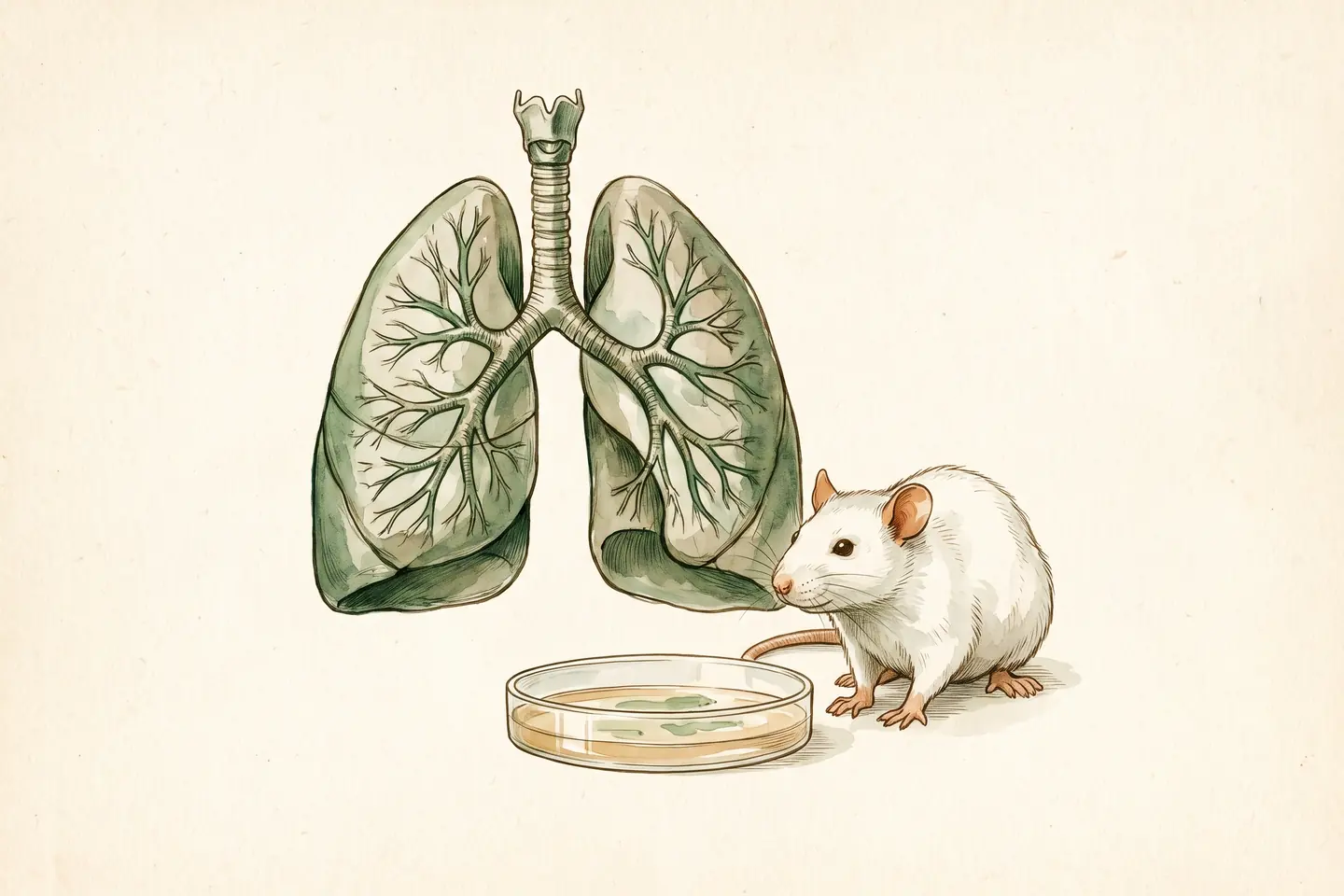
One rat study links Bronchogen to reversal of COPD-like lung tissue remodeling [2]. Wistar rats with COPD-like pathology induced by nitrogen dioxide exposure received Bronchogen for one month. Goblet cell hyperplasia, squamous metaplasia, and emphysematous change were reduced, ciliated cell populations were restored, secretory IgA production normalized, and the bronchoalveolar inflammatory markers TNF-alpha and IL-8 were lowered [2].
The rat study is the strongest whole-organism evidence for Bronchogen, and a real signal worth taking seriously as hypothesis-generating data. It has three limits. It is a single rat study from a research group closely tied to the peptide's development. Its chemically induced model only approximates human obstructive lung disease. None of the studies cited below independently replicates it.
Has Bronchogen been tested in human clinical trials?
No human clinical trial of Bronchogen exists: no randomized, placebo-controlled, or blinded study, and no efficacy or safety trial of any size. That absence is the most important fact about Bronchogen's evidence base.
Hype-oriented coverage omits it. Writeups cite "clinical studies" and "decades of research" without naming, dating, or sizing a single Bronchogen-specific human trial.
Bronchogen's evidence grade is E, minimal: mechanistically plausible, preclinically supported at the cell and animal level, and entirely unproven in humans.
Do Khavinson's human aging trials count as evidence for Bronchogen?
Khavinson-group human aging trials are not evidence for Bronchogen: where those trials exist, they tested other peptides against other endpoints. Forum and marketing writeups often cite human aging or geroprotective trial data from the Khavinson group as though it validates Bronchogen.
Those trials, when they exist, were generally conducted on other named bioregulators in the same peptide family. Their endpoints were general aging-related or organ-specific outcomes, not bronchial or pulmonary ones, and none of the data is Bronchogen-specific.
Extrapolating from a trial of a different sequence, targeting a different organ, to claims about Bronchogen's effects on lung tissue is not supported reasoning. How often that extrapolation appears next to Bronchogen dosing protocols online does not change it.
Is there a tested Bronchogen dose?
No human dosing, cycling, or route-comparison data exist for Bronchogen. Reported routes include subcutaneous injection and oral capsules. No study establishes a dose, a cycle length, or the relative bioavailability of the two routes in humans, and the specific numbers in forum protocols do not trace to any study.
Every Bronchogen dosing protocol online is an unsourced convention, not a tested regimen. Why peptide cycling lacks documented evidence covers cycling schedules across peptides, and how swallowed peptides fare in digestion covers the oral route.
Is Bronchogen safe?
No controlled human data exist on Bronchogen's long-term safety. The only concrete safety signal is injection-site reactions, which are noted with subcutaneous peptide use generally.
Product quality is a separate risk. Bronchogen is sold almost exclusively as an unregulated research-use-only product, so purity, sterility, and accurate labeling are unverified variables layered on top of an already thin efficacy picture. How to read a peptide COA covers what a certificate of analysis can and cannot confirm.
What is still unknown about Bronchogen?
Every question that matters to a human user of Bronchogen remains untested:
- Human airway effects. Whether the gene-expression changes in cultured cells [1] or the tissue-remodeling reversal in rats [2] translate into any measurable functional effect in human airways is untested.
- Pharmacokinetics. Human pharmacokinetics, injectable or oral, are uncharacterized.
- Dose. No study has established a human dose, cycle length, or relative bioavailability by route.
- Long-term safety. No controlled human data exist.
- Product identity. Research-use-only material carries unverified purity, sterility, and labeling.
Sources
Last updated

Written by
Chemist and biochemist. Co-founder and author, The Peptide App.
Jay is a chemist, biochemist and entrepreneur whose work connects scientific research with consumer health products. He has held Chief Science Officer and product development leadership roles and previously served as Chief Revenue Officer at Minicircle.
Keep reading

Compound evidence
Cardiogen stimulated heart-cell growth in rat tissue studies
Cardiogen stimulated heart-cell proliferation in young and aged rat tissue cultures. Every study is preclinical and traces to one research group.

Compound evidence
Peptide cycling is a convention borrowed from steroid and SARM culture
Peptide cycling began in steroid culture, and daily MK-677 kept IGF-1 up in older adults for two years. Popular peptides have no cycled-versus-continuous trial.
Compound evidence
Swallowed peptides rarely survive; oral semaglutide is an exception
Swallowed peptides face stomach enzymes, intestinal enzymes, and gut-wall and liver barriers. Oral semaglutide is the clearest documented exception.
Profiles and tools

The Peptide App
Track protocols, doses, and reconstitution in one place.
Save your calculations, set reminders, log doses, and keep outcome notes — free to start.
 or scan the QR code →