
Calcitonin's weak benefit lost to an ambiguous cancer signal in 2012
Europe pulled calcitonin's osteoporosis indication in 2012 when an ambiguous cancer signal outweighed a weak fracture benefit. The cancer link is unproven.

By Jay Spall, chemist and biochemist
Disclosure: Jay is a co-founder of The Peptide App. This review discusses the studies cited below; it is not a comprehensive live trial registry or treatment recommendation. Development and regulatory status can change. The app’s tools organize records and arithmetic and do not validate a research product.
On this page
Key facts
| Question | Direct answer |
|---|---|
| What did European regulators do to calcitonin in 2012? | They pulled the nasal spray's osteoporosis indication after an EMA Article 31 referral, leaving only short-course uses such as Paget's disease of bone and hypercalcemia of malignancy. |
| Does calcitonin cause cancer? | Not proven. The signal was a small excess of malignancy diagnoses in pooled trial data, with no consistent cancer type and no dose-response relationship, the pattern regulators typically treat as ambiguous rather than causal. |
| Does nasal calcitonin prevent fractures? | Not convincingly. Independent meta-analyses keep finding calcitonin's fracture and bone-density effects too small or inconsistent to distinguish from other explanations, especially next to bisphosphonates or PTH-receptor agonists [1][2][3]. |
| Is calcitonin still used or studied? | Yes, mostly outside osteoporosis prevention. Calcitonin and analogs like elcatonin remain in comparative trials in specific populations, including kidney transplant recipients and some Asian cohorts, generally with modest or non-superior results against newer agents [4][6][7]. |
| Why does the restriction matter beyond the cancer headline? | It was a benefit-risk recalculation, not a carcinogen verdict: a thin, hard-to-replicate fracture benefit meant even an ambiguous safety signal was enough to shift the balance. |
7 sources cited. View sources
What did European regulators decide about calcitonin in 2012?
In 2012, the EMA's Committee for Medicinal Products for Human Use (CHMP) pulled calcitonin nasal spray's osteoporosis indication in Europe after an Article 31 referral on calcitonin-containing medicines. Calcitonin kept only short-course uses, for conditions such as Paget's disease of bone, acute immobilization-related bone loss, and hypercalcemia of malignancy. The restriction reads as a benefit-risk recalculation, not a carcinogen verdict.
How does calcitonin work?
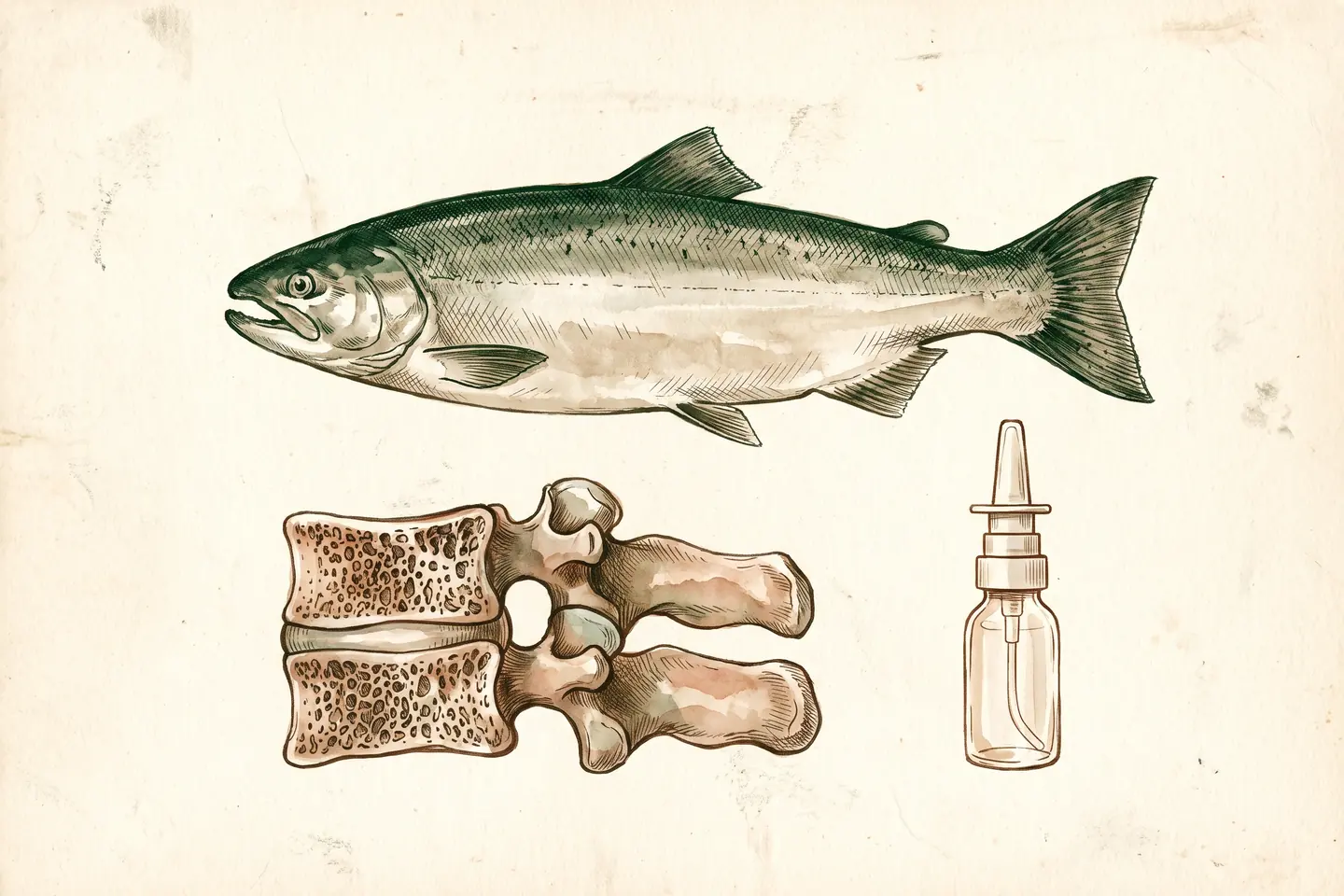
Calcitonin is a peptide hormone, produced physiologically by thyroid C-cells, that binds calcitonin receptors on osteoclasts and slows osteoclast-mediated bone resorption [1]. That action is the rationale for using synthetic salmon calcitonin as an antiresorptive in low bone-density conditions where architectural degradation drives fracture risk [1].
Salmon calcitonin binds the human receptor with higher affinity than the native human hormone, which is why salmon calcitonin, rather than human calcitonin, became the marketed molecule. The mechanism is well established at the receptor level. What was never well established was whether that receptor effect translated into a fracture reduction large enough to matter clinically, or whether long-term exposure carried a downstream risk that offset it.
Does calcitonin prevent fractures?
Calcitonin's fracture case was weak from the beginning, and independent meta-analyses keep finding its fracture and bone-density effects too small or inconsistent to distinguish from other explanations [1][2][3]. That weakness is decisive for interpreting the 2012 decision.
A 2021 meta-analysis of intranasal salmon calcitonin trials found real effects on serum calcium, creatinine ratio, and alkaline phosphatase, which are markers of bone turnover. It could not confirm an advantage for lumbar spine or hip bone mineral density, the outcomes that predict fracture protection [3].
In men, a systematic review pooling calcitonin trials against placebo found a relative risk for vertebral fracture of 0.272, with a confidence interval spanning 0.046 to 1.608 [2]. That interval makes the result statistically indistinguishable from no effect at all, in sharp contrast to alendronate and risedronate, which cleared statistical significance in the same analysis [2].
Comparisons with other treatments show the same pattern. A 2019 network meta-analysis of elcatonin, a related calcitonin analog still used in parts of Asia, found fracture rates comparable to non-calcitonin treatments rather than superior [6]. A 2021 comparison in Asian patients found teriparatide produced meaningful lumbar spine bone density gains, and salmon calcitonin was not shown to match them [7]. In kidney transplant recipients, a population with elevated fracture risk, calcitonin outperformed calcium alone on femoral neck density but was significantly inferior to denosumab at the lumbar spine [4].
Across a decade of independent re-analysis, the pattern is consistent: calcitonin nudges bone turnover markers and occasionally beats a weak comparator, but rarely clears the bar that bisphosphonates and PTH-receptor agonists clear routinely [1].
Does calcitonin cause cancer?
Calcitonin has no proven cancer link. The EMA's pooled analysis of calcitonin trials found a small increase in malignancy diagnoses among calcitonin-treated patients relative to placebo, but three features of that finding matter more than the headline:
- No dose-response gradient. Higher risk with higher exposure is the pattern expected of a real drug effect, and in the pooled data higher exposure did not track with higher risk.
- No single cancer type. Malignancies were scattered across categories rather than clustering in an organ plausibly linked to calcitonin receptor biology.
- No mechanism. No one has proposed a mechanism that would explain why an osteoclast-targeting peptide would promote malignancy generally.
Figures describing exact cancer percentages circulate widely online, but they do not trace to any study cited below.
Why did an ambiguous signal lead regulators to restrict calcitonin?
Calcitonin's weak fracture benefit meant an ambiguous safety signal did not need to be strong to tip the benefit-risk calculation. Regulators facing that kind of signal have two options: demand a large, purpose-built trial to resolve it, or weigh it against the drug's benefit as already understood.
Calcitonin's fracture benefit already rested on a single major trial with substantial dropout and dose-response inconsistencies. Regulatory reviewers flagged that detail at the time, though none of the cited studies documents it independently.
That is a different story from "regulators found calcitonin causes cancer," and it is the story most consumer content never tells.
Is calcitonin still used?
Calcitonin persists in narrower roles: short-term hypercalcemia management, and some transplant and thalassemia-related bone loss protocols where alternatives are limited or contraindicated [4][5]. In some countries, the analog elcatonin is still studied head-to-head against non-calcitonin regimens [6].
Nasal salmon calcitonin has largely receded from osteoporosis prevention in favor of agents with clearer dose-response fracture data. Those agents include bisphosphonates and the PTH1-receptor agonists teriparatide and abaloparatide, which show consistent vertebral and non-vertebral fracture reduction across recent network meta-analyses [1]. The evidence for those alternatives is covered in teriparatide's fracture prevention record and abaloparatide's injection and patch trials.
What is still unknown about calcitonin?
Calcitonin's open questions concern the size of its fracture effect, its formulations, and its cancer biology:
- Real effect or noise. No large confirmatory study has resolved whether calcitonin's fracture effect is real but small, or largely noise from an underpowered, high-dropout trial design.
- Formulation. None of the cited studies distinguishes cancer risk from nasal exposure versus injectable or oral calcitonin formulations. The general question is covered in why injection route matters for peptides.
- Non-vertebral fractures. None of the cited studies extends calcitonin's fracture outcome data meaningfully beyond vertebral endpoints.
- Cancer mechanism. No established mechanism links calcitonin receptor activity to malignancy promotion.
"Restricted over a cancer signal" is accurate as a regulatory description of calcitonin's 2012 restriction and misleading as a causal one.
Sources
Last updated

Written by
Chemist and biochemist. Co-founder and author, The Peptide App.
Jay is a chemist, biochemist and entrepreneur whose work connects scientific research with consumer health products. He has held Chief Science Officer and product development leadership roles and previously served as Chief Revenue Officer at Minicircle.
Keep reading
Compound evidence
Injected abaloparatide cut fractures; its patch lagged on bone density
In the ACTIVE trial of 2,463 postmenopausal women, injected abaloparatide cut new fractures versus placebo. A patch version missed bone density non-inferiority.

Compound evidence
Injection route matters for peptides, but effects vary by molecule
Route effects vary by molecule: glucagon peaked higher intramuscularly yet reached similar total exposure. Most peptides people inject lack human route data.
Compound evidence
Teriparatide prevents fractures in osteoporosis; healing data are thin
Teriparatide cut new vertebral fractures to 5.4%, versus 12.0% on risedronate, in a 24-month trial. Faster healing of an existing break is not established.
Profiles and tools

The Peptide App
Track protocols, doses, and reconstitution in one place.
Save your calculations, set reminders, log doses, and keep outcome notes — free to start.
 or scan the QR code →