
Cortexin shrank brain necrosis in rat models of brain ischemia
Cortexin, an animal brain extract, cut brain necrosis in rat ischemia models. One 80-person trial passed independent review, with modest, low-certainty effects.

By Jay Spall, chemist and biochemist
Disclosure: Jay is a co-founder of The Peptide App. This review discusses the studies cited below; it is not a comprehensive live trial registry or treatment recommendation. Development and regulatory status can change. The app’s tools organize records and arithmetic and do not validate a research product.
On this page
Key facts
| Question | Direct answer |
|---|---|
| Is Cortexin one defined peptide? | No. Cortexin is a heterogeneous polypeptide extract (<10 kDa fraction) from bovine or porcine cerebral cortex tissue, not a single characterized molecule, and it carries acknowledged lot-to-lot variability. |
| Do controlled trials show Cortexin works? | Not convincingly. One controlled trial (n=80) met an independent systematic review's inclusion criteria; the review rated evidence certainty low to very low and described effect sizes as probably below clinical relevance [2]. |
| Where do the "Russian clinical trials" come from? | Almost entirely from Russian-language publications inside Russia's own trial and publishing ecosystem, much of it open-label and industry-sponsored, which is why so little of it survives independent international review. |
| Does Cortexin have a real mechanism? | Yes, in rats and lab binding assays. Cortexin crossed the blood-brain barrier, bound AMPA, kainate, and mGluR1 receptors, and reduced necrosis and antioxidant deficits in ischemia models [1]. None of this has been shown to produce a measured human cognitive benefit. |
| Does Cortexin enhance cognition in healthy adults? | Untested. Every study enrolled patients with diagnosed neurological injury dosed in hospital settings, and no trial has tested healthy adults using Cortexin for enhancement. |
| Is Cortexin safe? | Cortexin carries the usual injectable risks, such as injection-site irritation and hypersensitivity, plus one synthetic peptides lack: as an undefined animal-CNS extract, it raises a low-probability but real theoretical prion/TSE exposure question. |
2 sources cited. View sources
What is Cortexin?
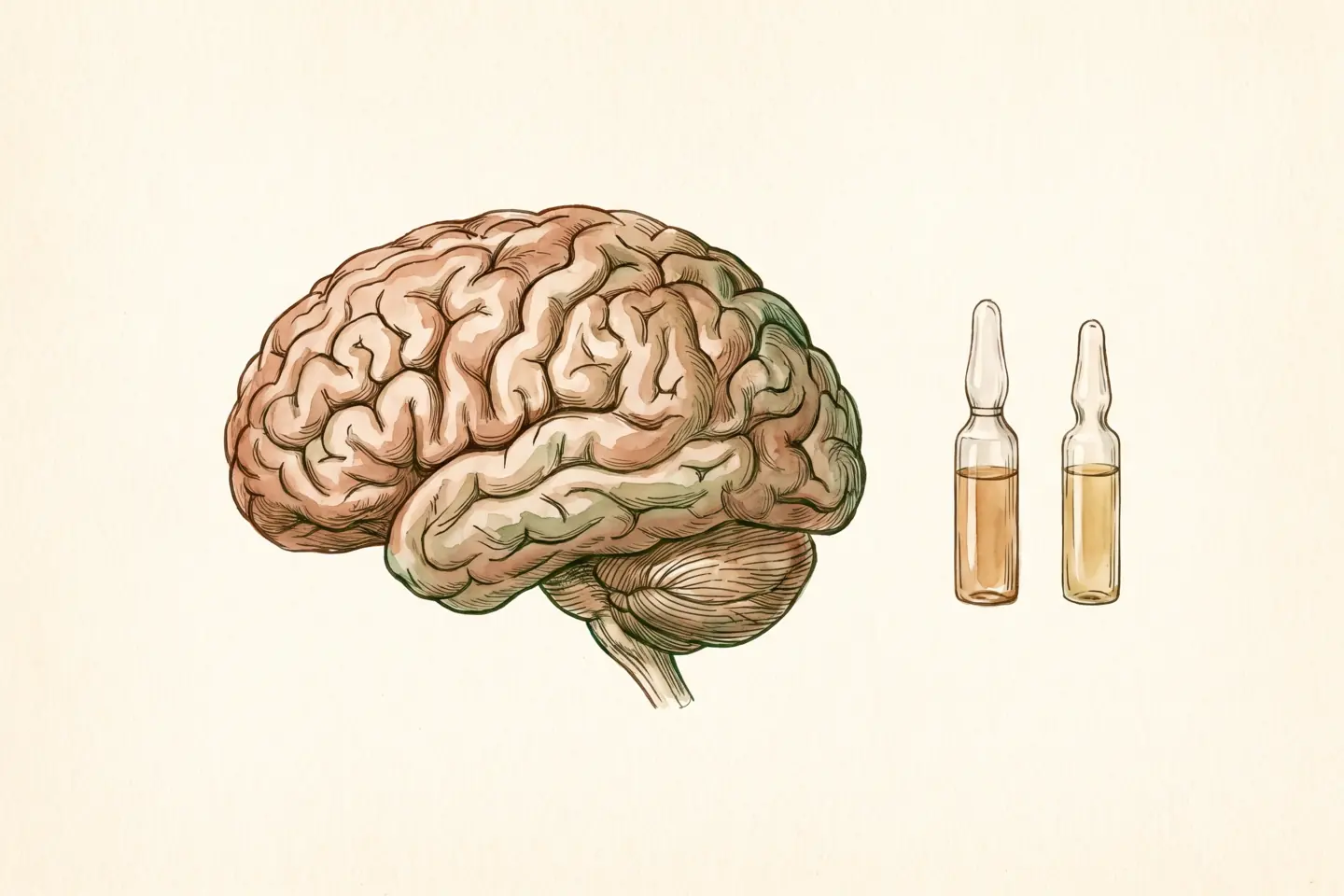
Cortexin is a heterogeneous polypeptide extract from bovine or porcine cerebral cortex, not a single chemically defined peptide. Cortexin is not a peptide in the sense that BPC-157 or TB-500 are: those are synthetic sequences with a known amino acid order and a defined molecular weight.
The manufacturer and the Russian label acknowledge that Cortexin is a complex, not a compound. "The mechanism of Cortexin" is shorthand for the aggregate effect of an undefined mixture of peptides, and that mixture can vary batch to batch with the source tissue and extraction run.
The mixture matters more than most coverage admits. When no one can specify which molecule is doing what, no one can specify dose-response with the precision a synthetic peptide allows. The Cortexin evidence profile summarizes where the extract stands.
What does animal research show about Cortexin?
In rat models of acute and chronic brain ischemia, Cortexin at 1 to 3 mg/kg reduced the size of brain necrosis and attenuated sensorimotor and cognitive deficits compared with untreated animals [1]. The models were middle cerebral artery occlusion and carotid stenosis, and Cortexin also improved antioxidant enzyme activity [1].
Radiolabeling studies in the same paper showed Cortexin crossing the blood-brain barrier at 6 to 8% of blood concentration. In vitro binding assays found notable affinity for glutamatergic receptors: 80% for AMPA, 74% for kainate, and 49% for mGluR1 [1]. Barrier penetration, receptor engagement, antioxidant activity, and reduced tissue damage add up to a coherent, mechanistically plausible story in an animal ischemia model.
These preclinical results are the strongest data on Cortexin, and they are informative, but not about humans. Rodent MCAO models are a standard tool for studying ischemic injury, but the translation rate from rat neuroprotection to human clinical benefit is notoriously poor across the entire neuroprotectant drug class, well beyond anything specific to Cortexin.
Because Cortexin is a mixture, even the receptor-binding data are aggregate. No one knows which fragment in the extract is responsible for which binding affinity, so Cortexin's "mechanism of action" describes what the whole soup does in a dish, not a validated pharmacophore. The Cerebrolysin evidence review covers a related animal-derived nootropic.
How many Cortexin trials have passed independent review?
Exactly one controlled Cortexin trial, enrolling 80 participants, met the inclusion criteria of the only international systematic review to search all available databases for Cortexin trials [2]. That review covered cognitive disorders research through August 2020 [2].
That is not eighty trials. It is eighty people, total, in the entire body of Cortexin evidence that cleared an independent methodological bar. There were not enough qualifying Cortexin trials to run a meta-analysis.
The review rated overall evidence certainty as low to very low using GRADE criteria, the standard framework for weighing trial quality. It described effect sizes for animal-derived nootropics generally, Cortexin included, as modest and probably below the threshold of clinical relevance [2].
Why don't the Russian Cortexin studies count?
The dozens of Russian-language Cortexin studies cited on manufacturer pages and forum threads exist, but most did not clear inclusion criteria for independent systematic review. They were typically open-label, lacked placebo control, or were sponsored and published within a system that does not apply ICH-GCP blinding and independent-replication standards the way Western regulatory trials do.
That evidence comes almost entirely from Russia's own trial and publishing ecosystem, much of it industry-sponsored, which is why so little of it survives independent international review. Citing unspecified "Russian clinical trials" without naming the trial, its design, and its funder is not citing evidence. It is citing a claim about evidence.
The Semax evidence review examines another nootropic peptide's cognitive claims.
Does Cortexin improve cognition in healthy adults?
No published trial has tested Cortexin in healthy adults for cognitive enhancement. Every trial in the Cortexin evidence base, including the one that met review criteria, enrolled patients with diagnosed stroke, traumatic brain injury, or chronic cerebral ischemia, dosed in a hospital setting under clinical supervision.
A healthy adult self-administering Cortexin for cognitive enhancement is a fundamentally different evidence question. Extrapolating from injured-brain recovery data to healthy-brain enhancement is not a small leap: the population, the baseline, and the outcome measure all differ, and none of them has been studied.
How is Cortexin dosed?
Cortexin is administered intramuscularly, and none of the cited studies describes an oral or subcutaneous product. The preclinical dosing that produced measurable neuroprotective effects in rats was 1 to 3 mg/kg [1].
Vendor and forum material commonly cites a human protocol of roughly 10 mg/day for 10 days, sometimes cycled or stacked with other injectables. That figure traces to hospital and manufacturer treatment protocols for diagnosed neurological patients, not to a placebo-controlled trial cited below. No independently reviewed human dosing study exists for cognitive enhancement in healthy adults, so any specific self-administration protocol online is unverified against the trial record.
The differences between the two common injection routes are covered in intramuscular versus subcutaneous peptide injection.
Is Cortexin safe?
Cortexin carries the standard injectable risks (injection-site pain, redness, or irritation, and possible hypersensitivity or allergic reactions) plus risks synthetic research peptides do not have. Because Cortexin is derived from animal central nervous system tissue rather than synthesized, it raises a theoretical immunogenicity and contamination concern as an undefined biological extract.
Any bovine-CNS-derived injectable also carries a historically raised, low-probability but real theoretical prion/TSE exposure concern. Manufacturers state that source tissue is screened. That claim is unverifiable for gray-market supply chains, which is where most of this product reaches consumers outside Russia.
Anecdotal reports also mention headache or overstimulation, and the Russian label contraindicates use in pregnancy and lactation.
What is still unknown about Cortexin?
Cortexin's open questions start with the trial that has never been published:
- A placebo-controlled trial. No placebo-controlled trial meeting Western regulatory standards has been published for Cortexin in any cognitive or neurological indication.
- Batch consistency. Batch-to-batch consistency of the polypeptide mixture has not been independently characterized, so "the same dose" does not necessarily mean the same peptide composition from trial to trial or vial to vial.
- Healthy-adult use. No published trial has tested Cortexin for enhancement in healthy adults.
- Dosing and long-term exposure. None of the cited studies addresses optimal dosing outside hospital protocols or long-term exposure.
Cortexin has a real, if thin, evidence base for a different question than the one most people asking about it are trying to answer.
Sources
Last updated

Written by
Chemist and biochemist. Co-founder and author, The Peptide App.
Jay is a chemist, biochemist and entrepreneur whose work connects scientific research with consumer health products. He has held Chief Science Officer and product development leadership roles and previously served as Chief Revenue Officer at Minicircle.
Keep reading
Compound evidence
Semax sped neurological recovery in open-label Russian stroke trials
Semax sped neurological recovery in open-label Russian stroke trials. Its one healthy-adult study enrolled 20 men with no placebo arm or blinding.

Compound evidence
Cerebrolysin improved dementia and stroke recovery scores in IV trials
IV Cerebrolysin improved cognition in dementia and arm recovery after stroke. Cochrane found no acute stroke benefit; no cited trial enrolled healthy adults.

Handling and product records
FSH absorbed alike from muscle and under the skin in a 19-woman trial
In a randomized crossover trial, FSH reached matching peak, timing and total exposure by intramuscular and subcutaneous injection. Most peptides lack such data.
Profiles and tools

The Peptide App
Track protocols, doses, and reconstitution in one place.
Save your calculations, set reminders, log doses, and keep outcome notes — free to start.
 or scan the QR code →