
Lifting and protein preserved lean mass in calorie-deficit trials
Resistance training and protein above the RDA preserve lean mass during a deficit in trials. Popular T3, clenbuterol and SARM stacks lack that evidence.

By Jay Spall, chemist and biochemist
Disclosure: Jay is a co-founder of The Peptide App. This review discusses the studies cited below; it is not a comprehensive live trial registry or treatment recommendation. Development and regulatory status can change. The app’s tools organize records and arithmetic and do not validate a research product.
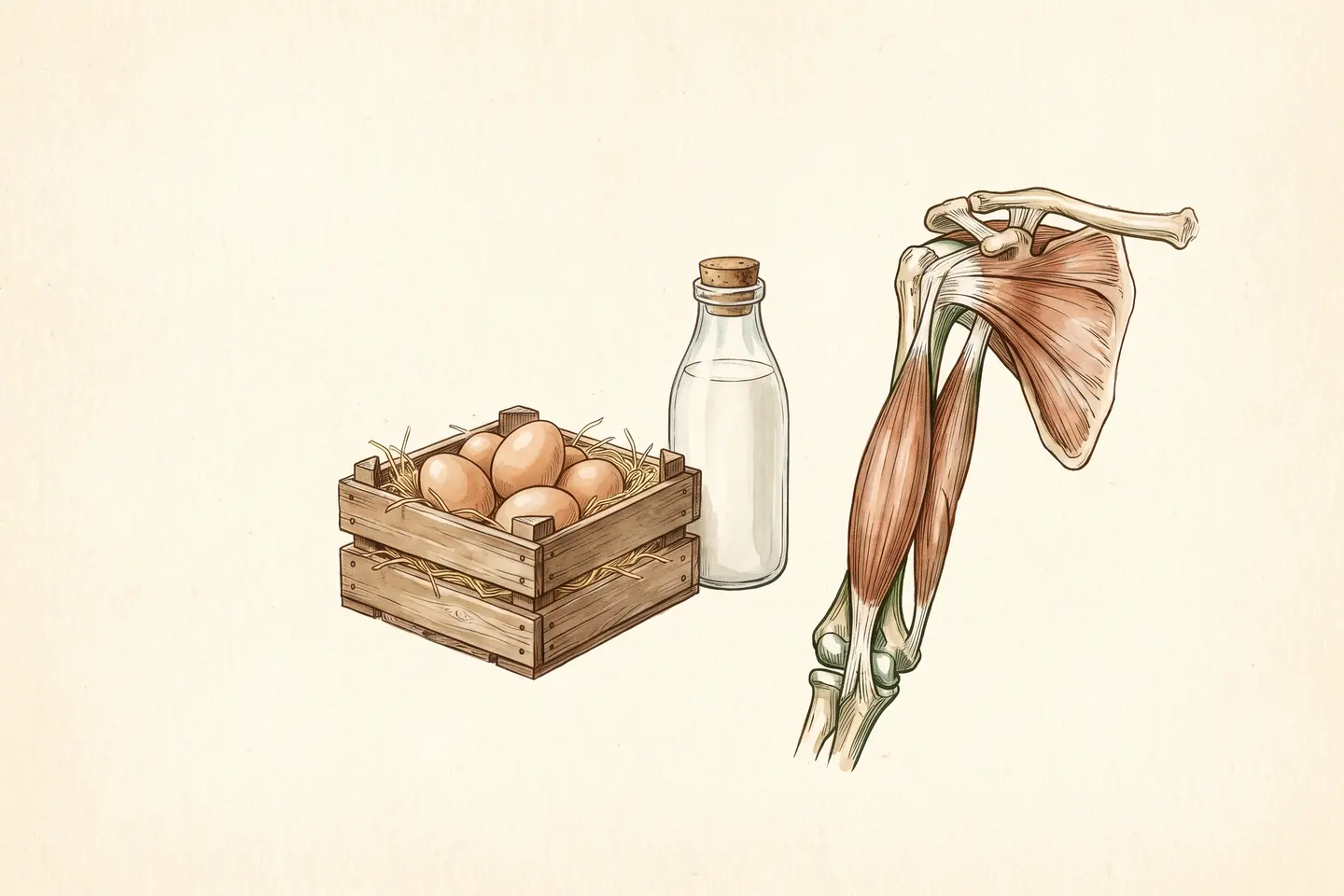
On this page
- Why do people lose muscle in a calorie deficit?
- Does resistance training preserve muscle during weight loss?
- How much protein preserves lean mass in a deficit?
- How does deficit size affect muscle during weight loss?
- How much muscle do GLP-1 drugs remove compared with diet alone?
- Does intermittent fasting with lifting preserve muscle?
- Do T3, clenbuterol, SARMs or GH secretagogues preserve muscle on a GLP-1?
- What is still unknown about preserving muscle on GLP-1 drugs?
- Sources
Key facts
| Question | Direct answer |
|---|---|
| Does about 40% of GLP-1 weight loss come from muscle? | No fixed figure applies. Pooled trial data put lean mass at roughly a quarter to over a third of total weight lost, depending on the drug, comparable to non-drug weight loss of similar magnitude [5][6]. |
| What has randomized trial evidence for protecting lean mass during a deficit? | Resistance training that maintains volume, and protein intake pushed above the RDA. Both have been tested repeatedly, alone and combined [2][3]. |
| Do T3, clenbuterol or SARMs preserve muscle during rapid fat loss? | Untested in these trials. None of the randomized trials behind the training and protein findings tests these compounds for that purpose, and their rationale borrows from unrelated populations. |
| Does a bigger deficit undercut lifting? | Yes. Deficits of about 500 kcal per day and steeper blunt the lean mass response to resistance training in pooled trial data [1]. |
| Does stacking several "anti-catabolic" compounds add protection? | No trial tests that combination for this outcome. The added risk of stacking is documented practice; the added benefit is not demonstrated. |
| Does intermittent fasting with lifting preserve lean mass as well as continuous restriction? | Generally yes, over the short trial periods studied, provided resistance training continues through the fasting window [7]. |
7 sources cited. View sources
Why do people lose muscle in a calorie deficit?
A calorie deficit tips muscle protein balance negative by removing the surplus energy and amino acids that muscle protein synthesis normally draws on. The deficit does not attack muscle directly, but the balance between synthesis and breakdown turns negative more easily.
Short-term energy deficits measurably impair anabolic hormone signaling and muscle protein synthesis. That impairment is the mechanistic root of lean mass loss during any weight loss method, drug-assisted or not [1].
Resistance training counteracts the deficit by giving the body a mechanical reason to keep the tissue: a muscle under load is defended differently from one sitting idle, even in the same calorie deficit. Protein works from the other direction, supplying the raw material synthesis needs when total energy is restricted. Neither lever eliminates the deficit's catabolic pressure. Both reduce it.
Does resistance training preserve muscle during weight loss?
Yes: resistance training prevented roughly 93.5% of the lean mass loss that caloric restriction alone produced, in a meta-analysis of obese elderly adults [2]. Fat and total mass losses stayed similar between groups [2].
Resistance training during caloric restriction is the strongest evidence in this space. The 93.5% figure is a large, consistent effect from randomized controlled trials, not a single study or a mechanism borrowed from somewhere else.
The practical rule is to maintain training through the deficit instead of letting volume slide as fatigue and hunger increase. Maintained resistance training is the single largest lean mass protector identified in trial data, preventing close to all of the deficit-induced loss in the obese elderly population studied [2].
How much protein preserves lean mass in a deficit?
Protein above the 0.8 g/kg RDA helps: a meta-analysis of 18 studies found a weighted mean lean mass benefit of 0.32 kg versus RDA-level intake [3]. The benefit was larger during energy restriction, at 0.36 kg [3]. That evidence is of similar grade to the resistance training data.
Whey protein shows a more complicated picture. In a meta-analysis of studies in women, whey supplementation improved lean mass by 0.90 kg in studies without a resistance training component, but the benefit essentially disappeared once resistance training was already part of the protocol (0.23 kg, not statistically significant) [4]. Once training is dialed in, the protein target matters more than the specific supplement source.
The widely circulated target of roughly 1 gram of protein per pound of bodyweight does not trace to these trials. The direction, more protein as the deficit gets steeper, does have trial support [3].
How does deficit size affect muscle during weight loss?
A deficit of roughly 500 kcal/day was enough to prevent lean mass gains from resistance training, in a meta-regression of resistance training trials run in an energy deficit [1]. Lean mass gains were significantly impaired in deficit versus non-deficit conditions (effect size -0.57), while strength gains were largely preserved [1].
Steeper deficits push harder against the same mechanism. Assume that a deficit steeper than about 500 kcal/day works against resistance training's protective effect, not alongside it [1].
How much muscle do GLP-1 drugs remove compared with diet alone?
GLP-1 drugs remove a share of lean mass comparable to lifestyle weight loss, between 25.4% and 35.2% of weight lost depending on the drug, versus 26.2% with lifestyle intervention [5]. Lean mass made up 25.4% of weight lost with tirzepatide, 26.8% with liraglutide and 35.2% with semaglutide in a meta-analysis of 20 randomized trials, the closest available data for pharmacological rapid fat loss [5]. The difference did not reach statistical significance [5].
In the same meta-analysis, lifestyle intervention combined with resistance training produced the most favorable body composition profile of any group studied [5].
A separate systematic review of incretin trials applied prespecified benchmarks: about 25% of weight loss as fat-free mass by DXA or BIA, and about 15% as skeletal muscle by CT or MRI [6]. Body composition outcomes largely fell within those ranges, not into an unprecedented muscle-wasting effect unique to the drug class [6]. The debate over GLP-1 muscle loss claims turns on the same benchmarks.
Does intermittent fasting with lifting preserve muscle?
Intermittent fasting combined with resistance training generally maintained lean body mass across the short-term trials reviewed, a pattern similar to continuous restriction paired with training [7]. The finding matters when a "rapid fat loss" protocol layers a fasting structure onto a GLP-1 drug.
Do T3, clenbuterol, SARMs or GH secretagogues preserve muscle on a GLP-1?
Mechanism, not trial data, is the case for T3, clenbuterol, SARMs and GH secretagogues in stacking guides. The randomized trials that established resistance training and protein include none of these compounds, so none of that evidence shows any of them preserving lean mass during rapid fat loss in humans.
The stacking guides lean on real pharmacology. Thyroid hormone affects metabolic rate, beta agonists such as clenbuterol show anti-catabolic signaling in some models, SARMs bind androgen receptors selectively, and GH secretagogues raise growth hormone and downstream IGF-1. The missing trials on GLP-1 drugs and secretagogues follow that last pairing in detail.
The mechanistic story is usually imported from a different context: hypothyroid patients restored to normal thyroid function, athletes in energy balance rather than deep deficit, rodent models, or case reports. None of those populations answers the question a person stacking with a GLP-1 or GIP agonist is asking.
The concern goes beyond missing upside. Exogenous thyroid hormone run even slightly above what a person's own axis would produce, combined with a steep deficit, plausibly accelerates protein breakdown instead of preventing it, because thyroid hormone raises metabolic turnover generally, not selectively toward fat. That is a mechanistic concern, not a trial finding: not proven, and not dismissible either. The entire pharmacological layer is untested in the trials cited below, and untested is not the same as safe or effective.
What is still unknown about preserving muscle on GLP-1 drugs?
The open questions all concern drugs added on top of a GLP-1:
- A second anti-catabolic drug. None of the trials cited below tests a GLP-1 or GIP agonist combined with a second pharmacological "anti-catabolic" agent for lean mass outcomes.
- Stacking anti-catabolic compounds. No trial tests whether stacking two or more of T3, clenbuterol, SARMs or GH secretagogues produces additive lean mass protection. Additive risk is the only thing documented in that combination, not additive benefit.
- Drug therapy versus lifestyle. The incretin body composition trials [5][6] are the closest analog to drug-assisted weight loss, and they show proportional lean mass loss in the same range as diet-only weight loss, not something categorically worse. They also confirm that lifestyle intervention with resistance training outperforms drug therapy alone on this outcome [5]. None of the trials cited below tests whether any injectable addition can close that gap.
The muscle section of using GLP-1 medications well applies these findings to day-to-day treatment.
Sources
Last updated

Written by
Chemist and biochemist. Co-founder and author, The Peptide App.
Jay is a chemist, biochemist and entrepreneur whose work connects scientific research with consumer health products. He has held Chief Science Officer and product development leadership roles and previously served as Chief Revenue Officer at Minicircle.
Keep reading
GLP-1 and metabolic peptides
About 15% of weight lost in GLP-1 drug trials is skeletal muscle
About 15% of the weight lost in GLP-1 drug trials is skeletal muscle on CT or MRI, and about 25% is fat-free mass. The typical trial was small and short.
GLP-1 and metabolic peptides
GLP-1 drugs and GH secretagogues move blood sugar in opposite ways
An oral ghrelin mimetic raised fasting glucose over two years in healthy older adults, while GLP-1 drugs lower it. No published trial has combined the two.
GLP-1 and metabolic peptides
Slower titration eased GLP-1 nausea; BPC-157's gut data come from rats
Slower titration reduced GLP-1 side effects in trials, and BPC-157's gut data come from rodent injury models. No trial has tested BPC-157 with a GLP-1 drug.
Profiles and tools

The Peptide App
Track protocols, doses, and reconstitution in one place.
Save your calculations, set reminders, log doses, and keep outcome notes — free to start.
 or scan the QR code →