
Tesamorelin shrinks visceral fat in people with HIV lipodystrophy
Tesamorelin cut visceral fat 10% to 18% in HIV-associated lipodystrophy trials. The effect is unproven in healthy adults with normal GH function.

By Jay Spall, chemist and biochemist
Disclosure: Jay is a co-founder of The Peptide App. This review discusses the studies cited below; it is not a comprehensive live trial registry or treatment recommendation. Development and regulatory status can change. The app’s tools organize records and arithmetic and do not validate a research product.
On this page
- How does tesamorelin work?
- Is tesamorelin safer than HGH?
- How much visceral fat does tesamorelin remove?
- Does tesamorelin reduce liver fat?
- How strong is the evidence for tesamorelin?
- Does tesamorelin reduce belly fat in healthy adults?
- Does tesamorelin improve cognition or slow aging?
- Does tesamorelin's effect last after stopping?
- What side effects does tesamorelin cause?
- What is still unknown about tesamorelin?
- Sources
Key facts
| Question | Direct answer |
|---|---|
| Does tesamorelin reduce visceral fat? | Yes, in HIV-associated lipodystrophy: a 10% to 18% visceral adipose tissue (VAT) reduction across two pivotal phase 3 trials and their pooled analysis [1][2][3]. |
| Is that effect proven in healthy adults trying to lose ordinary belly fat? | No. Every randomized trial cited below enrolled people with HIV-associated lipodystrophy, a population with documented GH axis disruption. Extrapolation to metabolically normal adults is mechanistically plausible, not trial-proven. |
| What happens to IGF-1, and does it matter? | Tesamorelin reliably raises IGF-1 as its mechanism of action. The trials tracked metabolic and glycemic safety over 12 months without red flags [2][3], but long-term IGF-1 elevation over years in adults without lipodystrophy has not been studied. |
| How is tesamorelin different from ipamorelin, CJC-1295, or direct HGH? | Tesamorelin is a GHRH analog: it stimulates the pituitary to release GH within the body's own negative-feedback loop, while exogenous GH bypasses that loop entirely, a real pharmacodynamic distinction. The trials did not compare tesamorelin head-to-head against other secretagogues. |
| What dose was studied? | 2 mg by subcutaneous injection daily, the studied and FDA-approved dose [1][2][3]. |
| What happens if you stop? | The benefit does not last off-drug in the trial data. VAT reduction is tied to continuous dosing [2][3], and no evidence shows a lasting structural change once treatment ends. |
| Is tesamorelin FDA-approved, and for what? | Yes, as Egrifta, specifically for HIV-associated lipodystrophy. That approval does not extend to body composition or cognitive use in the general population. |
4 sources cited. View sources
How does tesamorelin work?
Tesamorelin is a stabilized synthetic analog of growth-hormone-releasing hormone (GHRH 1-44) that stimulates the pituitary to release growth hormone in pulses.
A trans-3-hexenoyl group at the N-terminus slows tesamorelin's enzymatic degradation. Tesamorelin binds the GHRH receptor on pituitary somatotrophs and triggers pulsed GH release, the same physiologic mechanism the body uses on its own. Raising IGF-1 is how tesamorelin works, and it does so reliably.
Is tesamorelin safer than HGH?
Tesamorelin works upstream of GH secretion, inside the pituitary's own negative-feedback loop, but that does not make its downstream effects automatically safer than injected GH.
The "safer than HGH" forum claim rests on a real distinction. Tesamorelin still passes through the pituitary's regulatory checkpoints, including negative feedback from GH and IGF-1 themselves, rather than flooding the system with a fixed exogenous dose the way injectable GH does.
Elevated IGF-1 is still elevated IGF-1, whether it arrives through more pulsatile endogenous GH release or through direct administration. The trials that established tesamorelin's efficacy did not resolve whether the route of GH elevation changes the long-term risk profile, because they were not designed to test that question. For the hormone itself, see what growth hormone does to body composition.
How much visceral fat does tesamorelin remove?
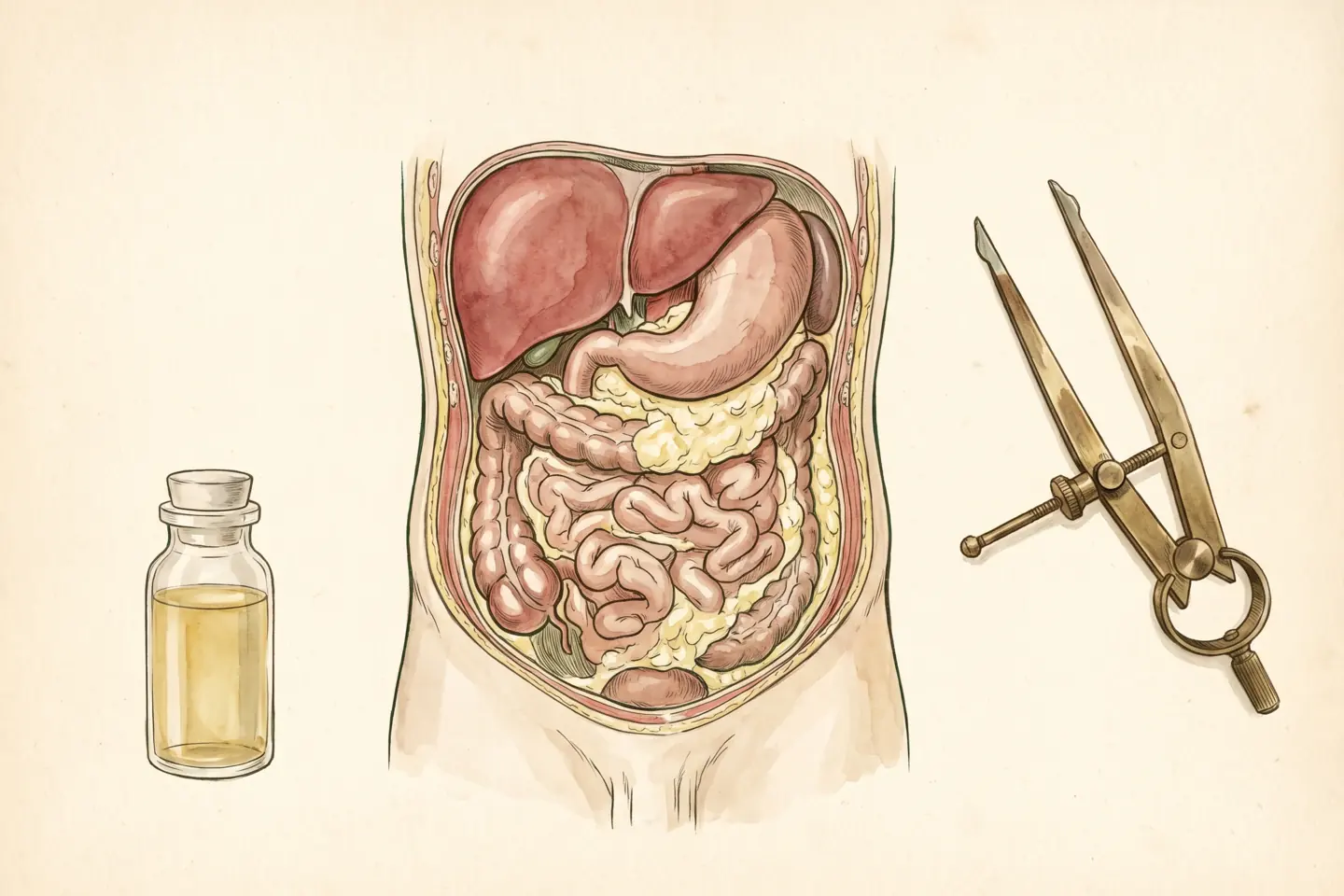
Tesamorelin reduced visceral adipose tissue by 10% to 18% in randomized trials of people with HIV-associated lipodystrophy [1][2][3].
Two pivotal double-blind phase 3 RCTs form the core of that evidence. The first, in 412 patients, found a 15.2% VAT reduction over 26 weeks versus a 5.0% increase in the placebo arm (P<0.001), alongside improvements in triglycerides and cholesterol-to-HDL ratio and no significant glycemic disturbance [1].
The second, in 404 patients, replicated the result: a 10.9% VAT reduction at six months, extending to roughly 18% with continuous treatment through 12 months, again without perturbing glucose parameters [2]. A pooled analysis of both trials (n=806) confirmed a 15.4% VAT reduction at 26 weeks, sustained near 17.5% through 52 weeks, with the safety and lipid signal holding across the combined dataset [3].
Does tesamorelin reduce liver fat?
Yes, in one smaller independent RCT: tesamorelin reduced hepatic fat alongside visceral fat in 50 participants with HIV [4].
Visceral fat fell by a net 42 cm2 more than with placebo (P=0.005), and liver lipid-to-water ratio dropped by a net 2.9 percentage points (P=0.003) [4]. That trial matters for two reasons. It extends the efficacy signal to ectopic fat in the liver, not just abdominal visceral fat, and it came from an academic center rather than the manufacturer-sponsored program.
How strong is the evidence for tesamorelin?
Tesamorelin's evidence earns grade A, unusually strong for a research peptide, but the grade applies to the studied HIV-associated lipodystrophy populations, not a general weight-loss indication.
Two pivotal phase 3 RCTs, their pooled analysis, and an independent academic RCT all show consistent visceral fat reductions. That consistent randomized evidence is why tesamorelin earns an A rather than the B or C grade typical of most peptides circulating in research-chemical markets.
Does tesamorelin reduce belly fat in healthy adults?
None of the randomized trials cited below tested tesamorelin in healthy adults with normal GH function, so its effect on ordinary belly fat is unproven.
HIV-associated lipodystrophy involves a specific pattern of GH axis dysfunction and fat redistribution. That pattern is not interchangeable with ordinary visceral adiposity in a metabolically healthy adult. The trial populations were selected because they had a defined deficit that tesamorelin's mechanism was designed to correct.
Whether a healthy adult with normal GH pulsatility sees anything close to a 15% VAT reduction from the same drug is an open question the randomized data do not answer. That gap is the difference between "demonstrated in a randomized trial" and "mechanistically plausible," and it is the single most important thing missing from most forum discussion of tesamorelin.
Does tesamorelin improve cognition or slow aging?
None of the four studies cited below assessed cognition, mood, or aging biomarkers; they measured visceral and hepatic fat in a lipodystrophy population.
The cognitive and general anti-aging claims common in peptide communities sit even further from this evidence than the healthy-adult fat-loss claim. Claims about nootropic or longevity benefits extrapolate from tesamorelin's GH-elevating mechanism and from separate literature on GH and cognition in different populations. They are not findings from these lipodystrophy trials. For the separate cognition question, see tesamorelin and cognition in older adults.
Does tesamorelin's effect last after stopping?
Tesamorelin's visceral fat reduction is tied to continuous dosing in the trial data [2][3], and no evidence shows that it persists once dosing stops.
The dose studied and FDA-approved is 2 mg subcutaneous daily [1][2][3]. The effect builds over time: roughly 10% to 15% VAT reduction by 26 weeks, extending to about 17% to 18% by 52 weeks with continuous dosing [2][3]. The benefit is not a one-time shift; it requires sustained administration to reach and hold its full magnitude.
Intermittent or cyclical off-label dosing has not been tested, and reversal after stopping appears to be the expected pattern.
What side effects does tesamorelin cause?
Tesamorelin's reported side effects include injection-site reactions (erythema, pruritus, pain, rash), arthralgia, myalgia, peripheral edema, fluid retention, and occasional carpal-tunnel-like symptoms.
Those effects, reported across the development program and post-marketing experience, are consistent with GH-axis stimulation. Hypersensitivity reactions have also been reported in some patients.
The pivotal trials did not find clinically meaningful glucose disturbance at the population level [1][2][3]. Glucose intolerance and worsened insulin sensitivity remain listed considerations, and individual variation in glycemic response has not been fully characterized outside the trial populations.
What is still unknown about tesamorelin?
Three questions about tesamorelin remain open:
- Healthy adults. Whether tesamorelin's visceral fat effect transfers, in any degree, to metabolically healthy adults without lipodystrophy. None of the trials cited below tested that population.
- Years of raised IGF-1. What sustained IGF-1 elevation over multiple years looks like outside a monitored clinical trial, and whether the theoretical mitogenic concern attached to chronically elevated IGF-1 has real-world weight at off-label doses and durations. The trial safety extensions covered roughly a year, not a lifetime of off-label use.
- Head-to-head outcomes. How tesamorelin compares in outcomes, not just mechanism, with other GHRH analogs or GHRP-class secretagogues such as ipamorelin and CJC-1295. None of the trials cited below compared them head-to-head, so any comparative claim beyond the receptor-level mechanism is pharmacologic reasoning, not measured outcome. The CJC-1295 and ipamorelin evidence covers those compounds.
Sources
Last updated

Written by
Chemist and biochemist. Co-founder and author, The Peptide App.
Jay is a chemist, biochemist and entrepreneur whose work connects scientific research with consumer health products. He has held Chief Science Officer and product development leadership roles and previously served as Chief Revenue Officer at Minicircle.
Keep reading

Compound evidence
Tesamorelin improved cognition in a 20-week trial of 152 older adults
Tesamorelin improved executive function in a randomized trial of 152 adults aged 55 to 87. The gain was modest and partly faded after a 10-week washout.

Compound evidence
Tesamorelin cut visceral fat in HIV; sermorelin has smaller trials
Tesamorelin cut visceral fat 10.9% versus 0.6% on placebo in a Phase 3 HIV trial. Sermorelin shares its receptor but has smaller trials, mostly in children.
Compound evidence
Growth hormone added lean mass in trials while strength stayed flat
Growth hormone added about 2.1 kg of lean mass in trials of healthy young adults, but strength stayed flat. Scans count the fluid it retains as lean mass.
Profiles and tools

The Peptide App
Track protocols, doses, and reconstitution in one place.
Save your calculations, set reminders, log doses, and keep outcome notes — free to start.
 or scan the QR code →