
Subcutaneous volume limits depend on site, person, and formulation
Some subcutaneous biologics are dosed at 5 to 20 mL, usually by a health professional. The 1 mL rule is a convention, and mixing changes tonicity too.

By Jay Spall, chemist and biochemist
Disclosure: Jay is a co-founder of The Peptide App. This review discusses the studies cited below; it is not a comprehensive live trial registry or treatment recommendation. Development and regulatory status can change. The app’s tools organize records and arithmetic and do not validate a research product.

On this page
- Why does subcutaneous tissue resist large injection volumes?
- Where does the 1 mL subcutaneous rule come from?
- How large can a subcutaneous injection be?
- Do the biologic trials show that combined injections are safe?
- Why can a combined subcutaneous injection hurt at a small volume?
- How should someone cut down on separate subcutaneous injections?
- What is still unknown about combining subcutaneous injections?
- Sources
Key facts
| Question | Direct answer |
|---|---|
| Is there a volume ceiling for a subcutaneous injection site? | Yes, but not a fixed number. Tissue backpressure and local distension are real and measurable, and the limit depends on the site, the person, and what is dissolved in the fluid [1][2]. |
| Where does the 1 mL rule come from? | A rough convention. The 1 mL and 1.5 mL figures that circulate online are a rule of thumb, not a measured limit. |
| Can subcutaneous tissue take much more than 1 mL? | Yes. A systematic review of approved and pipeline biologics found large-volume products, some dosed at 5 to 20 mL, typically given by a health professional at controlled rates or engineered for that volume [1]. |
| Can formulation change how much volume a site accepts? | Yes. In randomized trials, recombinant human hyaluronidase, an enzyme that loosens the extracellular matrix, measurably raised the rate of fluid a site could accept [2]. |
| Is combining two compounds mainly a volume problem? | No. Mixing changes concentration and tonicity along with volume, and the approved subcutaneous regimens for dupilumab, tezepelumab, depemokimab, and tirzepatide are each studied at their own volume and formulation, never as combined mixtures [3][4][5][6][7][8]. |
| How can someone cut down injection count more safely? | Change one variable at a time. Adjust site, volume, or timing and watch the tissue's response, instead of merging chemistries whose combined tonicity is uncharacterized. |
8 sources cited. View sources
Why does subcutaneous tissue resist large injection volumes?
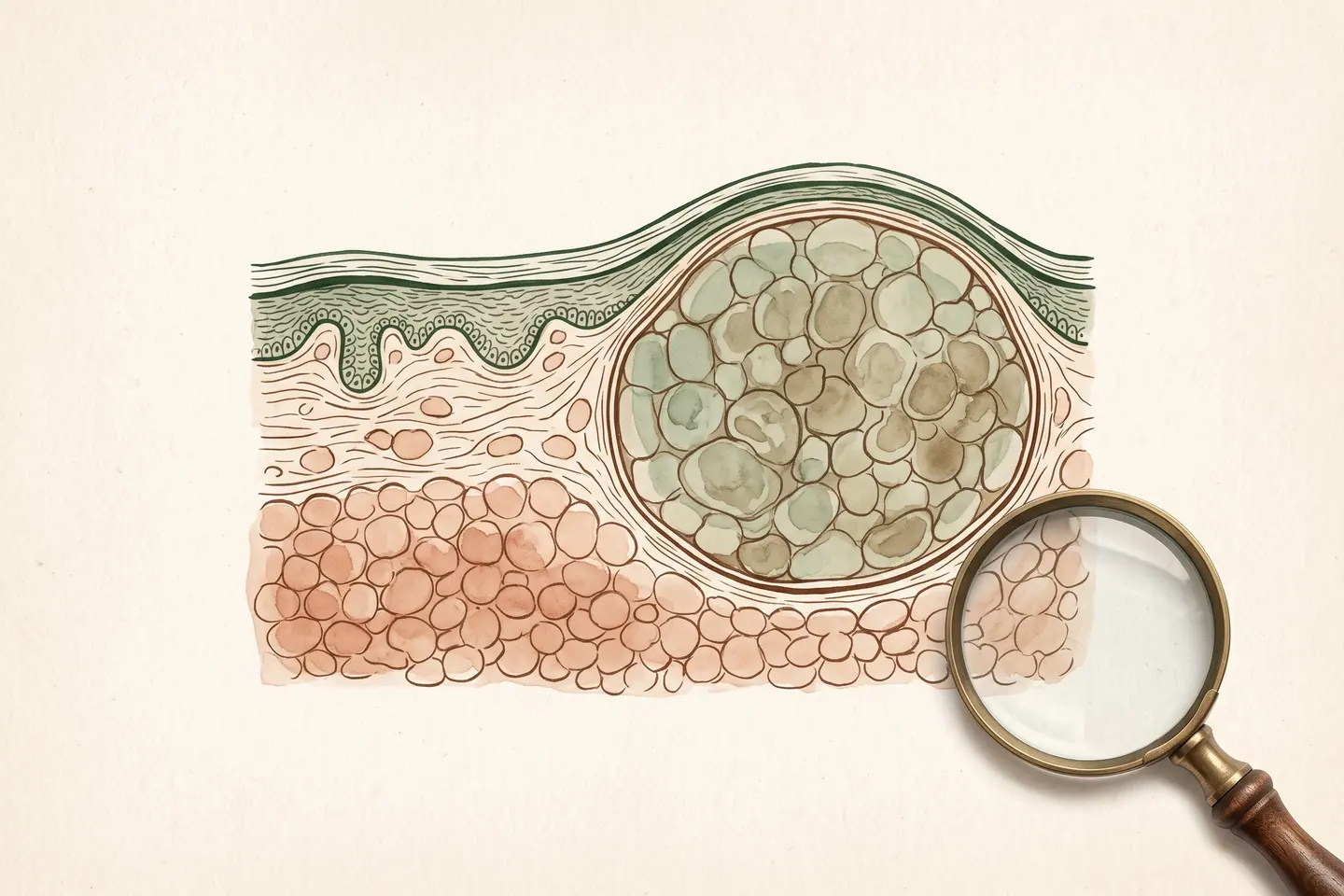
Subcutaneous tissue is loose connective tissue, not a free cavity, so an injected bolus has to spread through a matrix that resists it. That resistance is why a fast, large injection produces a firm, tender bleb instead of a diffuse coasting sensation.
The clearest evidence that the resistance is a physical property, not just discomfort tolerance, comes from recombinant human hyaluronidase, an enzyme that depolymerizes hyaluronan in the extracellular matrix. In randomized, double-blind, placebo-controlled phase III trials, adding the enzyme significantly increased the rate at which fluid could be infused subcutaneously across a range of doses, with only a minimal increase in limb circumference at the infusion site [2]. The tissue absorbed more fluid, faster, without swelling proportionally more. That result only makes sense if something in the untreated matrix was limiting flow in the first place.
The barrier is real and modifiable, but it is not a fixed number on a syringe label. The hyaluronidase trials answer a narrow question: whether this specific enzyme changes how much fluid a site can accept and how fast [2]. They are not evidence about two unrelated compounds mixed together without the enzyme, and none of them tested co-formulation of separate drugs in one syringe.
Where does the 1 mL subcutaneous rule come from?
The 1 mL rule is a rough convention, not a measured limit, and it usually describes an isotonic, aqueous, single-compound solution injected into a compliant site like the abdomen. Change any one of those conditions and the number stops applying. The 1.5 mL figure that also circulates online has the same status.
How large can a subcutaneous injection be?
Some subcutaneous biologics are dosed at 5 to 20 mL, according to a systematic review of dosing across clinical pipelines and approved products [1]. That review is the strongest available evidence on workable volume, though it is a review of dosing, not a mechanistic tolerability trial.
The review defined large-volume subcutaneous products as those over 2.0 mL and found two rough categories. Cancer-focused biologics are dosed at 5 to 20 mL every three weeks and administered by a health professional. Non-cancer biologics, typically self-administered monthly, predominantly stay under 5.0 mL [1].
The split is telling. When volumes climb well past what a single unassisted injection normally delivers, the products are either engineered for that volume or handed to clinical administration with controlled infusion rates. They are not left to routine self-injection with a syringe pushed by hand.
Do the biologic trials show that combined injections are safe?
The dupilumab, tezepelumab, depemokimab, and tirzepatide trials were efficacy and safety trials of single, purpose-formulated products, and none combined two drugs in one syringe. Each product was dosed at its own studied volume and schedule:
- Dupilumab: 200 or 300 mg every two weeks [4], and a pediatric version weight-banded at 100 or 200 mg every two weeks [6].
- Tezepelumab: 210 mg every four weeks, or 70 to 280 mg across different intervals in an earlier phase [5][8].
- Depemokimab: 100 mg twice yearly [3].
- Tirzepatide: titrated up in 2.5 mg steps every four weeks instead of jumping to the target dose [7].
None of these trials tested two of these agents, or any two compounds, in a single syringe. Their evidentiary weight applies to their individual formulations only, and using them to imply that combined injections are safe is an overreach the trials do not support.
Why can a combined subcutaneous injection hurt at a small volume?
Tonicity can make a combined injection painful at volumes well under any quoted ceiling, a mechanism that is pharmacologically plausible but not confirmed by the studies cited below. Compounds that are each comfortable alone can form a hypertonic solution when dissolved together, because concentration and osmolarity are additive properties of what is dissolved in the fluid, not just of its total volume.
A hypertonic bolus draws fluid across the tissue and irritates nerve endings locally, producing pain and induration. None of the large-volume review, the hyaluronidase trials, or the biologic trials measured osmolarity thresholds directly.
The evidence does confirm the underlying logic. Subcutaneous tissue has a measurable capacity limit that responds to formulation changes [2], and approved dosing regimens treat volume, concentration, and delivery rate as one package, validated together and not assembled ad hoc [1][3][4][5][6][7][8]. The guide to choosing a reconstitution volume covers the concentration side for a single vial.
How should someone cut down on separate subcutaneous injections?
A workable way to reduce subcutaneous injection count is to change one variable at a time, the way approved regimens are built in trials. Merging four separate subcutaneous injections changes three things at once: total volume, the concentration of each compound in that volume, and the combined tonicity of the mixture. Those changes, not a milliliter ceiling, are the reason for caution.
To cut injections, combine two compounds you have reason to believe are chemically compatible and isotonic together, inject slowly, and watch the site for firmness, redness, or delayed absorption over the following hours, rather than combining all four at once. Chemical compatibility is its own question, and peptide mixing has separate compatibility checks that volume does not answer. Site is one of the variables, and the guide to injection site lumps and rotation covers how to vary it.
The tirzepatide titration schedule is a useful analogy: even a single, well-characterized molecule is escalated in small increments rather than jumped to a full dose immediately [7]. In approved biologics, large-volume subcutaneous dosing relies on professional administration, slower infusion rates, or enzymatic assistance, not casual co-mixing [1][2].
What is still unknown about combining subcutaneous injections?
None of the studies cited below tested whether a given mix of research compounds is hypertonic, chemically stable together, or absorbed at the intended rate. The trials of approved subcutaneous products all studied single formulations, and the analysis of stability data for peptide combinations covers the chemistry side of that gap.
Applying an enzymatic approach like the one studied for single large-volume infusions [2] to a mixed, self-administered protocol is not established practice. It is speculative pipeline territory.
Volume tolerance and chemical compatibility are two separate questions, both real and both site- and formulation-dependent. Checking whether the total liquid is under an internet-quoted milliliter number answers neither.
Sources
Last updated

Written by
Chemist and biochemist. Co-founder and author, The Peptide App.
Jay is a chemist, biochemist and entrepreneur whose work connects scientific research with consumer health products. He has held Chief Science Officer and product development leadership roles and previously served as Chief Revenue Officer at Minicircle.
Keep reading

Reconstitution and syringe math
Peptide reconstitution volume should put your dose mid-syringe
Reconstitution volume changes peptide concentration, not the amount in the vial. Pick a volume that puts your dose mid-barrel to reduce measurement error.
Handling and product records
Poor site rotation is the top risk factor for insulin injection lumps
Lipohypertrophy affects about 42% to 59% of long-term insulin users, and poor rotation is its top risk factor. The data come from insulin, not other peptides.
Handling and product records
FSH absorbed alike from muscle and under the skin in a 19-woman trial
In a randomized crossover trial, FSH reached matching peak, timing and total exposure by intramuscular and subcutaneous injection. Most peptides lack such data.
Profiles and tools

The Peptide App
Track protocols, doses, and reconstitution in one place.
Save your calculations, set reminders, log doses, and keep outcome notes — free to start.
 or scan the QR code →