
Secretin matched placebo for autism in a Cochrane review of 16 trials
Secretin did no better than placebo on core autism symptoms in Cochrane reviews of 14 and 16 trials. Its US approval is for diagnostic testing only.

By Jay Spall, chemist and biochemist
Disclosure: Jay is a co-founder of The Peptide App. This review discusses the studies cited below; it is not a comprehensive live trial registry or treatment recommendation. Development and regulatory status can change. The app’s tools organize records and arithmetic and do not validate a research product.
On this page
- What is secretin approved for?
- Where did the claim that secretin treats autism come from?
- How rigorously was secretin tested in autism?
- What did randomized trials of secretin in children find?
- What do systematic reviews conclude about secretin for autism?
- Why did children seem to improve on secretin?
- Did any secretin trial find a benefit?
- What do the secretin trials leave unanswered?
- What does secretin's failure mean for other autism treatments?
- Sources
Key facts
| Question | Direct answer |
|---|---|
| What is secretin approved for? | Diagnostic use. Secretin is a gastrointestinal hormone that stimulates pancreatic bicarbonate secretion, and it is approved in the US as a diagnostic agent for pancreatic and GI function [4]. |
| Is secretin an approved autism treatment? | No. Repeated therapeutic dosing of secretin was never approved for anything, and the randomized trial evidence in autism is negative and unusually thorough [4]. |
| Where did the claim that secretin helps autism come from? | A single uncontrolled case report. Children received secretin during a diagnostic GI procedure, and media coverage drove international demand before any controlled trial existed [4]. |
| What did controlled trials of secretin find? | No benefit. A Cochrane review of sixteen randomized trials found no evidence that secretin improves core autism outcomes, matching an earlier Cochrane review of fourteen trials, a review that found twelve of thirteen placebo-controlled studies negative, and a federal systematic review of seven RCTs [2][3][4][5]. |
| Did any dose, formulation or subgroup of secretin work? | No. One small transdermal trial found a single isolated subgroup result that did not replicate and fits the pattern expected from chance [7]. Porcine and synthetic secretin were tested head-to-head, and neither beat placebo [8]. |
| What does secretin's record say about other autism treatments? | Strong rationale is not enough. A 2025 systematic review found 157 compounds tested by RCT in autism, and even candidates with strong preclinical rationale routinely fail their primary endpoints once tested properly, the same pattern secretin set in the late 1990s [1]. |
9 sources cited. View sources
What is secretin approved for?
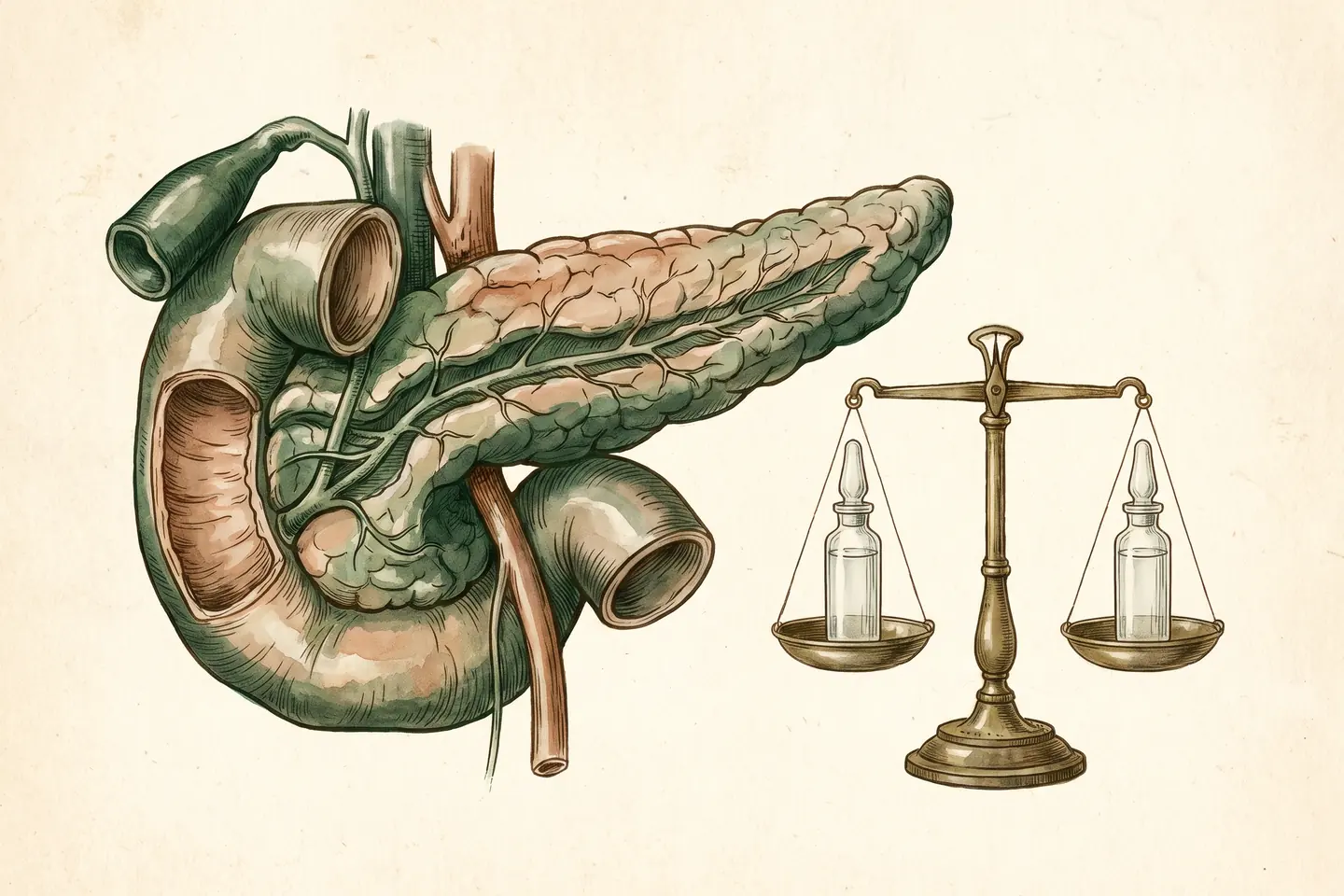
Secretin is approved in the US as a diagnostic agent for pancreatic and gastrointestinal function, and repeated therapeutic dosing was never approved for anything [4]. Secretin is a peptide hormone released by the small intestine. It signals the pancreas to release bicarbonate, which neutralizes stomach acid as digestion moves forward.
Physicians use secretin during endoscopic procedures to assess pancreatic and gastrointestinal function, not as a repeated treatment [4]. The autism story began during one of these diagnostic infusions, not in a study designed to test a behavioral hypothesis.
Where did the claim that secretin treats autism come from?
The secretin autism claim began with a small, uncontrolled case report: children who received secretin during a diagnostic GI procedure reportedly showed behavioral improvement afterward [4].
The report had no comparison group, no blinding, and no control for the many things that change in a child's presentation over weeks. Media coverage of those reports drove widespread public interest, and demand for secretin as an autism treatment grew internationally before a single randomized trial had been conducted [4].
The evidence that launched the phenomenon was an anecdote, not a study. The path from anecdote to mass use skipped the step where medicine usually intervenes.
How rigorously was secretin tested in autism?
Secretin became one of the most rigorously tested single interventions in autism history, studied in double-blind, placebo-controlled trials across roughly a decade. Investigators varied the formulation (porcine-derived and synthetic human secretin), the dose, the route (intravenous and transdermal), and the outcome measures.
The result is an unusually complete falsification. Different labs, formulations, doses, routes of administration, and outcome instruments converged on the same negative answer. Secretin's failure is not one underpowered trial amplified into a myth: more than a dozen independent replications landed on the same null result.
What did randomized trials of secretin in children find?
Randomized trials in 85 and 95 children found that neither porcine nor synthetic secretin did better than placebo [8][9].
A 2002 trial randomized 85 children, ages 3 to 12 with a mean IQ of 55, to biologic (porcine) secretin, synthetic secretin, or placebo, with all raters blind to assignment [8]. Direct observation measures showed no change attributable to secretin in either form. Parent-reported symptom severity fell in all three groups, including placebo, and one teacher-rated measure improved in the placebo and synthetic groups but not the biologic group. No dose or formulation separated from placebo, even when children with and without GI symptoms were analyzed separately [8].
A 2000 trial randomized 95 children, ages 2 to 7, to a single dose of intravenous porcine secretin or placebo and assessed them at three weeks [9]. No significant difference emerged on the language measure or on parent and clinician autism ratings. The proportion of children who improved substantially did not differ between the two arms [9].
What do systematic reviews conclude about secretin for autism?
Systematic reviews of secretin for autism found no evidence of benefit, including Cochrane reviews of fourteen trials in 2005 and sixteen trials in 2012 [2][3].
The Cochrane Collaboration applies some of the strictest inclusion and bias criteria in evidence synthesis. Both Cochrane versions concluded there was no evidence that secretin improved core autism features, and the 2012 update found nothing in the additional data to change that verdict [2][3].
A 2004 review of the full evidence base found that twelve of thirteen placebo-controlled studies failed to show any differential benefit for secretin over placebo [4]. A 2011 federal systematic review of seven RCTs reached the same verdict [5]. A 2010 evidence appraisal of autism interventions reached the same conclusion for secretin among the treatments it graded [6].
Why did children seem to improve on secretin?
In the secretin trials that reported improvement over time, children on placebo improved as much as children on secretin [5]. Equal improvement in both groups is the signature of natural fluctuation and rater expectation, not a drug effect [5].
The 2002 trial showed the same pattern: parent-reported symptom severity fell in all three groups, including placebo [8]. The case report that launched the claim had no comparison group, so it could not reveal that pattern.
Did any secretin trial find a benefit?
A 2005 transdermal trial in 15 children reported one marginal subgroup benefit in speech, and that result fits the pattern expected from chance, not a rescued signal [7].
The trial found no overall group difference in speech, sociability, sensory, or health scores. The marginal result was a speech improvement during the treatment phase among children not taking other medications (p = 0.0479) [7].
That subgroup result looks like evidence that secretin works for some children, and it should be read as the opposite. The trial tested multiple outcome domains across multiple subgroup splits in 15 children. A p-value that close to the conventional 0.05 threshold, in one of several comparisons, is what statistical noise looks like when enough tests are run.
No other trial reproduced anything resembling the finding, including the much larger trials of 85 and 95 children [8][9]. One marginal, non-replicated subgroup result is not a signal worth acting on. The same test applies to davunetide's secondary-endpoint signals.
What do the secretin trials leave unanswered?
The secretin trials leave two questions unanswered: secretin receptor biology in the central nervous system apart from a behavioral endpoint, and secretin's current regulatory and retail status.
The trials do settle the clinical question. Intravenous or transdermal secretin, at the doses and formulations tested, does not improve core autism symptoms compared with placebo.
None of the studies cited below was designed to test secretin receptor biology in the central nervous system in isolation from a behavioral endpoint. None tracks secretin's current regulatory or retail status, or its current sales and clinical use for autism. Any claim on either point is unsourced until a study addresses it directly.
What does secretin's failure mean for other autism treatments?
Secretin's failure fits a wider pattern in autism drug research. A 2025 systematic review found 157 compounds tested by randomized trial in autism. Even candidates with the strongest mechanistic and preclinical rationale, not case-report rationale, routinely fail to separate from placebo on primary outcomes [1].
Secretin was tested unusually well and failed unusually decisively. The lesson is not that parents were foolish to hope. The gap between a compelling anecdote and a compound that survives a blinded, placebo-controlled trial is enormous, and popularity closes none of it. For another peptide judged by pooled trial data, see intranasal insulin's pooled cognitive results.
Sources
Last updated

Written by
Chemist and biochemist. Co-founder and author, The Peptide App.
Jay is a chemist, biochemist and entrepreneur whose work connects scientific research with consumer health products. He has held Chief Science Officer and product development leadership roles and previously served as Chief Revenue Officer at Minicircle.
Keep reading
Compound evidence
Davunetide missed both main endpoints in a 313-patient PSP trial
Davunetide failed a 313-patient PSP trial on both primary endpoints. Its earlier signals were secondary, and brain delivery was never confirmed.
Compound evidence
Intranasal insulin matched placebo on cognition in five pooled trials
Intranasal insulin matched placebo on cognition and daily function across five pooled trials in MCI or Alzheimer's. A device switch clouds the largest trial.
BPC-157 and TB-500
BPC-157 has 100-plus studies, nearly all from one Zagreb group
The Zagreb group behind most BPC-157 papers reports gut, tendon and vascular effects in animals. Independent replication by other labs is scarce.
Profiles and tools

The Peptide App
Track protocols, doses, and reconstitution in one place.
Save your calculations, set reminders, log doses, and keep outcome notes — free to start.
 or scan the QR code →