
Livagen's developers report restored liver function in animal models
Livagen's developers report it restored liver function in animal injury models and loosened chromatin in cultured blood cells. No human trial exists.

By Jay Spall, chemist and biochemist
Disclosure: Jay is a co-founder of The Peptide App. This review discusses the studies cited below; it is not a comprehensive live trial registry or treatment recommendation. Development and regulatory status can change. The app’s tools organize records and arithmetic and do not validate a research product.
On this page
- What is Livagen?
- What does Livagen do to chromatin in human cells?
- Does Livagen protect the liver?
- How strong is the evidence for Livagen?
- Does oral or sublingual Livagen work?
- Is there a tested human dose of Livagen?
- Is Livagen safe?
- Is every product sold as Livagen the same peptide?
- What is still unknown about Livagen?
- Sources
Key facts
| Question | Direct answer |
|---|---|
| Has Livagen been tested in a human clinical trial? | No. Every Livagen study used human cells in culture (ex vivo) or an animal model, and no registered human RCT exists [1][2][3][4][5]. |
| What does Livagen do in human cells? | In cultured lymphocytes from elderly donors, Livagen loosened (decondensed) chromatin and reactivated silenced ribosomal genes [1][2][3]. That is a cell-culture finding, not gene activation inside a living liver. |
| Does Livagen "activate liver DNA" as vendors claim? | No study shows it. The chromatin work used blood cells outside the body, not liver tissue [1][2][3]. The liver data come from separate animal injury-model studies [4][5]. |
| Does oral or sublingual Livagen work? | Untested. Every cited study used ex vivo application or animal-model administration, not oral dosing, and no bioavailability data show that a four-amino-acid peptide survives gut proteases. |
| Is Livagen safe? | No controlled human safety trial exists. Reported problems are injection-site reactions and theoretical hypersensitivity, long-term safety is unknown, and unregulated sourcing adds purity and sterility risk. |
| How strong is the Livagen evidence? | Grade E, minimal: a specific, testable mechanistic hypothesis backed by preliminary animal and ex vivo human-cell work from one research lineage, not clinical proof of a liver effect in people. |
5 sources cited. View sources
What is Livagen?
Livagen is a synthetic four-amino-acid peptide, Lys-Glu-Asp-Ala (often abbreviated KEDA), one of a family of short peptides developed in Vladimir Khavinson's laboratory tradition in St. Petersburg. That tradition calls these peptides "bioregulators" and theorizes that such short sequences interact with chromatin and help re-express genes that aging or tissue injury has silenced.
The bioregulator program is specific and still debated, with its own vocabulary. It is not settled epigenetics. Almost all Livagen research comes from that one lab lineage, not from independent Western replication.
What does Livagen do to chromatin in human cells?
In cultured lymphocytes from elderly people, Livagen decondensed chromatin and reactivated ribosomal genes that are normally suppressed with age [1]. The decondensation was a measurable loosening of pericentromeric heterochromatin [1].
A follow-up study in donors aged 75 to 88 reproduced the effect and compared Livagen with two related peptides. Livagen's chromatin effect resembled Epitalon's: both decondensed pericentromeric heterochromatin on chromosomes 1 and 9. Vilon activated ribosomal genes without that pericentromeric change [2].
A third study in the same age range confirmed the pattern. Epitalon, Livagen, and Vilon all reactivated ribosomal gene synthesis, and only Epitalon and Livagen also decondensed pericentromeric structural heterochromatin [3]. The Epitalon human evidence and the Vilon aging evidence have their own reviews.
These papers describe chromatin biology in circulating white blood cells studied outside the body. The finding is real, specific, and internally consistent across three related papers, which is more than a vague gesture at "peer-reviewed research." It stops well short of showing that an injected or swallowed dose reprograms hepatocyte protein synthesis in a living person, the claim most vendor copy makes.
Does Livagen protect the liver?
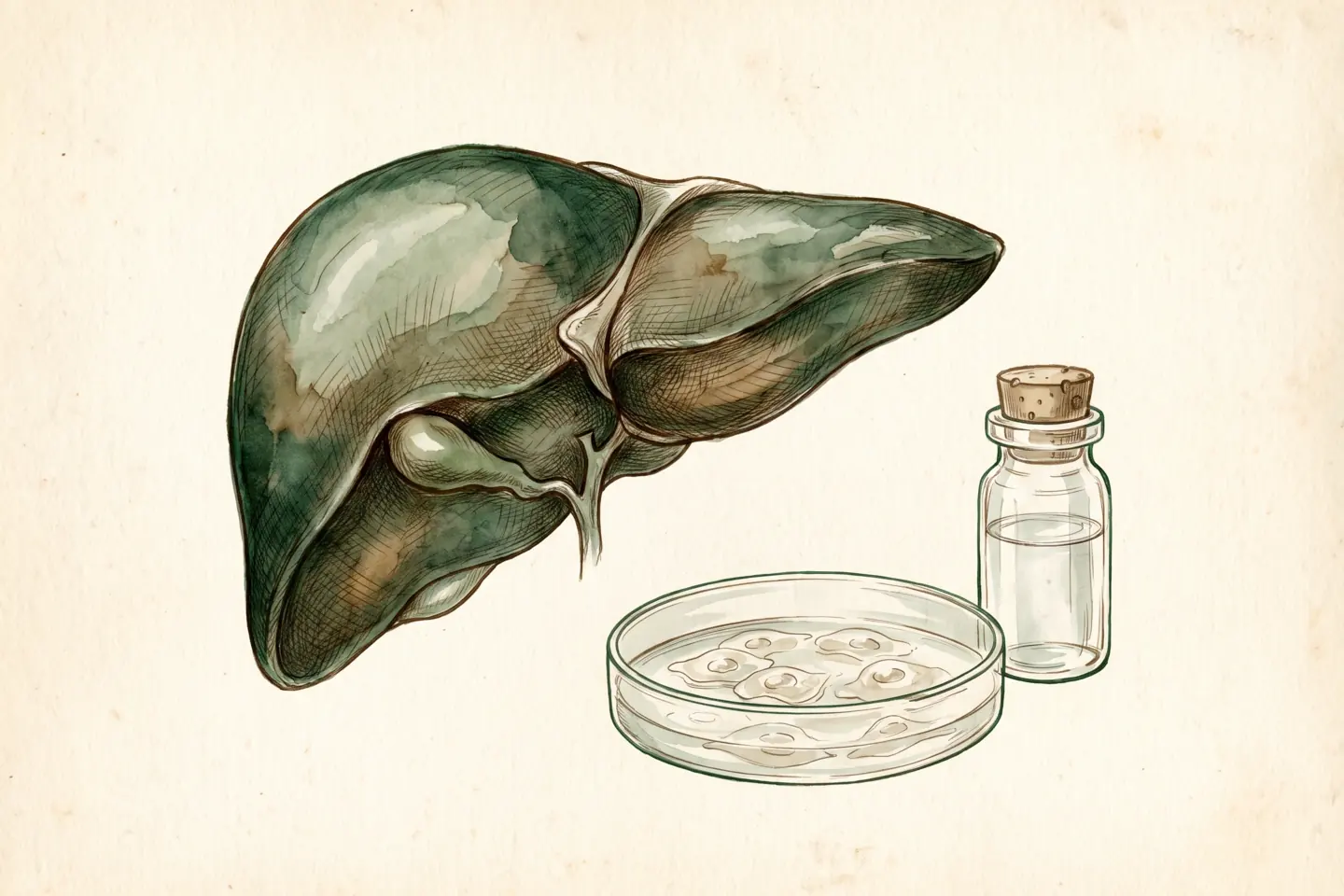
Livagen's liver evidence comes entirely from animal injury models and in vitro work, summarized in review articles from the lab tradition that developed the peptide [4][5]. The "liver bioregulator" label rests on that animal work, not on the lymphocyte studies.
A 2020 gerontology review describes KEDA (Livagen) tested in animal models of acute and chronic hepatitis and liver fibrosis. It reports normalized immune and antioxidant markers and restored liver function, with the largest effects in aged animals [4].
A 2021 review from the same research group summarizes hepatoprotective and immunomodulatory findings across animal-model and in vitro data and describes high efficacy in experimental liver-pathology models. The same review states plainly that no human trial data exist [5].
The animal models used chemically or otherwise induced liver injury. No group outside the Khavinson lineage has replicated the findings, no blinded human liver-function trial exists, and no human dose-response data exist.
How strong is the evidence for Livagen?
Livagen's evidence rates grade E, minimal. The grade reflects a coherent, specific mechanistic hypothesis tested mostly in animal injury models and small ex vivo human-cell experiments, from one research lineage. No clinical trial, no independent Western replication, and no regulatory review stand behind it.
Grade E does not mean the Livagen evidence is fake or pure bro-science. The chromatin work is specific, mechanistically detailed, and published in indexed journals [1][2][3]. It also does not make Livagen proven liver support. Livagen sits in the narrow middle: a real, testable hypothesis, examined mostly in animals and isolated cells.
Does oral or sublingual Livagen work?
No human study has tested oral or sublingual Livagen, and none of the studies cited below used either route. Forum and vendor protocols routinely sell and use it by both routes, often with the same confidence as the injectable form.
The lymphocyte studies applied the peptide directly to cultured cells, bypassing digestion entirely [1][2][3]. The animal hepatoprotection reviews describe injury-model outcomes without addressing oral pharmacokinetics [4][5].
The gap matters mechanically. A four-amino-acid peptide is a small, exposed target for gastrointestinal and blood proteases. None of the cited studies measures what fraction of an oral or sublingual dose reaches circulation intact, or whether a degraded fragment keeps any of the chromatin or hepatoprotective activity seen in the original studies.
No data rule out that oral dosing delivers little or no intact peptide. Anyone taking an oral Livagen product is extrapolating from injected or ex vivo data to a route no human study has tested. The general problem with swallowing peptides has its own explainer.
Is there a tested human dose of Livagen?
No Livagen study reports a human clinical dose, injection frequency, or cycling schedule. Every specific mg amount or "days on, days off" protocol circulating online is unsourced and does not trace to a study.
The research applied Livagen ex vivo to cultured cells or administered it in animal models. Neither design produces a human dose.
Is Livagen safe?
No controlled human safety trial of Livagen exists. The reported problems are injection-site reactions after subcutaneous injection, such as redness and transient discomfort, and those reports describe local rather than systemic effects.
Long-term human safety data, blood monitoring, and adverse-event tracking across repeated cycles do not exist in controlled form. Hypersensitivity is a reasonable general concern for any injectable peptide, a theoretical risk rather than a documented Livagen reaction.
Is every product sold as Livagen the same peptide?
Products sold as Livagen do not reliably share one sequence. The correct sequence is Lys-Glu-Asp-Ala, and some vendor listings circulate a Lys-Glu-Asp-Gly variant under the same name.
Nothing verifies that products sold as "Livagen" across research-chemical suppliers share identical sequence, purity, or endotoxin testing. Unregulated sourcing adds its own purity and sterility risk. That is an identity and manufacturing problem, separate from whether the bioregulator hypothesis holds up. A guide to reading a peptide certificate of analysis shows what a test report can and cannot confirm.
What is still unknown about Livagen?
Whether Livagen does anything inside a living human liver is the central unknown, and each step toward answering it is untested:
- Liver tissue. No study has tested whether the chromatin effects seen in cultured lymphocytes occur the same way in intact liver tissue in a living organism.
- Oral delivery. No study has tested whether any oral or sublingual dose survives digestion intact enough to reach the liver.
- Human liver outcomes. No blinded human trial with objective liver-function endpoints has tested whether the animal hepatoprotection findings replicate [4][5].
- Independent replication. Whether the broader bioregulator chromatin theory, developed almost entirely within one lab lineage, holds up under independent replication remains open.
Livagen remains a hypothesis from one research tradition, still waiting on the human trial that would move it out of grade E.
Sources
Last updated

Written by
Chemist and biochemist. Co-founder and author, The Peptide App.
Jay is a chemist, biochemist and entrepreneur whose work connects scientific research with consumer health products. He has held Chief Science Officer and product development leadership roles and previously served as Chief Revenue Officer at Minicircle.
Keep reading
Compound evidence
Epitalon extended mouse lifespan; most human studies used epithalamin
Epitalon extended lifespan in two mouse strains and lengthened telomeres in human cell cultures. Most human data come from epithalamin, a bovine pineal extract.

Compound evidence
Vilon extended lifespan in two of three studies in tumor-prone mice
Vilon extended lifespan in two studies of tumor-prone female CBA mice, and a third found no significant survival gain. Its human data come from cells in a dish.
Compound evidence
Swallowed peptides rarely survive; oral semaglutide is an exception
Swallowed peptides face stomach enzymes, intestinal enzymes, and gut-wall and liver barriers. Oral semaglutide is the clearest documented exception.
Profiles and tools

The Peptide App
Track protocols, doses, and reconstitution in one place.
Save your calculations, set reminders, log doses, and keep outcome notes — free to start.
 or scan the QR code →