
Reconstitution and syringe math
Syringe dead space can waste up to a third of a small dose
Syringe dead space can waste up to a third of a 0.2 mL dose. Fixed-needle, low dead space syringes cut that waste without any change in injection technique.

By Jay Spall, chemist and biochemist
Disclosure: Jay is a co-founder of The Peptide App. This article is educational and includes links to the app’s tools. Research on one compound or formulation does not establish the safety or stability of a different product.
On this page
- What is syringe dead space?
- How much drug does syringe dead space waste?
- How much of a small peptide dose can dead space lose?
- Which syringe wastes the least on a small peptide draw?
- Does a low dead space syringe make small injections more accurate?
- How accurate is drawing up a small dose by hand?
- Does syringe dead space matter for cost and infection risk?
- Should you discard a cloudy or shaken peptide vial?
- What hasn't dead-space research measured?
- Sources
Key facts
| Question | Direct answer |
|---|---|
| Does drug get stuck in the syringe after injecting? | Yes. After the plunger bottoms out, liquid remains trapped in the syringe tip, the needle hub, and the needle bore itself. That residual volume is called dead space, and every syringe and needle combination has some [6]. |
| Does syringe choice change the dose you get? | Substantially, for small draws. A national syringe-audit study measured average waste rates around 14% for a standard syringe/needle pairing, and found low dead space syringes cut that waste by roughly 10 percentage points [6]. |
| Which syringe wastes the least on a small peptide draw? | A fixed-needle, low dead space syringe, the insulin-syringe style. The needle is bonded to the barrel, so no detachable hub adds extra internal volume the way it does on a luer-lock syringe [6]. |
| How accurate is drawing a dose by hand, separate from the syringe? | Worse than most people assume. In a blinded trial that pre-filled dead space to remove it as a confounder, trained anesthetists and nurses still missed target volumes on 94% of draws, with error growing sharply below about 0.04 mL [1]. |
| Is a cloudy reconstituted vial automatically ruined? | The dead-space studies cannot say. They measured volume, not visual clarity against drug activity, so treat blanket "cloudy means discard" rules as unproven, not confirmed. |
| Does dead space matter for cost or safety? | Yes, on both fronts. A cost-effectiveness model of injectable eye drugs found that dead-space-free syringes changed which vial-sharing strategy was most economical [3], and dead space is the central variable behind bloodborne-pathogen risk when syringes are reused [5][4]. |
6 sources cited. View sources
What is syringe dead space?
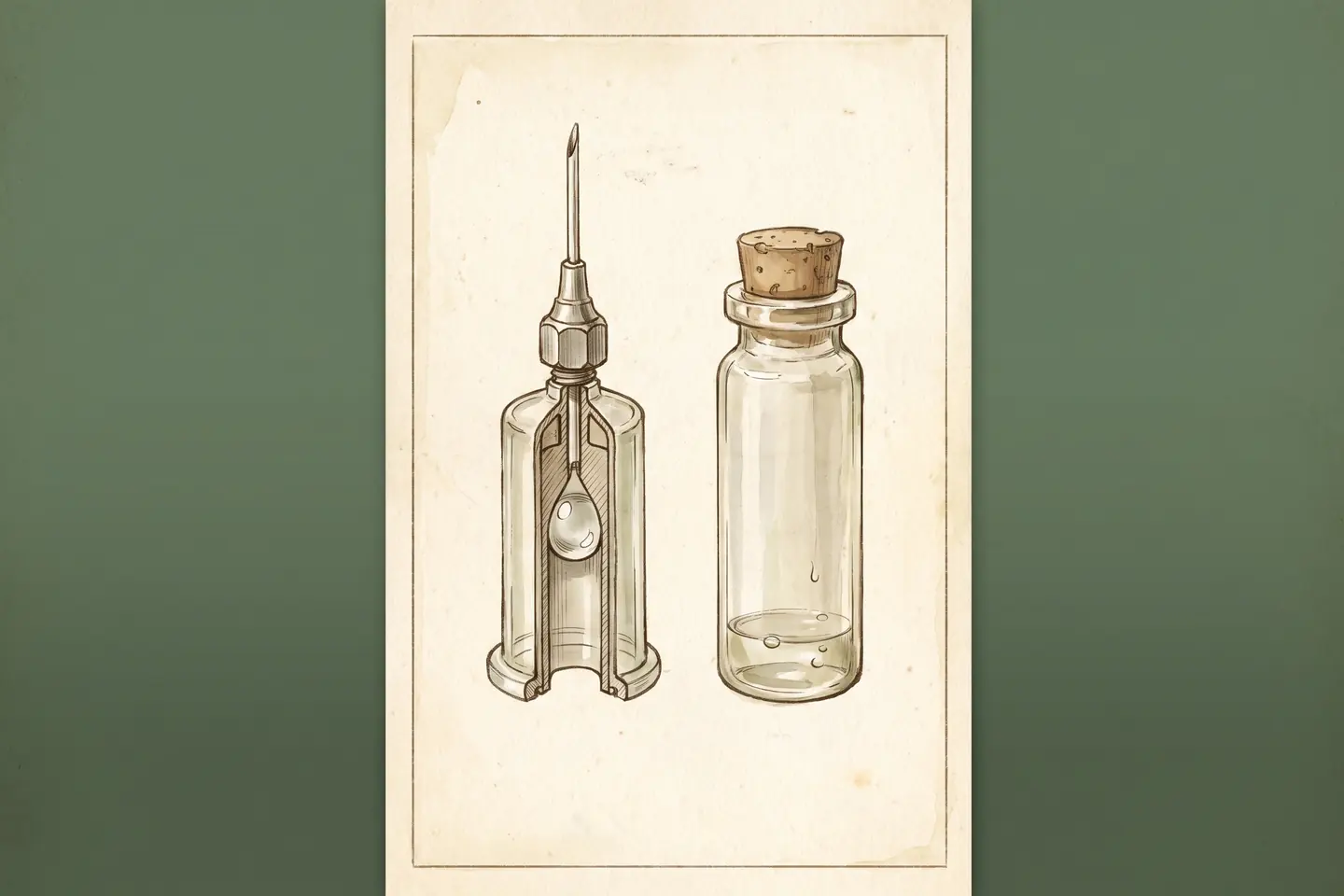
Syringe dead space is the volume of liquid that stays inside the device after you push the plunger as far as it goes. It sits in two places: the conical taper at the front of the barrel, and the hub where the needle attaches.
A syringe with a permanently bonded needle, the design used for most insulin syringes, essentially eliminates the second location, because there is no separate joint to fill. A luer-lock or luer-slip syringe with a detachable needle has to fill that hub chamber before any liquid reaches the needle bore, and the same liquid stays behind when you finish.
ISO 7886-1 sets the ceiling for standard syringes under 5 mL at up to 0.07 mL of residual volume, as reported in an audit of syringe and needle combinations used in Brazil's national vaccination program [6]. That figure is a maximum allowance, not a guarantee of what any specific product achieves, but it sets the scale of the problem.
How much drug does syringe dead space waste?
In a large real-world measurement study of vaccine syringes in Brazil, one common syringe and needle pairing averaged 0.0826 mL of residual volume and a 14.42% waste rate [6]. Switching to a low dead space plunger design cut that waste by roughly 10 percentage points, translating to an estimated 32 million wasted vaccine doses over five years at national scale [6].
The grade is descriptive, device-level measurement: solid for the existence and size of the effect. The fluid being injected was vaccine, not a reconstituted peptide.
How much of a small peptide dose can dead space lose?
A detachable-needle syringe with up to 0.07 mL of dead space [6] can lose up to a third of a 0.2 mL dose to the hub and needle bore. On an insulin-syringe unit scale, that dose is 20 units: U-100 syringes are marked so 100 units equals 1 mL, a labeling convention rather than a study finding.
The lost fraction shrinks fast as the draw volume increases. That is why clinical sources calling dead space "negligible" are not wrong for a 3 mL injection and are wrong for a 20-unit one.
Which syringe wastes the least on a small peptide draw?
A fixed-needle, low dead space syringe wastes the least, because its needle is bonded to the barrel and no detachable hub adds internal volume [6]. The design removes most of the loss structurally, without requiring any change in technique.
The difference between fixed-needle, low dead space designs and detachable-needle designs is the strongest, most repeatable finding in the dead-space evidence [6][5].
Does a low dead space syringe make small injections more accurate?
Low dead space design improved reproducibility more than raw accuracy in a device study of intravitreal eye injections targeting 50 µL [2]. Every syringe design tested delivered more than the target, 55.5 to 58.0 µL on average, with mean errors of 12.8% to 17.3% [2]. In that study, the low dead space design had the lowest coefficient of variation.
The result corrects a naive assumption. Dead space does not only cause underdosing through loss; it also distorts how consistently a given draw technique overshoots to compensate.
How accurate is drawing up a small dose by hand?
Hand-drawn doses miss their target most of the time: in a blinded trial with dead space removed, 94.3% of 1,900 measurements missed target volumes between 0.01 and 1.0 mL [1]. Investigators in the randomized trial eliminated the dead-space variable entirely by pre-filling it, and the people drawing were trained veterinary anesthetists and nurses [1].
Absolute error fell as target volume increased and with practice, and error grew sharply below about 0.04 mL [1]. Small doses are inherently harder to draw accurately, dead space or not. Choosing a reconstitution volume for syringe accuracy applies that problem to peptide vials.
Does syringe dead space matter for cost and infection risk?
Syringe dead space matters for both cost and infection risk. A cost-effectiveness model of injectable eye drugs found that dead-space-free syringes changed which vial-sharing strategy was most economical [3].
The harm-reduction literature supplies mechanistic proof that dead space is a real, physically distinct volume worth engineering around. Laboratory simulations found low dead space syringes retained roughly 1,000 times less residual blood than high dead space designs after rinsing, a difference large enough to be used in mathematical models projecting bloodborne-pathogen transmission [5].
An ecological comparison of people who inject drugs in Hungary and Lithuania found higher use of detachable-needle, higher-dead-space syringes associated with higher hepatitis C prevalence [4]. That comparison is observational, cross-country data, and it cannot establish that syringe design alone caused the difference.
Should you discard a cloudy or shaken peptide vial?
Your vial's manufacturer documentation is the guide, because the dead-space studies did not measure visual clarity, gentle-versus-vigorous mixing, or temperature excursions during transit against drug potency. None measured whether visual cloudiness in a reconstituted product tracks with any loss of activity.
The "don't shake, it denatures the peptide" claim circulating online is mechanistically plausible for some protein formulations, but the dead-space research did not test it, and it did not test a blanket "cloudy equals discard" rule either. Manufacturer reconstitution or storage instructions for your vial trump forum consensus. Why peptide vials should not be shaken covers what the agitation research measures, and what cloudiness in injectable vials means covers the causes of haze.
What hasn't dead-space research measured?
Three gaps separate the dead-space evidence from peptide self-injection:
- Peptide-specific loss. The vaccine [6] and intravitreal [2][3] dead-space numbers are the closest quantitative analogues to peptide self-injection, not a peptide-specific measurement.
- Causation in the infection data. The bloodborne-pathogen data [5][4] establish that dead space is a real, physically meaningful volume difference between syringe designs, but the Hungary and Lithuania comparison [4] is ecological and cannot prove causation.
- Multi-use vials. None of the vaccine, eye-injection, or harm-reduction studies measured dose accuracy across repeated draws from the same multi-use vial over its full lifespan.
Sources
Last updated

Written by
Chemist and biochemist. Co-founder and author, The Peptide App.
Jay is a chemist, biochemist and entrepreneur whose work connects scientific research with consumer health products. He has held Chief Science Officer and product development leadership roles and previously served as Chief Revenue Officer at Minicircle.
Keep reading
Reconstitution and syringe math
Peptide reconstitution volume should put your dose mid-syringe
Reconstitution volume changes peptide concentration, not the amount in the vial. Pick a volume that puts your dose mid-barrel to reduce measurement error.
Reconstitution and syringe math
Syringe units measure volume, not dose
A unit on a U-100 syringe marks 0.01 mL of volume, whatever is dissolved in it. Your dose depends on the concentration you create when reconstituting.
Reconstitution and syringe math
U-40 and U-100 syringe mix-ups cause 2.5-fold dosing errors
U-40 and U-100 syringes space unit marks for different concentrations, so the wrong one causes a 2.5-fold dosing error. Any dilution means redoing the math.
Profiles and tools

The Peptide App
Track protocols, doses, and reconstitution in one place.
Save your calculations, set reminders, log doses, and keep outcome notes — free to start.
 or scan the QR code →