
Hexarelin raised growth hormone in people and protected rodent hearts
In small 1990s trials, IV hexarelin released about twice GHRH's growth hormone. It protected rat and mouse hearts; no therapeutic human RCT has been completed.

By Jay Spall, chemist and biochemist
Disclosure: Jay is a co-founder of The Peptide App. This review discusses the studies cited below; it is not a comprehensive live trial registry or treatment recommendation. Development and regulatory status can change. The app’s tools organize records and arithmetic and do not validate a research product.
On this page
- How does hexarelin release growth hormone?
- Why does hexarelin desensitize so quickly?
- Does hexarelin work independently of the GHRH pathway?
- Does hexarelin protect the heart?
- Do the rodent cardiac findings apply to people using hexarelin?
- What do the human hexarelin trials show?
- Where do hexarelin's forum doses come from?
- What is still unknown about hexarelin?
- Sources
Key facts
| Question | Direct answer |
|---|---|
| Is hexarelin the "strongest" GH secretagogue? | In dose-response terms, yes. IV hexarelin produced roughly double the GH release of equidose GHRH and a higher peak than GHRH regardless of prior GH exposure [1][2][4]. "Strongest" describes receptor affinity, not a therapeutic outcome. |
| Why does hexarelin desensitize faster than GHRP-2 or GHRP-6? | Hexarelin's unusually tight binding to GHSR-1a drives both its high potency and its rapid tachyphylaxis. The receptor downregulates faster because it is being hit harder, so the effect is not a dosing quirk. |
| Does hexarelin's cortisol and prolactin bump come from the same mechanism? | Most likely, through the same high-affinity GHSR-1a binding, but none of the trials cited below quantified a cortisol or prolactin dose-response, so the link is plausible inference, not a proven causal chain. |
| Is hexarelin good for the heart? | Only in rodents. The cardioprotective evidence is real but entirely preclinical, via a separate CD36-mediated pathway that does not require GH or the pituitary at all [5][6]. None of the studies cited below measured a cardiac outcome in humans. |
| Is hexarelin's evidence base different from that of GHRP-2 and GHRP-6? | Yes, in kind, not just degree. Hexarelin has a documented second receptor system, CD36 in cardiac tissue, that other GHRPs in its class do not share in the same studied way, so a straight potency ranking misleads. |
| What human safety and efficacy data exist for hexarelin? | Small, old pharmacodynamic trials of 6 to 96 subjects proving GH release across multiple routes, and zero completed therapeutic RCTs on body composition, GH deficiency or cardiac endpoints in humans. |
6 sources cited. View sources
How does hexarelin release growth hormone?
Hexarelin is a synthetic hexapeptide ghrelin mimetic that binds GHSR-1a with high affinity and triggers a pulse of growth hormone release from the pituitary. That action is uncontroversial and well replicated in the trial literature.
Single IV doses as low as 0.5 microg/kg produced measurable GH release, with an ED50 around 0.50-0.64 microg/kg and peak concentrations near 55 ng/mL, substantially above what GHRH achieved in the same design [1].
A separate open-label trial found that IV hexarelin produced roughly twice the GH output of equidose GHRH. The effect held up across subcutaneous, intranasal and even oral administration, with calculated bioavailabilities of 77%, 4.8% and 0.3% respectively [2].
Why does hexarelin desensitize so quickly?
Hexarelin's high-affinity GHSR-1a agonism means stronger acute receptor activation, and stronger acute activation is what predicts faster receptor desensitization on repeated dosing. The tachyphylaxis and the potency are the same property seen from two sides.
That same affinity also means less selectivity for the GH-release pathway alone. GHSR-1a activation upstream of the hypothalamic-pituitary axis has known crosstalk into cortisol and prolactin secretion, and a secretagogue that binds harder pulls on those levers harder too.
None of the hexarelin trials cited below ran a head-to-head cortisol or prolactin dose-response against GHRP-2 or GHRP-6. The cortisol and prolactin comparison is a mechanistic inference built on affinity data, not a quantitative finding from those trials. The GHRP-2 evidence review covers the cortisol evidence for that compound.
Does hexarelin work independently of the GHRH pathway?
Partly. Hexarelin's GH response partly resists negative feedback from prior GH exposure. In a crossover study, giving subjects exogenous rhGH beforehand only partially blunted hexarelin's GH-releasing effect, and hexarelin still outperformed GHRH regardless of prior GH exposure [4].
That partial resistance to feedback is consistent with a receptor system operating somewhat independently of the classic GH axis, which sets up the second, much less understood part of hexarelin's record.
Does hexarelin protect the heart?
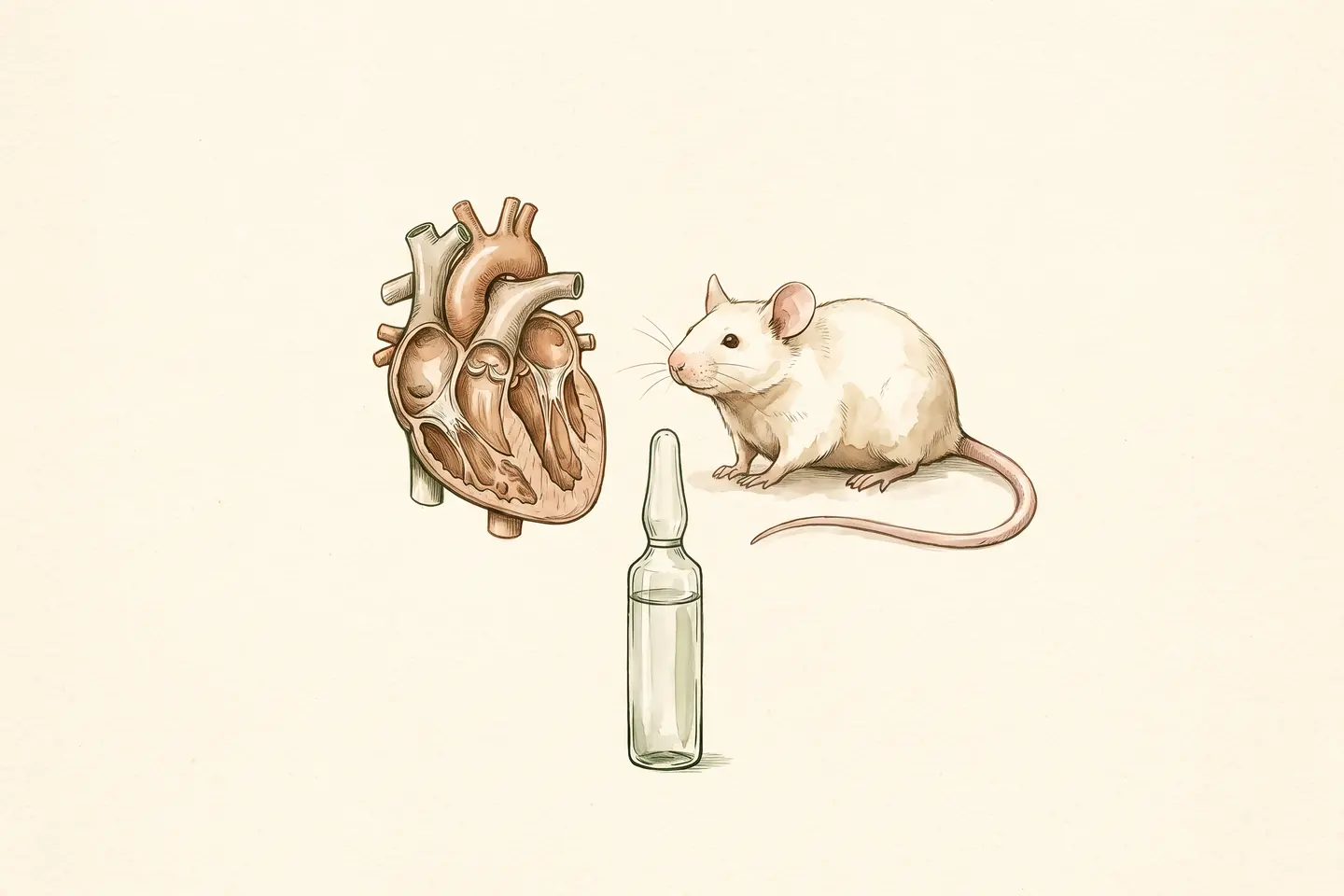
Hexarelin's cardioprotective evidence is entirely preclinical, in rats and mice, and it runs through CD36 rather than the GH axis [5][6]. Most coverage collapses two unrelated evidence bases into one.
CD36 is a receptor expressed on cardiac tissue that hexarelin binds directly, independent of pituitary GH release. The cleanest demonstration used hypophysectomized rats, animals with no functioning pituitary and therefore no capacity for hexarelin to raise GH. Seven days of hexarelin at 80 microg/kg subcutaneously still prevented the ischemia-reperfusion-induced rise in left ventricular end-diastolic pressure, coronary perfusion pressure, creatine kinase release and angiotensin II reactivity [5]. A different GHRP compound, EP51389, which does not bind cardiac receptors, showed no such protection, isolating the effect to hexarelin's direct receptor engagement rather than anything downstream of GH [5].
A later mouse study extended the finding into a more clinically relevant infarction model. After coronary ligation, 21 days of hexarelin at 0.3 mg/kg/day improved ejection fraction, reduced interstitial collagen and TGF-beta1 expression, lowered troponin-I and TNF-alpha, and shifted autonomic tone toward parasympathetic dominance compared with vehicle [6].
Do the rodent cardiac findings apply to people using hexarelin?
Not established. Neither animal experiment validates a human cardiac treatment dose. Both studies are interesting and reproducible within the preclinical literature.
The doses, routes, dosing durations and disease models, hypophysectomized rats and surgically infarcted mice, have no established equivalence to a healthy adult using hexarelin for a GH-pulse protocol. CD36, the receptor engaged in the cardiac studies, is not the receptor responsible for the GH release people use hexarelin for.
Calling hexarelin "good for your heart too" takes a mechanistically distinct, animal-only finding and repackages it as a bonus feature of the human GH-secretagogue effect. That repackaging is the single biggest distortion in how hexarelin gets discussed.
What do the human hexarelin trials show?
Four small, methodologically clean pharmacodynamic studies from the 1990s establish that hexarelin releases GH, dose-dependently, across multiple administration routes, in both adults and children.
The four are a 12-person placebo-controlled dose-response RCT [1], a 12-person open-label multi-route trial [2], a 96-person pediatric and pubertal study [3], and a 6-person feedback-inhibition crossover [4]. The GH response is amplified during puberty, with peak GH of 77.5 versus 39.4 microg/L (p < 0.001) [3].
Those trials establish nothing about clinical outcomes. They contain no body composition data, no data on GH deficiency treatment, no cardiac endpoints in humans and no long-term safety follow-up.
Hexarelin's grade of C, moderate, is generous. It rewards the reproducibility of the pharmacodynamic signal while separating two different claims: hexarelin reproducibly raises GH in healthy volunteers, and hexarelin does something clinically useful. The preclinical cardiac program adds mechanistic depth without moving the human evidence grade, because it answers a different question in a different species through a different receptor.
Where do hexarelin's forum doses come from?
Not from the trials. The figures circulating online, 100 to 200 mcg two to three times daily, do not trace back to any of the studies cited below.
The controlled human studies cited below used IV or subcutaneous doses calculated by body weight, 0.5 to 2 microg/kg, not flat mcg amounts. None ran multi-week repeat-dose protocols measuring desensitization curves, appetite, or side-effect accumulation over time.
The reported tachyphylaxis, water retention, flushing and appetite stimulation, described as intermediate between GHRP-6 and ipamorelin, come from accumulated user and pharmacological reports rather than those controlled trials. Those reports are consistent with the mechanism, not confirmed by RCT-grade dosing data. The GHRP-6 evidence review and the ipamorelin evidence review cover the comparison compounds.
What is still unknown about hexarelin?
Every question that chronic use raises sits outside the acute window the trials measured:
- Cortisol and prolactin. None of the trials cited below measured the cortisol or prolactin dose-response curve in humans.
- Desensitization. How quickly tachyphylaxis sets in with repeated subcutaneous dosing outside a lab setting is unknown.
- Cardiac translation. Whether any of the rodent cardiac protection translates at human-relevant doses or routes is unknown.
- Insulin sensitivity. What sustained GH elevation does to insulin sensitivity over anything longer than the acute window is unmeasured.
Treating hexarelin as interchangeable with GHRP-2 or GHRP-6 ignores that hexarelin operates through an additional receptor system with no human dose-response map at all.
Sources
Last updated

Written by
Chemist and biochemist. Co-founder and author, The Peptide App.
Jay is a chemist, biochemist and entrepreneur whose work connects scientific research with consumer health products. He has held Chief Science Officer and product development leadership roles and previously served as Chief Revenue Officer at Minicircle.
Keep reading

Compound evidence
GHRP-2 raised growth hormone about 13-fold in seven healthy men
GHRP-2 raised growth hormone in four small human trials, about 13-fold in healthy men. None measured body composition, and the longest adult trial ran 30 days.
Compound evidence
GHRP-6 triggered a GH pulse in men, women and children after one dose
A single GHRP-6 dose raised GH in men, women and children in a 37-person trial. No trial has tested weeks of dosing for body composition or recovery.

Compound evidence
Ipamorelin released GH in men but missed in two bowel-recovery trials
In rats and swine, ipamorelin released GH without raising cortisol; single doses raised GH in 40 healthy men. Both bowel-recovery trials missed their goals.
Profiles and tools

The Peptide App
Track protocols, doses, and reconstitution in one place.
Save your calculations, set reminders, log doses, and keep outcome notes — free to start.
 or scan the QR code →