
Exenatide did not slow Parkinson's in its 96-week Phase 3 trial
Exenatide did not slow Parkinson's motor decline in a 96-week multicenter Phase 3 trial. The result did not replicate an earlier single-center Phase 2 signal.

By Jay Spall, chemist and biochemist
Disclosure: Jay is a co-founder of The Peptide App. This review discusses the studies cited below; it is not a comprehensive live trial registry or treatment recommendation. Development and regulatory status can change. The app’s tools organize records and arithmetic and do not validate a research product.
On this page
- Does exenatide slow Parkinson's disease?
- How was the Exenatide-PD3 trial designed?
- Why did exenatide look promising for Parkinson's disease?
- Why did the exenatide Phase 2 signal fail in Phase 3?
- Does the exenatide result rule out GLP-1 neuroprotection?
- Why is exenatide based on Gila monster venom?
- How do GLP-1 receptor agonists like exenatide work?
- What did the Exenatide-PD3 trial leave unanswered?
- Sources
Key facts
| Question | Direct answer |
|---|---|
| Does exenatide slow Parkinson's disease? | No. The multicenter Phase 3 Exenatide-PD3 trial found no benefit over placebo on the primary motor outcome at 96 weeks [5][6]. |
| Why did people expect it to work? | A small single-center trial reported a motor-score difference favoring exenatide, which generated large interest. The larger Phase 3 trial did not replicate it [5][6]. |
| Does the result mean GLP-1 drugs cannot protect the brain? | No. One molecule's test on Parkinson's motor symptoms failed to replicate. Other GLP-1 drugs and other neurological endpoints remain under active, mostly preclinical or early-stage, investigation [1][2][7]. |
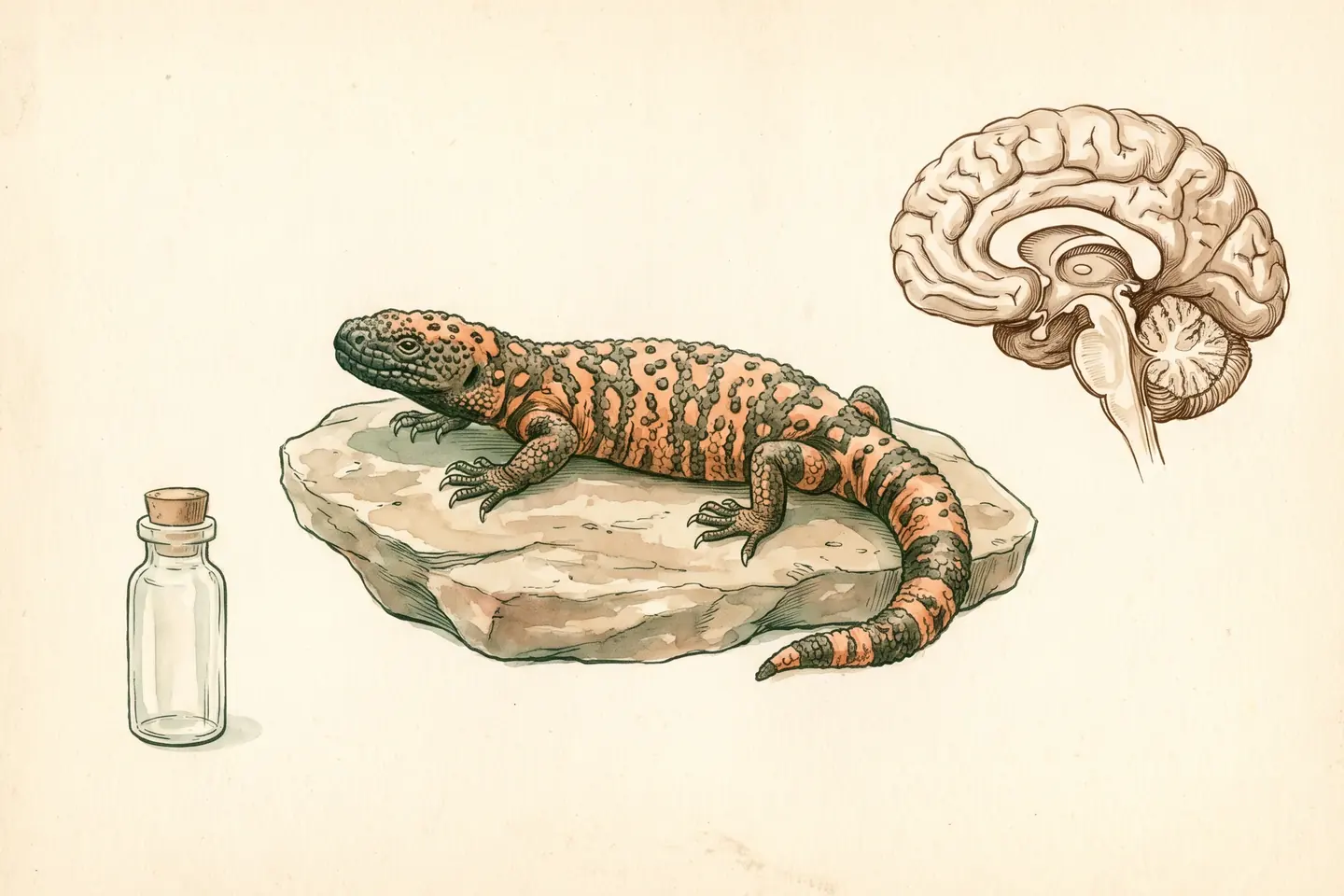
| Where does exenatide come from? | Exenatide is a synthetic version of exendin-4, a peptide first identified in the venom gland of the Gila monster (Heloderma suspectum). It is not toxic to humans; the lizard uses it as a digestive and metabolic signal, not a weapon. |
| Why does exenatide work as a drug when native human GLP-1 does not? | The enzyme DPP-4 degrades human GLP-1 within minutes. Exendin-4's sequence differs enough from human GLP-1 that DPP-4 does not degrade it the same way, which gives it a much longer working life in the body. |
| Does the venom origin explain the Parkinson's result? | No. The venom origin explains exenatide's pharmacokinetics, why it lasts longer than native GLP-1, not its efficacy for anything beyond glycemic control. |
9 sources cited. View sources
Does exenatide slow Parkinson's disease?
No. In the Phase 3 Exenatide-PD3 trial, published in The Lancet in 2025, exenatide showed no benefit over placebo on the primary motor endpoint at 96 weeks [5].
The result is specific and informative, not ambiguous. A properly powered, multicenter, placebo-controlled trial, designed for the sole purpose of confirming a Phase 2 signal, did not confirm it.
The finding does not say exenatide is dangerous, that the underlying biology is nonsense, or that every earlier report was wrong. The result means exenatide, at 2 mg weekly for 96 weeks in people with mild to moderate Parkinson's disease, did not slow motor decline more than placebo [5][6].
How was the Exenatide-PD3 trial designed?
Exenatide-PD3 was a Phase 3, multicenter, double-blind, randomized, placebo-controlled trial run at six UK research hospitals [6]. It enrolled people with mild to moderate Parkinson's disease and compared extended-release exenatide 2 mg weekly with placebo for 96 weeks. The primary outcome was the MDS-UPDRS part III motor score, measured off dopaminergic medication [6].
The design was built to test whether the earlier single-center result would hold up in a larger, more rigorously controlled setting.
Why did exenatide look promising for Parkinson's disease?
Interest in exenatide for Parkinson's disease grew out of preclinical models and small human studies, including a single-center trial with a positive motor-score signal. The Exenatide-PD3 protocol states the basis plainly: exenatide had been associated in single-center studies with reduced motor deterioration over 1 year [6].
That description is accurate and appropriately hedged. The earlier work was a single-center, relatively small trial with a positive signal on an off-medication motor score. "Associated with reduced motor deterioration" is not the same claim as "exenatide slows Parkinson's disease," although headlines from that era often collapsed the distinction.
Reviews of antidiabetic drug repurposing for neurodegenerative disease describe the signal as promising, cite it as rationale for larger trials, and frame it as one input among several rather than a settled result [9].
One positive trial of that size is not sufficient grounds to claim a disease-modifying effect. It is sufficient grounds to fund a bigger, longer, multicenter trial designed to either confirm or fail to confirm the finding, and Exenatide-PD3 was that trial.
Why did the exenatide Phase 2 signal fail in Phase 3?
Exenatide's roughly 60-patient single-center trial and the larger multicenter Phase 3 trial diverged in a pattern common in neurodegenerative drug development. Three general factors explain that pattern:
- Chance imbalance. Smaller trials are more vulnerable to chance imbalances between groups.
- Homogeneous recruitment. Single-center recruitment tends to produce a more homogeneous patient population than multicenter recruitment.
- Noisy scoring. Off-medication UPDRS scoring is known in the field to be noisy and sensitive to placebo response and assessment variability.
Which of them, if any, applies to exenatide's case is not established. None of these factors proves the Phase 2 result was a fluke. They explain why Phase 2 to Phase 3 replication failure happens routinely without indicting the entire hypothesis. Davunetide's failed trial covers a similar collapse of earlier signals in another neurodegenerative disease.
Does the exenatide result rule out GLP-1 neuroprotection?
No. Exenatide-PD3 tested one GLP-1 drug on one endpoint in one disease, and the broader question of GLP-1 receptor agonism in the nervous system remains open. Researchers are testing it from several directions:
- Neurodegenerative disease. A network meta-analysis of GLP-1 receptor agonists and SGLT2 inhibitors across seven neurodegenerative diseases found preclinical neuroprotective signals worth continued study, and it noted that their disease-prevention role in humans remains unclear [1].
- Ischemic stroke. A systematic review and meta-analysis of GLP-1 receptor agonists in nondiabetic ischemic stroke found consistent benefit on functional outcome and infarct volume in preclinical animal models. Only four clinical studies were available, and the clinical evidence is still limited [2].
- Psychiatry. A review of semaglutide through a psychiatric lens describes neuroprotective effects alongside a preliminary, mixed picture on mood and psychiatric symptoms [3].
- Eye disease. Ophthalmic research found associations between GLP-1 receptor agonist use and reduced glaucoma incidence, with more nuanced, direction-dependent findings for diabetic retinopathy [4].
- Alzheimer's disease. A systematic review found no end-of-treatment difference between GLP-1 receptor agonists and placebo on cognitive endpoints across its randomized trials, although metabolic and glucose-uptake measures showed benefit [7].
The field combines real preclinical enthusiasm, scattered epidemiological association, and thin, inconsistent clinical trial confirmation. Exenatide's Parkinson's result fits that pattern rather than breaking it. The hypothesis is not dead; it has one fewer positive data point, in one disease, for one molecule, on one endpoint. Pooled trials of intranasal insulin cover a related metabolic approach to Alzheimer's disease.
Why is exenatide based on Gila monster venom?
Exenatide is a synthetic version of exendin-4, a peptide first identified in the venom gland of the Gila monster (Heloderma suspectum). Exendin-4 shares meaningful sequence homology with human glucagon-like peptide-1 (GLP-1), the gut hormone that stimulates insulin release after eating. Exendin-4 is not toxic to humans; the lizard uses it as a digestive and metabolic signal, not a weapon.
In humans, the enzyme dipeptidyl peptidase-4 (DPP-4) degrades native GLP-1 within minutes of release, which is why native GLP-1 never worked as an injectable drug on its own. Exendin-4 resists that degradation, a resistance mechanism well established in the broader GLP-1 receptor agonist pharmacology literature. That resistance is the entire reason exenatide became viable as an injectable drug rather than a hormone with a half-life measured in minutes.
The payoff of the venom origin story is pharmacokinetic, not toxicity or novelty for its own sake: an evolutionary quirk in a lizard that eats only a few times a year and needed a metabolic signal that lingers. The venom origin explains why exenatide lasts longer than native GLP-1. It does not explain efficacy for anything beyond glycemic control, and the Parkinson's result is a separate question entirely.
How do GLP-1 receptor agonists like exenatide work?
GLP-1 receptor agonists stimulate insulin secretion, suppress glucagon release, and slow gastric emptying, effects that extend to appetite regulation and are shared across the drug class [8].
None of that pharmacology says anything about brain effects. The neurotrophic hypothesis holds that GLP-1 receptor activation in neurons reduces inflammation or supports cell survival. That hypothesis is a separate biological claim, and it has to be tested on its own terms, disease by disease and trial by trial.
The guide to using GLP-1 medications well covers the class mechanism and why titration is paced the way it is.
What did the Exenatide-PD3 trial leave unanswered?
Exenatide-PD3 answered the question it was designed to answer: exenatide did not beat placebo on off-medication motor scores at 96 weeks [5]. Several neighboring questions remain open.
The trial does not show whether other GLP-1 receptor agonists, dosed differently or tested on non-motor or biomarker endpoints, behave differently. Dual GLP-1/GIP agonists and newer molecules in the class are pharmacologically distinct enough that extrapolating a negative exenatide result onto them is not warranted [8].
The trial also does not settle whether GLP-1 signaling matters for earlier-stage or prevention-oriented use rather than treatment of established disease. The network meta-analysis flags that distinction as unresolved [1].
Nothing in the venom origin bears on any of these questions. The Gila monster explains why exenatide survives longer in human plasma than native GLP-1, not whether it does anything useful once it gets there.
Sources
Last updated

Written by
Chemist and biochemist. Co-founder and author, The Peptide App.
Jay is a chemist, biochemist and entrepreneur whose work connects scientific research with consumer health products. He has held Chief Science Officer and product development leadership roles and previously served as Chief Revenue Officer at Minicircle.
Keep reading

Compound evidence
Davunetide missed both main endpoints in a 313-patient PSP trial
Davunetide failed a 313-patient PSP trial on both primary endpoints. Its earlier signals were secondary, and brain delivery was never confirmed.

Compound evidence
Intranasal insulin matched placebo on cognition in five pooled trials
Intranasal insulin matched placebo on cognition and daily function across five pooled trials in MCI or Alzheimer's. A device switch clouds the largest trial.

GLP-1 and metabolic peptides
GLP-1 medications work best titrated slowly, with other drugs adjusted
GLP-1 medications work best on a slow dose ramp, with insulin and blood pressure pills adjusted as weight falls. Faster escalation adds harm, not weight loss.
Profiles and tools

The Peptide App
Track protocols, doses, and reconstitution in one place.
Save your calculations, set reminders, log doses, and keep outcome notes — free to start.
 or scan the QR code →