
Apelin infusions raise cardiac output; aging claims come from mice
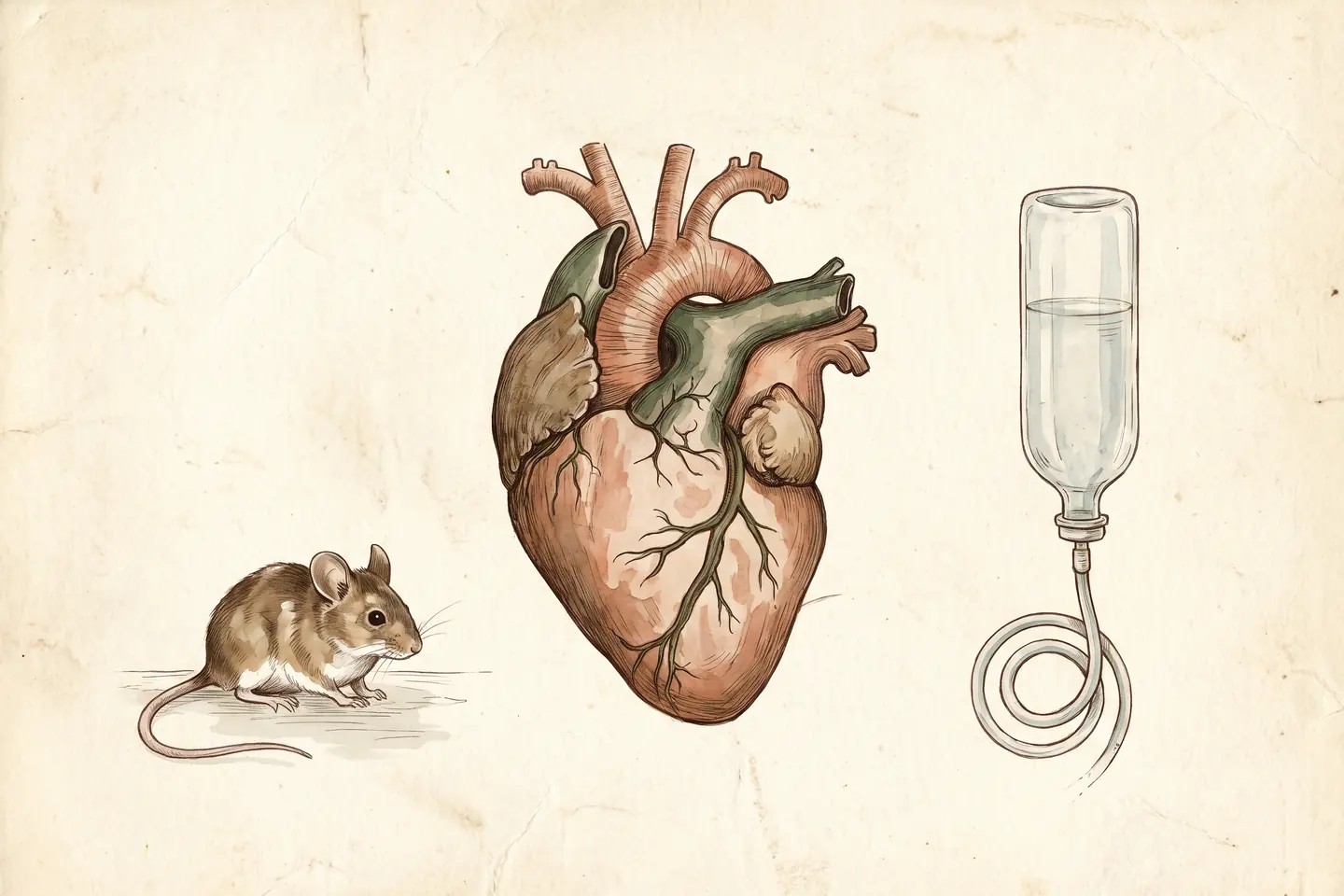
Apelin infusions raise cardiac output and blood flow in human trials. Apelin's muscle and aging claims come from mice, and no human trial has tested them.

By Jay Spall, chemist and biochemist
Disclosure: Jay is a co-founder of The Peptide App. This review discusses the studies cited below; it is not a comprehensive live trial registry or treatment recommendation. Development and regulatory status can change. The app’s tools organize records and arithmetic and do not validate a research product.
On this page
- What did apelin infusions do in humans?
- How does apelin work at the APJ receptor?
- Why does every apelin study use continuous infusion?
- Can an apelin injection or capsule raise apelin in the body?
- Is apelin an anti-aging or muscle-building peptide?
- Where is apelin research headed?
- What is still unknown about apelin?
- Sources
Key facts
| Question | Direct answer |
|---|---|
| Has apelin been given to a person? | Yes. Apelin has been infused intravenously and intra-arterially in controlled human studies, not only tested in animals [2][3]. |
| What did the apelin infusions show? | Increased forearm blood flow, increased coronary blood flow, higher cardiac output, and lower peripheral resistance in healthy volunteers and in people with chronic heart failure, under continuous monitored infusion [2][3]. |
| How long does apelin last in the body? | Minutes, not hours. Apelin is degraded rapidly in circulation, which is why every human study used continuous infusion rather than a single injection [3][4]. |
| Can a shot, capsule, or protocol raise apelin? | No. No human data support oral or subcutaneous apelin reaching the bloodstream intact, and the pharmacokinetics of the native peptide make that route implausible with current science. |
| Is apelin an exercise and longevity peptide? | Not in humans. The claim rests on a mouse sarcopenia study [1], and no human data cover apelin and exercise capacity or age-related muscle loss. |
| Where is apelin research headed? | Away from native apelin, toward stabilized peptide analogs and biased small-molecule agonists of the APJ receptor designed to survive longer in circulation [3][4][7]. |
7 sources cited. View sources
What did apelin infusions do in humans?
Infused apelin increased blood flow and cardiac output in healthy volunteers and in heart failure patients. The strongest human data come from a series of randomized, double-blind, placebo-controlled infusion studies in 26 healthy volunteers, 18 patients with class II to III chronic heart failure, and 6 patients undergoing diagnostic coronary angiography [2].
Intrabrachial infusion of [Pyr1]apelin-13 produced forearm vasodilatation comparable to established vasodilators, and the effect was preserved in the heart failure group even though the response to acetylcholine was blunted in that same population [2]. Intracoronary apelin-36 increased coronary blood flow and the rate of rise in left ventricular pressure while reducing peak and end-diastolic pressures, and systemic infusion increased cardiac output [2].
A later pharmacology review confirms those acute effects, increased cardiac output and decreased peripheral resistance without reported adverse effects during infusion, in patients with pulmonary arterial hypertension. The same review reports that apelin infusion increased glomerular filtration rate while reducing proteinuria in chronic kidney disease [3].
That is grade-A evidence for one specific claim: infused apelin produces measurable, receptor-mediated hemodynamic changes in humans, acutely, under continuous IV administration.
How does apelin work at the APJ receptor?
Apelin is the endogenous ligand for APJ, also written APLNR, a G-protein-coupled receptor that also binds a second, structurally distinct peptide called Elabela [3].
Activating APJ on vascular endothelium triggers nitric-oxide-dependent vasodilation. Activating it in cardiac tissue produces a positive inotropic effect, an increase in the force of contraction, independent of that vasodilation [2][3]. Relaxing vessels and increasing cardiac output at the same time is what made apelin interesting to cardiovascular pharmacologists well before "longevity peptide" entered the conversation.
The apelinergic system is not uniformly pro-cardiovascular. Reviews of the receptor's biology describe context-dependent and sometimes opposing effects by tissue and disease state, including roles in pulmonary vascular disease that differ from the role in systemic heart failure [5][6]. That complexity is part of why native apelin never became a straightforward drug candidate.
Why does every apelin study use continuous infusion?
Apelin is cleared from circulation within minutes, so a single injection would be gone before a steady drug effect could be established. The pharmacology and patent literature describes apelin as binding APJ with high, sub-nanomolar affinity and being degraded rapidly in circulation [4].
The infusion protocols in the heart failure and healthy-volunteer trials were built around that clearance [2][3]. The route was a pharmacokinetic necessity, not an incidental design choice.
Apelin also does not exist as one molecule. Apelin-13, apelin-17, apelin-36, and the pyroglutamated form of apelin-13 used in the human trials are distinct isoforms with different degradation kinetics [4]. A vendor peptide sold simply as "apelin" does not specify which one it claims to be.
Can an apelin injection or capsule raise apelin in the body?
No human data support oral or subcutaneous apelin reaching the bloodstream intact. None of the apelin isoforms has demonstrated systemic bioavailability in humans outside continuous IV or intra-arterial delivery.
The native peptide's pharmacokinetics make either route implausible with current science, and peptides generally cannot be swallowed for related reasons. Protocols for injected or oral apelin have no human exposure data behind them.
Is apelin an anti-aging or muscle-building peptide?
The apelin muscle story traces to a mouse intervention study layered on a human correlation, not to a human muscle-aging trial. Apelin production by contracting muscle declines with age in both rodents and people, and restoring apelin signaling in aged mice improved muscle mitochondrial function, autophagy, and stem-cell-driven regeneration [1].
That is a real, peer-reviewed finding in mice. No trial has infused or otherwise administered apelin to humans and measured strength, sarcopenia markers, or physical function.
The gap between "apelin correlates with exercise benefit in older humans" and "apelin treatment improves human muscle outcomes" has not been closed. Popular longevity peptides lack rigorous lifespan evidence for much the same reason.
Where is apelin research headed?
Apelin research has moved on from the native peptide toward molecules engineered to last longer. Patent activity around APJ receptor modulators grew substantially between 2014 and 2019, with the bulk of it focused on metabolically stable peptide analogs and small-molecule agonists rather than native apelin [4].
Newer engineering strategies include G-protein-biased agonists designed to reduce receptor desensitization by limiting β-arrestin-mediated internalization, an approach intended to extend both the duration and the selectivity of effect compared with native apelin [3][7]. Those analogs remain investigational.
What is still unknown about apelin?
Apelin's human record covers acute infusion measures and nothing else:
- Aging and performance. No human trial has tested apelin, or a stabilized analog, for exercise performance, sarcopenia, or a healthspan endpoint. The human signal is confined to acute hemodynamic and renal measures under infusion [2][3].
- Direction of effect. Apelin/APJ signaling shows biphasic, context-dependent behavior: cardioprotective in some settings and implicated in vasoconstrictive or pro-atherogenic processes in others, with a role that differs between cardiovascular disease and pulmonary vascular disease [5][6].
- Chronic dosing. Whether a stabilized analog can replicate the acute human hemodynamic benefits over chronic, non-infusion dosing has not been tested in people.
- Translation. Whether any such chronic effect would reach a muscle or aging outcome is untested. The mitochondrial peptide stack sits in the same position.
Sources
Last updated

Written by
Chemist and biochemist. Co-founder and author, The Peptide App.
Jay is a chemist, biochemist and entrepreneur whose work connects scientific research with consumer health products. He has held Chief Science Officer and product development leadership roles and previously served as Chief Revenue Officer at Minicircle.
Keep reading

Compound evidence
Longevity peptide claims rest on cell, biomarker and pilot studies
Longevity peptide claims draw on cell studies, biomarkers and small pilots. The NIA program that tested 54 agents in over 30,000 mice has run none of them.
Compound evidence
Swallowed peptides rarely survive; oral semaglutide is an exception
Swallowed peptides face stomach enzymes, intestinal enzymes, and gut-wall and liver barriers. Oral semaglutide is the clearest documented exception.

Combinations and evidence
The mitochondrial peptide stack is one peptide and two small molecules
MOTS-c has mouse and cell data on insulin sensitivity, and the two small molecules have rodent data. None has a human trial, and no study combines the three.
Profiles and tools

The Peptide App
Track protocols, doses, and reconstitution in one place.
Save your calculations, set reminders, log doses, and keep outcome notes — free to start.
 or scan the QR code →