
Adipotide cut fat in animals but kidney injury ended its human trial
Adipotide shrank fat in mice and monkeys by destroying its blood supply. Kidney injury tracked the fat-loss doses in monkeys and ended the one human trial.

By Jay Spall, chemist and biochemist
Disclosure: Jay is a co-founder of The Peptide App. This review discusses the studies cited below; it is not a comprehensive live trial registry or treatment recommendation. Development and regulatory status can change. The app’s tools organize records and arithmetic and do not validate a research product.
On this page
- How does adipotide work?
- Why does adipotide damage the kidneys?
- What did adipotide do in mice and rats?
- What happened in the obese monkey study?
- What happened in adipotide's human trial?
- Where do adipotide dosing protocols come from?
- What side effects has adipotide caused?
- What is still unknown about adipotide?
- Sources
Key facts
| Question | Direct answer |
|---|---|
| Does adipotide cause fat loss? | Yes, but only in animals: full obesity reversal in mice [1][2] and about 11% body weight loss with 39% white adipose tissue reduction in obese monkeys [3]. No human efficacy data exist. |
| Does adipotide act on fat cells directly? | No. Adipotide binds prohibitin on the blood vessels feeding white adipose tissue, and the fat shrinks because its blood supply is destroyed [1][3]. |
| Is adipotide's kidney toxicity a rare high-dose effect? | No. Renal proximal tubule injury was the primary toxicity signal in the primate study, and it tracked with the same dosing that produced the biggest fat-loss effects [3]. |
| Has adipotide been tested in humans? | Once. A four-subject Phase 1 trial was terminated early for dose-limiting kidney toxicity, and no efficacy data were published from it. |
| Are forum adipotide protocols based on human data? | No. No human pharmacokinetic or safety dataset exists to extrapolate from, so a "low and slow" protocol is a guess layered on animal dosing. |
| What is adipotide's evidence grade? | D, limited. Every efficacy finding is preclinical, and the one human trial ended on a safety signal rather than a completed dataset. |
3 sources cited. View sources
How does adipotide work?
Adipotide targets the blood supply of white fat rather than the fat cells themselves. It is a chimeric peptidomimetic combining a homing sequence, CKGGRAKDC, which binds prohibitin on the blood vessel endothelium of white adipose tissue, with a proapoptotic peptide, D(KLAKLAK)2 [1].
The result in animals is apoptosis in the endothelial cells of vessels that supply white fat. With that vasculature gone, the fat tissue it feeds is starved of blood flow and shrinks [1]. Adipotide is therefore not a lipolysis drug, and it does not suppress appetite through a hormone receptor the way GLP-1 drugs do.
A 2010 rodent study found a second component to the weight effect: reduced food intake, independent of leptin signaling, without changes in energy expenditure or overt signs of illness [2]. In animals, adipotide works through vascular ablation in fat tissue plus an appetite effect the vascular hypothesis alone does not explain.
Why does adipotide damage the kidneys?
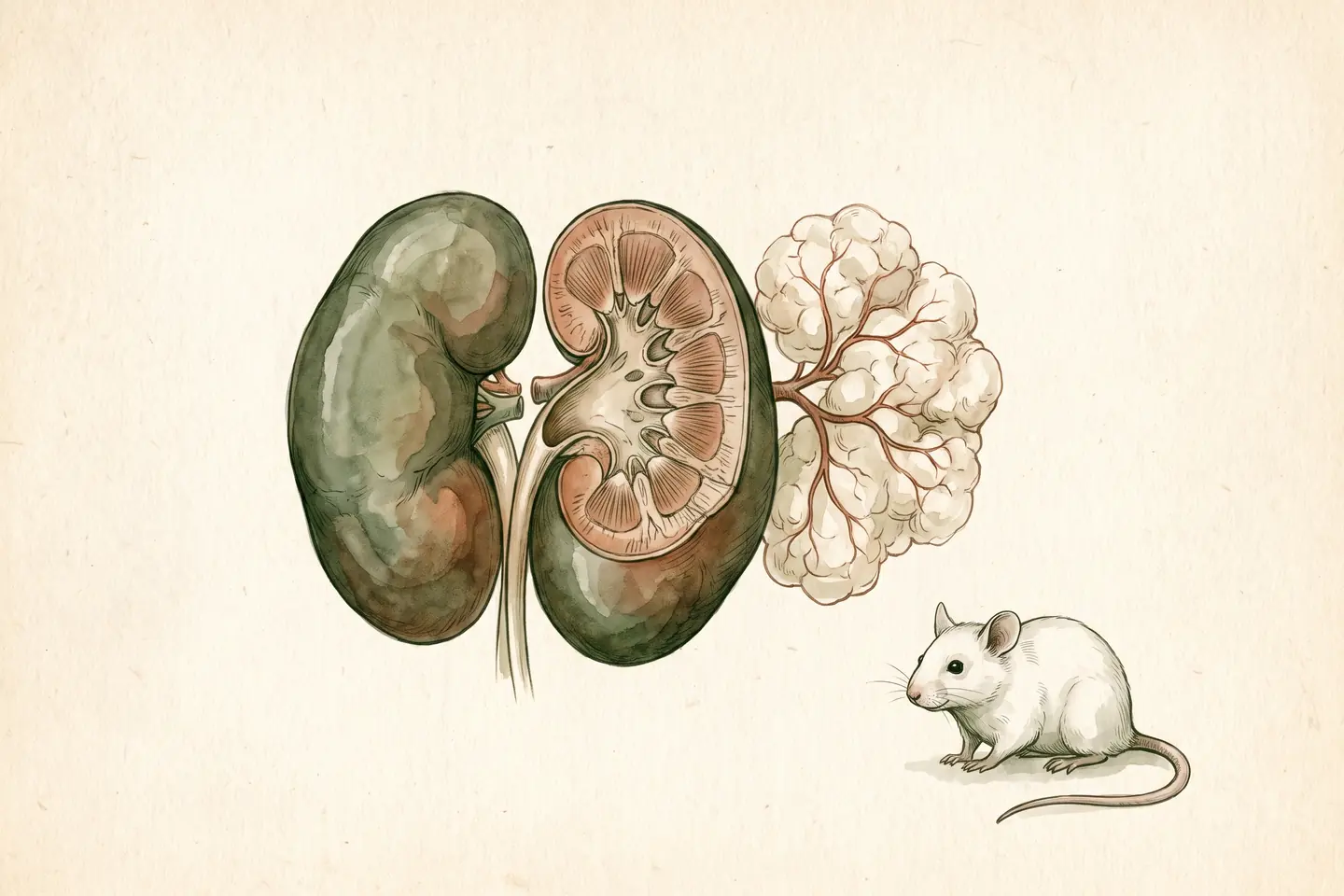
Prohibitin, adipotide's target, is not unique to fat tissue vasculature. Prohibitin is expressed in vascular beds elsewhere in the body, including the kidney.
That expression pattern is the thread connecting adipotide's efficacy signal to its toxicity signal. The renal injury is not a side pathway unrelated to the drug's action; it is plausibly the same targeting mechanism landing somewhere other than intended.
What did adipotide do in mice and rats?
Adipotide reversed obesity in mice. The 2004 origin study showed that the construct selectively ablated white adipose vasculature and reversed obesity with metabolic normalization in obese mice, and reported no detectable adverse effects at the doses and duration tested [1].
That "no adverse effects" line does a lot of work in secondhand summaries. The study was in mice, over a short period, and adverse effects not detected is a different claim from adverse effects do not occur.
The 2010 study extended the work into mice and rats, showing complete reversal of diet-induced obesity in mice and weight reduction in rats through reduced food intake, again without visceral illness or altered energy expenditure at study doses [2]. Both studies are rodent, with short observation windows relative to how a person would plausibly use the compound.
What happened in the obese monkey study?
Subcutaneous adipotide produced roughly 11% body weight loss and about 39% reduction in white adipose tissue volume by MRI and DXA in obese Old World monkeys, alongside improved insulin resistance [3].
Those are the figures forum coverage quotes. The same 2011 study reported a second headline: predictable, dose-linked renal proximal tubule injury as the primary toxicity finding [3]. The animals that lost the most fat were the animals showing the clearest kidney signal.
The paper describes the renal effect as reversible in the monkeys studied. Reversible is not absent, and that reversibility was demonstrated under controlled veterinary monitoring with dose adjustment, not under a self-administered gray-market protocol.
The primate study is simultaneously the strongest evidence that adipotide's targeting mechanism works in a primate and the strongest documented evidence that its effective dose range overlaps its nephrotoxic dose range. No published data separate those two doses in a way that shows the fat-loss effect can be obtained without the kidney signal.
What happened in adipotide's human trial?
The one human trial on record was a Phase 1 study in four subjects, terminated early for dose-limiting renal toxicity. No efficacy data were published from it.
That is the entire human record for adipotide: zero completed trials, zero published human efficacy numbers, one early-terminated safety signal. The gap between the fat-loss dose and the nephrotoxic dose was never closed in primates, and the human trial stopped before it could generate the data that would answer the question. The adipotide evidence profile collects what the animal studies measured.
The record is what holds adipotide to a D grade rather than something higher. The mechanism is well characterized and the preclinical efficacy signal is real and reproduced across species, and no controlled human evidence establishes either benefit or an acceptable safety margin.
Where do adipotide dosing protocols come from?
Adipotide dosing protocols come from scaled-down animal numbers, because no human-derived dosing figures exist. That absence is the relevant fact rather than a gap to work around.
Circulating protocols, typically framed as cycling small subcutaneous doses over several weeks, are not fractions of a validated human protocol. They extrapolate from the animal body-weight-based dosing in the monkey study [3], adjusted downward by guesswork, with no human pharmacokinetic data confirming that the adjustment lands somewhere safe.
Nobody following those protocols has data on how adipotide clears in a human kidney, what dose threshold triggers proximal tubule injury in a person, or whether the fat-loss effect requires the same dose range in humans that it required in monkeys. What research tests in peptide dosing covers how far animal dose figures carry.
What side effects has adipotide caused?
Every reported adipotide effect comes from animal studies or the terminated human trial. Renal proximal tubule injury and rising creatinine were the dose-limiting toxicity in primates and the reason the Phase 1 trial stopped [3]. Animal work also noted dehydration and altered kidney function, and injection-site reactions are reported.
Human safety at any self-administered dose is unknown, not "probably fine at low doses." Nobody has generated the data that would support that claim.
What is still unknown about adipotide?
The open questions are the ones that would decide whether adipotide could ever be used:
- Dose separation. Whether the fat-loss dose and the nephrotoxic dose can be pharmacologically separated in a primate, let alone a human, has never been shown.
- Human kidney risk. Whether prohibitin expression patterns in human kidney vasculature create the same vulnerability seen in monkeys is unconfirmed.
- Pharmacokinetics. Human half-life, clearance, and any dose-response curve for either efficacy or toxicity do not exist in the published record.
- Long-term outcomes. Nothing beyond the short observation windows of the animal studies was established, because the development program stopped first.
Sources
Last updated

Written by
Chemist and biochemist. Co-founder and author, The Peptide App.
Jay is a chemist, biochemist and entrepreneur whose work connects scientific research with consumer health products. He has held Chief Science Officer and product development leadership roles and previously served as Chief Revenue Officer at Minicircle.
Keep reading
Compound evidence
Glucose blunts GHRH-driven GH release, giving fasted dosing a basis
Glucose blunts GHRH-stimulated growth hormone release, which gives fasted dosing a real basis. The timing windows and dietary fat rules have no such test.
GLP-1 and metabolic peptides
Semaglutide reduced weight and cardiovascular events in three trials
Semaglutide cut weight 14.9% versus 2.4% on placebo in STEP 1 and reduced cardiovascular events in SUSTAIN-6 and SELECT. Substantial regain follows stopping.
Compound evidence
Follistatin-344 gene therapy built muscle in mice and macaques
Follistatin-344 gene therapy built muscle in animals and improved walking in two six-patient open-label trials. Injected FS-344 peptide has no human data.
Profiles and tools

The Peptide App
Track protocols, doses, and reconstitution in one place.
Save your calculations, set reminders, log doses, and keep outcome notes — free to start.
 or scan the QR code →