
ACE-083 increased muscle volume in FSHD without improving strength
ACE-083 increased muscle volume 9.5% to 16.4% versus placebo in a Phase 2 FSHD trial. Strength and functional tests did not improve.

By Jay Spall, chemist and biochemist
Disclosure: Jay is a co-founder of The Peptide App. This review discusses the studies cited below; it is not a comprehensive live trial registry or treatment recommendation. Development and regulatory status can change. The app’s tools organize records and arithmetic and do not validate a research product.
On this page
- What is ACE-083 designed to do?
- How was the ACE-083 FSHD trial designed?
- Did ACE-083 build real muscle in FSHD?
- Did ACE-083 improve strength or function?
- Why did ACE-083's added muscle not make FSHD patients stronger?
- Does added muscle usually bring added strength?
- Is MRI muscle volume a valid surrogate for strength in muscle disease?
- What happened to the ACE-083 program?
- What is still unknown about ACE-083?
- Sources
Key facts
| Question | Direct answer |
|---|---|
| Did ACE-083 make muscle measurably bigger in patients? | Yes. In a randomized, placebo-controlled Phase 2 trial in facioscapulohumeral muscular dystrophy (FSHD), MRI-measured total muscle volume increased 16.4% in the biceps brachii and 9.5% in the tibialis anterior versus placebo [4]. |
| Did ACE-083 improve strength or function? | No. The same trial found no meaningful improvement in strength, patient-reported outcomes, or the muscle-matched functional tests (six-minute walk, 10-meter walk/run, four-stair climb, upper-limb performance score) [4]. |
| Was the ACE-083 volume gain just fat or fluid? | No. Contractile muscle volume increased significantly and fat fraction decreased in both muscle groups, so muscle tissue grew while function stayed flat [4]. |
| Did ACE-083 show the same split in another disease? | Reportedly, in Charcot-Marie-Tooth disease. A parallel program is reported to have shown the same volume-without-function split, but its specific numbers are unverified. |
| Is ACE-083 still in development? | Public reporting indicates the developer discontinued the program. The FSHD trial report does not document that decision, so it remains unverified. |
| Does ACE-083 prove MRI muscle volume fails for the whole drug class? | No. The dissociation happened in at least one controlled human trial [4]; whether it generalizes to every myostatin- or activin-pathway molecule is not established. |
6 sources cited. View sources
What is ACE-083 designed to do?
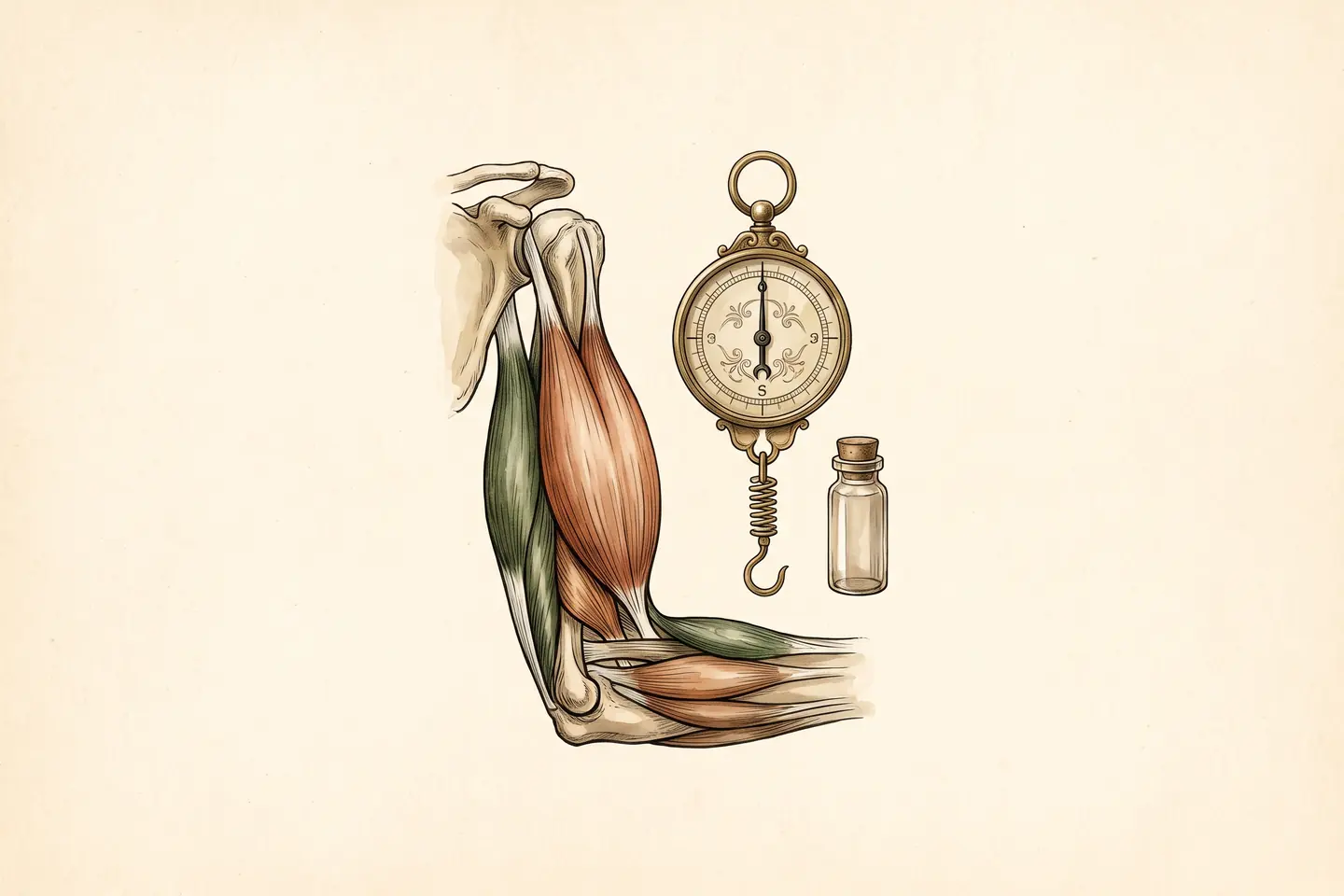
ACE-083 is a locally injected follistatin fusion protein, delivered directly into a single target muscle rather than systemically. The randomized Phase 2 trial describes ACE-083 as a "muscle-promoting agent" built on the general logic of follistatin biology: neutralizing myostatin and activin, growth factors that normally cap how much a muscle fiber can enlarge [4].
That mechanism is design rationale, not separately confirmed pharmacokinetics. What the trial confirms is the architecture built around it: intramuscular injection meant to grow one targeted muscle, the biceps brachii or the tibialis anterior, while avoiding the systemic exposure that has limited other myostatin-pathway drugs.
How was the ACE-083 FSHD trial designed?
The ACE-083 trial was a two-part Phase 2 study in adults with FSHD1 or FSHD2 [4]. Part 1 was open-label dose escalation in 37 participants, establishing safety, not efficacy.
Part 2 was the controlled portion. It randomized 58 participants to 240 mg per muscle or placebo, injected bilaterally every three weeks into the biceps brachii or tibialis anterior. Part 2 ran double-blind for six months, followed by six months open-label [4].
Did ACE-083 build real muscle in FSHD?
ACE-083 built real muscle on MRI: total muscle volume, the primary endpoint, rose 16.4% in the biceps brachii and 9.5% in the tibialis anterior versus placebo [4].
Those figures are least-squares mean differences versus placebo: 16.4% in the biceps group (90% CI 9.8-23.0, p<.0001) and 9.5% in the tibialis anterior group (90% CI 3.2-15.9, p=.01) [4]. On imaging, ACE-083 did what the mechanism predicts.
Contractile muscle volume, the imaging estimate of muscle tissue rather than intramuscular fat, also increased significantly, and fat fraction decreased in both groups [4]. By every imaging measure used, the growth was real muscle, not swelling.
Did ACE-083 improve strength or function?
No. ACE-083 produced no meaningful treatment effect on strength, patient-reported outcomes, or the muscle-matched functional tests [4].
The functional tests were six-minute walk distance, 10-meter walk/run, and four-stair climb for the leg group, and a validated upper-limb performance score for the arm group [4]. A drug that reliably added 9 to 16 percent more muscle volume, confirmed as contractile tissue, left walking speed, stair climbing, and arm function essentially where placebo left them.
Why did ACE-083's added muscle not make FSHD patients stronger?
FSHD muscle mixes surviving fibers with fibrofatty replacement tissue, and ACE-083's local blockade grows healthy and dysfunctional fibers alike, adding volume without necessarily adding usable force.
Some surviving fibers in FSHD muscle already have compromised innervation or excitation-contraction coupling. Local myostatin and activin blockade has no way to distinguish healthy contractile fiber from those already-dysfunctional fibers.
Does added muscle usually bring added strength?
In healthy or minimally impaired muscle, tissue added through resistance training generally does track with strength. Large training literatures in healthy adult men show consistent muscle mass gains from resistance training [1], and older adults with osteoarthritis gain both lean mass and cross-sectional area from strength training versus non-exercise controls [2].
Studies that isolate which fibers hypertrophy, such as selective hamstring growth from Nordic curls versus stiff-leg deadlifts, find strength gains accompanying that selective growth in untrained, non-pathological muscle [5]. Comparisons across different resistance-training protocols in healthy lifters find hypertrophy and strength moving together regardless of method [6]. ACE-083's dissociation is notable because it breaks that usual coupling, in muscle that was already structurally compromised before treatment.
The closer precedent for a size marker moving without functional payoff sits outside muscle disease, in sports nutrition. A meta-analysis of HMB supplementation in resistance-trained young adults found a significant increase in total body mass but no significant gain in fat-free mass or strength [3]. The tissue and mechanism differ, but the lesson is the same: a mass or volume number moving on its own is not evidence that the tissue behind it is functionally relevant. The same gap between mass and strength appears in growth hormone research.
Is MRI muscle volume a valid surrogate for strength in muscle disease?
MRI-measured muscle volume, however precisely quantified, is not automatically a valid surrogate for strength or function in dystrophic muscle, and the ACE-083 trial is one of the cleanest human demonstrations of that [4].
The FSHD trial establishes directly that, in a placebo-controlled human trial, follistatin-driven local muscle growth and functional improvement were measurably different things. Reporting the volume figure alone misrepresents what happened [4].
What happened to the ACE-083 program?
Public reporting indicates the developer discontinued the ACE-083 program. The decision is unverified, and the FSHD trial report does not document it.
A parallel program reportedly tested ACE-083 in Charcot-Marie-Tooth disease and showed a similar volume-without-function pattern. Its numbers are unconfirmed, and so is the reasoning behind the discontinuation.
What is still unknown about ACE-083?
Three questions remain open after the FSHD trial:
- Other regimens. Whether longer treatment, a different injected muscle, or combination with a training stimulus could have produced a functional signal is untested.
- Healthy muscle. Whether the same split applies to non-dystrophic, healthy muscle is unproven. The closest healthy-muscle evidence shows hypertrophy and strength usually moving together [1][2][5][6], which is why the ACE-083 result stands out rather than reflecting ordinary muscle physiology.
- Other molecules. Whether the size-function split generalizes to other myostatin- or activin-pathway molecules, including systemically delivered ones, is not established.
Sources
-
Benito PJ, Cupeiro R, Ramos-Campo DJ (2020). A Systematic Review with Meta-Analysis of the Effect of Resistance Training on Whole-Body Muscle Growth in Healthy Adult Males. Int J Environ Res Public Health. pubmed.ncbi.nlm.nih.gov/32079265
-
Liao CD, Chen HC, Kuo YC (2020). Effects of Muscle Strength Training on Muscle Mass Gain and Hypertrophy in Older Adults With Osteoarthritis: A Systematic Review and Meta-Analysis. Arthritis Care Res (Hoboken). pubmed.ncbi.nlm.nih.gov/31628720
-
Jakubowski JS, Nunes EA, Teixeira FJ (2020). Supplementation with the Leucine Metabolite β-hydroxy-β-methylbutyrate (HMB) does not Improve Resistance Exercise-Induced Changes in Body Composition or Strength in Young Subjects: A Systematic Review and Meta-Analysis. Nutrients. pubmed.ncbi.nlm.nih.gov/32456217
-
Statland JM, Campbell C, Desai U (2022). Randomized phase 2 study of ACE-083, a muscle-promoting agent, in facioscapulohumeral muscular dystrophy. Muscle Nerve. pubmed.ncbi.nlm.nih.gov/35428982
-
Morin T, Caillet AH, Nordez A (2025). Robustness of hamstring muscle activation strategies following selective hypertrophy induced by Nordic hamstring curl and stiff-leg deadlift exercises. J Appl Physiol (1985). pubmed.ncbi.nlm.nih.gov/40586278
-
Terada K, Kikuchi N, Burt D (2022). Low-Load Resistance Training to Volitional Failure Induces Muscle Hypertrophy Similar to Volume-Matched, Velocity Fatigue. J Strength Cond Res. pubmed.ncbi.nlm.nih.gov/35622108
Last updated

Written by
Chemist and biochemist. Co-founder and author, The Peptide App.
Jay is a chemist, biochemist and entrepreneur whose work connects scientific research with consumer health products. He has held Chief Science Officer and product development leadership roles and previously served as Chief Revenue Officer at Minicircle.
Keep reading
Compound evidence
ACE-031 grew muscle in women; nosebleeds halted its Duchenne trial
One dose of ACE-031 raised lean mass 3.3% in healthy postmenopausal women. Nosebleeds and dilated skin capillaries in boys halted its Duchenne trial.
Compound evidence
Growth hormone added lean mass in trials while strength stayed flat
Growth hormone added about 2.1 kg of lean mass in trials of healthy young adults, but strength stayed flat. Scans count the fluid it retains as lean mass.
Compound evidence
Follistatin-344 gene therapy built muscle in mice and macaques
Follistatin-344 gene therapy built muscle in animals and improved walking in two six-patient open-label trials. Injected FS-344 peptide has no human data.
Profiles and tools

The Peptide App
Track protocols, doses, and reconstitution in one place.
Save your calculations, set reminders, log doses, and keep outcome notes — free to start.
 or scan the QR code →