
ACE-031 grew muscle in women; nosebleeds halted its Duchenne trial
One dose of ACE-031 raised lean mass 3.3% in healthy postmenopausal women. Nosebleeds and dilated skin capillaries in boys halted its Duchenne trial.

By Jay Spall, chemist and biochemist
Disclosure: Jay is a co-founder of The Peptide App. This review discusses the studies cited below; it is not a comprehensive live trial registry or treatment recommendation. Development and regulatory status can change. The app’s tools organize records and arithmetic and do not validate a research product.
On this page
- What is ACE-031, and how does it work?
- Did ACE-031 build muscle in humans?
- Why was the ACE-031 Duchenne trial stopped?
- Why did ACE-031 cause nosebleeds and dilated capillaries?
- Do selective myostatin inhibitors cause the same bleeding?
- What happened to ACE-031 after the Duchenne trial?
- Is research-chemical ACE-031 the same drug tested in trials?
- What is still unknown about ACE-031?
- Sources
Key facts
| Question | Direct answer |
|---|---|
| What is ACE-031? | A decoy receptor. ACE-031 is a soluble extracellular fragment of activin receptor type IIB fused to an antibody Fc region, which mops up myostatin and several related ligands before they can signal [5]. |
| Did ACE-031 build muscle in humans? | Yes, in one setting. A single dose increased total lean mass by 3.3% and thigh muscle volume by 5.1% at 29 days in healthy postmenopausal women [5]. |
| Why did the ACE-031 Duchenne trial stop? | Safety, not efficacy. The trial was halted early after epistaxis (nosebleeds) and telangiectasias (dilated skin capillaries) appeared in boys receiving the drug [2]. |
| Was the bleeding a myostatin-inhibitor problem? | No. Myostatin-selective drugs tested elsewhere have not reproduced the pattern, and the signal tracks with ACE-031's lack of ligand selectivity at the receptor level, not with myostatin blockade itself [8]. |
| Do more selective myostatin drugs cause the same vascular effect? | Not as a trial-halting signal. The more selective antibodies and peptibodies (domagrozumab, AMG 745, apitegromab) have documented adverse-event profiles, and none reports epistaxis and telangiectasia as a reason to stop [3][4][6][7]. |
| Is vendor-sold "ACE-031 peptide" the molecule tested in trials? | Unverifiable. The clinical trials used a specific, formulated fusion protein under controlled dosing, and none tested unregulated research-chemical product [5][2]. |
8 sources cited. View sources
What is ACE-031, and how does it work?
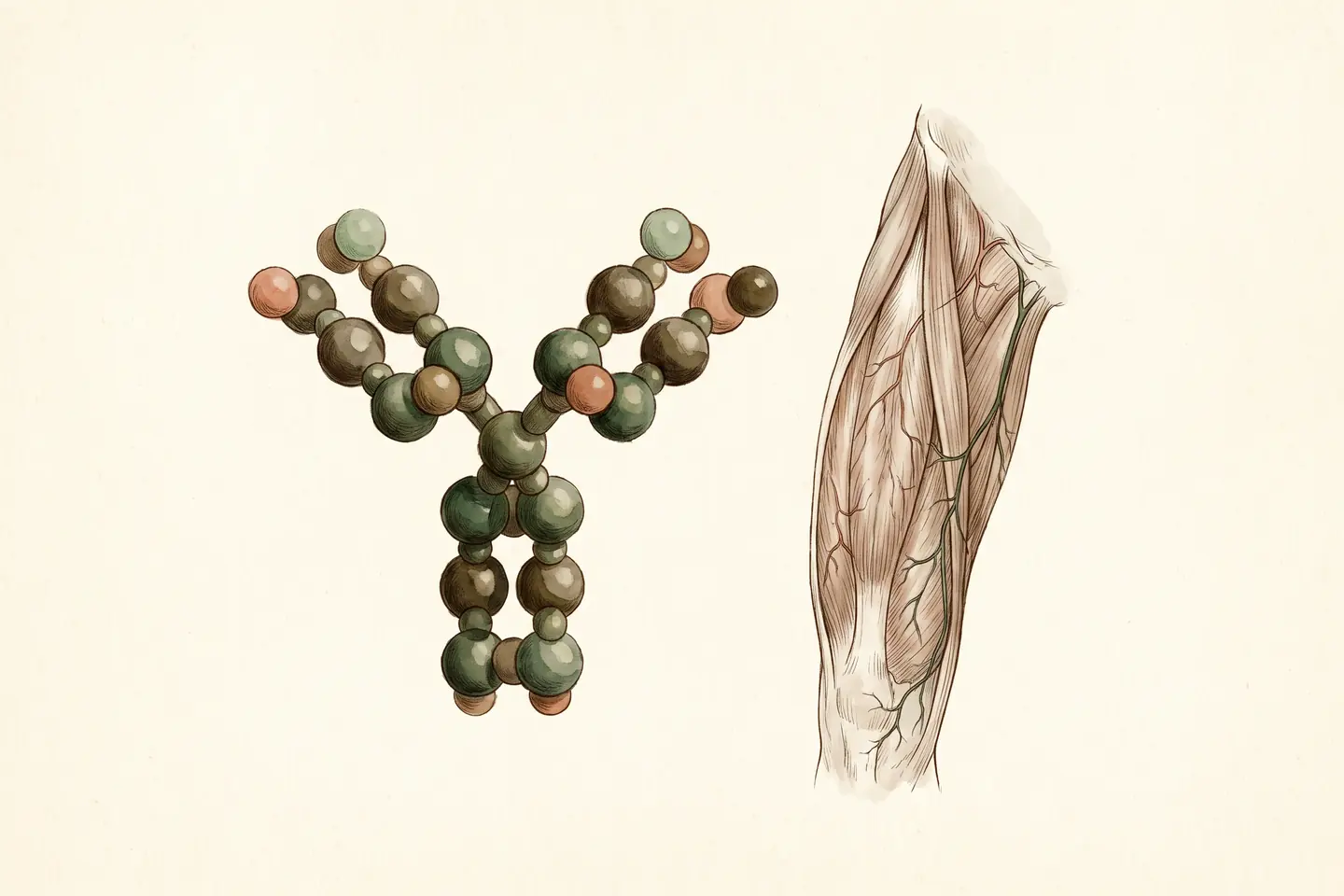
ACE-031 is a decoy receptor built from the extracellular ligand-binding domain of activin receptor type IIB (ActRIIB), the natural receptor myostatin uses to suppress muscle growth [5]. Fusing that domain to an antibody Fc region creates a stable, circulating trap. Any ligand that would normally dock onto ActRIIB on a cell surface can bind ACE-031 instead and get cleared without ever signaling.
ActRIIB was never myostatin's private receptor. It is a shared docking site for a cluster of TGF-beta superfamily ligands, including activin A and other growth and differentiation factors. A 2022 review of the myostatin/activin receptor drug class describes this shared-receptor architecture and links off-target interactions to the serious adverse events that have derailed several drugs in this space [8].
Blocking ActRIIB broadly, rather than blocking myostatin specifically, means blocking everything else that ligand pool does, including its roles outside skeletal muscle.
Did ACE-031 build muscle in humans?
Yes, in one narrow setting: a single dose of ACE-031 increased total lean mass by 3.3% and thigh muscle volume by 5.1% at 29 days in healthy postmenopausal women [5].
The healthy-volunteer study was randomized and placebo-controlled, the strongest design available. It enrolled 48 postmenopausal women and gave single ascending doses from 0.02 to 3 mg/kg. Gains in lean mass and thigh muscle volume were statistically significant at the top dose, with favorable trends in bone and fat biomarkers [5].
The result is a mechanistic proof-of-concept in humans. It is also one dose, 29 days of follow-up, and one narrow population. The study says nothing about repeated dosing, nothing about men, nothing about young or healthy adults training for hypertrophy, and nothing about efficacy for any condition. Muscle size and function are separate outcomes, as a drug that increased muscle volume without improving strength shows.
Why was the ACE-031 Duchenne trial stopped?
The ACE-031 Duchenne trial was halted early after epistaxis (nosebleeds) and telangiectasias (dilated skin capillaries) appeared in boys receiving the drug, a safety signal, not an efficacy failure [2].
The trial was a randomized, double-blind, placebo-controlled, ascending-dose study in ambulatory boys with Duchenne muscular dystrophy, with safety as the primary endpoint [2]. It stopped after the second dosing regimen. The authors classify epistaxis and telangiectasias as the driving safety concern, alongside other non-muscle adverse events that contributed to discontinuation.
The trial showed non-significant trends toward preserved lean mass, bone mineral density, and 6-minute walk distance versus placebo. A non-significant trend in a trial stopped early is not an efficacy finding. Anyone citing those lean-mass or walk-test numbers as evidence that ACE-031 works is citing a number the trial itself could not confirm.
Why did ACE-031 cause nosebleeds and dilated capillaries?
ACE-031's bleeding signal fits its design: the drug traps activin A along with myostatin, and activin A has documented roles in vascular biology beyond muscle. That makes the vascular effect predictable, not incidental.
The nosebleeds were not a random side effect layered on top of a muscle-building mechanism. ACE-031 does what a non-selective receptor decoy would be expected to do: it disrupts signaling in tissue compartments where the receptor also matters [8].
The 2022 drug-class review frames off-target receptor interactions as a recurring reason multiple myostatin/activin pathway candidates failed in clinical development, not a one-off event unique to a single molecule [8].
Do selective myostatin inhibitors cause the same bleeding?
None of the selective myostatin inhibitors tested in separate trials reports epistaxis and telangiectasia as a trial-halting signal. Those trials tested domagrozumab, an antibody, in limb-girdle muscular dystrophy [7]; AMG 745, a peptibody, in men on androgen deprivation therapy [6]; and apitegromab, an antibody that selectively inhibits myostatin activation, in spinal muscular atrophy across two trials [3][4]. Those drugs report adverse events such as injection-site reactions, falls, diarrhea, fatigue, and bruising.
The comparison separates two claims that get conflated constantly: "myostatin inhibition caused nosebleeds" and "a broad ActRIIB ligand trap caused nosebleeds." The trials support only the second. The gap is an absence of evidence rather than a study that compared selectivity head to head, and it is still informative.
What happened to ACE-031 after the Duchenne trial?
Development of ACE-031 did not continue past the Duchenne trial's early stop [2]. The field's later candidates moved toward narrower targets: antibodies engineered to bind myostatin itself or its activation step rather than the shared ActRIIB receptor.
Domagrozumab in limb-girdle disease is one example [7]. Apitegromab, which selectively inhibits myostatin activation, is now in phase 3 testing for spinal muscular atrophy [4]. A 2025 review of preclinical and clinical myostatin work in spinal muscular atrophy notes favorable safety signals for more targeted approaches, while large-scale efficacy remains unproven [1].
Selectivity has improved the safety picture while efficacy still lags. That pattern is consistent with ACE-031's problem being its receptor promiscuity, not the myostatin pathway itself.
Is research-chemical ACE-031 the same drug tested in trials?
Research-chemical ACE-031 cannot be verified as the trial molecule: no study has tested unregulated product, and the clinical trials used a specific, formulated fusion protein under controlled dosing [5][2].
No data cover unregulated ACE-031 products sold outside clinical channels. They have no verified identity, purity, or bioactivity testing, and there is no basis for treating them as equivalent to the studied compound. Dosing protocols circulating for such products trace to anecdote, not to any study. The ACE-031 evidence profile summarizes what was measured in the trials. How to read a peptide COA covers what vendor testing paperwork does and does not establish.
What is still unknown about ACE-031?
ACE-031 has no published chronic-dosing safety data in adults and no efficacy dataset showing it does anything functionally useful in any population.
- Functional benefit. Every positive number in the ACE-031 trials is a trend or a short-term biomarker change, not a demonstrated clinical benefit [5][2].
- Dose-response. The Duchenne trial stopped after the second dosing regimen, before a full dose-response relationship for the vascular signal could be characterized [2]. Whether higher exposure produced more bleeding, or whether the finding appeared at a threshold regardless of dose, is not established.
- Adult safety. The healthy-volunteer study tested only a single dose in postmenopausal women, so no chronic-dosing safety record in adults exists to compare against the pediatric signal [5].
- Population. Whether the vascular finding is specific to boys with Duchenne muscular dystrophy, a population with disease-related vascular and cardiac involvement already in play, or would appear in healthy adults on repeated dosing, is an open question the trials do not answer.
Any claim that settles the population question with confidence, in either direction, goes beyond the literature.
Sources
Last updated

Written by
Chemist and biochemist. Co-founder and author, The Peptide App.
Jay is a chemist, biochemist and entrepreneur whose work connects scientific research with consumer health products. He has held Chief Science Officer and product development leadership roles and previously served as Chief Revenue Officer at Minicircle.
Keep reading

Compound evidence
ACE-083 increased muscle volume in FSHD without improving strength
ACE-083 increased muscle volume 9.5% to 16.4% versus placebo in a Phase 2 FSHD trial. Strength and functional tests did not improve.

Compound evidence
MK-677 raised IGF-1 and lean mass, not strength, in a year-long trial
MK-677 raised IGF-1 about 40 to 94% in four studies. Strength did not improve, glucose tolerance worsened, and a heart-failure signal halted one trial.
Compound evidence
IGF-1 DES infusion lifted muscle protein synthesis 21% in rats
IGF-1 DES raised muscle protein synthesis 21% in nitrogen-restricted rats on infusion. No study has tested whether local injection builds new muscle fibers.
Profiles and tools

The Peptide App
Track protocols, doses, and reconstitution in one place.
Save your calculations, set reminders, log doses, and keep outcome notes — free to start.
 or scan the QR code →