
Thymogen shifted immune markers in lab work and small Russian trials
Thymogen shifted immune markers in lab studies and small Russian trials, and lowered tumor rates in one rat study. No independent blinded trial has tested it.

By Jay Spall, chemist and biochemist
Disclosure: Jay is a co-founder of The Peptide App. This review discusses the studies cited below; it is not a comprehensive live trial registry or treatment recommendation. Development and regulatory status can change. The app’s tools organize records and arithmetic and do not validate a research product.
On this page
- What is Thymogen?
- Where does Thymogen come from?
- What does Thymogen do to immune cells?
- What human trials of Thymogen exist?
- How strong is the evidence for Thymogen?
- Does Thymogen extend lifespan or prevent cancer?
- What doses and routes of Thymogen have been studied?
- Is Thymogen safe?
- What questions about Thymogen remain open?
- Sources
Key facts
| Question | Direct answer |
|---|---|
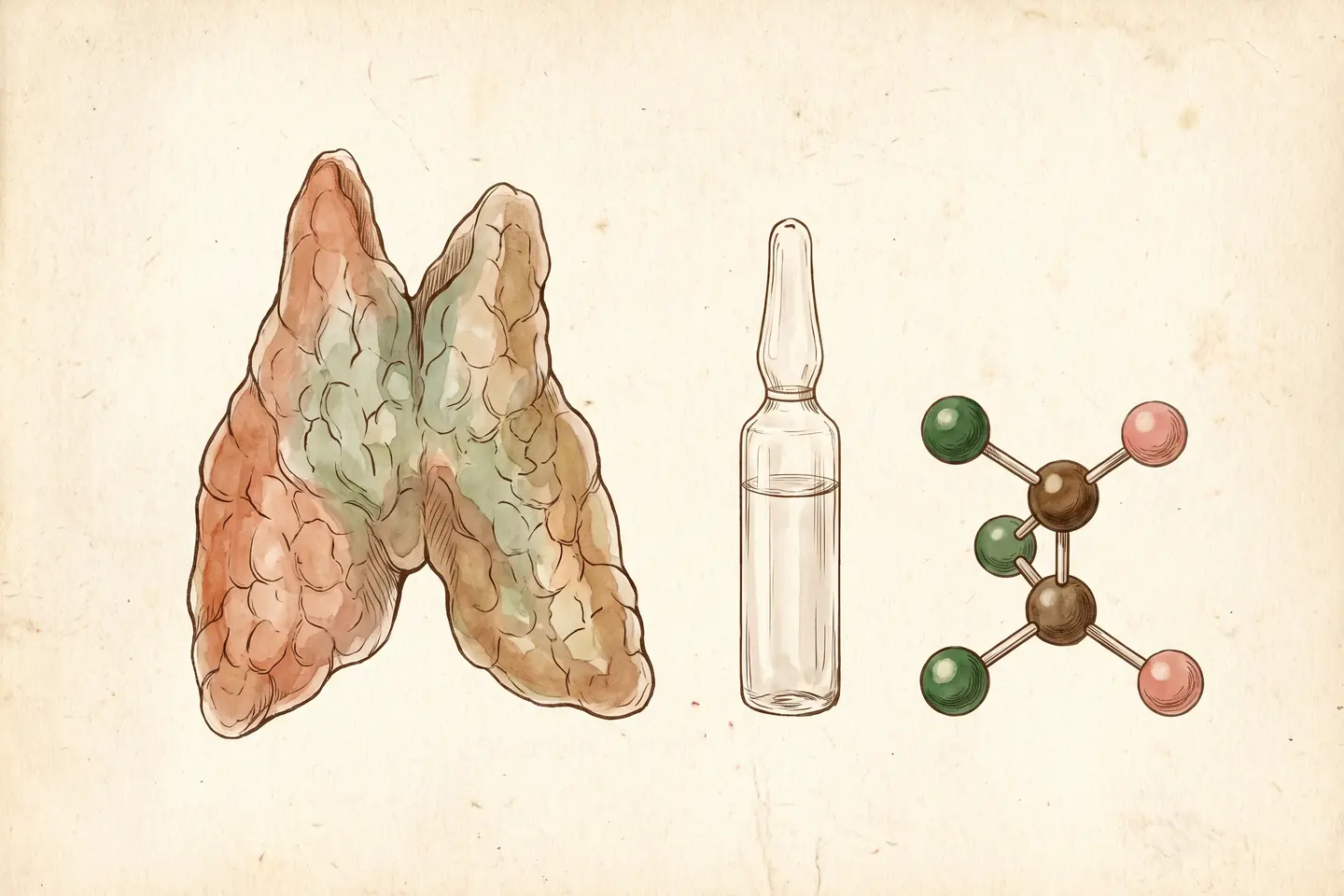
| What is Thymogen? | A synthetic two-amino-acid dipeptide, glutamyl-tryptophan (L-Glu-L-Trp), designed to replicate the active fragment of thymalin, a calf-thymus extract [1]. Thymogen is not thymalin and not Thymosin Alpha-1; the three share a research lineage, not a molecule. |
| Has Thymogen been tested in humans? | Yes, narrowly. The human data are small, mostly non-blinded, manufacturer-affiliated Russian trials using surrogate immune markers, plus one open-label military cohort study on respiratory infection [3]. No independent Western RCT exists [4]. |
| How does Thymogen work? | The proposed mechanism is activation of T-cell differentiation, modulation of cyclic nucleotide signaling, and induced cytokine (IL-2, IFN) release, largely from preclinical and in vitro work [1]. The gene-regulation theory behind short bioregulator peptides is coherent but not independently validated [4]. |
| Does Thymogen slow aging or prevent cancer? | In one rat study, long-term subcutaneous dosing reduced tumor incidence and modestly extended maximum lifespan [2]. The result has not been shown to translate to humans. |
| Is Thymogen safe? | Russian clinical use reports it as generally well tolerated, with local injection-site or nasal irritation as the main documented reaction. Independent, Western-standard safety data are minimal to absent. |
| Is Thymogen FDA approved or backed by international trials? | No. Thymogen has been registered for clinical use in Russia since 1990, a regulatory fact about one country's approval pathway, not a global validation stamp. |
4 sources cited. View sources
What is Thymogen?
Thymogen is the trade name for L-Glu-L-Trp, a synthetic dipeptide built to reproduce the biologically active fragment isolated from thymalin, a polypeptide extract of calf thymus tissue. That lineage is the whole basis for the "thymic peptide family" framing in vendor copy and forum threads. Thymalin, Thymogen, and Thymosin Alpha-1 all act on the immune system and all trace conceptually back to thymic biology, but they are structurally and evidentially separate compounds.
Thymalin is a multi-peptide extract with its own trial history, examined in the thymalin evidence review. Thymosin Alpha-1 is a distinct 28-amino-acid peptide with a substantially larger and more rigorously controlled international evidence base, laid out in Thymosin Alpha-1's evidence by indication. Thymogen is a two-amino-acid synthetic construct from one Russian research program. Its evidence stands or falls on its own, not on the reputation of its better-studied cousins.
Where does Thymogen come from?
Thymogen comes from the Khavinson-school "peptide bioregulator" research tradition at what is now the St. Petersburg Institute of Bioregulation and Gerontology. That program works from the premise that peptides only a few amino acids long act as gene expression regulators, not through classical receptor-ligand pharmacology.
A 2024 review pairs Thymogen with its mirror-image D-enantiomer, Thymodepressin. The review proposes that the two peptides produce opposite immune effects, stimulation versus suppression, through stereospecific interactions: the L-form and D-form of the same amino acid sequence behave differently in the body [4]. The stereospecificity finding is scientifically interesting and mechanistically plausible. By the review's own framing, it is not yet independently validated outside the originating research group [4].
What does Thymogen do to immune cells?
In preclinical models, Thymogen activates T-cell differentiation and induces blood lymphocytes to secrete IL-2 and interferon [1]. The foundational mechanistic paper also describes enhanced T-cell recognition of peptide-MHC complexes, modulation of intracellular cyclic nucleotide levels, and improved neutrophil chemotaxis and phagocytosis [1].
That profile is coherent and multi-pronged, and the paper is the correct citation for anyone asking whether Thymogen does anything to immune cells at all. It is mechanism-level, preclinical-model evidence that Thymogen has measurable biological activity on immune cell populations. It does not show that the activity produces a clinically meaningful outcome in a person with a specific condition, which is a different and much higher evidentiary bar.
What human trials of Thymogen exist?
Thymogen's human data consist of one 1993 open-label military trial in respiratory infection [3] and a body of small Russian trials that tracked surrogate immune markers [1][4].
The 1993 trial, run in a military training unit, tested intranasal and subcutaneous Timogen (the same synthetic Glu-Trp under a variant name) for the prevention and treatment of acute respiratory viral infections in an organized group. It reported reduced morbidity, severity, and illness duration [3]. Its design limits what that result can show: open-label, no blinding, no placebo control described, a single military cohort, and publication in a Russian military medical journal. The trial supports studying Thymogen properly; it does not meet the bar of a controlled clinical trial by international standards.
The rest of the clinical experience, described in the mechanism review and the 2024 stereochemistry review, follows the same pattern: small trials, surrogate immune markers (cytokine levels, cell counts, chemotaxis assays) instead of hard clinical endpoints, and a research base concentrated almost entirely within one institutional lineage [1][4]. The 2024 review states that no independent Western-standard randomized controlled trials exist for Thymogen or its enantiomer, despite three decades of registered clinical use in Russia [4].
How strong is the evidence for Thymogen?
Thymogen's evidence rates Grade D, limited: a plausible mechanism backed by narrow same-lab human data and no independent replication.
The grade combines three facts. The gene-regulation theory behind Thymogen is specific and coherent, if still speculative. The human trial data are weak to moderate, come from the same lab, and use surrogate endpoints rather than blinded outcome trials. No independent Western group has replicated the work.
Thymogen is not "clinically proven." Its Russian pharmaceutical registration, in place since 1990, reflects that country's regulatory pathway, not an FDA or EMA review. Thymogen is not "baseless pseudoscience" either: it has a testable mechanistic proposal and decades of documented, if narrow, clinical use.
Does Thymogen extend lifespan or prevent cancer?
Thymogen reduced tumor incidence and extended maximum lifespan in one study of female rats [2], and that result has not been shown to translate to humans.
In that study, long-term subcutaneous L-Glu-L-Trp at 5 mcg per rat, five days a week for 12 months, reduced total tumor incidence roughly 1.5-fold, malignant tumor incidence roughly 1.7-fold, and hematopoietic malignancies about 3.4-fold. It also extended maximum lifespan from 949 to 1048 days compared with untreated controls [2]. The finding is real and statistically significant in a rodent model, and it is one of the more striking data points in the Thymogen literature.
It is also a single preclinical rat study. The data do not support extrapolating that dosing pattern or those effect sizes to human cancer risk or lifespan. The study answers a question about female rats on a defined protocol, not about humans on any protocol.
What doses and routes of Thymogen have been studied?
Neither the 1993 military trial nor the rat lifespan study establishes a validated human dose of Thymogen. Routes described across the literature include intramuscular injection, intranasal spray, and topical application.
The military cohort trial used intranasal and subcutaneous administration for respiratory infection prophylaxis [3]. The rat carcinogenesis study used subcutaneous dosing at 5 mcg per animal on a five-day-per-week schedule [2]. None of the cited studies reports controlled human pharmacokinetics or a dose-response relationship in people. A human dose extrapolated from these figures is unsupported cross-species math, not an established clinical protocol.
Is Thymogen safe?
Russian clinical reports describe Thymogen as generally well tolerated, with mild local reactions as the main documented effect. The reported reactions are injection-site irritation with intramuscular use and transient nasal irritation with the spray. Independent, Western-standard safety data are minimal to absent.
Thymogen's proposed T-cell-activating mechanism [1] raises a theoretical caution about immune overstimulation in people with autoimmune conditions. That caution rests on plausibility, not data: none of the cited studies is a dedicated safety study in that population.
What questions about Thymogen remain open?
Thymogen's open questions start with efficacy, because no independent, blinded, placebo-controlled human trial has tested it.
- Hard outcomes. Cytokine shifts and chemotaxis improvements are surrogate markers. They are not demonstrated reductions in infection rates or improved clinical outcomes measured against placebo.
- Independent replication. Essentially the entire clinical evidence base originates from one research and manufacturing lineage. That does not invalidate the findings, but no one with an independent incentive structure has checked them.
- Long-term safety. No cited study documents long-term human safety outside routine Russian clinical use.
- The enantiomer mechanism. The stereospecific mechanism proposed for how Thymogen and Thymodepressin produce opposite effects remains unconfirmed by outside groups, by the reviewing authors' own account [4].
Anyone weighing Thymogen against thymalin or Thymosin Alpha-1 should treat each compound's evidence base as its own file, not a shared folder.
Sources
Last updated

Written by
Chemist and biochemist. Co-founder and author, The Peptide App.
Jay is a chemist, biochemist and entrepreneur whose work connects scientific research with consumer health products. He has held Chief Science Officer and product development leadership roles and previously served as Chief Revenue Officer at Minicircle.
Keep reading
Compound evidence
One 266-person elderly trial linked Thymalin to halved mortality
Thymalin was linked to 2-fold lower all-cause mortality over 6 to 8 years in a 266-person elderly trial. One Russian group ran it; no one has replicated it.
Compound evidence
Thymosin Alpha-1 beat interferon in hepatitis B; sepsis data are mixed
Thymosin Alpha-1 beat interferon-alpha on virologic response in a 4-trial hepatitis B meta-analysis. Its largest sepsis trial found no 28-day mortality benefit.
Compound evidence
hCG alone normalized testosterone in hypogonadotropic men
hCG alone normalized testosterone in hypogonadotropic men across four trials, and sperm production began once FSH was added. TRT use is extrapolated.
Profiles and tools

The Peptide App
Track protocols, doses, and reconstitution in one place.
Save your calculations, set reminders, log doses, and keep outcome notes — free to start.
 or scan the QR code →