
New to peptides? Start here.
Peptides for beginners: how to start your research.
Start with the exact compound and product. Check its category, strongest matching human evidence, and lot-specific documents. Use a calculator only after the inputs are confirmed, and take any remaining questions to a licensed clinician or pharmacist.
Follow a specific example
Just heard about one?
Choose the name you know. The next page explains the claim, product category, and evidence in the context of that peptide.
I do not have a name yetChoose your starting point
What brought you here?
Get the noun right
What is a peptide?
A peptide is a short chain of amino acids connected by peptide bonds. The National Human Genome Research Institute describes peptides as typically containing 2–50 amino acids; longer chains are generally called proteins, though boundaries can vary by scientific and regulatory context. Read the NHGRI definition
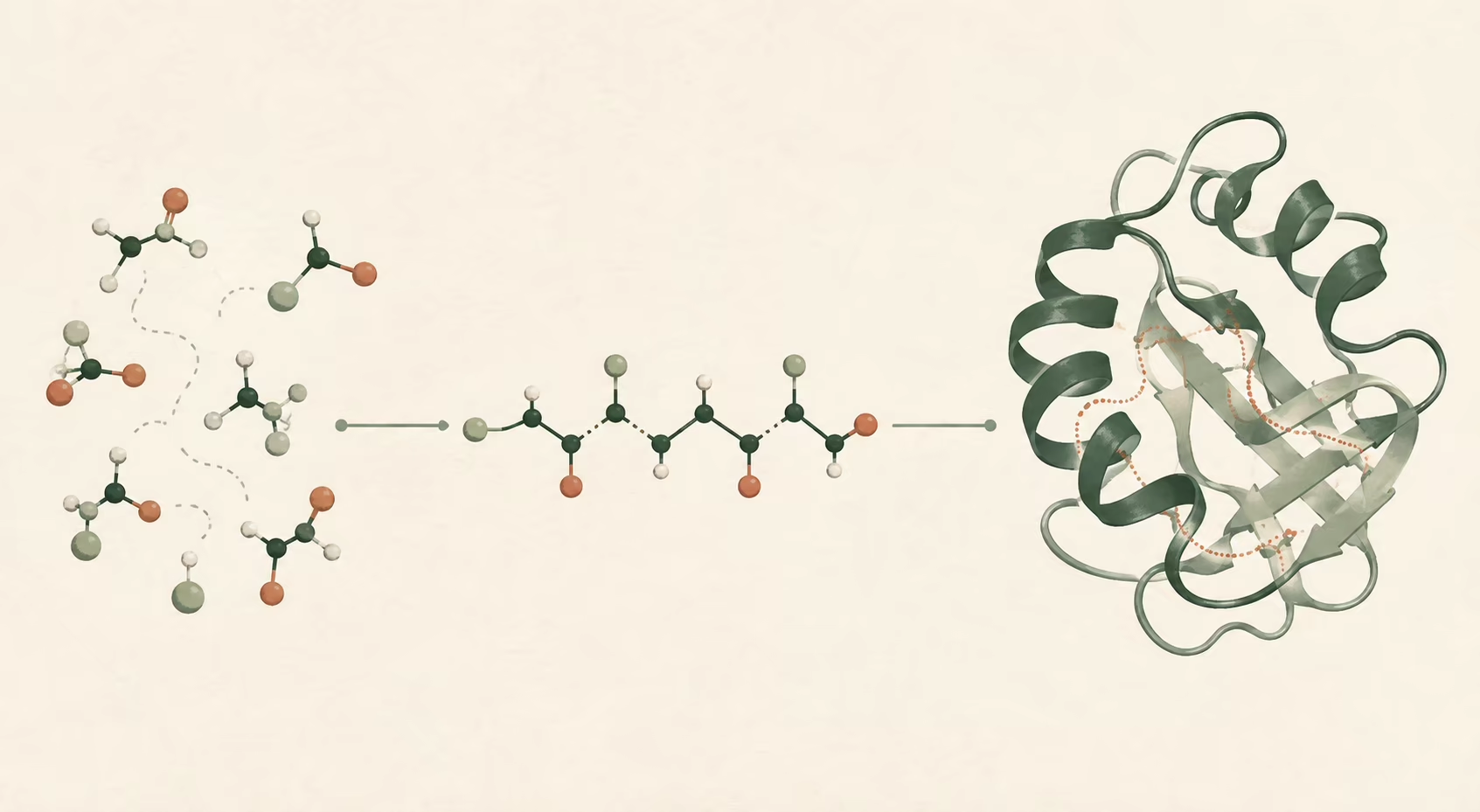
Amino acid
One building block in the chain.
Peptide
A shorter chain with a specific sequence.
Protein
A larger folded chain or set of chains.
Sequence matters. Two molecules can both be called peptides and still have very different functions, evidence, manufacturing requirements, and risks. That is why “Are peptides safe?” is too broad to answer without naming the exact compound and product.
You may encounter naturally occurring signaling peptides, approved medicines, compounded preparations, cosmetic ingredients, dietary protein fragments, and research reagents. The category comes first because it determines which label, regulator, evidence, and questions apply.
Name the lane
Do not treat every peptide like the same product
Before searching for benefits or side effects, establish what is actually in front of you. Similar compound names do not make products interchangeable.
Approved prescription product
Approval applies to a specific product, formulation, manufacturer, and use. Start with the official prescribing information and clinician guidance.
How FDA approval worksCompounded preparation
Compounded drugs may serve a patient-specific need, but FDA does not approve them or review them before marketing for safety, effectiveness, or quality.
FDA on compounded-drug risksResearch-use product
A “research use only” label is not a human-use instruction. Marketing an unapproved drug for people bypasses FDA review of safety, effectiveness, manufacturing, and labeling.
FDA on unapproved drugsDietary or cosmetic product
Collagen peptides and peptide-containing cosmetics sit in different product categories from medicines. Evaluate the exact product and the claim being made, not the shared word on the label.
Explore the peptide libraryCatalog lookalikes can include non-peptides. A vial format or vendor category does not determine chemistry. 5-Amino-1MQ, SLU-PP-332, and MK-677 (ibutamoren) are small molecules, while NAD+ and NMN are not amino-acid chains. Check the exact compound rather than assuming everything listed beside a peptide is one.
Peptides are not steroids. They are different chemical families. Legality is a separate, product-specific question that depends on the compound, how it is sold, the intended use, and the rules that apply in your location or sport.
Competitive athlete?
Check the current World Anti-Doping Agency Prohibited List and your sport’s rules before relying on a product label or seller claim.
Follow the evidence
Start by naming the study type
“Research-backed” can mean anything from a cell experiment to multiple human trials. Match the evidence to the exact compound, formulation, route, population, outcome, and intended use before drawing a conclusion.
Product-specific regulatory record
Official label, approved use, manufacturer, and known warnings.
Randomized controlled human studies
Most useful when the studied product, people, outcome, and use match the claim.
Other human evidence
Observational studies and case reports can signal patterns but carry more uncertainty.
Animal or cell research
Helpful for mechanisms and hypotheses; it does not establish a human outcome.
Anecdote or marketing claim
Useful as a question to investigate. It cannot prove cause, benefit, safety, or product quality.
The ladder is a reading order, not an automatic verdict. A small early trial may be appropriate for an emerging question; it simply cannot carry the same certainty as a well-matched body of replicated human evidence. Watch for absolute language, surrogate outcomes, tiny samples, missing control groups, and claims that jump from a related molecule to the product being sold.
Inspect the record
Know exactly what a COA can establish
Product documentation should be read as a chain of specific claims. A result is useful only if you know what sample was tested, which lot it represents, when it was tested, who performed the test, and what the method can actually establish.

Document match
Can this record be tied to this product?
- Compound and product name
- Lot or batch identifier
- Test date and named laboratory
- Method and reported result
Scope check
What does the record not establish?
- Clinical effectiveness for a person
- Safety, sterility, or handling unless tested
- Authenticity of every vial or future lot
- Regulatory approval or prescribing guidance
It helps locate indexed public documents and compare identifying fields. A matched document is not an endorsement of the vendor, product, laboratory, or suitability for human use.
Search testing recordsRespect the math boundary
A calculator checks inputs. It does not invent them.
Unit conversion can prevent arithmetic mistakes, but a polished result is still wrong when the starting information is wrong. Enter only values confirmed by the label, written instructions, prescriber, or dispensing pharmacy.
Four terms to keep separate
- mg
- milligram · a measure of mass
- mcg
- microgram · one-thousandth of a milligram
- mL
- milliliter · a measure of liquid volume
- units
- a device scale that must be tied to a known volume
Stop before calculating if…
- The product or vial amount is uncertain.
- The intended dose is not written clearly.
- The liquid type or volume has not been specified.
- The device scale is unfamiliar or does not match.
Ask the prescriber or dispensing pharmacy to clarify. Do not fill a missing instruction with a common online example.
Use the right tool at the right step
Your peptide research toolkit
Each tool answers a different question. Using the boundary line on every card keeps a lookup, comparison, record, or calculation from turning into advice it was not designed to give.
Peptide library
Identify the compound, common names, research context, and the questions worth investigating next.
A research index, not a personal recommendation.Open toolCompare profiles
Put structured profiles side by side so differences are visible before you read broader claims.
Comparison does not select a product for you.Open toolEvidence Atlas
Find indexed public testing documents and check whether a document matches the product and lot in front of you.
A document match is not a quality or safety grade.Open toolPricing explorer
Review public listing data after you understand the exact product being compared.
Price is not evidence of quality, legitimacy, or safety.Open toolPeptide calculator
Check unit and concentration arithmetic using inputs already supplied by a label, prescriber, or pharmacy.
It does not choose a dose, diluent, or schedule.Open toolProtocol tracker
Organize written instructions, reminders, notes, and questions so the record stays consistent over time.
It records a plan; it does not create treatment advice.Open toolBring better questions
What to ask a clinician or pharmacist
A useful appointment starts with specifics. Bring the exact product name, label, written instructions, medication list, relevant health history, and the claim you are trying to evaluate.
- 01What is the regulatory status of this exact product and intended use?
- 02What human evidence supports this use, and how closely does it match me?
- 03What contraindications, interactions, or monitoring requirements apply?
- 04What exact formulation, concentration, route, storage, and instructions apply?
- 05Which effects or symptoms should prompt a call, urgent evaluation, or stopping?
- 06How will we decide whether the plan is helping, causing harm, or needs review?
Turn instructions into a reliable record
Once a qualified professional has given you a plan, record the exact instructions, reminders, questions, and observations without changing the plan yourself.
Organize written instructionsAvoid the predictable traps
Seven beginner mistakes to skip
Treating every peptide as one risk category
Using animal or cell research as proof of a human outcome
Reading a purity result as a complete safety assessment
Trusting a seller summary without opening the underlying source
Copying a dose, mixture, or schedule from a forum
Mixing up mass, volume, concentration, and device units
Starting with a multi-product stack that obscures cause and effect
Quick answers
Peptide beginner FAQ
What are peptides?
Peptides are short chains of amino acids joined by peptide bonds. The category is broad: naturally occurring signaling molecules, prescription medicines, cosmetic ingredients, dietary protein fragments, compounded preparations, and laboratory reagents may all be described as peptides, but they should not be evaluated as if they are the same product.
Are peptides safe for beginners?
There is no category-wide yes or no. Risk depends on the exact compound, product, route, intended use, evidence, quality controls, health history, and other medicines. A beginner label does not make a product appropriate or safe. Product-specific questions belong with a licensed clinician or pharmacist.
How do I start with peptides if I am completely new?
Start by naming the exact compound and product. Check its regulatory category, find the strongest human evidence for the intended use, match any testing records to the current lot, and write down questions for a licensed clinician or pharmacist. Do not begin with a generic stack or copy dosing and preparation instructions from a forum.
What is the best peptide for beginners?
There is no responsible universal pick. The right first step is to define the goal, identify the exact product and regulatory status, review human evidence for that use, and discuss personal risks with a qualified professional. This guide helps with that evaluation; it does not rank products for personal use.
Are peptides FDA approved?
Some specific peptide-based prescription products are FDA approved for specific uses. The word peptide itself is not an approval status. Approval applies to a particular drug product, formulation, manufacturer, and indication. Products that share a compound name do not inherit that approval.
Are compounded peptides FDA approved?
No. FDA states that compounded drugs are not FDA approved and are not reviewed before marketing for safety, effectiveness, or quality. Compounding can serve a patient-specific need when an FDA-approved product cannot, but that is a clinical decision with its own requirements and risks.
What can a peptide COA prove?
A certificate of analysis can report results for a particular sample or lot, such as identity, purity, or content, depending on the methods used. It does not by itself establish clinical effectiveness, sterility, correct handling, authenticity of every vial, or safety for a person. Always check the lot, date, lab, methods, and scope of the document.
When should a beginner use a peptide calculator?
Use a calculator only after the exact amount, concentration or vial content, liquid volume, and device units are known from a label or written instructions. A calculator can check arithmetic; it cannot choose a dose, diluent, schedule, or treatment. If an input is unclear, stop and ask the prescriber or dispensing pharmacy.
Should a beginner start with a peptide stack?
A generic stack recommendation is not a responsible starting point. Combining products adds variables, makes effects and adverse events harder to attribute, and can increase interaction risk. Learn how to evaluate one exact product and one evidence question before considering combinations with a clinician.
Primary sources
Where this guide starts
We use primary government and scientific sources for definitions, regulatory distinctions, and anti-doping rules. Product-specific decisions require the current label and guidance from a qualified professional.
- What is a peptide?National Human Genome Research Institute
- Understanding the risks of compounded drugsU.S. Food and Drug Administration
- Compounding and FDA: questions and answersU.S. Food and Drug Administration
- Is it really FDA approved?U.S. Food and Drug Administration
- Unapproved drugsU.S. Food and Drug Administration
- The prohibited listWorld Anti-Doping Agency
Published July 12, 2026 · Substantially updated and source-checked September 4, 2026 by The Peptide App editorial team.
Your next responsible step
Look up the exact compound first.
Look up the exact compound, note its category and evidence, then write down what you still need to verify. Take those questions to a licensed clinician or pharmacist before making a product decision.
Additional research context by Jay Spall
Further evidence and practical limits
Key facts
| What you're actually asking | Straight answer |
|---|---|
| Is "peptide" a real chemistry term or just a store category? | A peptide has a specific chemical definition: a short chain of amino acids joined by peptide (amide) bonds. Many products sold under that label do not meet it. |
| Is 5-Amino-1MQ a peptide? | No. It is a small-molecule inhibitor of the enzyme NNMT, structurally nothing like an amino acid chain [5]. |
| Is SLU-PP-332 a peptide? | No. It is a small-molecule agonist of the ERR receptor family, studied so far only in mouse models; there is no human data to cite. |
| Is MK-677 (ibutamoren) a peptide? | No. It is a non-peptide, orally active compound that stimulates growth hormone release through a different route than peptide secretagogues. |
| Why does the distinction matter if I'm just deciding whether to care? | It predicts whether a compound survives digestion, how it's dosed, and how much human evidence exists, three things that "research peptide" marketing pages don't sort out. |
| Does calling something a peptide tell me anything about safety or evidence quality? | No. It only describes a shape. The evidence quality has to be checked compound by compound. |
7 sources cited. View sources
What a peptide actually is
Chemically, a peptide is boring in the best way: a short string of amino acids connected end to end by amide bonds, the same bond that holds proteins together, just fewer links. That's the whole definition. It says nothing about what the molecule does, how strong the evidence for it is, or how it's sold. "Peptide" as used on supplement and clinic websites has drifted into something else: a catalog category for anything marketed as an experimental biohacking compound, regardless of its actual backbone. Small-molecule NNMT inhibitors, which are compact organic molecules rather than amino acid chains, get filed in that same category [5], and that's where the trouble starts.
Three names, two different chemistries
5-Amino-1MQ inhibits nicotinamide N-methyltransferase (NNMT), the enzyme that methylates nicotinamide using SAM as the methyl donor, producing methylnicotinamide and consuming methyl groups needed elsewhere in the cell [1] [3]. That mechanism, not an amino acid sequence, is what the compound targets. Reviews of this inhibitor class describe them as small, drug-like organic molecules built to fit the enzyme's active site, with ongoing medicinal-chemistry work to improve their binding affinity and pharmacokinetics [5]. Nothing about that description involves peptide bonds.
SLU-PP-332 is a pan-agonist of the estrogen-related receptors (ERRα, β, γ), studied in mouse models as an exercise-mimetic tool compound. This falls outside the source list available here, so it has to be stated plainly and without a citation: it is a small molecule, and to date it has not been tested in humans. Any claim you see about human effects of SLU-PP-332 is not currently traceable to a clinical study.
MK-677 (ibutamoren) is likewise outside the cited source list here, so the same honesty applies: it is described in the pharmacology literature as a non-peptide, orally active compound that stimulates growth hormone release through a mechanism distinct from peptide secretagogues like ipamorelin. That structural distinction is well established in the field, but no citation for it appears in the source list this article is restricted to, so it's flagged rather than footnoted.
The pattern across all three: two are unambiguously small molecules, one of those has essentially no human data, and none of them are amino acid chains, despite sitting in the same online "peptide" listing as compounds that genuinely are.
What the evidence actually shows, and at what grade
For the NNMT-inhibitor class that 5-Amino-1MQ belongs to, the evidence base is broad but almost entirely preclinical. Across reviews covering NNMT's role in cancer metabolism [1] [7], cardiovascular disease [2] [3], obesity and type 2 diabetes [2], fatty liver disease [4], and neurodegenerative conditions [6], the recurring finding is the same enzyme mechanism (NAD+ depletion via SAM consumption) studied in cell culture and animal models, not confirmed treatment outcomes in people. One of the strongest statements available in this literature comes from a 2026 review of NNMT inhibitor drug development, which notes that despite compounds with high target affinity now existing, "insufficient target engagement, reduced bioavailability, and unknown safety profiles have led to limited preclinical success across diseases," and that clinical translation is only now becoming an "emerging opportunity" rather than an established fact [5]. A representative example of how far this evidence sits from humans: one 2025 study combining an NNMT inhibitor with an existing cancer drug demonstrated its effect in mouse xenograft models of lung cancer resistance, not in patients [7].
That is a genuinely useful mechanism under active study. It is also, honestly, nowhere near a body of human trial evidence, and nothing here supports treatment claims for any disease in people. The gap between "enzyme target under preclinical investigation" and "proven human intervention" is exactly the gap that generic peptide-shop marketing tends to erase.
Why the delivery method is the tell, not a footnote
Peptides are generally broken down by stomach acid and gut peptidases before they can be absorbed intact, which is the practical reason peptide-based research compounds are almost always injected rather than swallowed. Small molecules don't have that structural liability by default, but they aren't automatically well absorbed either: the same 2026 review flags "reduced bioavailability" as a persistent obstacle even for small-molecule NNMT inhibitors specifically engineered for oral use [5]. In other words, being a small molecule removes one failure mode (digestive destruction of a peptide backbone) but doesn't guarantee good oral pharmacokinetics on its own; that still has to be tested compound by compound. This is the concrete, checkable version of the abstract chemistry lesson: if a product is sold as a capsule and claims to be a peptide, that alone is worth a second look, because most true peptides don't survive that route.
What's genuinely unknown
The sources available here establish NNMT biology and inhibitor development reasonably well at the mechanism and animal-model level [1] [2] [3] [4] [5] [6] [7], but none of them report human trial data for 5-Amino-1MQ by name, human safety data at any specific dose, or long-term outcomes. For SLU-PP-332, the honest answer is that no human data exists in the literature this article draws on; it remains a mouse-model research tool. For MK-677's specific pharmacology, the claims commonly repeated online (oral activity, receptor mechanism, long-term trial data) fall outside this source list entirely and should be treated as unsourced until checked against the primary literature directly, not against a supplement site's citation of it.
Sources

The Peptide App
Track protocols, doses, and reconstitution in one place.
Save your calculations, set reminders, log doses, and keep outcome notes — free to start.
 or scan the QR code →
Educational use only. This guide does not provide medical advice, diagnosis, dosing, preparation, or treatment recommendations. Consult a licensed healthcare professional for decisions about a specific product or health condition.