
Reconstitution / May 28, 2026
Do Peptides Always Need BAC Water? A Reconstitution Checklist
Peptides do not always need BAC water. The answer depends on the exact product form and label: some products arrive as dry powder that must be reconstituted with the correct diluent before use, while some compounded products arrive already mixed or in a ready-to-use device. Do not guess from a Reddit comment or reuse someone else's math. Read the label, follow the prescriber or pharmacy instructions, and record the setup before any dose is scheduled.
Educational, not medical advice. The Peptide App can help organize the record, but it does not decide whether a product is appropriate, sterile, correctly prepared, or safe for you.
Short Answer
Start with the product form, not the forum answer.
A recent Reddit question asked whether peptides always need BAC water, with the poster looking for something that came ready to use. That is a common point of confusion because people use the word "peptides" for several different formats: lyophilized powder, compounded liquid vials, branded pens, blends, and research-labeled products with very different instructions.
BAC water usually refers to bacteriostatic water for injection, which includes benzyl alcohol as a preservative. The public product labels on DailyMed describe it as a sterile preparation with a bacteriostatic preservative, while CDC injection-safety guidance treats vial handling, single-dose containers, and multi-dose containers as separate safety questions. The practical takeaway: the label and clinician/pharmacy instructions matter more than the generic phrase "add BAC water." For more on what bacteriostatic water is and how long it lasts, see the bacteriostatic water guide. If you are comparing bacteriostatic water to bacteriostatic sodium chloride (saline), see our BAC water vs bacteriostatic sodium chloride guide.
If you are comparing product formats, pair this with our peptide protocol tracking guide. If travel is involved, read the peptide travel planning guidebefore you make the first week harder than it needs to be.
Record the vial before the routine starts
Save the product form, reconstitution math, target dose, and dose schedule in one workflow instead of rebuilding it from memory.
The Checklist
Five things to capture before you log a dose.
1. Product form
Is it a dry powder, a pre-mixed vial, a branded pen, or a compounded ready-to-use product? Write the form exactly as it appears on the label.2. Label instructions
Record the stated concentration, storage instructions, beyond-use date, single-dose or multi-dose language, and any pharmacy or prescriber instructions. If those conflict with internet advice, pause and ask the prescriber or pharmacy. Use the peptide refrigerator and room-temperature guide to compare current branded-label rules. A compounded or research-labeled vial needs its own instructions.3. Reconstitution event
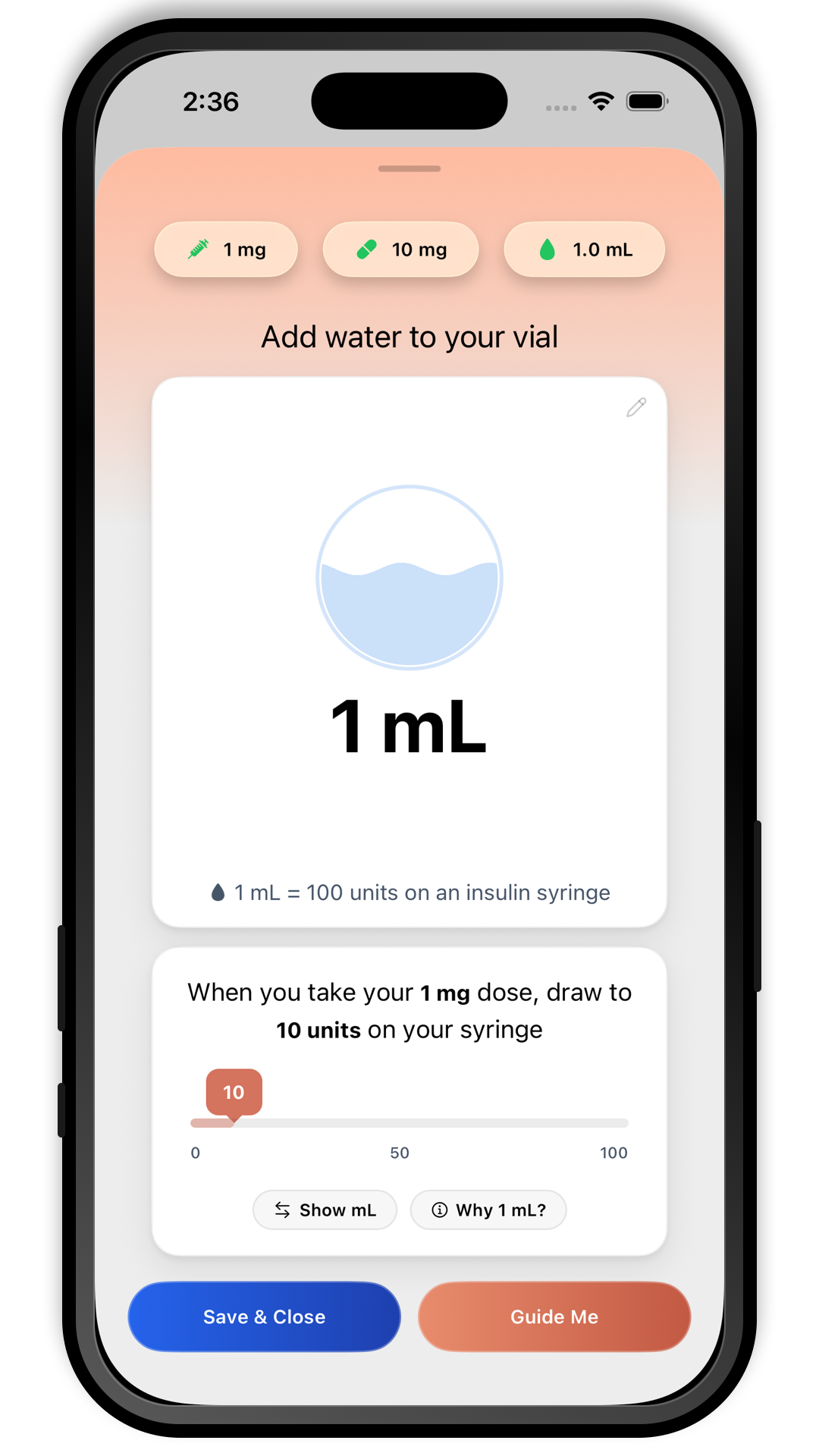
If the product is meant to be reconstituted, record the date, vial size, diluent volume, and resulting concentration. This is a recordkeeping step, not a substitute for sterile technique training.4. Dose math
Save the target dose and resulting syringe units every time the vial size, water volume, or dose changes. Most confusion starts when milligrams, micrograms, milliliters, and syringe units get mixed together.5. Open questions
Keep a short list for the clinician or pharmacy: which diluent, storage after mixing, discard date, missed-dose handling, and what to do if the vial, label, or solution looks wrong.

Safety Boundary
The app can organize the record. It cannot validate the vial.
The Peptide App is useful when the problem is workflow: what did you buy, what does the label say, when was it mixed, what dose was planned, and what happened afterward? That is the part people often lose across screenshots, calculator tabs, notes, and comment threads.
The app is not the authority on whether a product is legitimate, sterile, clinically appropriate, or safe for your health history. If you do not know whether the product needs reconstitution, what diluent to use, or whether a ready-to-use claim makes sense, treat that as a pharmacy or clinician question before it becomes a dose log.
For injection-safety context, CDC guidance emphasizes using sterile equipment and preventing contamination of medication containers. DailyMed product labels for bacteriostatic water also distinguish the preservative-containing product from plain water. Those details are exactly why a label-first record beats a memory-first routine.
App Workflow
How to make the first dose less chaotic.
Create the protocol first, even if the first dose is not today. Add the compound name, form, planned start date, dose schedule, and what you still need to verify. Then save the reconstitution calculation only after the label and instructions are clear.
When the protocol starts, log each dose with the time, amount, and notes. If something changes - a new vial, different water volume, delayed dose, travel day, or symptom note - update the record. The goal is not to make peptide decisions feel casual. It is to make the operational trail clear enough that you and your clinician can see what actually happened.

The Peptide App
Track protocols, doses, and reconstitution in one place.
Save your calculations, set reminders, log doses, and keep outcome notes — free to start.
 or scan the QR code →
Sources used for safety context