
Pancragen lowered glucose in diabetic rats and aged monkeys
Pancragen lowered glucose in diabetic rats and aged monkeys, and glucose improved in a 33-patient open-label pilot. All five papers come from one Russian group.

By Jay Spall, chemist and biochemist
Disclosure: Jay is a co-founder of The Peptide App. This review discusses the studies cited below; it is not a comprehensive live trial registry or treatment recommendation. Development and regulatory status can change. The app’s tools organize records and arithmetic and do not validate a research product.
On this page
- What is Pancragen?
- Has any lab outside Khavinson's program studied Pancragen?
- How is Pancragen supposed to work?
- What does the Pancragen animal data show?
- What did the one human Pancragen study find?
- Is there a human dose for Pancragen?
- What do forum claims about Pancragen get wrong?
- What is still unknown about Pancragen?
- Sources
Key facts
| Question | Direct answer |
|---|---|
| Is Pancragen a real compound or a marketing name? | A real name in the peer-reviewed literature. Five papers from one Russian research group describe a tetrapeptide (Lys-Glu-Asp-Trp) under that name [1][2][3][4][5]. No lab outside that group has published independent data on it. |
| Has Pancragen been tested in humans? | Once. An open-label pilot in 33 elderly patients with type 2 diabetes, with no randomization, no placebo and no blinding [2]. That is the entire human evidence base. |
| Does Pancragen lower blood glucose? | In streptozotocin-diabetic rats and aged rhesus monkeys, yes [1][4][5]. In the human pilot, fasting glucose, glucose tolerance and an insulin resistance index all improved [2]. None of that is controlled human evidence. |
| Is Pancragen's mechanism confirmed? | No. Human pancreatic cell cultures showed increased expression of pancreatic differentiation transcription factors, a plausible mechanistic signal rather than proof of a comparable effect in a living, dosed human [3]. |
| Are the subcutaneous doses on forums legitimate? | No. None of the five published papers specifies a human subcutaneous dosing protocol. The circulating numbers do not trace to those papers and appear borrowed from unrelated peptides. |
| What is Pancragen's evidence grade, and why? | E, minimal. The animal and cell data are internally consistent, everything traces to a single research program, nothing has been independently replicated, and the one human study fails basic trial design standards. |
5 sources cited. View sources
What is Pancragen?
Pancragen is a tetrapeptide, Lys-Glu-Asp-Trp (KEDW), studied across five published papers between 2007 and 2015, all from Vladimir Khavinson's research program at the St. Petersburg Institute of Bioregulation and Gerontology [1][2][3][4][5]. The name points to a checkable compound with real PMIDs behind it.
Pancragen belongs to the Khavinson bioregulator family: short synthetic peptides theorized to act as tissue-specific gene-expression modulators, distinct from receptor-ligand peptides such as growth-hormone secretagogues. Why tripeptide gene claims overstate the evidence examines that theory directly.
Has any lab outside Khavinson's program studied Pancragen?
No. Every one of the five papers comes from the same lab or its direct collaborators. No independent group, in Russia or elsewhere, has replicated the findings, characterized the peptide's pharmacokinetics or confirmed its identity outside that program's own publications.
That matters more than it sounds. A compound's evidentiary floor is not that someone published something; it is that more than one lab, working independently, found the same thing. Pancragen has never cleared that bar. Calling it a next-generation peptide with an established pharmacological profile overstates what a single-lab, single-country publication line establishes. Other peptides in the same family carry the same limitation, including Ovagen and Epitalon.
How is Pancragen supposed to work?
The proposed model is that these tetrapeptides influence chromatin activity or transcription factor expression in a way biased toward the tissue their sequence was derived from or tested in, which for Pancragen is pancreatic tissue.
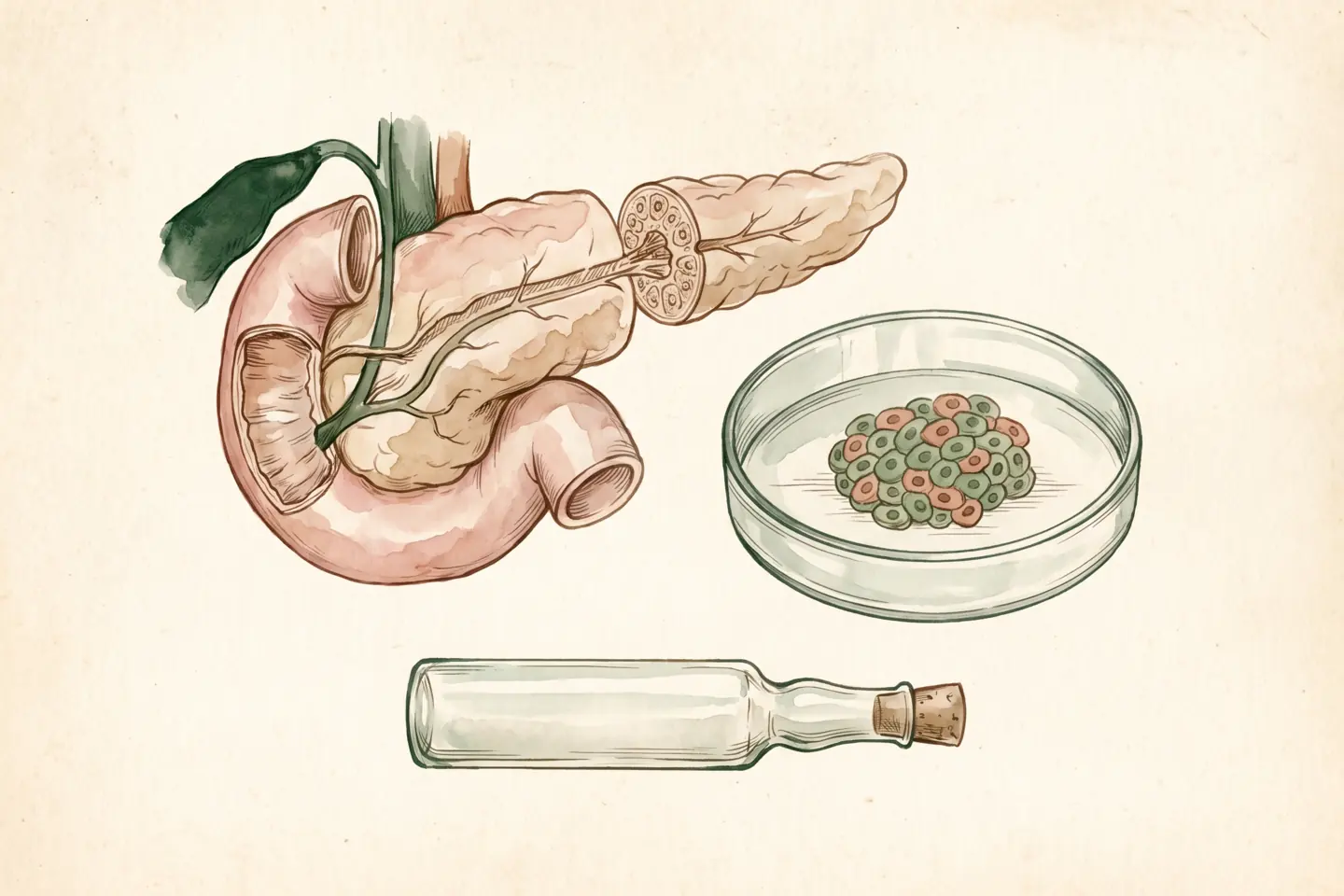
The strongest direct mechanistic evidence is a 2013 human cell-culture study. Pancragen increased expression of several transcription factors central to pancreatic cell differentiation, including Pdx1, Ptf1a, Pax6, Pax4, Foxa2 and Nkx2.2, in both young and aged pancreatic acinar and islet cell cultures, with a more pronounced effect in the aged cultures [3].
That is a real, specific, plausible mechanistic finding in a dish of isolated cells, not in a person. Vendor copy describing it as stimulating islet regeneration or upregulating insulin receptor sensitivity in a living human converts a cell-culture transcription factor signal into a clinical outcome none of the five papers measured.
What does the Pancragen animal data show?
Pancragen lowered glucose in diabetic rats and improved glucose handling in aged monkeys. In streptozotocin-induced diabetic rats, oral pancragen produced a pronounced hypoglycemic effect, and intramuscular administration normalized adhesion of mesenteric capillary endothelium, a marker relevant to vascular complications of early diabetes [1].
In aged female rhesus monkeys given 50 mcg per animal per day intramuscularly for 10 days, pancragen increased the rate of glucose disappearance from blood and normalized insulin and C-peptide dynamics in response to a glucose load. Partial recovery persisted three weeks after the drug was stopped [4].
A follow-up study in nine aged rhesus monkeys compared pancragen directly with glimepiride, an established sulfonylurea. Both reduced basal glucose. Pancragen additionally normalized insulin and C-peptide secretion patterns without the delayed hypoglycemic overshoot that glimepiride produced, which the authors read as a potentially safer endocrine recovery profile [5].
Most of Pancragen's research volume sits in these animal studies.
What did the one human Pancragen study find?
The human record is a single open-label study in 33 elderly patients with type 2 diabetes. Fasting blood glucose, glucose tolerance test results, plasma insulin and an insulin resistance index all improved, measured against an untreated comparison group of 30 healthy elderly people who showed no change [2].
The design was open-label, with no randomization, no placebo and no blinding [2]. No dose or administration route is specified for that trial in the published record, so any specific human dosing number attached to the study online is not sourced to the study.
Taken together, Pancragen's record is a coherent, internally consistent line of preclinical work with one small, methodologically weak human signal on top. That combination earns an E grade, minimal evidence, not because the findings are unbelievable, but because nothing has been replicated outside one lab, no randomized or blinded human trial exists, and an open-label design without placebo or documented blinding cannot rule out expectation effects, regression to the mean, or concurrent changes in diet and medication in an elderly diabetic population.
Is there a human dose for Pancragen?
No published human dose exists. The only concrete dosing figure in Pancragen's literature is 50 mcg per animal per day, intramuscular, for 10 days, in aged rhesus monkeys [4]. That is a monkey dose and not a starting point for a person.
None of the five papers specifies a human dose, injection frequency or cycle length. No published human pharmacokinetic or toxicology data exist for the synthetic peptide, and the side-effect profile circulating online is assumed from anecdote rather than measured.
Given the pancreatic and glucose-regulatory target, unpredictable effects on blood glucose remain a theoretical concern that no human study has examined. Injectable use carries the standard injection-site and sterility risks of any subcutaneous peptide, and because the material is sold research-use-only, identity and purity are not guaranteed without an independent third-party assay.
What do forum claims about Pancragen get wrong?
Forum and vendor copy compresses two separate questions into one false claim. The first question is identity: whether Pancragen is a defined compound at all. The answer is a qualified yes, since a named sequence and a real, narrow publication trail exist.
The second question is whether that trail meets the bar for efficacy claims, and the answer is no. "Studies show" stands in for five papers from one program [1][2][3][4][5], no RCT, and a human dosing protocol specified nowhere.
The subcutaneous reconstitution instructions, cycle lengths and stacking advice in forum threads come from unrelated peptide protocols, reassigned to Pancragen's name.
What is still unknown about Pancragen?
Five gaps remain after all five papers:
- Replication. No independent replication exists outside the originating research program.
- Controlled human data. No controlled human trial has been run.
- Dose-response. No human dose-response data exist.
- Long-term safety. No long-term safety data exist at any dose.
- Clinical translation. Whether the transcription-factor effect seen in cultured cells [3] translates into a measurable clinical outcome in a person is unconfirmed.
Pancragen is a real, if early, line of preclinical evidence. It is not a characterized pharmacological agent, and no published evidence supports treating it as one.
Sources
Last updated

Written by
Chemist and biochemist. Co-founder and author, The Peptide App.
Jay is a chemist, biochemist and entrepreneur whose work connects scientific research with consumer health products. He has held Chief Science Officer and product development leadership roles and previously served as Chief Revenue Officer at Minicircle.
Keep reading

Compound evidence
Epitalon extended mouse lifespan; most human studies used epithalamin
Epitalon extended lifespan in two mouse strains and lengthened telomeres in human cell cultures. Most human data come from epithalamin, a bovine pineal extract.
Compound evidence
Ovagen, marketed for fertility, eased kidney injury in rats
Ovagen protected rat kidneys from gentamicin and ischemic injury and raised MMP-14 in aging kidney cells. No study involves ovarian tissue, fertility or people.

Compound evidence
GHK shifted gene expression in cultured cells; skin trials were mixed
GHK's gene profile in cultured cells opposed a lung-tissue destruction pattern in one computational study. Its human trials are topical, with mixed results.
Profiles and tools

The Peptide App
Track protocols, doses, and reconstitution in one place.
Save your calculations, set reminders, log doses, and keep outcome notes — free to start.
 or scan the QR code →