
In aged mice, GDF-11 improved heart and stroke outcomes
GDF-11 reversed cardiac hypertrophy and aided stroke recovery in aged mice. No human trial has reported, and independent labs dispute its muscle results.

By Jay Spall, chemist and biochemist
Disclosure: Jay is a co-founder of The Peptide App. This review discusses the studies cited below; it is not a comprehensive live trial registry or treatment recommendation. Development and regulatory status can change. The app’s tools organize records and arithmetic and do not validate a research product.
On this page
Key facts
| Question | Direct answer |
|---|---|
| Has GDF-11 been shown to reverse aging in humans? | No. Every rejuvenation finding attributed to GDF-11 comes from mouse studies, and no human interventional trial has been published [1][2][3]. |
| Why does GDF-11 appear on longevity stack lists? | Because mouse studies from 2013 and 2014 reported that restoring GDF-11 reversed cardiac hypertrophy and improved muscle stem cell function in old animals, and that story got repeated without its caveats [1][2]. |
| What is the myostatin cross-reactivity problem? | GDF-11 is nearly identical to myostatin (GDF-8), the protein that limits muscle growth. Early antibody-based assays could not reliably tell the two apart, so some foundational measurements may have mixed signal from both proteins. |
| Does GDF-11 rise or fall with age? | Disputed. Different labs using different assays report different directions of change, and the disagreement is unresolved rather than settled either way. |
| Is there a human dose, route or safety profile for GDF-11? | No. No published human pharmacokinetic, dosing or safety data exist for exogenous GDF-11 at any dose. |
| What is GDF-11's evidence grade? | E, minimal: preclinical-only evidence, with an active methodological controversy sitting underneath its own origin studies. |
3 sources cited. View sources
What is GDF-11?
GDF-11 is a member of the TGF-beta superfamily, the same signaling family as its closest structural relative, myostatin (GDF-8). As a mature protein, GDF-11 circulates as a roughly 25 kDa homodimer and signals by binding activin type II receptors, which triggers phosphorylation of SMAD2/3 transcription factors inside the cell.
That pathway regulates cell growth, differentiation and tissue remodeling across multiple organ systems, which is why a molecule in this family could plausibly affect heart, muscle and brain tissue at once. It is also why the same pathway can produce opposite effects depending on tissue, dose and developmental stage. SMAD signaling is context-dependent, not a single on-off switch for youth.
GDF-11 is a recombinant growth factor, structurally and behaviorally closer to a biologic drug than to a small peptide such as BPC-157 or a GHRP. Oral supplement pharmacology does not apply to it.
What did the GDF-11 mouse studies find?
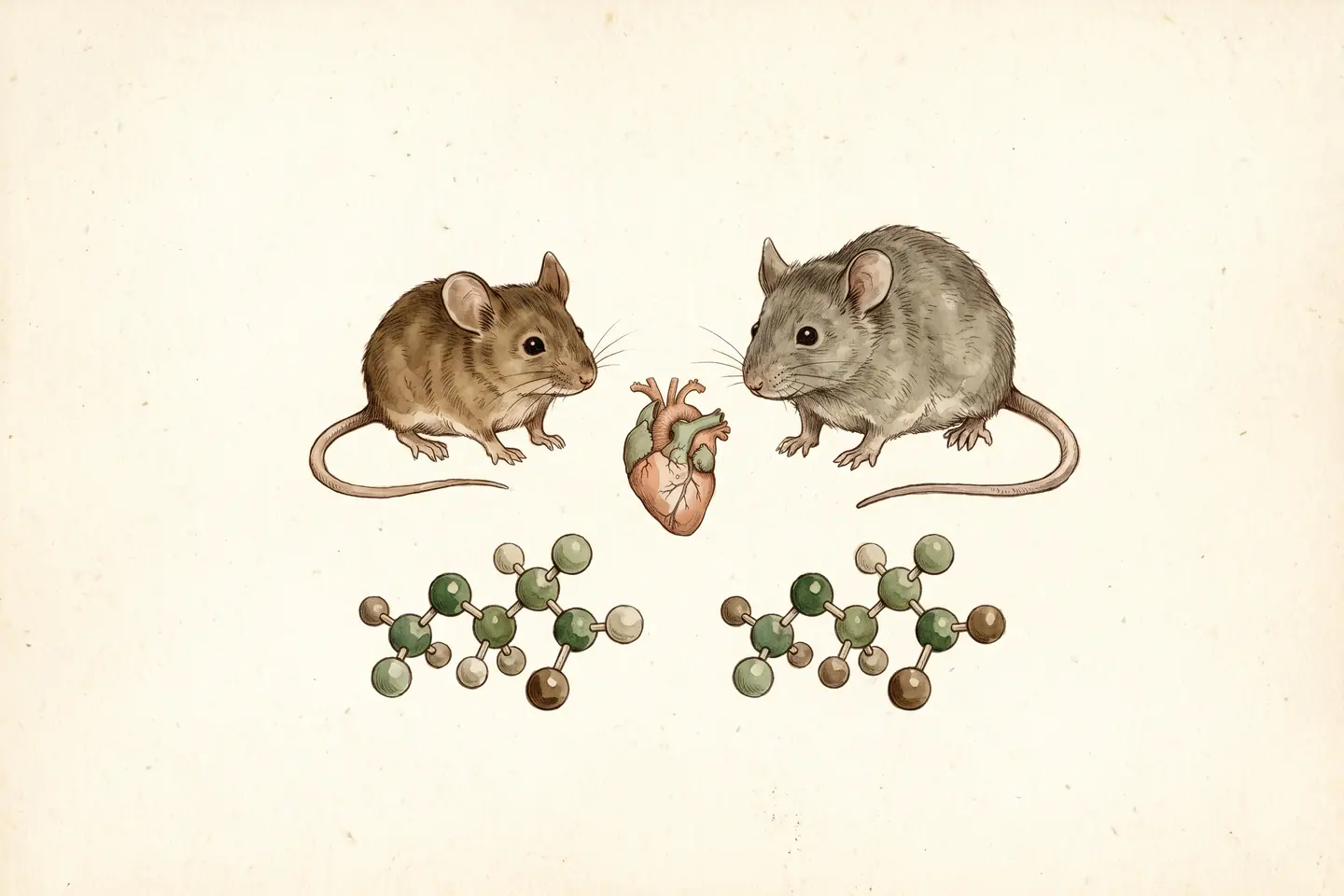
Three mouse studies carry GDF-11's entire reputation, and each tested a different organ system. Loffredo and colleagues gave recombinant GDF11 to aged mice in 2013 at doses intended to restore circulating levels seen in young animals, and reported reversal of age-related cardiac hypertrophy along with reduced cardiomyocyte size [1].
Sinha and colleagues followed in 2014 with daily intraperitoneal recombinant GDF11 at 0.1 mg/kg for four weeks in aged mice. They reported restored satellite cell frequency and function, reduced DNA damage in muscle stem cells, and improved grip strength and endurance capacity [2].
Hudobenko and colleagues extended the thesis to the brain in 2020. Recombinant GDF11 given to aged mice after induced stroke reduced mortality, improved sensorimotor recovery, reduced brain atrophy and gliosis, and increased angiogenesis. That paper also reported lower GDF11/8 levels in postmortem human brain tissue with age [3].
Read individually, these are legitimate, peer-reviewed, mechanistically interesting papers. Read together as proof that GDF-11 restores youth, they overreach what any of them tested: three separate organ systems, three separate dosing regimens, all in mice, with no human replication of any endpoint. Popular longevity peptides share that structure.
Why does the myostatin assay problem undercut the GDF-11 story?
GDF-11 and myostatin share extremely high sequence homology, and the antibody-based ELISA assays used in the founding era of GDF-11 research were later criticized for insufficient specificity between the two proteins. When independent labs used assays designed to separate GDF-11 signal from myostatin signal, some reported that raising GDF-11 impaired rather than improved muscle regeneration, the opposite direction from the original narrative.
That corrective work is a well-known controversy in the field rather than a settled result. Measurement quality, not only biology, is a live explanation for why results diverge across labs.
The problem changes how every other GDF-11 claim should be weighed. If the assay used to measure youthful levels in a given study cannot cleanly distinguish GDF-11 from its relative, which acts as an antagonist, then "restore youthful GDF-11" rests on an uncertain foundation rather than a validated biomarker target. Follistatin's animal-only record shows how myostatin-axis claims look when human data are missing.
What human data on GDF-11 exist?
The human data on GDF-11 are descriptive, not interventional, and they answer a different question than whether dosing it works. Large observational biomarker studies have examined circulating GDF-11 across age and health status in humans, and more recent cross-sectional clinical work has examined its relationship to muscle loss risk in older adults.
These are correlational studies. They cannot establish which direction causality runs, and they cannot cleanly separate GDF-11 from myostatin without the right assay. At least one recent report reportedly associates higher, not lower, circulating GDF-11 with markers of muscle loss, which cuts directly against the mouse-derived rejuvenation model.
That contradiction is the current state of the science: unresolved, neither debunked nor confirmed. No completed human trial has administered exogenous GDF-11 and measured an outcome. A related protein was recast as a stress signal rather than a longevity lever.
What dose of GDF-11 has been studied?
The only sourced GDF-11 dose is a mouse dose: 0.1 mg/kg daily by intraperitoneal injection in aged mice for four weeks [2]. That is a mouse research dose by a mouse route, and no published pharmacokinetic bridge connects it to any human dose.
People running personal protocols administer research-use-only GDF-11 subcutaneously. No clinical study establishes a human dose, frequency, injection site or duration. Anyone citing a specific milligram number for human use is extrapolating.
What are the safety concerns with GDF-11?
The preclinical and mechanistic literature raises four concerns, none quantified in a controlled human study. Muscle wasting or cachexia-like effects are possible at supraphysiological exposure. Some animal work found impaired rather than improved muscle regeneration.
Immunogenicity risk is inherent to any recombinant protein. Sterility and contamination risk come with non-pharmaceutical-grade material.
No human toxicology data exist for GDF-11.
What is still unknown about GDF-11?
The open questions reach back into the origin studies:
- Direction with age. Whether circulating GDF-11 rises or falls with human age is unknown.
- Relationship to myostatin. Whether GDF-11 and myostatin are opposing signals whose ratio matters more than either alone, or two proteins whose effects have been conflated by imprecise assays, is unresolved.
- Mouse to human. Whether any effect seen in mouse heart, muscle or brain tissue translates to a human system with different receptor density, tissue architecture and baseline signaling tone is untested.
- A first trial. What dose, route or duration would be worth testing in a first human trial is not established.
Until an assay-validated human interventional study exists, "restore youthful GDF-11" is a hypothesis borrowed from mouse tissue and an imperfect measurement history, not a protocol with evidence behind it.
Sources
-
Loffredo FS et al. (2013). Growth differentiation factor 11 is a circulating factor that reverses age-related cardiac hypertrophy. Cell. pubmed.ncbi.nlm.nih.gov/23663781
-
Sinha M et al. (2014). Restoring systemic GDF11 levels reverses age-related dysfunction in mouse skeletal muscle. Science. pubmed.ncbi.nlm.nih.gov/24797481
-
Hudobenko J et al. (2020). Growth differentiation factor-11 supplementation improves survival and promotes recovery after ischemic stroke in aged mice. Aging (Albany NY). pubmed.ncbi.nlm.nih.gov/32365331
Last updated

Written by
Chemist and biochemist. Co-founder and author, The Peptide App.
Jay is a chemist, biochemist and entrepreneur whose work connects scientific research with consumer health products. He has held Chief Science Officer and product development leadership roles and previously served as Chief Revenue Officer at Minicircle.
Keep reading

Compound evidence
Elevated GDF-15 tracked with higher death risk in three human cohorts
Chronically high GDF-15 tracks with cardiovascular, cancer, and kidney disease mortality. Drug developers build an antibody to block GDF-15, not to raise it.
Compound evidence
Follistatin-344 gene therapy built muscle in mice and macaques
Follistatin-344 gene therapy built muscle in animals and improved walking in two six-patient open-label trials. Injected FS-344 peptide has no human data.

Compound evidence
Longevity peptide claims rest on cell, biomarker and pilot studies
Longevity peptide claims draw on cell studies, biomarkers and small pilots. The NIA program that tested 54 agents in over 30,000 mice has run none of them.
Profiles and tools

The Peptide App
Track protocols, doses, and reconstitution in one place.
Save your calculations, set reminders, log doses, and keep outcome notes — free to start.
 or scan the QR code →