
Two interventions that work alone can cancel each other out
Two interventions that each work can blunt or cancel each other via a shared pathway, as trials pairing cold water immersion or ibuprofen with training show.

By Jay Spall, chemist and biochemist
Disclosure: Jay is a co-founder of The Peptide App. This review discusses the studies cited below; it is not a comprehensive live trial registry or treatment recommendation. Development and regulatory status can change. The app’s tools organize records and arithmetic and do not validate a research product.
On this page
- Can two interventions that each work cancel each other out?
- How does pathway convergence keep two agents from stacking?
- Can anti-inflammatory compounds blunt training adaptations?
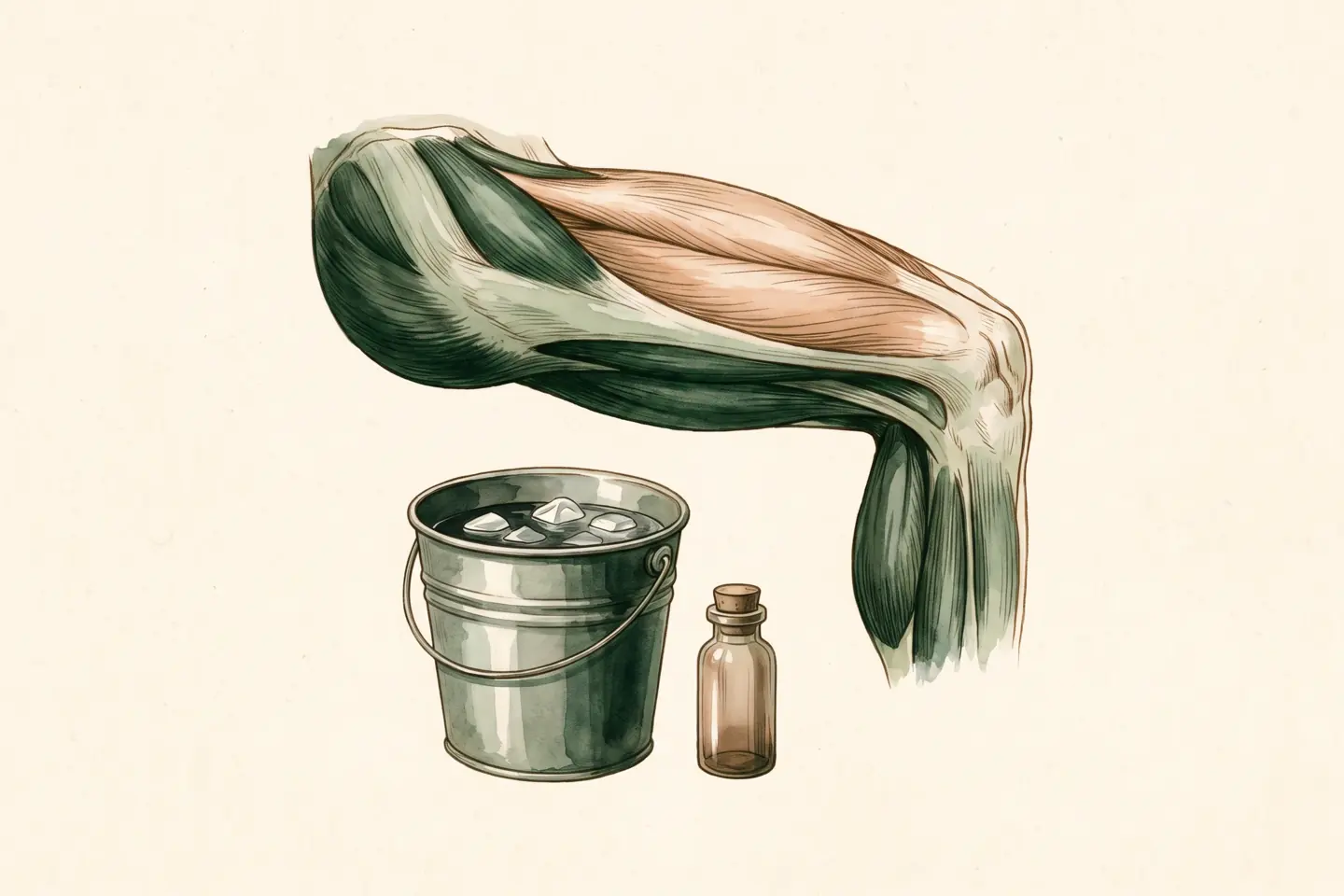
- Does cold water immersion blunt the response to resistance training?
- How strong is the evidence that interventions cancel each other?
- How can you tell whether two interventions will cancel out?
- What is still unknown about combination antagonism?
- Sources
Key facts
| Question | Direct answer |
|---|---|
| Can two interventions that each work on their own cancel each other out when combined? | Yes. This is a repeatable, measurable finding in the literature, not a rare exception. |
| What is the cleanest human example? | Cold water immersion after resistance training blunts the post-exercise testosterone and inflammatory cytokine rise compared with passive recovery, in a randomized crossover trial [1]. |
| Does the pattern show up outside temperature manipulation? | Yes. High-dose ibuprofen produced less quadriceps growth than low-dose aspirin over 8 weeks of matched training [4], and a compound that suppressed exercise-induced inflammation also abolished the exercise-induced rise in mitochondrial content [3]. |
| How can you predict whether two interventions will cancel out? | Check whether they share a receptor, a metabolic enzyme, or a downstream signal. Independent pathways can run side by side without interference, as combined strength and endurance training did in one 24-week trial [2]. |
| Why doesn't this show up in forum stacks? | A canceled-out effect produces no dramatic side effect and no story worth posting. Absence of complaints online is not evidence that the interaction is absent. |
8 sources cited. View sources
Can two interventions that each work cancel each other out?
Two interventions that each work on their own can blunt or cancel each other when combined, and the literature documents it repeatedly. Antagonism between two interventions is not exotic pharmacology. It happens through a small number of well-characterized routes: receptor or pathway convergence, suppression of a shared downstream signal, and temperature or environmental suppression of the same cascade. Each one can be reasoned about before combining anything.
How does pathway convergence keep two agents from stacking?
Pathway convergence keeps two agents from stacking because the second agent re-triggers the mechanism the first already uses instead of adding a second effect. The mechanism has one output regardless of how many inputs are pulling on it. Why stacking sermorelin and tesamorelin fails rests on the same convergence logic.
Can anti-inflammatory compounds blunt training adaptations?
High-dose ibuprofen and NMN each blunted a training adaptation in small randomized trials. Resistance training's adaptive signal runs partly through a transient inflammatory and hormonal response. Anything that blunts that response can blunt the adaptation it was supposed to support, even when the blunting agent is "anti-inflammatory" and sounds like it should help.
High-dose ibuprofen (1200 mg/day) produced smaller quadriceps volume gains than low-dose aspirin (75 mg/day) over an 8-week program with matched training volume, a group difference of 34 cm³ (p = 0.029) [4]. A separate trial found that 1200 mg/day of NMN, taken for 7 days around blood-flow-restriction exercise, suppressed the exercise-induced rise in inflammatory gene expression and also abolished the 171% increase in mitochondrial content that placebo produced at 24 hours post-exercise [3]. Neither agent failed on its own terms. Each succeeded at its stated job of dampening inflammation and, in doing so, removed part of the signal the training depended on.
The NSAID evidence is not uniformly one-directional. A trial of NSAID treatment during two weeks of limb immobilization and six weeks of retraining in older men found no significant effect of ibuprofen on muscle mass or strength recovery [5]. A smaller study of NSAID and glucosamine treatment during resistance training in osteoarthritis patients found differences in muscle collagen and receptor expression between groups, but not a clean strength or hypertrophy penalty [6].
Does cold water immersion blunt the response to resistance training?
Cold water immersion after resistance exercise blunted the testosterone and inflammatory cytokine response in a randomized crossover trial, the best-studied antagonism case [1]. Fifteen minutes at 15°C significantly altered the testosterone response over time (condition-by-time interaction, p = 0.030). At 30 minutes post-exercise, testosterone rose 9.2% with passive recovery versus fell 0.5% with immersion (p = 0.049), and by 60 minutes it had dropped 10.4% below baseline in the immersion group versus 1.6% in controls (p = 0.028). Interleukin-6 and TNF-α rises were similarly suppressed, at 30 and 15 minutes respectively [1].
A cell culture study offers a plausible mechanism. Mild hypothermia (32°C versus 37°C) altered myotube morphology, reduced protein synthesis within 8 hours, and impaired the anabolic response to glutamine exposure, with lower ribosomal RNA and reduced expression of a key growth regulator [8]. Cold immersion sounds like a recovery tool, but cold and training converge on the same signaling cascade, and one dampens the other.
How strong is the evidence that interventions cancel each other?
The evidence for antagonism comes from small trials, the strongest of them internally controlled crossovers, plus one cell culture study:
- Cold water immersion. A randomized, counterbalanced crossover trial with 11 resistance-trained men, small but internally controlled, with each subject serving as their own comparison [1].
- High-dose ibuprofen. A randomized parallel trial with 31 participants across two dosing arms [4].
- NMN. A randomized, placebo-controlled crossover with 11 participants and a three-week washout [3].
Dose, timing relative to the stimulus, population age, and the outcome measured all appear to matter. Convergence on a shared pathway creates the conditions for antagonism, but it does not guarantee a specific magnitude of loss in every context.
How can you tell whether two interventions will cancel out?
A shared receptor, metabolic enzyme, or downstream signal predicts that two interventions will interfere, and separate pathways predict independence. A 24-week trial combined strength and endurance training in the same session, varying only the order and time of day [2].
All groups in that trial increased leg press strength (14 to 24%) and muscle cross-sectional area (12 to 20%), evening training produced somewhat greater hypertrophy during weeks 13 to 24, and diurnal testosterone and cortisol rhythms remained statistically unaltered by training order [2]. Two demanding stimuli, run through mostly separate physiological machinery, did not blunt each other. That result is the mirror image of the antagonism cases.
Forum stacks rarely surface antagonism, because a canceled-out effect produces no dramatic side effect and no story worth posting. Absence of complaints online is not evidence that the interaction is absent. The trial design that isolates a combination effect is covered in how to test if a drug combination works.
What is still unknown about combination antagonism?
Most of what matters for a specific peptide pairing is unknown, because the peptide-specific literature on combination antagonism is thin:
- Peptide data. The only human peptide study cited, a GHRP-2 and GHRH trial [7], comes from a pediatric diagnostic context, not from adults combining peptides for training or recovery goals.
- Study size and scope. Sample sizes across the cited studies run from 11 to 31 participants and durations from 7 days to 24 weeks, and populations skew toward young healthy men or specific clinical groups.
- Specific pairs. Whether a given pair of compounds shares a receptor, enzyme, or signal tightly enough to reproduce these effects is often not directly tested.
- Magnitude. Mechanism gives a reason to expect interference when pathways overlap; it does not supply a guaranteed number for how much benefit is lost.
Sources
-
Earp JE, Hatfield DL, Sherman A (2019). Cold-water immersion blunts and delays increases in circulating testosterone and cytokines post-resistance exercise. Eur J Appl Physiol. PMID: 31222379
-
Küüsmaa M, Schumann M, Sedliak M (2016). Effects of morning versus evening combined strength and endurance training on physical performance, muscle hypertrophy, and serum hormone concentrations. Appl Physiol Nutr Metab. PMID: 27863207
-
Yang DL, Chao KC, Yang HT (2026). Anti-inflammatory effects of nicotinamide mononucleotide (NMN) in human skeletal muscle after BFR-exercise. J Int Soc Sports Nutr. PMID: 41705654
-
Lilja M, Mandić M, Apró W (2018). High doses of anti-inflammatory drugs compromise muscle strength and hypertrophic adaptations to resistance training in young adults. Acta Physiol (Oxf). PMID: 28834248
-
Dideriksen K, Boesen AP, Kristiansen JF (2016). Skeletal muscle adaptation to immobilization and subsequent retraining in elderly men: No effect of anti-inflammatory medication. Exp Gerontol. PMID: 27235849
-
Mattiello-Sverzut AC, Petersen SG, Kjaer M (2013). Morphological adaptation of muscle collagen and receptor of advanced glycation end product (RAGE) in osteoarthritis patients with 12 weeks of resistance training: influence of anti-inflammatory or glucosamine treatment. Rheumatol Int. PMID: 23443332
-
Pihoker C, Middleton R, Reynolds GA (1995). Diagnostic studies with intravenous and intranasal growth hormone-releasing peptide-2 in children of short stature. J Clin Endocrinol Metab. PMID: 7559885
-
Rantala R, Chaillou T (2019). Mild hypothermia affects the morphology and impairs glutamine-induced anabolic response in human primary myotubes. Am J Physiol Cell Physiol. PMID: 30917033
Last updated

Written by
Chemist and biochemist. Co-founder and author, The Peptide App.
Jay is a chemist, biochemist and entrepreneur whose work connects scientific research with consumer health products. He has held Chief Science Officer and product development leadership roles and previously served as Chief Revenue Officer at Minicircle.
Keep reading
Combinations and evidence
Drug combinations need a four-arm factorial trial to prove synergy
Drug combinations need a four-arm factorial trial to isolate a combination effect. Most consumer stacks have never been tested this way, for benefit or harm.
Combinations and evidence
Sermorelin and tesamorelin share a receptor; a stack is a bigger dose
Sermorelin and tesamorelin activate the same pituitary GHRH receptor, so stacking them acts like a higher single dose. No trial has tested the pair.
Profiles and tools

The Peptide App
Track protocols, doses, and reconstitution in one place.
Save your calculations, set reminders, log doses, and keep outcome notes — free to start.
 or scan the QR code →