
Ghrelin agonists increased food intake 10.2% to 70.1% in human trials
Ghrelin receptor agonists raised food intake by 10.2% to 70.1% in human trials of people with an intact vagus nerve. One low-dose infusion found no effect.

By Jay Spall, chemist and biochemist
Disclosure: Jay is a co-founder of The Peptide App. This review discusses the studies cited below; it is not a comprehensive live trial registry or treatment recommendation. Development and regulatory status can change. The app’s tools organize records and arithmetic and do not validate a research product.
On this page
- Do ghrelin agonists increase appetite in humans?
- How much do ghrelin agonists increase food intake?
- Why does a growth hormone secretagogue raise appetite?
- Can GH release be separated from appetite stimulation?
- Does obesity blunt the ghrelin appetite response?
- Does injection route change the appetite effect?
- Is there a ghrelin dose too low to affect appetite?
- What do the ghrelin trials not measure?
- Sources
Key facts
| Question | Direct answer |
|---|---|
| Does a compound that raises GH through the ghrelin receptor also raise appetite? | Yes, in every human trial that used subjects with an intact vagus nerve. The appetite effect is not a side reaction; it is the receptor doing what it does in the hypothalamus as well as the pituitary. |
| How large is the appetite effect? | Intravenous ghrelin raised ad libitum buffet intake by 20.1% to 70.1% depending on dose and body weight [1], and by 41% in lean and 35% in obese subjects in a separate trial [4]. Subcutaneous ghrelin raised intake by 27% [6]. The synthetic secretagogue GHRP-2 raised intake by 10.2% at low dose and 33.5% at high dose [3]. |
| Does obesity blunt the response? | No. Obese subjects showed equal or larger percentage increases in intake than lean subjects across multiple trials [1][3][4]. |
| Can GH release and appetite stimulation be split apart pharmacologically? | No trial cited below has shown it. The clearest separation found was anatomical, not molecular: patients with a severed vagus nerve or a prior gastrectomy still got the GH pulse and lost the appetite response entirely [2][4]. |
| Do any marketed secretagogues deliver "GH without appetite"? | No evidence in the trials cited below supports that claim. The one dose-response dataset, for GHRP-2, shows a clean, dose-dependent increase in food intake alongside GH release [3]. |
| Is there a dose or route below which appetite is unaffected? | One low-dose IV infusion trial found no measurable effect on hunger, satiety, or subsequent meal size [5], which suggests a threshold. That result contradicts the effective low doses used in other trials, and the discrepancy is unresolved. |
6 sources cited. View sources
Do ghrelin agonists increase appetite in humans?
Yes. Every human trial of a ghrelin receptor agonist in subjects with an intact vagus nerve found increased food intake [1][3][4][6], apart from one low-dose infusion [5]. The effect appeared with native ghrelin and with the synthetic secretagogue GHRP-2, by intravenous infusion and by subcutaneous injection.
Across four independent trials and two administration routes, the orexigenic effect is reproduced more consistently than some of the GH-release claims made for individual synthetic analogs. Secretagogue marketing rarely bills appetite as the primary action.
How much do ghrelin agonists increase food intake?
Between 10.2% and 70.1%, depending on the compound, dose, route, and body weight [1][3][4][6].
- Intravenous ghrelin. At 1 and 5 pmol/kg/min, buffet-meal intake rose 20.1% in lean subjects and 70.1% in obese subjects at the higher dose. The low dose alone produced a 36.6% increase in the obese group [1].
- Intravenous ghrelin, second trial. The same infusion approach produced a 41% increase in lean subjects and 35% in obese subjects. Ghrelin also restored a "lean-type" preprandial hunger pattern in obese subjects, who otherwise showed little variation in hunger scores across the day [4].
- Subcutaneous ghrelin. The route closer to how synthetic secretagogues are typically dosed produced a smaller but still significant 27% increase in energy intake, along with higher rated food palatability [6].
- GHRP-2. The synthetic ghrelin mimetic replicated the pattern in a dose-response design: 10.2% more intake at low dose and 33.5% more at high dose, with obesity status not changing the response [3].
Why does a growth hormone secretagogue raise appetite?
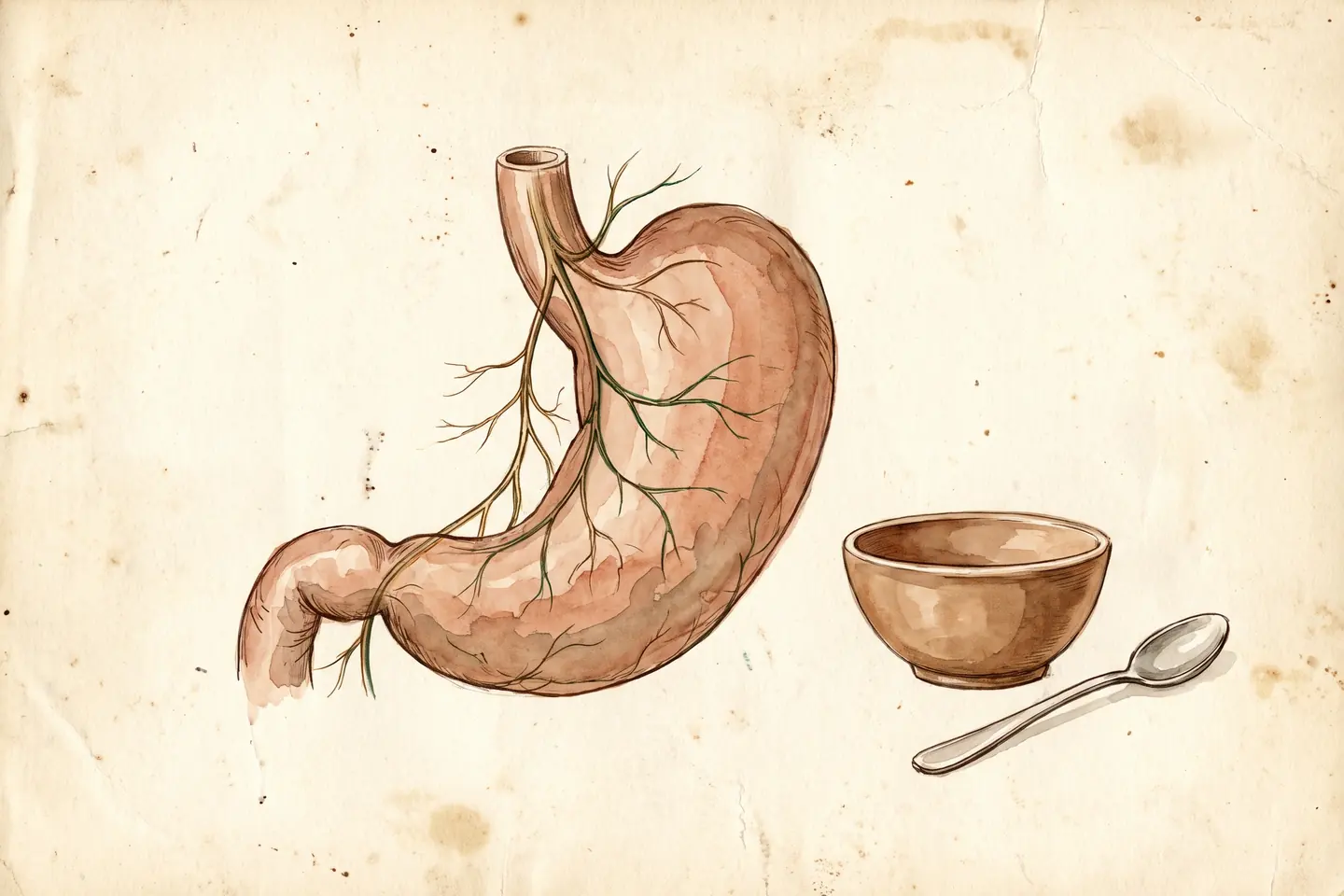
The growth hormone secretagogue receptor sits in two places. It sits in the pituitary, where activation triggers a GH pulse, and it sits in appetite-regulating circuits reached by vagal afferent signaling from the gut.
One receptor with two downstream outputs is why no trial has separated the appetite effect by picking a different molecule at the same target. GHRP-2's growth hormone record covers what that GH pulse does and does not translate into.
Can GH release be separated from appetite stimulation?
Only anatomically, not pharmacologically. Patients who lack an intact vagus nerve still get the GH pulse and lose the appetite response [2][4].
In postgastrectomy subjects, IV ghrelin produced its expected effects in the other groups tested the same day, and the postgastrectomy group showed no increase in energy intake at all [4].
Patients with a prior truncal vagotomy showed a dose-dependent GH rise, confirming the ghrelin was biologically active. Their energy intake at the follow-up buffet meal did not differ from saline at either dose tested [2].
GH pulse present, appetite effect absent, is the strongest available evidence that the two outputs travel on partially separate wiring. The separation is anatomical, meaning an intact vagus is required for the appetite arm, rather than a property of any specific molecule.
No trial cited below shows a compound that hits the same receptor in subjects with an intact vagus and produces GH release without appetite stimulation. Ipamorelin's selectivity claim rests on animal studies rather than chronic human use.
Does obesity blunt the ghrelin appetite response?
No. Obese subjects were, if anything, more sensitive to ghrelin's appetite effect than lean subjects at comparable low doses [1], and obesity status did not attenuate the response to GHRP-2 at either dose tested [3].
That finding matters for anyone assuming that existing appetite dysregulation would blunt further stimulation. The data say the opposite.
Does injection route change the appetite effect?
Route appears to matter. Subcutaneous ghrelin's 27% increase [6] was smaller than the 41% to 70.1% increases seen with IV infusion [1][4].
Those are different studies with different populations, so they cannot be compared as a clean dose-response curve.
Is there a ghrelin dose too low to affect appetite?
One trial suggests yes, and it does not fit the rest of the evidence. A low-dose IV infusion at 1 ng/kg/min, lower than the doses used in the other trials, found no significant effect on hunger, satiety ratings, timing of the next meal, or calories consumed at that meal [5].
The authors argued for a hormonal threshold below which a rise in ghrelin does not drive meal initiation on its own [5]. That result has not been reconciled with the effective low doses used in the Druce and Laferrère trials [1][3].
Dose matters, and the literature has not mapped where the threshold sits. Anyone evaluating a specific secretagogue's dosing claims should treat the threshold as an open question rather than a settled one.
What do the ghrelin trials not measure?
The ghrelin trials measure single doses and single meals, so repeated dosing, tolerance, and appetite-sparing claims are all unaddressed:
- Repeated dosing. Every trial is a single infusion or injection followed by one buffet meal, measured over hours rather than days or weeks. None measures total daily intake, meal frequency, or body weight over repeated dosing, which is the actual use pattern for anyone taking a secretagogue regularly.
- Tolerance. Whether tolerance develops to the appetite effect while the GH response persists, or the reverse, is unaddressed in these trials.
- Appetite-sparing analogs. None of the trials cited below tests a marketed "appetite-sparing" analog against saline in a buffet-intake design comparable to these trials, so the burden of proof for that claim has not been met.
In cancer cachexia, where appetite stimulation is the goal rather than a drawback, anamorelin's trial record shows what a ghrelin receptor agonist achieved on mass and on function.
Sources
Last updated

Written by
Chemist and biochemist. Co-founder and author, The Peptide App.
Jay is a chemist, biochemist and entrepreneur whose work connects scientific research with consumer health products. He has held Chief Science Officer and product development leadership roles and previously served as Chief Revenue Officer at Minicircle.
Keep reading
Compound evidence
Anamorelin increases lean mass but not grip strength in cachexia
Anamorelin raised lean mass in three Phase 3 cancer cachexia trials and is approved in Japan. Grip strength did not improve, and the FDA and EMA rejected it.
Compound evidence
GHRP-2 raised growth hormone about 13-fold in seven healthy men
GHRP-2 raised growth hormone in four small human trials, about 13-fold in healthy men. None measured body composition, and the longest adult trial ran 30 days.
Compound evidence
Ipamorelin released GH in men but missed in two bowel-recovery trials
In rats and swine, ipamorelin released GH without raising cortisol; single doses raised GH in 40 healthy men. Both bowel-recovery trials missed their goals.
Profiles and tools

The Peptide App
Track protocols, doses, and reconstitution in one place.
Save your calculations, set reminders, log doses, and keep outcome notes — free to start.
 or scan the QR code →